The Crossroads for Growing Businesses
The spreadsheets are multiplying, product descriptions don’t match across your website and Amazon, and launching a new product line feels like orchestrating a military campaign. You know you need a Product Information Management (PIM) system, that’s no longer up for debate.
But now you face a critical fork in the road. Do you choose an all-in-one suite like OdooPIM, or do you invest in a standalone, best-of-breed PIM software platform?
This is the defining tech decision for countless SMBs and Mid-Market companies scaling up: Do you prioritize integration, or specialized power?
On one path, you have solutions like OdooPIM. The appeal is that it is a unified platform that handles your catalog management, inventory, CRM, and accounting. It promises to be a cohesive brain for your marketing and sales operations.
On the other path, you have the traditional best PIM solutions. These are the standalone champions of product data. They’re built to master the intricate world of Product Data Management (PDM) and PIM, offering specialized tools that can handle complexity and drive sophisticated omnichannel strategies.
Your searches for “best PIM software for small businesses” or “PIM software comparison”. You’ll click on ads for sleek Cloud-based PIM and SaaS PIM platforms. You’ll book PIM software demos that dazzle with features. But the core question remains unanswered: Which architectural approach is right for your business?
This isn’t about a minor feature checklist. It’s a strategic choice about how your business will operate and grow.
We’re going to directly compare OdooPIM against traditional PIM platforms across the factors that truly matter for a growing company: implementation, cost, core functionality, and scalability. By the end, you’ll have the clarity to choose not just a tool, but the right foundation for your next phase of growth.
Understanding the Contenders
Before we pit them against each other, let’s define what each option is. The distinction starts with architecture.
What is OdooPIM? The All-in-One Module
If you are an Odoo users, think of OdooPIM not as a standalone PIM software, but as an integrated feature of a much larger machine. It is the dedicated Product Information Management (PIM) module within the comprehensive Odoo business suite.
When you log into Odoo, you’re in a single system. Your PIM system shares an identical database with your ERP for inventory, your CRM for customer data, your e-commerce platform for listings, and your accounting for costs. There are no connectors, no APIs, no syncing delays between these core functions, they are all native parts of the same organism.
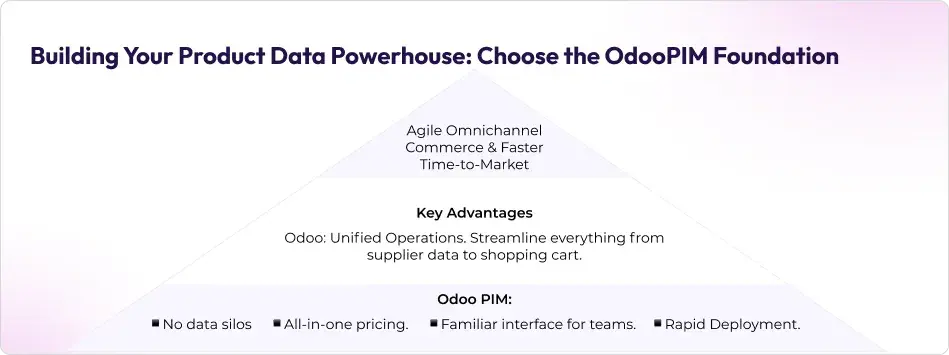
OdooPIM’s superpower is out-of-the-box cohesion. Updating a product’s cost in the procurement app instantly reflects in the PIM module. A sales order in the CRM can check real-time stock levels managed in the same system. For a business wanting one dashboard, OdooPIM is the catalog management heart of that unified vision.
Learn more about PIM for E-commerce.
What Are Traditional PIM Platforms? The Specialized Powerhouses
When people search for “best PIM solutions” or “enterprise PIM,” this is what they find. These are standalone, best-of-breed applications like Akeneo, Pimcore, or inRiver. They are built for one primary mission: to be the absolute best at Product Information Management (PIM) and Product Data Management (PDM).
These platforms don’t natively run your accounting or your warehouse. They are designed to become the central, authoritative product data hub for your existing tech stack. They connect to
your ERP, your e-commerce platforms, your marketplaces, and your DAM via robust APIs and pre-built connectors.
Their superpower is unparalleled specialization. They offer granular control over complex data models, sophisticated workflows for global teams, advanced digital asset management, and syndication engines to push data to dozens of channels simultaneously.
The Analogy:
- OdooPIM is like buying a premium, fully-integrated kitchen from a single manufacturer. The refrigerator, oven, and dishwasher are designed to work together perfectly with a unified control panel.
- A Traditional SaaS PIM is like hiring a world-class chef to design a custom kitchen. You pick the best-in-class Wolf range, Sub-Zero fridge, and Bosch dishwasher. They aren’t from the same brand, but a specialist integrates them into a system of unmatched capability.
This architectural difference, native unity versus specialized depth, informs comparison that follows, from cost and setup to scalability and daily use. It’s the lens through which you should view PIM software demo and PIM software comparison, when evaluating the best PIM software for small businesses. Your choice defines your operational blueprint.

Head-to-Head Comparison: The Core Analysis
Here’s where your decision gets real. We’ll break it down across the five factors that will impact your team, your budget, and your growth.
1. Implementation & Time-to-Value: The Speed vs. Tailor Fit
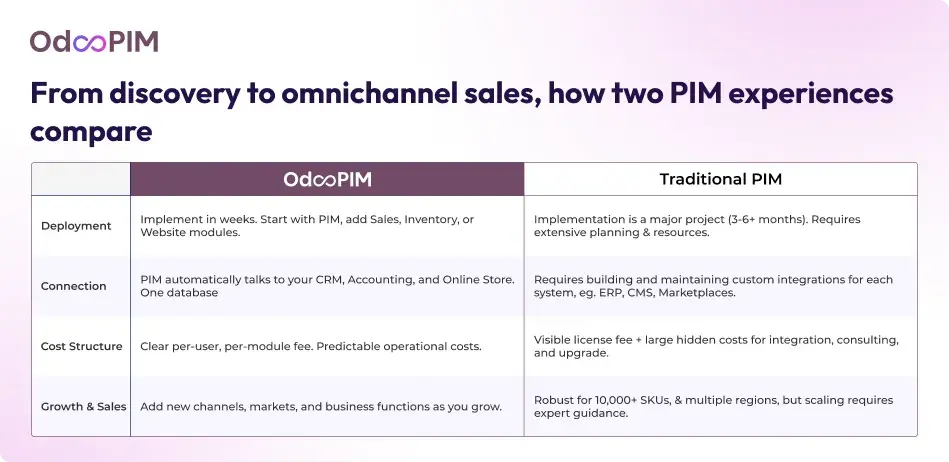
- OdooPIM:If Odoo is your business’s operating system, adding the PIM module is like installing a new app. The setup is direct. There’s no integration project because it’s already part of the whole. Your product data lives in the same house as your orders and inventory. The time-to-value is fast, but that speed is contingent on you buying into the Odoo ecosystem.
- Traditional PIM:Implementing a standalone PIM system is a dedicated project. It requires mapping your data, setting up API connections to your ERP, e-commerce platforms, and other tools. That time is spent tailoring the PIM software to your exact business processes and existing tech stack. The initial ramp is longer, but the fit can be perfect.
The Takeaway: OdooPIM wins on sheer speed of deployment within its own walls. Traditional best PIM solutions win on strategic, customized implementation for your unique environment.
2. Cost Structure & Total Ownership: The Sticker Price vs. The Real Bill
- OdooPIM: The apparent entry cost is attractive, especially as a module add-on. It’s frequently cited in searches for “best PIM software for small businesses” due to this affordability. The value isn’t just in the catalog management features, but in the avoided cost and headache of integrating multiple disparate systems.
- Traditional PIM:The standalone license for a top-tier SaaS PIM or Cloud-based PIM will have a higher starting price. This is the cost of specialization. But the real analysis is in Total Cost of Ownership (TCO). You must add the cost (in time or money) for the integrations, the middleware, and potentially the specialist administrator. You’re investing in a best-in-class tool that demands proper connection.
The Analysis: For an SMB, OdooPIM presents a lower initial financial barrier and a simpler TCO model. The true cost of a traditional Enterprise PIM platform isn’t just the license, it’s the investment to properly connect and leverage it.
3. Core PIM & Catalog Management Capabilities: Good vs. Great
- Traditional PIM: These platforms treat Product Data Management (PDM) as a science. They excel at handling complex, hierarchical attribute management, multi-language and multi-region data with fine-grained control, automated workflow approvals for large teams, and robust, fault-tolerant syndication to dozens of sales channels. They are engineered for depth.
- OdooPIM: It provides robust, reliable core features that satisfy 80% of business needs. You can manage attributes, handle digital assets, and publish to key channels. When you push into AI-driven data enrichment, complex validation rules across thousands of SKUs, or orchestrating a global digital shelf, you find a dedicated powerhouse.
The Takeaway: For sophisticated Product Information Management (PIM) needs where data is a key competitive lever, traditional platforms are unrivaled. For solid, competent catalog management within a unified business workflow, OdooPIM is sufficient.
4. Scalability & Future-Proofing: Growing Together vs. Growing Apart
- OdooPIM: It scales predictably on the Odoo platform. Adding users, products, or new Odoo modules is a linear process. Your PIM system grows in lockstep with your finance and sales ops.
- Traditional PIM: It scales in the domain of product data. It’s built to handle exploding SKU counts, skyrocketing channel complexity, and global data governance. This path is ideal if you anticipate that your product data complexity will grow faster than, or independently from, the complexity of your other business operations.
The Takeaway: OdooPIM scales your business as a single entity. A traditional Cloud-based PIM scales your product data mastery as a specialized function.
5. The Integration vs. Unification Debate: The Philosophical Divide
- Traditional PIM: It champions the “Best-of-Breed” philosophy. Your PIM software is the undisputed master of product data, and it uses API-led integrations to synch with your best-in-class ERP, e-commerce platform, and marketing tools.
- OdooPIM: There is no integration for core functions because there is no separation. The data between your PIM, CRM, and inventory isn’t talking—it’s the same data. This eliminates a whole category of sync errors, reconciliation work, and technical debt.
The Takeaway: Do you want the best individual tools connected by digital highways (Traditional), or one contiguous country with no borders (OdooPIM)? Your answer here likely determines your winner before you even click on a PIM software demo.
The right choice isn’t universally “better”—it’s the one whose strengths align with your company’s anatomy and ambition.
Learn more about PIM vs PRM.
Decision Framework: Which PIM Solution is Right for You?
Here’s a clear, no-fluff guide to identify the right solution for you.
Choose OdooPIM if these statements describe your business reality:
- You already run on Odoo, or you’ve decided its integrated suite is your future. Adding the odooPIM module is a low-friction next step that leverages your existing investment.
- You need solid, centralized control. Your goal is to escape spreadsheets, create a single source of truth for product info, and execute reliable catalog management. You don’t have (and don’t foresee) extreme complexity in your data models or channel syndication.
- The idea of a single vendor, one unified database, and one login for your PIM system, ERP, and sales is a major advantage for you. You want to eliminate integration headaches.
- When you search for “best PIM software for small businesses,” you’re looking for value and efficiency. OdooPIM’s approach offers a cost-effective entry point that grows with your operation.
- Your SKU complexity, rich technical attributes, or omnichannel presence are central to your strategy.
- You run a “best-of-breed” tech stack with specialized tools like NetSuite, Salesforce Commerce Cloud, or a marketplace integrator. The OdooPIM system can be easily integrated with these ERPs.
- You operate in multiple regions and languages with strict governance. You require complex approval workflows, AI-driven data enrichment, or the ability to syndicate to 20+ unique channel endpoints.
- You are a scaling mid-market company or a complex SMB with dedicated resources. You have, or are building, a team to own and drive value from a specialized system.
Learn more about PIM for manufacturing industry.
Your Buying Intent is Your Compass
Listen to your own searches. They reveal your stage and needs:
- If your Buying Intent Keywords are “best PIM software for small businesses” and “odooPIM demo,” you’re likely leaning toward the integrated, efficiency path.

Unity vs. Specialization – There’s No Wrong Choice
Let’s be clear: this isn’t a story about a winner and a loser. Both roads lead to a better place than the spreadsheet chaos you’re leaving behind. The goal is to match the tool to your company’s DNA.
The Recap, Straight Up:
- OdooPIM is the path of unity. It trades some specialized depth for operational simplicity. You get a competent, integrated catalog management engine that’s born into the same system that runs your sales, your warehouse, and your finances. It’s the tool for business cohesion.
- Traditional PIM platforms are the path of specialization. They trade some out-of-the-box simplicity for immense power and flexibility. As SaaS PIM or Cloud-based PIM solutions, they offer the advanced Product Data Management (PDM) and syndication capabilities that turn product information into a genuine competitive weapon. They are built to lead your tech stack, not just participate in it.
Learn about PIM syndications
The Final Verdict:
For SMBs and Mid-Market companies at a crossroad, the decision isn’t about finding the “best” software in an abstract sense. It’s a strategic declaration.
Choose OdooPIM if you view Product Information Management (PIM) as a critical integrated business function. Your priority is streamlining operations, creating a single source of truth across departments, and fueling growth from a unified core. This is the smarter, efficient play for businesses where product data supports the business—it isn’t the business itself. This is why it consistently appears in searches for “best PIM software for small businesses” looking for a smart, all-in-one launchpad.
Frequently Asked Questions
1. Is OdooPIM a “real” PIM, or just a basic catalog tool within Odoo?
When businesses search for the best PIM software for small businesses, they want a solution, not just a glorified spreadsheet. They see odooPIM listed as a module and wonder if it’s a true PIM system or merely a basic feature tacked onto an ERP. This doubt is completely valid. The term Product Information Management (PIM) carries weight; it promises a central hub to govern complex data, enrich customer experiences, and drive omnichannel sales. Can a single component within a larger suite deliver on that promise?
The direct answer is yes, OdooPIM is a “real” PIM software.
It provides the core, non-negotiable functions of a PIM system: a centralized repository for all product attributes, digital asset management, basic taxonomy and category trees, and the ability to manage and publish product information. It excels at catalog management and data centralization for companies whose needs are complex enough to require a dedicated system but not so extreme as to need a specialist. When you run a PIM software comparison, you’ll find that standalone best PIM solutions are engineered from the ground up for Product Data Management (PDM) mastery. They offer capabilities in areas like complex multi-lingual data governance, automated workflow engines for global teams, AI-driven attribute enrichment, and robust, fault-tolerant syndication to dozens of unique sales channels. OdooPIM gets you out of the chaos and provides control. A traditional platform aims to turn your product data into a sophisticated, scalable asset that outpaces your competition. Your choice isn’t between “real” and “fake,” but between a competent generalist and a world-class specialist.
2. Which option is truly cost-effective for a growing business?
Every growing business asks this, and the easy answer is usually wrong. Simply comparing the license costs of the OdooPIM module to the license cost of a standalone SaaS PIM is a trap. True cost-effectiveness is measured by Total Cost of Ownership (TCO) over 3-5 years, and that calculation changes dramatically based on your operational blueprint.
For the OdooPIM route, the entry cost is lower and is a key reason it’s highlighted as best PIM software for small businesses. You’re adding a module to an existing platform, so the core infrastructure cost is shared. The major hidden savings, are in avoided costs: no middleware, no ongoing integration maintenance between your PIM and your ERP/CRM, and reduced training time with a single interface. The TCO is relatively predictable and bundled. You’re paying for operational cohesion. For the traditional Cloud-based PIM route, the initial license investment is higher because you’re paying for specialized power. But the real costs extend further. You must budget for the implementation services to connect it to your e-commerce platform, your ERP (like NetSuite or SAP), your DAM, and your marketplaces via APIs. You may need a part-time administrator with technical skills.
3. Can a traditional PIM platform integrate with Odoo (or our other systems)?
The direct answer is yes, a traditional Cloud-based PIM or SaaS PIM can absolutely integrate with Odoo and nearly any other modern business system. Top-tier PIM software is built on an API-first foundation, designed explicitly to be the central hub in a mixed technology ecosystem. They don’t just offer generic APIs; have marketplaces with pre-built, certified connectors for major platforms like Magento, BigCommerce, Salesforce Commerce Cloud, and ERPs including Odoo. During a PIM software demo, you should demand to see this connectivity in action. Ask about the Odoo connector: Is it a two-way sync? How does it poll for data? Can it handle custom fields? The integration project requires planning and resources, but it is a standard, solvable implementation task. The outcome is a “best-of-breed” stack where your specialized Product Information Management (PIM) tool ingests data from Odoo (like inventory levels and costs), enriches and manages it with superior tools, and then syndicates perfected product content back to your sales channels. The question isn’t if it can integrate, but whether your team has the capacity to manage these integrations as a strategic asset, rather than a burden.
4. Will we outgrow OdooPIM? How do these platforms scale?
This isn’t just a question about technical limits; it’s about forecasting your company’s identity. Scaling isn’t merely adding users or products—it’s about handling exploding complexity and seizing new opportunities. The scaling paths of these two options diverge sharply, and choosing wrong can become a painful, expensive constraint.
OdooPIM scales predictably and in lockstep with the broader Odoo suite. Adding 10,000 more SKUs or 50 new users is a linear process. Its scaling is holistic: your PIM system, your finance, and your sales ops all grow together on the same platform. You will not outgrow OdooPIM even when your Product Data Management (PDM) needs become complex or if you need to manage products in 30 languages with region compliance. OdooPIM is engineered to scale for product data dominance. It scales horizontally across global markets and vertically into data complexity. It’s built to manage not just a large catalog, but a sophisticated, dynamic, and multi-faceted product information universe. For a business where product content is the core competitive lever, this specialized scalability is non-negotiable.
5. We’re already using Odoo for ERP/CRM. Does it even make sense to look outside?
This is the million-dollar question for any company already invested in the Odoo ecosystem. Adding the odooPIM module feels like a natural extension. You protect your existing investment, avoid new vendors, and maintain that prized native unity where data flows instantly between sales, inventory, and your product hub. The simplicity is compelling, especially when you’re searching for the best PIM software for small businesses that values streamlined operations. Why would you complicate your life?
If you’re managing thousands of SKUs with intricate technical attributes, selling across a dozen global markets with strict compliance rules, or if your e-commerce conversion depends on rich, AI-optimized content, OdooPIM is still the solution for you.
6. What features will we miss with OdooPIM that a traditional PIM offers?
There are no features that you will miss with OdooPIM that a traditional PIM will offer.
First, consider workflow and governance. The OdooPIM platform offers industrial-strength workflow engines. You can design automated, multi-stage approval processes involving marketing and localization teams across different countries, with role-based permissions and version control. This is critical for regulated industries or global brands.
Second, look at data intelligence and syndication. OdooPIM includes built-in AI for automated attribute enrichment, image tagging, and quality scoring—turning data management from a manual task into a smart system. Their channel syndication isn’t just an export; it’s a sophisticated, rules-based publishing engine that can transform and push tailored product feeds to hundreds of endpoints simultaneously, with error monitoring and rollback capabilities. Think of handling complex product relationships (bundles, up-sells, cross-sells, spare parts), managing extensive digital asset libraries with lifecycle rights, or creating truly fluid multi-language content variants. With OdooPIM, you get solid, reliable control to turn product information into a measurable competitive advantage.