Why PIM and ERP Matter Now
Commerce demands operational precision and compelling product storytelling. The volume and complexity of product data have exploded. Managing thousands of SKUs across multiple channels requires a robust system for deep, enriched information far beyond basic stock-keeping details.
While Odoo ERP excels at its core competencies, namely, streamlining finance, orchestrating inventory, and automating back-office operations, it is not engineered to be a high-performance catalog management engine for product content, diverse media assets, and complex attribute syndication. A PIM system is. The Best PIM solution centralizes and controls market information from technical specifications and marketing copy to images, videos, and channel descriptions. An enterprise PIM centralizes product data to provide a single source of truth across customer touchpoints.
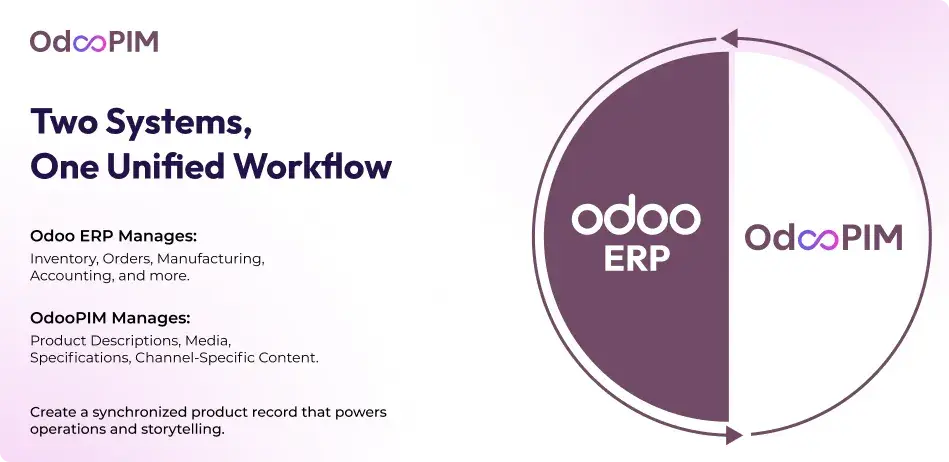
A strategic PIM integration with Odoo ERP creates the foundation for unified operations. The Odoo ERP manages the transactional and operational flow, while the cloud-based PIM governs product information. This synergy ensures that your commercial engine (ERP) is powered by channel-ready data (PIM).
With OdooPIM, your operations are built on a synchronized data core. You achieve agility in launching products and entering new markets, backed by the operational integrity of your ERP.
What Is Product Information Management (PIM)?
Product Information Management (PIM) is the discipline of controlling the data required to market and sell products. A PIM system serves as the central command center for customer information.
A PIM software delivers core capabilities that generalist systems cannot match:
- A Product Data Hub: It consolidates information from suppliers, engineering, and marketing into one source.
- Granular Attribute Management: It governs thousands of specifications, variants, and relational attributes.
- Advanced Digital Asset Handling: It directly manages images, videos, documents, and 3D files, linking them to relevant products.
- Channel Ready Content Syndication: It tailors and formats product content to meet the requirements of a website, marketplace, or print catalog.
The ERP handles transactions and inventory counts. The PIM supplies the descriptions, compelling assets, and technical details that drive those sales. This PIM integration with Odoo ERP creates a flow where operational data and commercial content are synchronized.
For organizations requiring robust governance and multi-channel scale, an enterprise PIM becomes critical infrastructure. The Best PIM solutions, including platforms like OdooPIM, are essential for a business committed to efficient growth and a unified commerce experience.
Why Odoo ERP Alone Is Not Enough for Rich Product Data
Using Odoo ERP to manage complex marketing and sales content reveals limitations. The system’s product module is designed for operational data, not for the depth required by commerce.
These constraints become apparent in three key areas:
- Native Odoo fields cannot structure the thousands of specifications, variant combinations, and technical details that define today’s products. This restricts your ability to create filters, comparisons, and compelling narratives.
- Managing digital assets, images, videos, and manuals, and their multilingual variations, is cumbersome. This turns content updates into error-prone tasks.
- Formatting and syndicating product information to diverse channels, with data requirements, is a manual process. This slows time-to-market and creates inconsistent customer experiences.
For product storytelling and meeting channel demands, an Enterprise PIM layer is key. PIM integration with Odoo ERP creates a workflow. The ERP manages the business of selling, while the PIM system manages the story you sell. The cloud-based PIM becomes the source for market-ready content, which is fed into the operational core of Odoo and out to sales channels.
Platforms like OdooPIM are designed to augment Odoo’s operational power with catalog management, eliminating the data gap between your operations and your market.

OdooPIM: Built for Odoo ERP
OdooPIM is the Product Information Management (PIM) solution engineered for the Odoo ecosystem. It functions as a layer that transforms Odoo ERP from an operational backbone into a commercial command center.
OdooPIM occupies the role of product data orchestration. It sits between your operational core in Odoo ERP and your customer channels, your e-commerce site, marketplaces, and POS systems. This PIM system pulls raw product data from the ERP, enriches it into sales content, and then syndicates that information to the destination.
OdooPIM stands among the Best PIM solutions for Odoo users for three decisive reasons:
- Its architecture mirrors Odoo’s structure, speaking the same data language. This eliminates complex data mapping and ensures product information flows between systems.
- Built on Odoo’s technology stack, it delivers a known UX. Your teams work within an interface and logic they understand, reducing training time and accelerating user adoption.
- This inherent compatibility means PIM integration with Odoo ERP is streamlined. The result is lower integration friction.
As a cloud-based PIM, OdooPIM provides the scalability and centralized control required for modern catalog management. For growing businesses, it offers an Enterprise PIM level of capability without the typical disruption of introducing a foreign system.
Learn about PIM requirements
The Architecture: How PIM Integration with Odoo ERP Works
Odoo ERP and the OdooPIM system operate on a bidirectional data flow. This architecture establishes a division of labor, turning separate applications into a unified commercial engine.
The high-level process is direct:
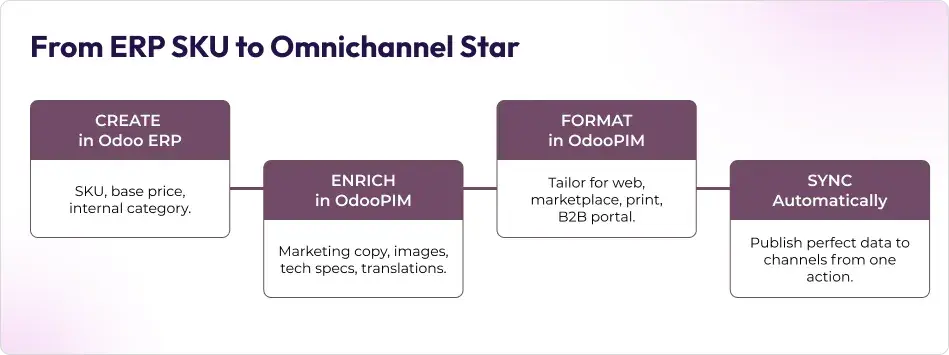
- Core product data, SKUs, internal categories, and essential fields, flows from Odoo ERP into the PIM software. This establishes the product record.
- Marketing teams add descriptions, technical specifications, high-resolution media, and localized content. This stage is where product information becomes sales content.
- The channel data is then distributed. It flows back into Odoo ERP modules (like eCommerce) and is syndicated directly to connected sales platforms, ensuring consistency.
The benefit of this architecture is operational agility. The ERP ensures transactional integrity, while the enterprise PIM provides the speed and control needed for market expansion and campaign execution.
Key Benefits of Integrating PIM with Odoo ERP
Single Source of Truth for Product Data
A commerce operation requires one version of product fact. PIM integration with Odoo ERP and merges technical specifications from operations with marketing narratives.
Odoo ERP remains the system of record for transactional and inventory data, while the PIM system becomes the absolute authority for commercial content. This separation of concerns, managed through an enterprise PIM layer, enforces data discipline. Marketing teams control attributes and assets within the cloud-based PIM, while operations manage stock and fulfillment in the ERP, working from synchronized, reliable information.
Implementing a solution like OdooPIM transforms your catalog management from a reactive task into a controlled process.
Richer, Channel Ready Catalog Management
You require control over how products are presented across a unique sales environment. A PIM system like OdooPIM provides this capability.
You can build multiple, overlapping product hierarchies for different buyer journeys, organizing by brand, by collection, or by seasonal campaign within the centralized system.
Create tailored assortments for your B2B portal versus your direct to consumer site. Design product bundles for market places. Manage region imagery, localized descriptions, and compliant technical sheets within a cloud-based PIM.
The final output is a flow of formatted data. This content is synchronized directly back to your Odoo ERP modules and Odoo e-commerce platform.
Faster Time to Market and Fewer Errors
A PIM integration with Odoo ERP accelerates your commercial velocity while eliminating costly mistakes.
The process begins with streamlined product onboarding within the PIM software. Once approved, the PIM system automates the distribution. It pushes channel data directly into your Odoo ERP, connected e-commerce websites, and external marketplaces. This synchronization removes manual hand-offs and their inherent delays.
The result is a reduction in commercial risk. By governing the process through an enterprise PIM like OdooPIM, you eradicate the listing errors, pricing mismatches, and incomplete product pages that undermine customer trust and damage brand reputation.
Scalability with Cloud-Based PIM
A cloud-based PIM provides the foundation for expansion. Entering new regions, launching additional brands, and activating new sales channels becomes a matter of configuration. The PIM system manages localization, brand hierarchies, and channel data rules within its established framework, eliminating setup work.
OdooPIM is engineered for this progression. It scales from managing core product lines for a market to functioning as a global enterprise PIM. The system accommodates increasing data volume, user complexity, and process sophistication without requiring a disruptive platform migration.
The PIM integration with Odoo ERP ensures your operational core remains stable while your catalog management capabilities expand. You gain the capacity to execute broader commercial strategies, confident that your PIM software can handle the scope and complexity.
Core Integration Use Cases and Workflows
New Product Introduction (NPI)
Introducing new products to the market requires a controlled workflow. PIM integration with Odoo ERP transforms this process into a streamlined pipeline.
A product is created in Odoo ERP with only its master data: a foundational SKU, basic taxonomy, and core operational attributes. This establishes the item within your financial and logistical systems.
Marketing and technical teams take that record into OdooPIM, where they build the commercial profile. They add detailed attributes, marketing descriptions, technical specifications, and digital assets. This stage is where the product gains its market-ready identity.
The PIM software pushes the channel data set back to the Odoo ERP record and syndicates it directly to your e-commerce website and connected marketplaces. This eliminates manual data entry across platforms.
This governed NPI process is a benefit of adopting an enterprise PIM. It ensures that product launch is consistent, complete, and accelerated.
Learn about Best PIM software
Catalog Updates and Seasonal Refreshes
Managing these changes requires system agility, not manual effort. A PIM system provides the command center for catalog management.
You manage collections and assortments as unified entities, not as disconnected SKUs. This allows for strategic actions that are impossible within basic ERP modules. Update promotional pricing across a product line, refresh descriptions for a seasonal campaign, apply new marketing tags, or swap image sets, through governed actions in the PIM software.
The cloud-based PIM then executes these changes with precision and speed. Approved updates are synchronized to the records in Odoo ERP and pushed to all connected sales channels. This eliminates the risk of error inherent in updating the platforms.
What was a tedious, multi-week process of spreadsheet updates and manual uploads becomes a controlled deployment. It ensures your market presence is current and campaign-ready.
Multi-Channel and Multi-Region Selling
A Product Information Management (PIM) strategy is the solution for managing this scale without operational collapse.
The architecture is built around a central, master product record within OdooPIM. This source holds global attributes, specifications, and digital assets. You manage region marketing copy, comply with local regulatory fields, and maintain translated content within the governed environment.
The cloud-based PIM acts as a distribution hub. It syndicates the correct, compliant data set to a unique endpoint: a regional Odoo ERP database, a localized e-commerce site, or a third-party marketplace with its strict formatting rules. This targeted distribution ensures the channel receives a tailored product story.
Learn more about PIM For e-commerce.
Why Choose OdooPIM Over Generic PIM Tools
AI-powered OdooPIM eliminates the integration nightmare that plagues generic PIM tools, delivering native synergy with Odoo’s ERP, CRM, eCommerce, and inventory modules for true omnichannel product data mastery without API middleware or data silos. Standalone PIMs force constant synchronization battles, product updates created in PIM must sync to ERP for inventory, to websites for pricing, and to marketplaces via separate connectors, creating error-prone delays where a catalog change takes days to propagate across channels. OdooPIM lives inside your core business suite, so a single attribute update instantly reflects in real-time stock levels, dynamic pricing engines, and automated order fulfillment across POS, Shopify, Amazon, and B2B portals.
Native Intelligence Powers Competitive Edge: Unlike generic PIMs, OdooPIM leverages AI Assistant for automated product enrichment, multi-language translation, and predictive categorization, features that understand your full business context from sales trends to supplier performance. Generic tools require exporting data to external AI services, losing real-time context and incurring additional costs; OdooPIM’s AI operates within your live transaction data, generating SEO-optimized titles, suggesting cross-sell bundles, and flagging data inconsistencies before they impact customers, delivering 40% faster catalog launches.
Scalability Without Vendor Lock-in: OdooPIM grows easily from 1K to 1M+ SKUs as a true enterprise PIM within Odoo’s open-source ecosystem, avoiding the pricing cliffs and migration nightmares of proprietary PIMs that charge per connector or data volume. Retailers report 60% lower TCO versus Akeneo/Salsify stacks, with zero data migration costs when expanding to new channels or regions, plus Navabrind IT Solutions support ensures OdooPIM evolves with business needs rather than forcing adaptation to rigid vendor templates.
Learn More About PIM For Retail Industry.
Implementation Blueprint: Rolling Out OdooPIM with Odoo ERP
Successful deployment of an enterprise PIM like OdooPIM with Odoo ERP requires a blueprint to your PIM solution delivers value and builds a foundation for governance.
Phase 1: Foundation & Design
Navabrind IT Solutions analyzes the state of product information across your Odoo ERP, spreadsheets, and digital assets, and defines your attribute models and catalog management hierarchies. This phase establishes the target data architecture.
Phase 2: System Configuration
Next we configure the PIM system, aligning its structure with your business rules. We establish the PIM integration with Odoo ERP, configuring the data flows for synchronization. This step turns two systems into one cohesive platform.
Phase 3: Data Migration & Activation
Execute a migration of product data into the AI-powered OdooPIM. This is not a lift and shift but a structuring of data to the new model.
Phase 4: Governance & Scale
Assign data ownership for different product categories. Implement approval workflows and checkpoints within OdooPIM to maintain data integrity. This governance turns the PIM system from a project into a permanent competency.
Learn more about OdooPIM vs. Traditional PIM Platforms.

Measuring Success: KPIs for PIM and Odoo ERP Integration
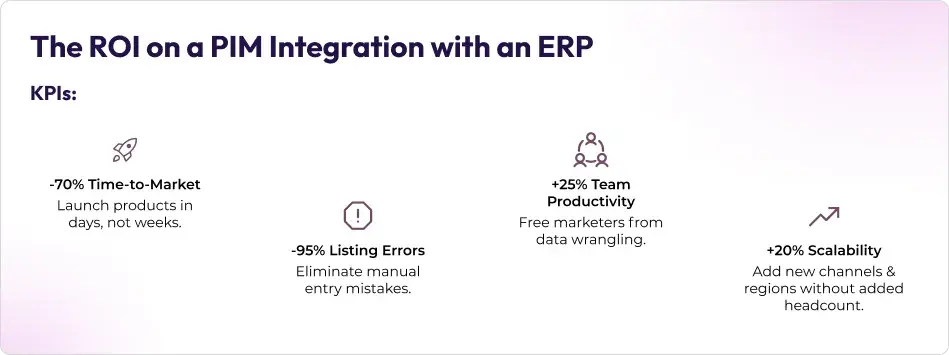
The impact of deploying OdooPIM can be measured through concrete commercial and operational metrics that validate the PIM integration with Odoo ERP.
Track these key performance indicators:
- Data Quality & Operational Efficiency
- Measure the percentage of product records with all the attributes, descriptions, and assets. A catalog management hub in your cloud-based PIM should drive this score to near 100%.
- Quantify the reduction in days or hours to launch new products and execute catalog updates. This metric captures the agility gained from PIM software workflows.
- Monitor decreases in customer service tickets related to incorrect product information, pricing mismatches, and fulfillment errors. This demonstrates the enterprise PIM’s role in creating an operational foundation.
- Commercial Impact
- Analyze changes in channel conversion rates and product return rates. Consistent content managed by the PIM system influences buyer confidence and satisfaction.
- Measure the reduction in time marketing, sales, and e-commerce teams spend aggregating and correcting product data. This quantifies the burden lifted by the Odoo ERP and OdooPIM synergy.
Learn More About PIM for the Manufacturing Industry.
Building a Ready Product Data Backbone
A PIM system belongs to your ERP because it performs a different role. The ERP manages transactions; the PIM software governs the narrative that drives those transactions. Attempting to force one to perform the other’s function creates friction, errors, and stagnation.
OdooPIM delivers the capability of an enterprise PIM, advanced catalog management, scalable cloud-based PIM architecture, and omnichannel agility, through a PIM integration with Odoo ERP.
It is the foundation for launching new products with speed, entering markets with confidence, and presenting a brand story. If committed to scaling, adopting this architecture is not an optional upgrade. It is the step to transform product data from a persistent challenge into a competitive advantage.
Frequently Asked Questions
1. Why do I need an Odoo PIM integration with Odoo ERP, and why is it critical for modern businesses?
Odoo PIM integration with Odoo ERP gives you a single, trusted source of product truth that flows into every operational and customer-facing process, such as inventory, pricing, sales, e-commerce, marketplaces, and print or digital catalogs. Instead of juggling spreadsheets, ERP records, and channel-specific feeds, teams enrich product data once in Odoo PIM and let Odoo ERP handle stock, orders, and finance, ensuring every channel shows accurate specs, images, prices, and availability in real time. This tight integration cuts catalog management effort by up to 30–70% while reducing product data errors and returns, especially where dimensions, variants, and compliance attributes matter.
For modern omnichannel businesses, this is no longer a “nice to have”; it is critical infrastructure. Customers expect consistent, detailed, and correct information whether they buy on your website, Amazon, a marketplace, or in-store, and Odoo PIM and Odoo ERP integration centralizes that information and automatically syncs it everywhere. When price changes, new collections, or regulatory updates go live, product data, inventory, and pricing stay aligned across systems, preventing overselling, misinformation, and the costly cycle of cancellations and support tickets. In competitive categories like fashion, electronics, FMCG, and marketplaces, brands using integrated PIM–ERP stacks report faster time-to-market and 2x–3x higher conversion lifts due to richer, consistent product content.
This integration is also essential for scale and future readiness. As your catalog grows to thousands of SKUs, multiple languages, and new regions or channels, Odoo PIM with Odoo ERP handles complex attributes, relationships, and multi-channel rules without collapsing into manual workarounds. AI-driven OdooPIM variants, like Navabrind’s solution, go further by auto-enriching content, generating SEO-friendly copy, and orchestrating workflows, turning product information into a strategic growth engine rather than an operational burden. In a landscape where product data quality directly impacts revenue, Odoo PIM integration with Odoo ERP is the backbone that keeps modern businesses accurate, agile, and truly omnichannel.
2. How does a cloud-based PIM enhance Odoo ERP’s capabilities?
A cloud-based PIM is a powerful extension to Odoo ERP, enhancing capabilities where the system is not designed to excel. The ERP’s strength lies in processing, inventory control, and financial management. A cloud-based PIM adds a catalog management layer on top of this backbone. It provides the environment needed for marketing and sales teams to produce records with channel narratives, complex attributes, and digital assets, without complicating the operational system.
First, it enables catalog management, allowing businesses to create multiple product hierarchies, seasonal collections, and channel assortments that are impossible to manage within standard ERP modules. Second, it introduces robust digital asset management, handling images, videos, and documents linked to product variants, which the ERP cannot do. Third, it automates omnichannel syndication; once it’s in the PIM, product data is formatted and pushed to the Odoo ERP e-commerce module, marketplaces, and print catalogs.
Odoo ERP runs operations, while the PIM software handles the customer content strategy. This means you can scale into new regions, add brands, or launch new sales channels without overloading your ERP or requiring customizations.
3. Is OdooPIM considered one of the Best PIM solutions for Odoo, and why?
Unlike PIM software that can be integrated via APIs and connectors, OdooPIM is built on the same technology stack and data model as the ERP. This architectural alignment makes it a component rather than an add-on, resulting in integration synergy and user experience.
First, it reduces PIM integration with Odoo ERP, leading to faster deployment, lower implementation risk, and a quicker return on investment. There’s no need for data mapping or of breaking ERP functions during updates. Second, it offers a familiar interface and workflow logic for users trained on Odoo, which accelerates adoption and minimizes training overhead. It ensures maintainability; as the OdooPIM evolves in lockstep, avoiding the compatibility issues with third party PIM system integrations.
OdooPIM delivers excellence for the Odoo environment. It provides the capabilities, catalog management, digital asset libraries, and omnichannel syndication, without the traditional solution.
4. What is the implementation process for adding an Enterprise PIM to our existing Odoo system?
Implementing an enterprise PIM like OdooPIM alongside an existing Odoo ERP is a process designed to minimize disruption and maximize value. It begins with the discovery and design phase. This involves an audit of your current product data, assessing its quality, location, and structure across your ERP, spreadsheets, and other systems. You will define your data model within the PIM system, designing the attribute sets, taxonomy, and catalog management hierarchies that will govern your product information.
The PIM software is configured to match your business rules and workflows. The integration is established, defining the automated sync rules for product data flowing from Odoo to PIM and for content flowing back. A focus is placed on data migration: product data is extracted, transformed to fit the new model, and then loaded into the cloud-based PIM.
Key users from marketing, sales, and e-commerce teams are trained on the workflows for creating, approving, and syndicating product content. A model is established, defining data ownership, approval chains, and quality control checkpoints within the enterprise PIM. The process concludes with a launch, starting with a product category or sales channel, followed by iterative refinement and scaling.
5. Can a PIM system truly create a source of truth for product data across sales channels?
A dedicated PIM system is the technological solution for establishing a source of truth for product data. It achieves this by functioning as the command center where product information is created, managed, and governed. The PIM software holds every piece of product intelligence, from SKUs and supplier specifications to marketing descriptions, localized copy, and digital assets in one accessible repository.
In this repository in the cloud-based PIM, you define and automate the syndication of data sets to the sales channel. Your B2B portal receives specs and pricing, your e-commerce site gets marketing copy and lifestyle imagery, and the marketplace gets its format and attributes. Any update made at the source, a specification, a regulatory flag, or a seasonal image is propagated.
The ERP remains the system of record for transactional truth, while the PIM becomes the system for commercial truth. This division of responsibility, connected via sync, is what allows a solution like OdooPIM to deliver.
6. What are the measurable KPIs and ROI of implementing PIM integration with Odoo ERP?
The return on investment from PIM with Odoo ERP is measured through operational gains and commercial impact. Key performance indicators fall into categories that track the transformation from data management to governed processes.
These include Time to Market, measuring the reduction in days or hours to launch products or execute catalog updates. Data Quality Scores track the percentage of product records. Error Reduction Rates quantify the decrease in customer service tickets and returns caused by incorrect product information. Productivity Metrics capture the time saved by marketing, sales, and IT teams who are no longer aggregating and correcting data across spreadsheets and systems.
Channel Performance metrics, such as conversion rates and reduced cart abandonment on e-commerce sites, correlate to product content. Customer Experience indicators, like lower product return rates, signal higher accuracy and better expectations. The Scalability Metric contains the ability to onboard new brands, expand into regions, or activate sales channels without an increase in time.
Implementing a solution like OdooPIM accelerates positive movement across these KPIs by reducing the friction of PIM integration with Odoo ERP. The investment transforms product data from a cost center into a revenue asset.