Why the PIM vs. PCM Confusion Persists
A PIM system is engineered for governance, transforming raw, technical specifications and logistical attributes into an accurate source of truth. It excels at catalog management, ensuring consistency across thousands of SKUs and countless sales channels. When evaluating best PIM solutions, you’re assessing systems built for data integrity, validation, and efficient syndication.
It is the domain of marketing and storytelling, managing media, lifestyle imagery, promotional copy, and video assets.
Selecting a tool designed for creative agility (a Product Content Management (PCM) to solve problems of data accuracy and scale will fail. On the other hand, using an enterprise PIM to manage marketing narratives is inefficient. This is not a matter of one being superior, but of correctly aligning the tool to the task.
An enterprise PIM is for global manufacturers wrestling with data hierarchies. A growing brand might seek the PIM software for small businesses, prioritizing simplicity and value.
Are you slowed down by inaccurate data, inefficient syndication, and compliance risk? Your requirement is a PIM software solution. Is your bottleneck the creation, localization, and lifecycle management of marketing content? You need a PCM.
What Is Product Information Management (PIM)?
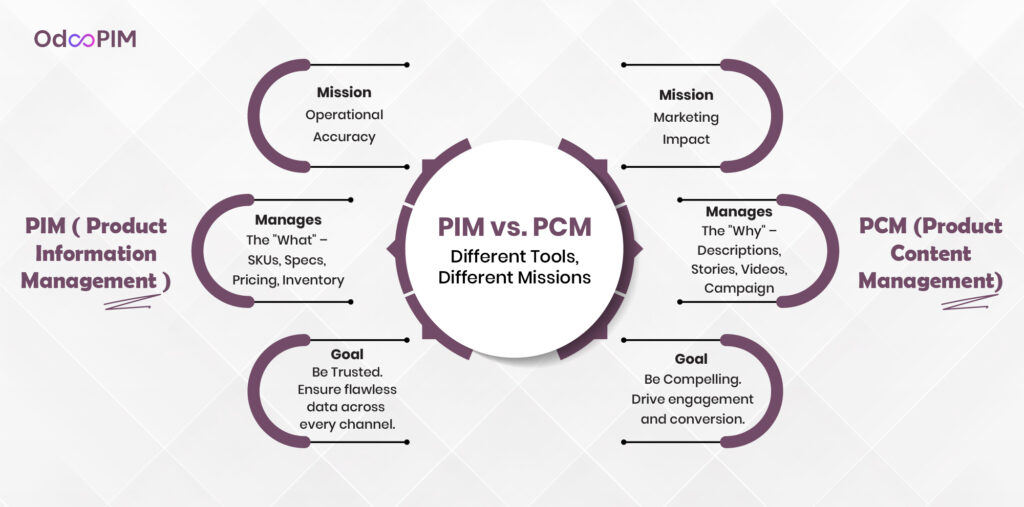
Product Information Management is the operational engine for your product data. A PIM system consolidates all information, SKUs, technical attributes, specifications, and pricing, into an authoritative source.
The discipline focuses on catalog management, master data governance, and logistical precision. It handles product variants and hierarchies. A PIM is not about storytelling; it’s about creating a flawless, distributable data foundation.
It synchronizes with ERP for foundational data, maintains alignment with inventory levels, and automates syndication to sales channels, from e-commerce sites to distributor portals.

What Is Product Content Management (PCM)?
A PIM system centralizes data, and orchestrates emotive assets: persuasive descriptions, brand stories, lifestyle videos, and campaign imagery.
PIM manages the creative lifecycle, from content creation and collaborative approval cycles to personalization for regional campaigns or certain channels. This system is the engine for transforming a product’s specifications into a compelling brand experience.
The PCM actively assembles assets into contextual, brand narratives for different audiences and touchpoints. It’s the difference between storing a high-resolution image and deploying it within a targeted seasonal campaign.
The PIM software provides the accurate foundation, the what and how much. The PCM layer applies the why and for whom. An enterprise PIM ensures global pricing and specs are correct. The PCM tailors the messaging for the market.
When conducting a PIM software comparison, you are not evaluating PCM capabilities. The best PIM solutions, including cloud-based platforms like OdooPIM, excel at catalog management and data integrity.
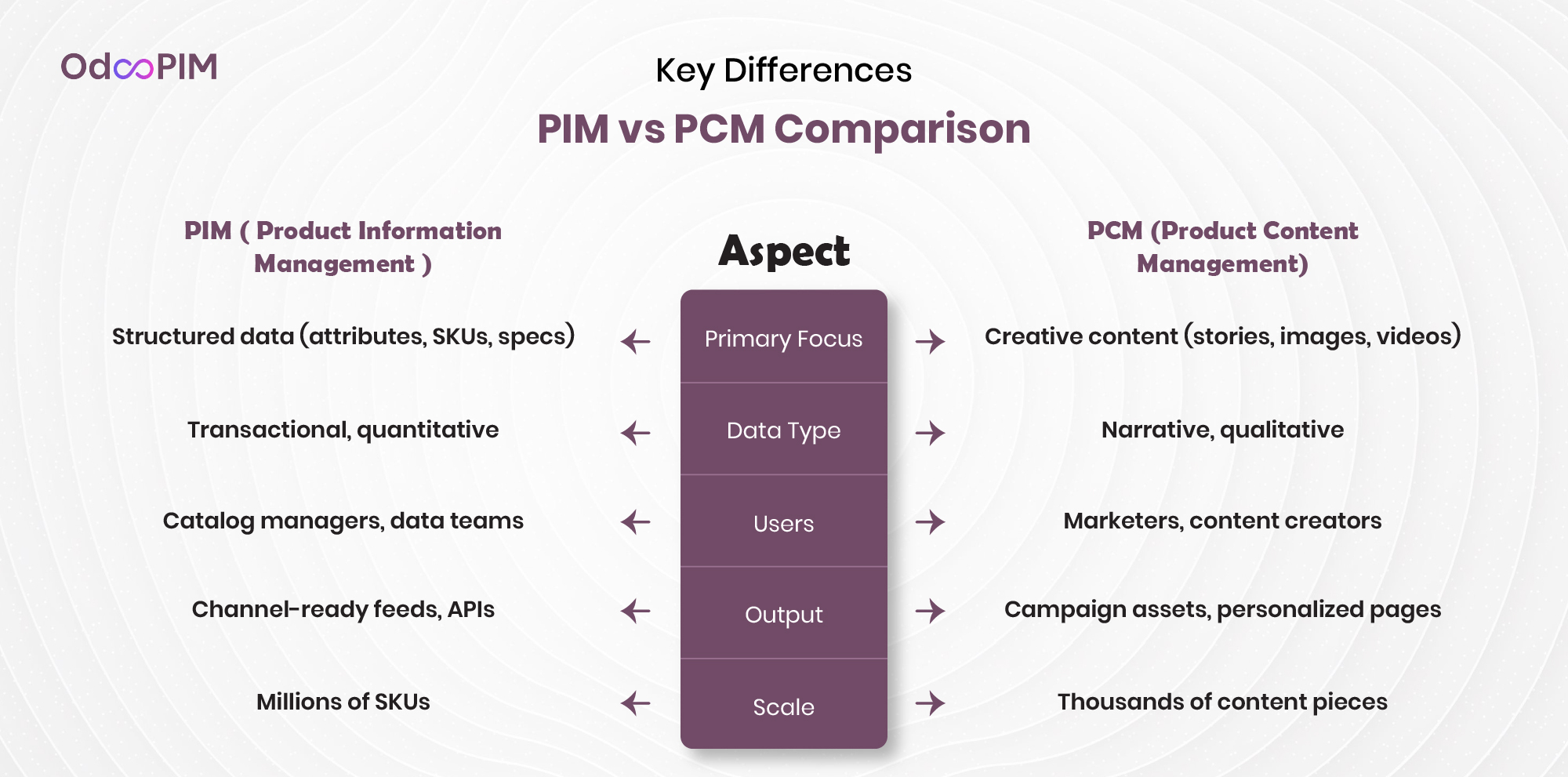
Key Differences: PIM vs PCM Side-by-Side Comparison
PIM Strengths: Operational Excellence and Catalog Management
A PIM ensures product data accuracy and governance, across complex catalogs. This is not just a marketing tool, it is an essential infrastructure for commerce.
A PIM enforces data quality rules, manages intricate product hierarchies and variants, and serves as the source of truth. This foundation eliminates the errors and inconsistencies that cripple channel performance and erode customer trust.
Cloud-based PIM platforms offer real-time synchronization. They orchestrate data flow to the endpoint, which is your e-commerce store, global marketplaces, distributor portals, and back office ERP.
Learn more about PIM E-Commerce.
PCM Strengths: Marketing Impact and Customer Engagement
A PIM system ensures data accuracy, and PCM crafts the narratives that boost conversion and build brand loyalty. It translates technical specifications into emotional resonance and practical desire.
PCM platforms enable marketers to test, personalize, and adapt. They support rigorous A/B testing of product stories, tailor messaging for audience segments, and deliver experiences across formats, from video to interactive guides. This agility turns static information into engaging customer journeys.
An enterprise PIM guarantees the truth of a global catalog, while PCM layers market narratives on top. A cloud-based PIM like OdooPIM provides the source of truth, liberating PCM tools to focus on engagement without questioning underlying data integrity.

Enterprise PIM vs Enterprise PCM: When Scale Demands Both
The distinction between Product Information Management and Product Content Management becomes critical, as scale magnifies the consequences of using the wrong tool. The requirements for them are different, and attempting to force one system to perform the other’s role leads to failure.
Its function is A PIM masters complexity: governs product hierarchies, ensures global regulatory and linguistic compliance, and executes high-volume synchronization across systems and channels. A PIM system is the backbone of catalog management at a global scale.
A PIM meets the need for workflow automation across distributed marketing teams, strict enforcement of global brand guidelines, and analytics on content performance. Its value is measured in campaign agility, audience engagement, and market responsiveness.
The best PIM solutions, including options, such as OdooPIM, as it incorporates features, such as marketing description fields or media linking, to streamline workflows.
You are not looking for PIM software; you are architecting a stack where a powerful enterprise PIM provides the data foundation, enabling a PCM to execute storytelling.
Learn more about PIM for the fashion Industry.
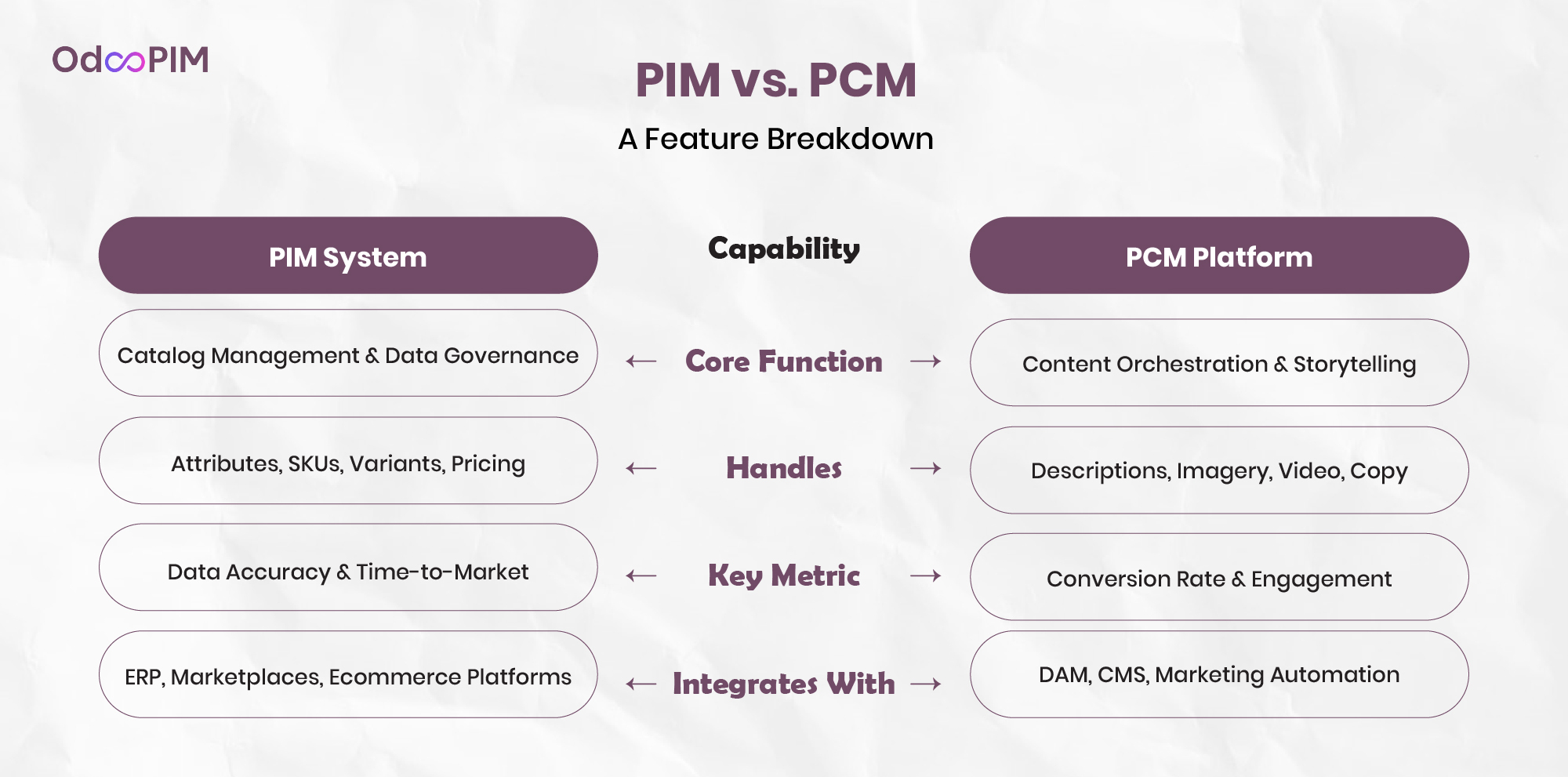
PIM vs. PCM: A Feature Breakdown
OdooPIM: Bridging PIM and PCM in One Platform
OdooPIM addresses a common market gap by integrating Product Information Management discipline with PCM functionality. This cloud-based PIM solution delivers data while providing the tools to manage marketing content, within a system.
The platform functions as a complete PIM system, centralizing technical specifications, variants, and catalog management with governance. It allows teams to craft, version, and manage persuasive descriptions, lifestyle imagery, and marketing narratives alongside that product data.
OdooPIMserves as the best PIM software for businesses that need both operational control and marketing agility from day one. Its architecture allows it to function as a cost-effective enterprise PIM for organizations seeking a consolidated operational view without investing in separate systems.
Learn about OdooPIM vs Traditional PIM
PIM Software Comparison: Evaluating PIM vs PCM Tools
A PIM software comparison demands criteria and an assessment of your business problem.
When evaluating a PIM system, scrutinize these operational foundations:
- Data Model: Does it handle complex hierarchies and variant rules essential for catalog management?
- Integrations: Can this cloud-based PIM synchronize with your ERP, marketplaces, and sales channels?
- Scalability: Will it function as the best PIM software for small businesses today and an enterprise PIM tomorrow?
These requirements differ from evaluating a PCM platform, where the criteria focus on creative workflow, content personalization, and media asset management.
The market splits into three distinct categories:
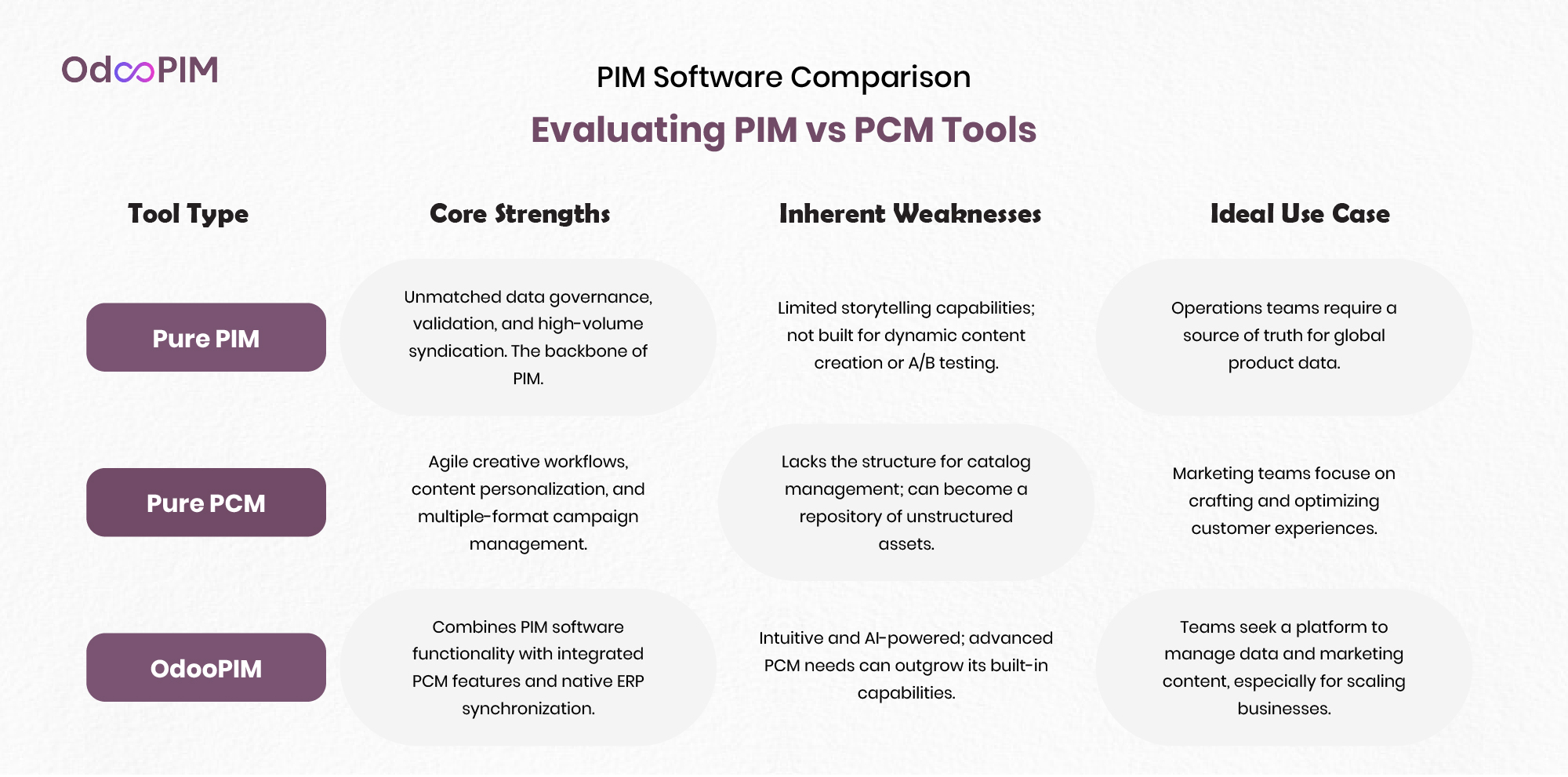
When to Choose PIM, PCM, or Both
The choice between Product Information Management, Product Content Management, is a response to your critical business constraint.
Choose a PIM system when operational chaos is your barrier. If your team is correcting errors across channels, struggling with manual updates, or delaying launches due to inconsistent data, your need is governance. Implementing a PIM software solution establishes the foundation of accurate product information. This is the first step for a business where data integrity impacts revenue and customer trust.
Once your product data is reliable, you can invest in a PCM platform. This move is justified when your growth is limited by content velocity, when you need to personalize narratives, run sophisticated A/B tests, or manage libraries of regionalized marketing assets. PCM tools leverage the data from your PIM system to build targeted stories that drive conversion.
Opt for a cloud-based PIM platform like OdooPIM when you need agility. Select this path if you require catalog management and content orchestration from an interface, to avoid tool sprawl and streamline across team collaboration. This approach is for scaling businesses that need both operational control and marketing agility without managing two deep-tier systems from day one.
Learn about cloud PIM
Build Your Product Data Strategy Right
Product Information Management defines the what. It is the system of record for specifications, attributes, and inventory. Product Content Management articulates the why. It crafts the narrative that connects features to customer desire.
Without synchronized data, most marketing stories collapse upon contact with reality. Inconsistent pricing, wrong specifications, and outdated availability undermine trust and cost sales.
For lean operations, seek a PIM software for small businesses, focusing on catalog management and channel syndication. For global organizations, an enterprise PIM manages complexity and ensures compliance.
Only after establishing this operational backbone should you layer on a PCM tool for storytelling. A PIM software comparison should evaluate data mastery, not creative features.

Frequently Asked Questions
1. What is the main difference between PIM and PCM software?
The difference lies in their purpose and the type of content they are designed to master. Product Information Management is an operational system built for data governance. A PIM system acts as the source of truth for factual, transactional product attributes: SKUs, technical specifications, inventory data, logistics details, and global pricing.
Product Content Management is a marketing system engineered for narrative and emotional engagement. PCM tools manage creative assets designed to persuade and connect. This includes marketing descriptions, brand stories, lifestyle imagery, video content, and campaign copy.
If your challenge is data errors, slow time-to-market, and channel inconsistency, you need PIM software. If your hurdle is creating, personalizing, and testing engaging content at scale, you need a PCM tool.
2. Do I need a PIM system or a PCM tool for my business?
You require a PIM system if your business is plagued by data chaos. Signals include errors in product listings across different channels, manual and time-consuming updates to spreadsheets, delayed product launches due to data preparation, and compliance risks from inconsistent specifications.
You need a PCM tool when your growth is limited by content velocity and relevance, not data accuracy. This need emerges after establishing a data foundation. Signs include an inability to personalize stories for customer segments, sluggish creative cycles, disjointed management of media assets, and a lack of insight into content conversions. A PCM platform empowers marketing teams to test narratives, adapt campaigns, and deliver resonant experiences.
For businesses experiencing a PIM challenge, a cloud-based PIM like OdooPIM is effective.
3. What are the PIM solutions that also handle marketing content?
The best PIM solutions with content features are cloud-based PIM systems designed for user-friendliness and cross-departmental collaboration. These platforms provide data modeling and catalog management, augmented with fields and modules for marketing descriptions, alt text, and media asset linking. They allow you to attach narratives and visuals to the product record, streamlining the workflow from data steward to content creator.
A PIM bridges the gap by offering a workspace where teams can manage attributes alongside content. This integration is powerful for businesses scaling rapidly, as it consolidates two functions without requiring software licenses and integrations.
While these solutions excel at combining data with managed marketing content, they are not replacements for deep-tier, enterprise PCM platforms.
4. Can an enterprise PIM replace a dedicated PCM platform?
An enterprise PIM and a dedicated PCM platform are designed for different outcomes at scale. An enterprise PIM is designed for data sovereignty, global compliance, and high-volume synchronization across supply chains and sales ecosystems. Its strengths are governance, validation, and distribution of trustworthy product facts.
A PCM platform is built for creative agility, brand storytelling, and audience engagement at a global level. It supports multi-lingual content workflows, granular personalization for regional campaigns, performance analytics on content assets, and dynamic content assembly. Attempting to force an enterprise PIM to perform these functions would compromise its operational integrity and fail to meet marketing’s need for speed and experimentation.
The PIM system serves as the source of truth for product data. This validated data is then fed into the PCM platform via integrations. Marketing teams use the PCM tool to craft narratives and campaigns, secure in the knowledge that they are building upon accurate information.
5. How does PIM software improve catalog management?
PIM software transforms catalog management from a reactive chore into a proactive, automated function. It centralizes product data, ending the reliance on disparate spreadsheets, legacy systems, and departmental silos. This creates an authoritative version of a product, including variants, bundles, and hierarchical relationships. By enforcing data quality rules and validating data at the point of entry, a PIM system ensures accuracy, eliminating errors that erode customer trust and increase return rates.
With a catalog management hub, adding new products or updating existing ones is a one-time action. The PIM software then automates the syndication of this validated data to any connected channel, e-commerce sites, marketplaces, distributor portals, print catalogs, and ERP systems. This synchronization ensures a touchpoint displays consistent, up-to-date information, freeing commercial teams from repetitive, error-prone uploads.
For businesses evaluating solutions, this operational efficiency is a driver of ROI. Whether considering an enterprise PIM for global governance or seeking the best PIM software for businesses to gain control, the benefit is the same: mastery over the product catalog.
6. Should I prioritize PIM or PCM software for ecommerce?
The foundation of online sales is transactional trust, which is built on accurate, reliable product information. PIM software addresses the pain points that undermine conversion: conflicting prices, incorrect specifications, “out-of-stock” items that are actually in stock, and slow listing updates. Without this foundation, the most beautifully crafted marketing content is rendered worthless the moment a customer encounters a factual error, leading to cart abandonment, negative reviews, and increased returns.
You risk wasting resources on amplifying and personalizing narratives built on inconsistent data. A PCM platform can optimize a listing’s story, but it cannot correct wrong data fed from source systems. The sequence is non-negotiable: first, use a PIM system to achieve a source of truth and automate channel distribution. Once your product data is a reliable asset, then layer on a PCM solution to test different descriptions, localize content, and enhance media to boost engagement and conversion rates.