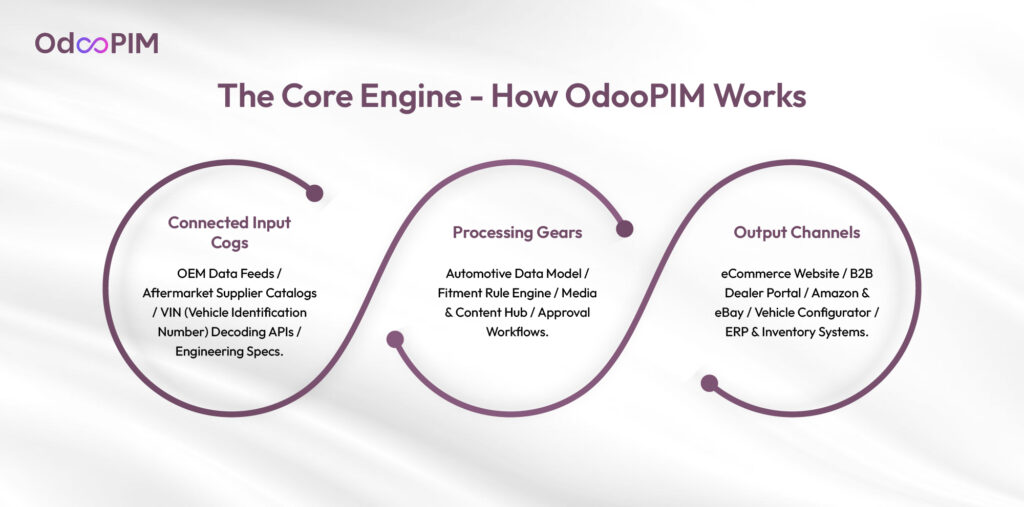
Why Automotive Needs Advanced PIM
Managing parts, accessories, and components with legacy systems or spreadsheets is a path to obsolescence. As complexity increases through millions of SKUs spanning OEM components, aftermarket accessories, and multi-brand vehicle compatibility. There arises a demand for a strategic solution.
Challenges in Automotive Parts Product Management
Manually managing fitment data for thousands of vehicle makes, models, and years is unsustainable. VIN (Vehicle Identification Number) integration with PIM is needed for accurate part identification, eliminating guesswork and returns. Regional specifications and compliance data add another layer of complexity, while disparate data sources create constant inaccuracy.
PIM: The Central Nervous System for Automotive Commerce
A PIM system acts as the source of truth, mastering the complexity of managing product information across channels. It consolidates data from suppliers, manufacturers, and engineering teams into one hub. For OEM product data management software and PIM needs for vehicle component manufacturers, this means centrally controlling technical attributes and warranty information.
It enables multi-brand automotive product catalog management from a platform, ensuring consistent, enriched, and accurate product information across sales touchpoints. This is the foundation for automotive repair and maintenance catalog PIM accuracy.
Operational Advantages of a Specialized PIM
Implementing the best PIM solutions delivers tangible control:
- Dynamic Fitment & Configuration: Support PIM integration with car configurators and complex vehicle fitment rules dynamically.
- Agile Inventory & Commerce: Synchronize car accessories inventory management with availability and pricing, enabling real-time product data updates for auto retailers.
- Scalable Architecture: A cloud-based PIM ensures global access, updates, and integration with e-commerce platforms, ERP, and dealer systems. For growing businesses, an adaptable platform like odooPIM can provide a comprehensive operational backbone, while large-scale operations require an enterprise PIM.
Automotive Product Data Complexity: An Operational Challenge
A component can have hundreds of valid applications, and a minor data error causes costly returns and operational friction. This complexity manifests across two primary domains: the world of PIM for vehicle component manufacturers and the fragmented landscape of PIM for aftermarket auto parts sellers. Both require mastering millions of interlinked SKUs, but their data demands differ.
Manufacturers and OEMs require OEM product data management software capable of structuring technical specifications, engineering change orders, and detailed compliance certifications for global markets. Their systems serve as the authoritative source for downstream partners.
A PIM moves beyond basic make/model/year filters to decode vehicle build data, engine, trim, factory options, enabling fitment matching. This capability feeds PIM integration with car configurators and powers automotive repair and maintenance catalog PIM systems.
The Multi-Dimensional Data Grid
- A part exists within a dense grid of attributes:
- Fitment Data: Make, model, year, sub-model, engine, transmission, drive type.
- Technical & Material Specifications: Dimensions, torque specs, composition, industry standards (SAE, DIN, ISO).
Commercial & Compliance Data: Regional certifications, safety regulations, hazard classifications, and warranty terms.
Learn about PIM vs ERP
The Cost of Inadequate Systems
Relying on manual spreadsheets and disconnected databases creates pain points:
- Inconsistent Catalogs: Different data versions on your website, Amazon store, and dealer portals destroy trust.
- Channel Mismatches: Stock levels or pricing in your ERP are not reflected in your car accessories inventory management feed, leading to overselling.
- Update Paralysis: Implementing real-time product data updates for auto retailers becomes impossible, stifling promotional agility and market responsiveness.
The best PIM solutions for automotive parts product management are engineered to handle this multi-dimensional data grid. A cloud-based PIM provides the scalability and accessibility needed for distributed teams and partners.

What a PIM System Delivers for Automotive
A PIM system transforms automotive product data from a persistent liability into an operational advantage. It provides the foundational control necessary to manage complexity at scale and sell across channels.
It centralizes technical specifications, high-resolution images, exploded diagrams, fitment charts, and dynamic pricing. This is the infrastructure for accurate automotive parts product management.
From Chaos to Centralized Control
A PIM eliminates data silos, ensuring your engineering documents, marketing copy, and fitment databases are synchronized.
Operational Precision and Agility
Modern PIM software delivers capabilities that are impossible with manual systems:
- Dynamic Fitment Accuracy: With VIN (Vehicle Identification Number) integration with PIM, fitment becomes a digital match, not a manual lookup. This data enables PIM integration with car configurators and ensures the reliability of automotive repair and maintenance catalog PIM.
- Unified Inventory Intelligence: The PIM synchronizes with inventory systems to provide a view of availability. This transforms car accessories inventory management from a reactive task into a proactive sales tool, preventing overselling and showcasing live stock levels.
- Instant Channel Synchronization: Real-time product data updates for auto retailers become the standard. Change a price, add a promotion, or correct a spec in the PIM, and that change propagates instantly to your website, marketplaces, and dealer portals.
Scalable Architecture for Every Tier
A cloud-based PIM ensures global accessibility, updates, and reduced IT overhead, ideal for dynamic commerce environments. For sprawling organizations, an enterprise PIM provides the governance, security, and deep ERP/CRM integrations required to manage global operations.
Platforms like odooPIM demonstrate how a PIM can serve as the central hub for a growing business, integrating catalog management with operational functions like sales, finance, and procurement.
Core PIM Features Tailored for Automotive Parts
The best PIM solutions for the automotive sector are built on specialized features that address the industry’s unique demands, transforming complex data into a competitive engine.
1. VIN (Vehicle Identification Number) Decoder Integration
A tailored PIM system connects to VIN (Vehicle Identification Number) decoding services to process the 17-digit code, unlocking the exact vehicle build engine, trim, factory-installed options, and production plant. This capability allows your catalog to display parts that match the vehicle, eliminating fitment guesswork and slashing return rates.
2. Advanced Variant Management for Accessories
A specialized PIM system provides control over product variants, colors, sizes, finishes, and compatible model years, as a manageable parent item. This structure streamlines catalog management while presenting an organized shopping experience. For PIM for aftermarket auto parts sellers, this feature is essential for handling style-driven inventory without chaos.
3. Dynamic Commerce with Vehicle Configurators
PIM integration with car configurators creates an interactive experience. Your PIM feeds accurate, vehicle part data and compatibility rules into the configurator tool. This allows customers to build dynamic bundles, such as a complete brake kit or a wheel-and-tire package, and have them validated against their VIN (Vehicle Identification Number). It turns complex automotive parts product management into a guided selling journey.
4. Structured Data for Repair & Maintenance
An automotive repair and maintenance catalog PIM structures data to support service workflows. It organizes parts by repair procedures, links components to service manuals, and enables the creation of predefined kit SKUs for common jobs. This meets the rigorous data needs of PIM for vehicle component manufacturers and wholesale distributors serving professional installers.
5. The Underlying Platform
A cloud-based PIM ensures these capabilities are always available, scalable, and updated, facilitating real-time product data updates for auto retailers. For global operations, an enterprise PIM provides the necessary power and governance, while an integrated platform like OdooPIM can unify this catalog management with full business operations.
It becomes an active platform for multi-brand automotive product catalog management, ensuring that the data required for OEM product data management software and the volume-driven needs of the aftermarket are handled with agility.
Cloud-based PIM for Automotive Scale
The choice between a cloud-based PIM and a system defines your operational agility and future growth trajectory. For automotive commerce, the scalability and flexibility of a cloud-based PIM are decisive.
The inherent demands of automotive parts product management, continuous updates, global access, and volatile data volumes are matched by the cloud model. A cloud-based PIM ensures your network, from headquarters to remote dealers, operates from a current version of the truth.
Operational Agility Under Load
Automotive sales cycles are punctuated by intense demand spikes: a major recall, a model launch, or the seasonal rush for tires and batteries. An on-premise system buckles under this pressure, requiring costly hardware provisioning for temporary needs. A cloud-based PIM scales resources to handle these peaks, ensuring your PIM for auto parts eCommerce channels remain stable and responsive when it matters most.
Global Operations
If managing multi-brand automotive product catalog management for a global distributor or ensuring a manufacturer’s technical data is available to plants, a cloud PIM provides universal, secure access. This is for PIM for aftermarket auto parts sellers with sprawling supplier and dealer networks, and for enabling complex PIM integration with car configurators across different regions.
The Enterprise PIM Imperative
When operations span multiple continents, involve numerous manufacturing plants, and require strict governance across thousands of users, a specialized Enterprise PIM becomes essential. This tier of solution is non-negotiable for complex OEM product data management software needs and for PIM for vehicle component manufacturers who synchronize engineering data, compliance files, and fitment rules across a vast supply chain. An Enterprise PIM offers the advanced security, deep ERP integrations, and workflow controls that massive organizations require.
Platforms like OdooPIM demonstrate the hybrid advantage, offering the inherent benefits of a cloud-based system with the functional integration of a business suite, serving as a comprehensive hub for catalog management.
It future-proofs your operations, ensuring your Product Information Management infrastructure can not only handle today’s volume of VIN (Vehicle Identification Number) integration with PIM requests but adapt to tomorrow’s demands, from managing an automotive repair and maintenance catalog PIM to powering next-generation digital sales tools.
OdooPIM: Built for Automotive Workflows
PIM systems require extensive customization to handle automotive data, OdooPIM delivers an intelligent solution designed for industry complexity. It goes beyond catalog management to provide an integrated operational backbone.
Native fields and attributes capture technical specifications, OEM part numbers, torque values, material grades, and cross-reference interchangeability without clumsy workarounds. This data foundation is essential for building a reliable automotive repair and maintenance catalog PIM and meets the rigorous needs of OEM product data management software.
Operational Integration
Product data flows into Odoo’s ERP, CRM, and e-commerce modules, creating an order-to-delivery pipeline. This integration is powerful for PIM for auto parts eCommerce, where inventory, pricing, and product information should be synchronized to prevent overselling and ensure accuracy.
Automated data import and enrichment tools normalize disparate supplier feeds into a consistent, market-ready format. This capability allows PIM for aftermarket auto parts sellers to scale their assortments while maintaining data quality and brand presentation.
Driving Advanced Commerce Experiences
Along with dedicated connectors for VIN (Vehicle Identification Number) integration with PIM, it supports fitment filtering and vehicle-specific search. This data readily fuels PIM integration with car configurators, allowing retailers to build dynamic, validated part bundles that enhance average order value and customer confidence.
As a cloud-based PIM, it ensures real-time product data updates for auto retailers across sales channels, from B2B portals to direct-to-consumer storefronts. The platform manages complex car accessories inventory management, handling color, size, and finish variants as product families to simplify operations and enrich the shopping experience.
For businesses scaling from mid-market to Enterprise PIM requirements, Odoo’s architecture grows with them. It proves that the best PIM solutions provide not just data control, but a streamlined path to operational excellence, consolidating Product Information Management, sales, finance, and logistics onto a powerful platform.
Best PIM Solutions for Automotive Segments
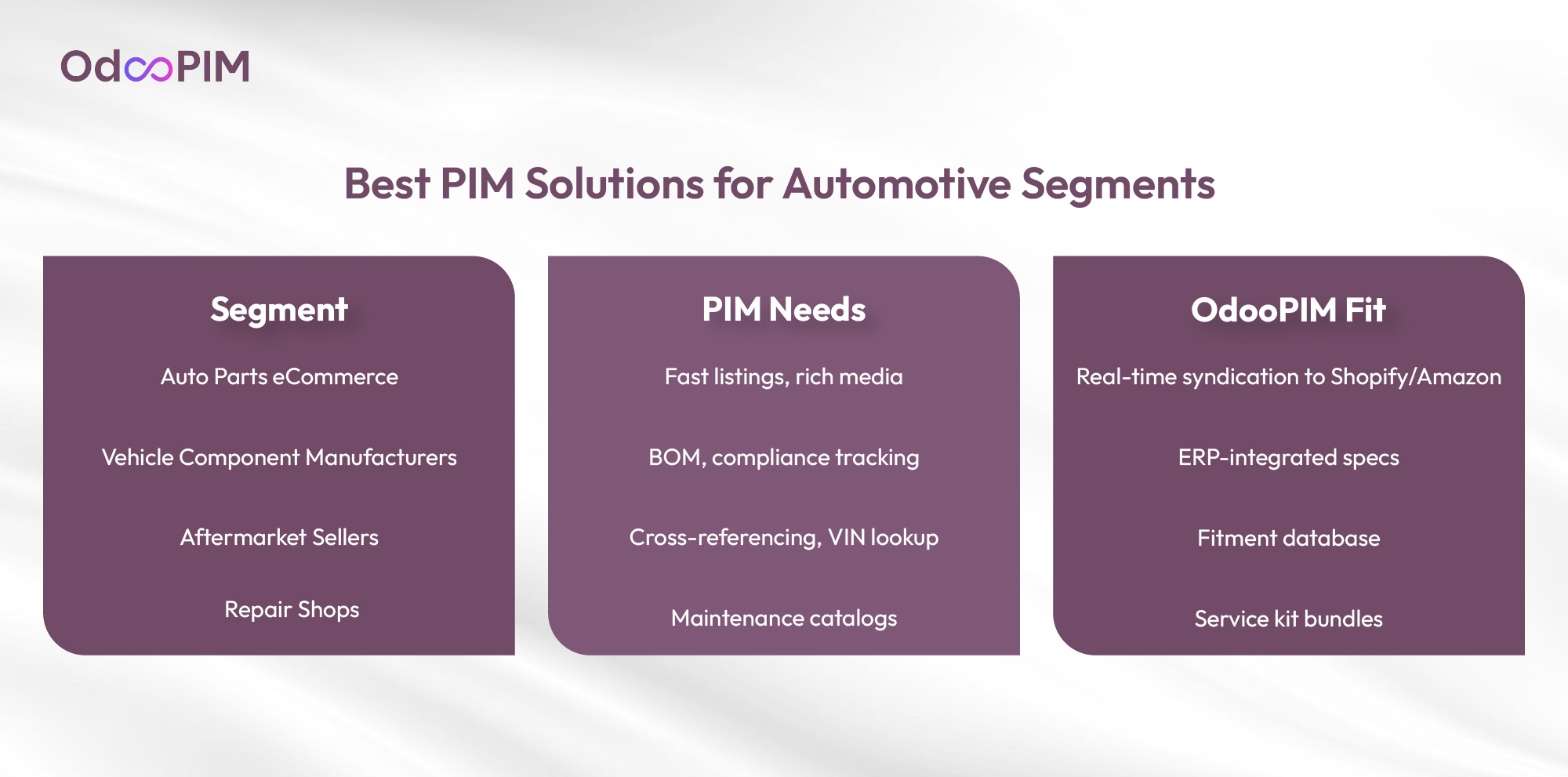
PIM Software Comparison for Automotive
PIM Software Comparison: Automotive Criteria
In the automotive sector, the best PIM solutions are defined by their ability to handle unique data complexity and drive precise commerce.
Traditional vs. Cloud-Based: A Fundamental Divide
They struggle with the dynamic, high-volume demands of automotive parts product management. Updates are slow, scaling requires hardware investment, and providing real-time product data updates for auto retailers is a constant technical challenge.
It offers the inherent scalability, automatic updates, and global accessibility required for today’s commerce. This architecture is essential for managing multi-brand automotive product catalog management and supporting distributed dealer or installer networks.
Evaluation Criteria for Automotive
When comparing PIM software, assess these non-negotiable capabilities:
- VIN (Vehicle Identification Number) Decoding & Fitment Engine Accuracy: Evaluate the depth and reliability of its VIN (Vehicle Identification Number) integration with PIM. The system should decode to the trim and factory option level to guarantee part compatibility and minimize returns. This is the foundation for credible PIM for auto parts eCommerce.
- Multi-Channel Publishing Velocity: Test the platform’s ability to syndicate enriched product data, including complex fitment rules and inventory levels to your website, Amazon, eBay, and B2B portals.
- Technical Ecosystem Integration: Scrutinize its ability to connect with adjacent systems. This includes PIM integration with car configurators for guided selling, links to diagnostic software for professional automotive repair and maintenance catalog PIM, and ERP/CRM connections for car accessories inventory management.
Positioning OdooPIM: The Integrated Alternative
It transcends being a standalone PIM system by functioning as the data of a fully integrated business suite. It meets the specialized data needs of PIM for vehicle component manufacturers and PIM for aftermarket auto parts sellers within a cohesive platform.
It delivers catalog management, operational integration, and the scalability of a cloud-based PIM, consolidating the value chain from OEM product data management software requirements to the final customer transaction.
Implementation Roadmap for Automotive PIM
Phase 1: Foundational Data Audit & Cleanup
Scrub your part numbers, validate OEM references, and rationalize fitment tables. Identify and map superseded parts to their active replacements. For PIM for aftermarket auto parts sellers, this means consolidating and normalizing disparate supplier feeds. For OEM product data management software implementations, it involves securing authoritative engineering data. A clean baseline prevents migrating legacy inaccuracies into your new PIM system.
Phase 2: Automotive Attribute Modeling
This includes establishing the schema for VIN (Vehicle Identification Number) integration with PIM, building vehicle compatibility matrices, and capturing technical specs like torque values and material grades. This modeling is the blueprint for effective automotive parts product management and determines the utility of your future automotive repair and maintenance catalog PIM.
Phase 3: Strategic System Integration
Connect to your ERP for synchronized inventory and financial data, enabling accurate car accessories inventory management. Establish PIM integration with car configurators to enable dynamic vehicle-specific selling. For professional channels, integrate with diagnostic API services to support technician workflows. This interconnectedness is what separates a repository from an operational platform.
Phase 4: Multi-Channel Syndication
Use the PIM to publish product data to customer touchpoints. This powers your PIM for auto parts eCommerce on your website and major marketplaces. It feeds dedicated B2B dealer portals, ensuring consistency for multi-brand automotive product catalog management. The goal is a customer experience, regardless of sales channel.
Phase 5: Automated Governance & Validation
Automate validation checks for new item setups and fitment rules. Establish clear ownership and approval workflows for data changes. This governance framework is important for executing real-time product data updates for auto retailers with confidence, ensuring that price change, inventory adjustment, or new part introduction is accurate and immediately live.
Platform Consideration:
Its integrated nature reduces the friction of Phase 3, as the PIM system is connected to ERP, CRM, and e-commerce modules. If opting for a scalable cloud-based PIM or a comprehensive Enterprise PIM, selecting one of the best PIM solutions that aligns with this disciplined approach transforms Product Information Management from a project into a lasting competitive framework.
ROI: Automotive Retailers Gain from PIM
Accelerate Time-to-Market and Revenue
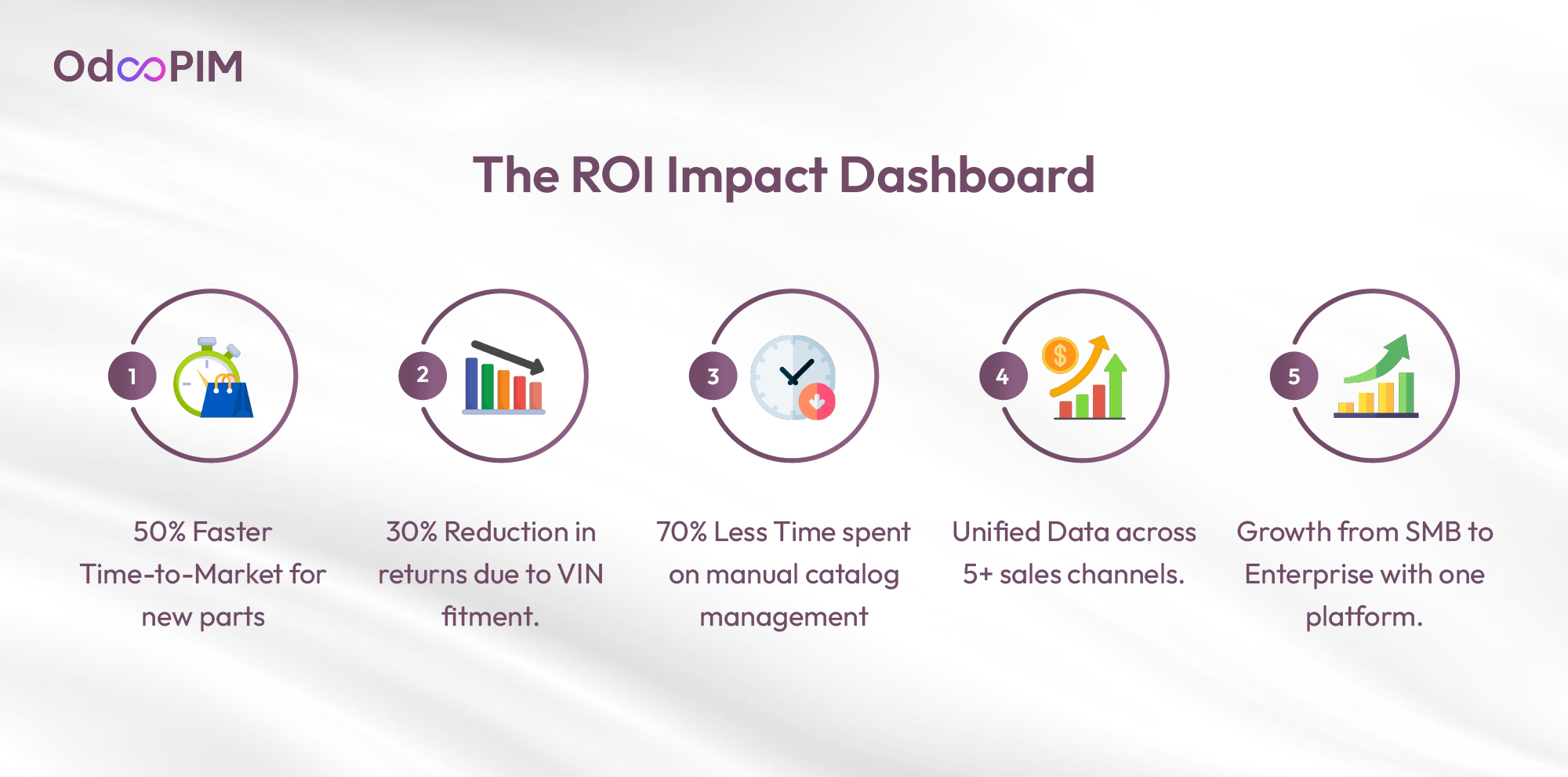
Implementing a PIM system slashes the time required to onboard new parts and execute model year updates by 50% or more. You capture sales faster when new vehicles launch and respond instantly to market trends. This operational speed is an advantage of a cloud-based PIM, enabling real-time product data updates for auto retailers across channels.
Dramatically Reduce Costly Returns
VIN (Vehicle Identification Number) integration with PIM eliminates guesswork by validating part compatibility against the exact vehicle build. This cuts return rates, reducing associated logistics, restocking, and customer service costs. For PIM for aftermarket auto parts sellers, this justifies the investment, protecting margin on transaction.
Drive Higher Conversion with Confidence
An automotive repair and maintenance catalog PIM that provides exploded diagrams, technical specifications, and definitive fitment data builds professional trust and consumer confidence. This rich content answers buyer questions on the page, reducing hesitation and cart abandonment.
Optimize Inventory and Operational Costs
A view of stock across warehouses and sales channels prevents overselling and enables intelligent stock allocation. This reduces carrying costs for slow-moving items and increases turnover for high-demand products. The efficiency gains in data management free technical staff from manual catalog upkeep, redirecting resources to strategic growth.
Scalable Efficiency from Mid-Market to Enterprise
For a growing seller, a platform like odooPIM can deliver this ROI within a business suite. For large distributors or PIM for vehicle component manufacturers, an Enterprise PIM provides the governance and deep integration to apply this efficiency across a global operation, mastering multi-brand automotive product catalog management.
Why OdooPIM Leads Automotive PIM Solutions
In a field of specialized point solutions and generic platforms, OdooPIM delivers a distinct advantage: operational unity. It excels not merely as a data management tool, but as the integrated commerce engine for the automotive sector.
For PIM for aftermarket auto parts sellers, OdooPIM stands out among the best PIM solutions by addressing challenges. It masters multi-brand automotive product catalog management with automated data import and enrichment tools, normalizing disparate supplier feeds into a consistent, market-ready catalog. This capability allows businesses to scale their assortments without proportional increases in operational overhead.
Scalability and Control
It handles car accessories inventory management for a growing SMB, managing complex variants and stock across channels. It possesses the architecture and governance features to perform as an Enterprise PIM, meeting the rigorous data demands of OEM product data management software and PIM for vehicle component manufacturers.
The Decisive Advantage: Business Integration
This integration dismantles the traditional silos between Product Information Management, sales, inventory, finance, and service operations. A part added in the PIM system is available for quoting in the CRM, synced with stock in the inventory module, and ready for fulfillment. This creates a flow for real-time product data updates for auto retailers, ensuring pricing, availability, and specifications are perfectly synchronized everywhere.
It simplifies PIM integration with car configurators, allowing vehicle-specific part bundles to be created, priced, and converted into sales orders within an environment. It supports the technical depth required for an automotive repair and maintenance catalog PIM, linking parts to service procedures and kits.
Future-Proof Your Automotive Catalog
Relying on fragmented systems or manual processes guarantees obsolescence. The strategic imperative is to implement a PIM system that transforms operational chaos into a competitive advantage.
It replaces scattered spreadsheets and inconsistent data with an authoritative command center for product intelligence. This is the non-negotiable foundation for mastering automotive parts product management at any scale.
It ensures your business can handle demand surges, adapt to new regulations, and support global expansion. This architecture is essential for executing real-time product data updates for auto retailers and maintaining accurate car accessories inventory management across complex networks.
OdooPIM: The Platform for Automotive Commerce
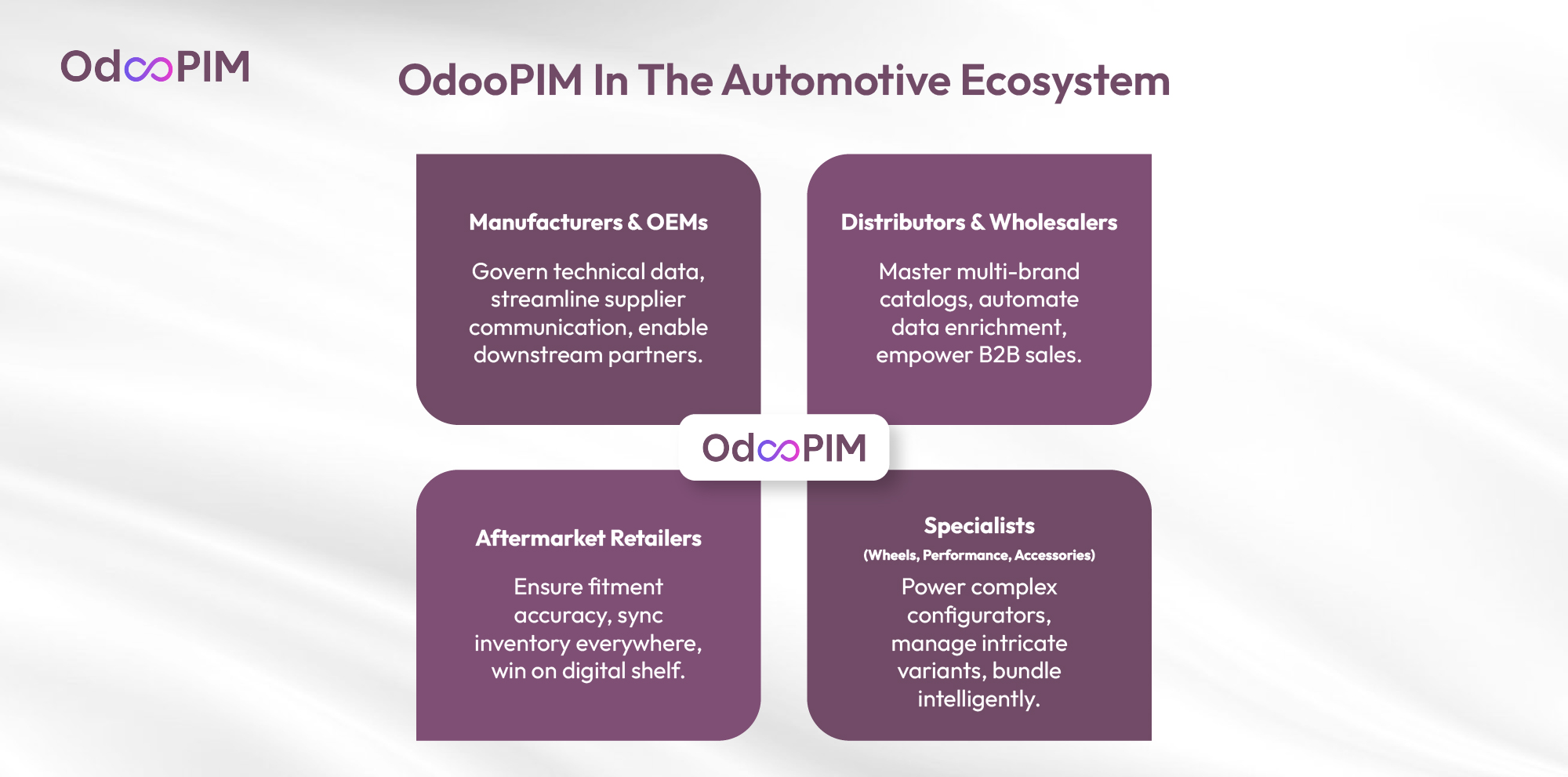
For businesses demanding a comprehensive solution, odooPIM stands among the best PIM solutions. For manufacturers, it provides the rigorous data governance and technical depth required for OEM product data management software, serving as a powerful solution for PIM for vehicle component manufacturers.
For distributors and retailers, it excels at PIM for auto parts eCommerce and PIM for aftermarket auto parts sellers. The platform handles multi-brand automotive product catalog management, while advanced features like VIN (Vehicle Identification Number) integration with PIM ensure pinpoint fitment accuracy.
PIM integration with car configurators becomes a function, creating dynamic buying experiences. The platform supports the detailed needs of an automotive repair and maintenance catalog PIM, linking parts to service procedures. As a fully integrated suite, OdooPIM erases the boundaries between catalog management, sales, and fulfillment, offering a scalable path from operations to an Enterprise PIM capability.
Frequently Asked Questions
1. What is the best PIM software for managing complex automotive parts catalogs?
Identifying the best PIM software for automotive hinges on its ability to master industry complexity, not just generic catalog management. The ideal solution should be engineered to handle the immense scale and technical depth of automotive parts product management. This involves managing millions of SKUs with intricate attributes like torque specs, OEM numbers, and material grades, while structuring data for both PIM for vehicle component manufacturers and the high-volume needs of PIM for aftermarket auto parts sellers. A leading system should provide a foundation for multi-brand automotive product catalog management, normalizing disparate supplier data into a market-ready source of truth.
Key differentiators include native support for VIN (Vehicle Identification Number) integration with PIM for fitment, capabilities for building an automotive repair and maintenance catalog PIM with diagrams and kit assemblies, and tools for PIM integration with car configurators. The architecture should be inherently scalable, with a cloud-based PIM foundation being essential for global accessibility and resilience. Solutions like odooPIM are highlighted as top contenders because they deliver this specialized capability within a fully integrated business suite.
It must empower real-time product data updates for auto retailers across channels, provide control for car accessories inventory management, and scale from mid-market needs to full Enterprise PIM requirements without a disruptive re-platforming. The benchmark is a system that functions not as a passive database, but as the active, intelligent of your automotive commerce operation, making it the definitive engine for PIM for auto parts eCommerce and manufacturing alike.
2. How does VIN (Vehicle Identification Number) integration work within a PIM system for accurate part fitment?
VIN (Vehicle Identification Number) integration with PIM is a technical process that transforms a 17-character code into a dynamic filter for guaranteed part compatibility. It begins when a customer or sales representative enters a vehicle’s VIN (Vehicle Identification Number) into a connected e-commerce site, configurator, or dealer portal. The PIM system does not store interpretations of VIN (Vehicle Identification Number) internally; instead, it securely calls a dedicated VIN (Vehicle Identification Number) decoding API service. This service acts as a universal translator, cracking the code to return the vehicle’s exact factory build details, including make, model, year, trim, engine, transmission, drive type, and factory-installed options.
Within the product database, part is tagged with a comprehensive set of compatibility rules based on the vehicle attributes. The system performs an instantaneous match, filtering the catalog to display only components validated for that vehicle build. This process moves far beyond basic make/model/year filters, addressing the complexity of automotive parts product management. It ensures that a brake rotor for a V6 model is not mistakenly offered for a V8, or that an accessory is shown only for the trim line.
It eliminates fitment guesswork, which is the driver of costly returns and eroded customer trust. For businesses, it protects margin and boosts conversion rates. This vehicle data unlocks advanced selling tools, enabling sophisticated PIM integration with car configurators that can recommend dynamic bundles. By embedding this capability, a PIM system shifts from being a catalog to becoming a trusted fitment authority, which is essential for PIM for aftermarket auto parts sellers and professional distributors.
3. Can a PIM system handle updates across multiple sales channels for auto parts?
A function of Product Information Management is to serve as the source of truth that synchronizes data across customer touchpoints. This capability is fundamental for PIM for auto parts eCommerce and omnichannel retail strategies. When a change is made within the central PIM system, such as updating a price, correcting a specification, adjusting inventory levels, or adding a new vehicle fitment that modification is processed and pushed out to connected channels through pre-built connectors or APIs.
This means the update appears at the moment on your B2C website, your Amazon and eBay storefronts, your B2B dealer portal, and any integrated car configurators. This ensures real-time product data updates for auto retailers, eliminating the dangerous discrepancies that cause overselling, customer confusion, and brand damage. For car accessories inventory management, this is critical: when a product sells out in the warehouse, the sales channel can reflect “Out of Stock”, preventing backorders and fulfillment failures.
The cloud environment provides the necessary computing power and connectivity to process and distribute high volumes of data changes reliably. If you are a PIM for aftermarket auto parts sellers managing daily specials or an Enterprise PIM user rolling out a global price change, the system ensures consistency. This engine turns the PIM software from a backend repository into a dynamic command center, allowing businesses to react to market demands, promotions, and inventory shifts with agility and precision across the front.
4. What is the difference between a generic PIM and an automotive-specific PIM solution?
A generic PIM system provides a foundational framework for catalog management: it can store product descriptions, images, and basic attributes, and syndicate them to various sales channels. It is designed for common commerce data like size, color, and price. It lacks the data structures, relationships, and business logic required for the technical and operational complexity of the automotive industry. Using a generic solution for automotive parts product management forces extensive, costly, and fragile customization to handle basic fitment data, inevitably leading to gaps and inefficiencies.
This includes support for VIN (Vehicle Identification Number) integration with PIM, structured fields for OEM part numbers and technical specifications, and a system for managing vehicle compatibility matrices. It understands the difference between managing an accessory and building a detailed automotive repair and maintenance catalog PIM with service kits and labor times. This specialized design is essential for both OEM product data management software needs and multi-brand automotive product catalog management.
An automotive PIM system will offer built-in pathways for PIM integration with car configurators and diagnostic tools, which are foreign to generic platforms. It provides advanced tools for PIM for aftermarket auto parts sellers to normalize and enrich chaotic supplier data feeds. An automotive solution like odooPIM doesn’t just manage data; it understands the automotive parts business. It delivers precision, reduces time-to-market for new parts and model years, and provides the accurate, rich product information that drives sales and minimizes returns in PIM for auto parts eCommerce.
5. How does an integrated PIM and ERP system benefit automotive parts businesses?
The PIM software acts as the commercial and technical master for product information, governing rich marketing content, fitment data, and digital assets. The ERP manages the operational and financial backbone: inventory quantities, warehouse locations, purchase orders, cost accounting, and order fulfillment. When these two systems are deeply connected, a change in one automatically and accurately updates the other, creating a source of truth for both customer-facing and internal operations.
For car accessories inventory management, it means the rich product descriptions and fitment rules from the PIM are perfectly aligned with real-time stock levels and locations from the ERP. This prevents overselling and enables accurate promise dates. It powers real-time product data updates for auto retailers by ensuring that a stock depletion in the warehouse immediately triggers an update on the e-commerce site. For PIM for vehicle component manufacturers, integration ensures that engineering changes and new part releases in the PIM system smoothly trigger the creation of new items and BOMs in the ERP, streamlining production planning.
It allows a salesperson to configure a complex vehicle-specific parts bundle, convert it to a sales order with accurate pricing and availability, and have it flow into warehouse picking and invoicing within one system. This end-to-end integration accelerates order cycles, reduces errors, and provides complete visibility, making it a transformative advantage for PIM for aftermarket auto parts sellers and manufacturers aiming for operational excellence.
6. Is a cloud-based PIM secure and scalable enough for large automotive enterprises?
Cloud-based PIM platforms are not only secure and scalable but are the preferred infrastructure for Enterprise PIM deployments in large automotive organizations. Leading cloud providers invest more in physical security, cybersecurity, and compliance certifications than any corporation could feasibly manage on-premise. These platforms offer enterprise-grade security features, including encryption for data at rest and in transit, comprehensive identity and access management, and dedicated compliance programs for standards like ISO 27001, SOC 2, and GDPR. For PIM for vehicle component manufacturers handling sensitive OEM data, this provides a security posture that surpasses that of a private data center.
Regarding scalability, a cloud-based PIM is inherently elastic, which is for the volatile demands of the automotive sector. It can scale computing resources to handle peak loads during new model launches, major marketing campaigns, or seasonal surges like tire-change periods. This ensures that PIM for auto parts eCommerce operations remain performant under extreme traffic. It supports global expansion, allowing teams and partners worldwide to access the data without latency or infrastructure delays. This elastic model means the PIM system grows with the business, eliminating the costly and disruptive cycles of procuring and installing new on-premise hardware.
A cloud PIM software ensures global divisions operate on the version with real-time product data updates for auto retailers everywhere. It simplifies the immense challenge of multi-brand automotive product catalog management across regions. Updates, patches, and new features are rolled out by the provider, freeing internal IT teams to focus on strategic initiatives rather than maintenance.