


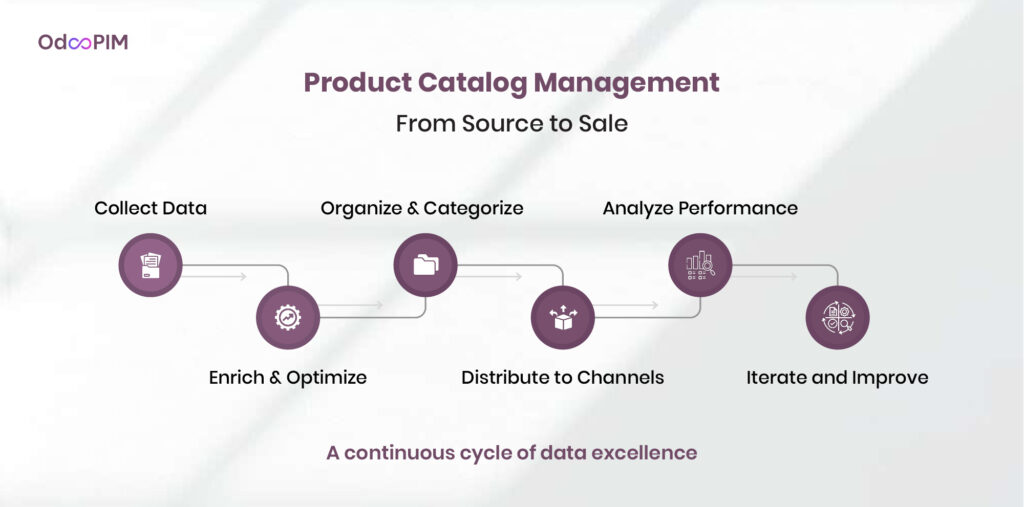
Effective product catalog management is the centralized discipline of structuring, enriching, and governing item data across sales channels, transforming this liability into an asset. Specialized product catalog management software, or integrated catalog management tools, automate this process, ensuring accuracy from procurement to the digital shelf. In e-commerce, this practice of product catalog optimization influences discoverability and conversion. Strategic product catalog management is what prevents operational friction and secures sales, making superior catalog management solutions foundational to commerce.
What is Product Catalog?
A product catalog is the digital inventory, the source of truth containing attributes, images, and prices for your offerings. Product catalog management is the active governance of this asset. Without disciplined product catalog management, data becomes inconsistent, impacting customer experience and sales. This is why implementing product catalog management software is essential. Catalog management tools automate updates and enforce standards. For an enterprise product catalog, this catalog management system ensures accuracy across channels, forming the foundation for scalable commerce.
What is Product Catalog Management?
Product catalog management is the strategic control of your item data from creation to the customer. It’s the process of product catalog optimization, ensuring information is accurate, enriched, and consistent everywhere. For large organizations, an enterprise product catalog demands a product catalog management system. This catalog management software centralizes control, replacing spreadsheets with automated workflows. Effective product catalog management powers e-commerce catalog management and stabilizes procurement catalog management.

Product Catalog Management Software Types
1. Cloud-Based Product Catalog Management (PCM)
Cloud-based product catalog management liberates your data from servers, enabling updates and global team access. This approach transforms traditional catalogue management into a dynamic, scalable operation. Product catalog management software hosted in the cloud provides the agility for product catalog optimization across markets. It represents the evolution of catalog management solutions, offering superior security and integration compared to legacy systems. For any growing business, this product catalog management system is essential for maintaining an enterprise product catalog.
2. On-Premises Product Catalog Management (PCM)
On-premises product catalog management maintains data and applications within a company’s own physical infrastructure. This model grants organizations hands-on control over their enterprise product catalog and its security protocols. While offering sovereignty, this approach to product catalog management demands internal investment in hardware and IT staff for maintenance. It requires deploying and managing a localized product catalog management system, which can agile catalog management in e-commerce and scaling. For certain regulated industries, on-premises catalog management solutions address compliance mandates that cloud platforms may not. This traditional form of product catalog management provides control but at the cost of flexibility and update speed.
3. Open-Source Product Catalog Management (PCM)
Open-source product catalog management provides the foundational code for catalog management solutions, offering adaptability. This approach grants teams total autonomy to tailor their product catalog management system to business rules and workflows. This model of product catalog management shifts the burden of development, security, and ongoing product catalog optimization in-house. It demands technical expertise to transform raw code into a stable catalog management system capable of supporting an enterprise product catalog. While cost-effective initially, the total effort for product catalog management can escalate.
4. SaaS-Based Product Catalog Management (PCM)
SaaS-based product catalog management delivers a fully-hosted, subscription-service application accessible through a web browser. This model removes hardware burdens and internal maintenance, allowing teams to focus on catalogue management tasks. The vendor updates this product catalog management software, ensuring access to the latest features and security for product catalog optimization. As a scalable catalog management solution, it deploys a powerful product catalog management system without a large upfront investment. This approach standardizes processes for catalog management in procurement and accelerates execution for catalog management in e-commerce. SaaS-based product catalog management provides enterprise-grade capability with operational simplicity and predictable costs.
“Product Information Management solutions make a single, trusted source of product information available for multichannel commerce and data exchange.”
Product Catalog Management in E-commerce
Role of catalogs in e-commerce platforms
Within ecommerce platforms, the digital catalog is the central sales engine. Catalog management in e-commerce ensure product details are accurate and compelling, influencing conversion rates and search rankings. Strategic product catalog optimization transforms static listings into assets by enriching data, refining imagery, and aligning with SEO best practices. A product catalog management system automates this work, syncing updates across channels to prevent revenue leaks. This operation in catalog management in e-commerce turns an inventory list into a merchandising tool.
Mastering Channel-Specific Formatting in Product Catalog Management
Sales channel enforces data requirements, making manual adaptation a path to errors and missed sales. Product catalog management solves this by automating formatting from a master record. This function of catalog management in e-commerce ensures your listings are tailored for Amazon’s fields, Google’s schema, and your storefront’s design. Product catalog management software applies these rules at scale, a component of product catalog optimization that maximizes visibility. Without this automated discipline in product catalog management, brands struggle with inconsistent presentations that erode consumer trust. Implementing a product catalog management system is essential, as it transforms a unified enterprise product catalog into formatted listings.

Taming Variant Explosion with Strategic Product Catalog Management
Variant explosion, managing colors, sizes, and configurations, can fracture a catalog into thousands of individual SKUs, creating a data management nightmare. Effective product catalog management is the solution. This is a central challenge for catalog management in e-commerce, where poor handling impacts site search, filtering, and the customer experience. Product catalog management software uses parent-child relationships and inheritance rules to ensure consistency across options, a key facet of intelligent product catalog optimization. Masterful product catalog management transforms this chaos into an asset, enabling filtering.
Scaling Global Sales with Localized Product Catalog Management
Localization requires adapting currencies, measurements, cultural nuances, and compliance details for the target market. This complexity makes product catalog management an important operational pillar for international growth. A product catalog management system centralizes these regional adaptations, enabling efficient catalog management in e-commerce across diverse geographies. This process is a layer of product catalog optimization, ensuring listings resonate locally and comply with regional regulations. Without strategic product catalog management, global expansion stalls due to inconsistent customer experiences and logistical errors. Implementing specialized product catalog management software is essential, as it automates the scaling of an enterprise product catalog into multiple localized versions, turning a challenge into a competitive advantage.
The Product Catalog Management Process
Step 1: Foundation Through Comprehensive Data Collection
Successful product catalog management begins by aggregating raw product information from suppliers, manufacturers, and internal teams into a repository. This foundational phase of product catalog management transforms scattered data points, from technical specifications and marketing copy to compliance certificates and digital assets, into a structured master list. Product catalog management software is essential here, as it provides the framework to standardize this influx of data, preventing chaos from the start. The quality of this collection dictates the efficacy of product catalog optimization efforts. Data gathering establishes the accurate, comprehensive baseline required to build a scalable enterprise product catalog.
Step 2: Creating Value Through Strategic Data Enrichment
Data enrichment is the phase where product information is transformed into sales content. This stage of product catalog management involves augmenting specifications with images, descriptions, bullet points, and keywords to boost discoverability. Specialized product catalog management software includes tools to automate and standardize this enrichment, ensuring brand consistency. This process is the essence of product catalog optimization.
Step 3: Building Usability Through Organization and Categorization
Organization is the structural phase of product catalog management, where products are grouped into a hierarchy of categories and subcategories. This stage of product catalog management dictates the user experience, enabling intuitive browsing and effective site search. Advanced product catalog management software uses taxonomy tools to enforce tagging and attribute application across the enterprise product catalog. This systematic organization is a fundamental aspect of product catalog optimization, as it determines how customers can find what they need. A framework within your product catalog management system transforms a collection of items into a discoverable, shoppable inventory.
Step 4: Achieving Omnichannel Reach Through Distribution
Distribution is the core of product catalog management, where the master data is pushed to sales channels and touchpoints. This phase of product catalog management relies on automated syndication to ensure instant, error-free updates across your website, marketplaces, and partner platforms. A product catalog management system handles the complex technical mappings required for catalog management in e-commerce, formatting data to meet a channel’s specifications. This publishing capability is an output of product catalog optimization, ensuring product availability and accuracy where customers shop. Effective distribution, powered by product catalog management software, is what transforms a managed internal asset into live, revenue-generating listings.
Step 5: Driving Performance with Continuous Monitoring
Product catalog management is a discipline demanding analysis and refinement after publication. This final, ongoing phase of product catalog management involves tracking key metrics like search performance, conversion rates, and data accuracy across channels. Product catalog management software provides dashboards to identify underperforming listings and errors, enabling product catalog optimization. This feedback loop is what separates catalogue management from governance. By acting on these insights within your product catalog management system, you enhance the shopper experience and commercial results. Proactive monitoring is not a task; it is the essential engine of improvement in product catalog management, ensuring your catalog remains a high-performing asset.
Product Catalog Management Challenges
Eliminating Revenue Leaks by Shattering Data Silos
Data silos and fragmentation create incompatible versions of product truth across departments, causing errors, operational delays, and poor customer experiences. Effective product catalog management exists to dismantle these barriers by establishing an authoritative source for item information. A centralized product catalog management system consolidates data from marketing, sales, and procurement, replacing disparate spreadsheets and databases. This unification is the first step in strategic product catalog optimization, as accurate data precedes any enhancement.
Ending Customer Confusion Caused by Inconsistent Information
Inconsistent product information across channels, differing prices, specs, or imagery destroys consumer trust and sabotages sales. Strategic product catalog management solves this by enforcing a single golden record for each item, ensuring uniformity wherever it’s sold. This governance is the purpose of a product catalog management system, which syndicates approved data to endpoints. Implementing disciplined product catalog management software eliminates manual updates and the human error they introduce.
Erasing Costly Mistakes from Manual Data Entry
Manual data entry is a source of catalog corruption, introducing typos, misplaced decimals, and outdated information that impact sales and operations. Product catalog management is designed to eliminate this vulnerability by automating data ingestion and updates. A product catalog management system integrates with supplier feeds, PIM tools, and ERPs, ensuring information flows without human transcription. Deploying product catalog management software is an investment in data integrity and operational efficiency.
Scaling Your Catalog Without Operational Breakdown
A scalable product catalog management system uses rules, templates, and actions to maintain control and consistency even as volume explodes. This capability is important for a growing enterprise product catalog, ensuring catalogue management remains efficient. Investing in advanced product catalog management software is essential for any business with expansion plans.
Conquering the Chaos of Multi-Channel Selling
Sales channel enforces technical requirements, data formats, and update frequencies, creating immense operational complexity. Effective product catalog management is designed to master this environment by serving as a central command hub. A product catalog management system adapts your product data to meet the rules of Amazon, Google, Shopify, and other endpoints. This orchestration is a function of catalogue management, ensuring a consistent brand presence across the board.
Ending Lost Sales from Stale Product Information
Product catalog management eliminates this latency by enabling automated data synchronization. A cloud-based product catalog management system ensures any edit to your central enterprise product catalog is reflected everywhere in real time, a main requirement for catalog management in e-commerce. This is an important advantage provided by advanced product catalog management software, turning data into a live business asset. Implementing a responsive product catalog management strategy is essential to maintaining accuracy, capturing demand, and protecting revenue in a fast-paced market.
Some of the Main Benefits of Product Catalog Management
1. Building Elegant, Data-Driven Product Catalogs
A catalog merges aesthetics with underlying data to create an intuitive and persuasive shopping experience. This fusion is the goal of product catalog management, which enriches information into a commercial asset. Product catalog management software provides the tools to achieve this, enabling visual polish and product catalog optimization based on performance analytics. A well-executed product catalog management system ensures your enterprise product catalog is aligned with customer behavior and search trends. Professional product catalog management transforms an inventory list into an engine that guides buyers to purchase.
2. Accelerating Time-to-Market with Quick Publishing
Speed is a competitive advantage, and delays in publishing new products or updates cost sales and market relevance. A product catalog management system uses templates and rules to syndicate enriched data, a key capability for agile catalog management in e-commerce. This publishing velocity, enabled by product catalog management software, allows businesses to capitalize on trends and react to market changes immediately.
3. Ensuring Agility with Smooth Maintenance and Fast Scalability
Strategic product catalog management provides the automated workflows and framework to handle routine updates and massive expansion. A scalable product catalog management system uses editing, rules, and integrations to maintain an enterprise product catalog at any volume. This operational smoothness is a result of implementing product catalog management software, which turns tasks into repeatable processes. Product catalog management is the foundational practice that allows businesses to adapt, grow, and maintain a digital storefront without increasing their overhead.
4. Elevating Operations with AI in Your Catalog
AI transforms data into an asset by automating tasks such as demand forecasting, personalized search, and intelligent attribute tagging. This evolution redefines product catalog management, shifting it from an administrative function to a commercial engine. Advanced product catalog management software embeds these AI capabilities into the product catalog management system, enabling automated, manual-scale product catalog optimization.
Product Catalog Management Examples and Case Studies
A Fashion Retailer Transformed Its Product Catalog Management
A global fashion retailer struggled with seasonal collections, causing variant explosion, manual errors, and inconsistent listings across 20+ channels. Their decentralized catalogue management created data silos, delaying launches and causing stock mismatches. By implementing a product catalog management system, they centralized control of their whole enterprise product catalog. This product catalog management software automated data syndication, enabling catalog management in ecommerce. The result of this strategic product catalog management initiative was a 40% faster time-to-market for new collections, a 15% reduction in returns due to inaccurate sizing information, and a brand presentation that lifted online conversion by 8%.
Learn more about PIM for Retailer.

An Electronics Manufacturer Engineered Precision
An electronics manufacturer faced critical errors in its enterprise product catalog, where inconsistent technical specifications across distributor and B2B portals triggered compliance risks and costly support calls. The implementation of a specialized product catalog management system became essential. This product catalog management software enforced a source of truth, automating catalog management in procurement and partner channel syndication. Through disciplined product catalog management, they achieved 99.9% data accuracy, reduced time spent on catalog updates by 70%, and secured key retail partnerships that required automated data feeds.
Learn more about PIM for Manufacturing.
A Furniture E-commerce Brand Built a Cohesive Experience
A direct-to-consumer furniture brand struggled with disorganized product data, making it difficult for customers to find and configure items like sofas with various fabric and leg options. Their manual catalogue management process led to incomplete listings and high return rates. Investing in a cloud-based product catalog management system was their turning point. This product catalog management software structured complex configurable products, enabling intuitive visual browsing and accurate fulfillment. By applying product catalog optimization within their new platform, they enriched listings with room scene imagery and detailed dimensions. The result of this focused product catalog management initiative was a 25% decrease in product-related support inquiries, a 30% increase in average order value from better upselling, and an improved digital showroom experience.
Learn more about PIM for furniture.
Best Practices for Product Catalog Optimization
1. Establishing Foundational Governance for Your Catalog
Data governance policies are the rulebook for your enterprise product catalog, defining ownership, quality standards, and update workflows. Effective product catalog management operationalizes these policies within the product catalog management system, automating enforcement and approvals. This governance is the bedrock of sustainable product catalog optimization, ensuring enhancements adhere to brand and compliance standards. Instituting rules is the first strategic action in professional product catalog management, transforming your catalog from a passive repository into a controlled, high-integrity business asset.
2. Enforcing Consistency with Standardized Templates
Standardized templates serve as the blueprint for product entries, ensuring data collection and presentation across your enterprise product catalog. Implementing these templates is a function of product catalog management, eliminating formatting and incomplete listings. Advanced product catalog management software enforces these templates at the point of data entry, guaranteeing required attributes, from dimensions to keywords, are populated correctly. Deploying standardized templates is not a minor step but a fundamental discipline within professional product catalog management, enabling a superior customer experience.
3. Automating to Eliminate Inefficiency and Error
Automated workflows replace manual, error-prone tasks with processes for updating, approving, and publishing product data. A product catalog management system uses these workflows to route changes through proper governance, sync information with supplier systems for catalog management in procurement, and push updates to sales channels. This automation is the engine of proactive product catalog optimization, allowing teams to focus on strategy rather than repetitive data entry.
4. Designing Your Catalog for the Mobile Majority
Mobile optimization demands scannable product information, fast-loading media, and touch-friendly interfaces, requirements that shape your data strategy. Effective product catalog management mandates this mobile-first approach, structuring and trimming content for smaller screens. Your product catalog management system should format listings for mobile, a key aspect of catalog management in e-commerce. This focus is part of ongoing product catalog optimization, affecting the majority of your traffic and conversions. Prioritizing mobile is not a superficial design choice but a requirement of contemporary product catalog management, ensuring your enterprise product catalog delivers a device experience.
5. Automating Accuracy with AI-Powered Categorization
AI-driven auto-categorization analyzes product attributes and descriptions to assign accurate, consistent tags and category placements at scale. This technology is revolutionizing product catalog management, eliminating the subjective, labor-intensive work of manual taxonomy application. Product catalog management software embeds these AI tools into the system, ensuring your expanding product catalog remains organized. This intelligent automation is a powerful form of product catalog optimization, enhancing internal searchability and external SEO performance.
6. Building Discoverability Through SEO-Optimized Content
SEO-friendly descriptions are a commercial asset, embedding relevant keywords naturally to make products discoverable in organic search. Integrating this practice into your product catalog management strategy transforms listings from inventories into powerful marketing tools. Advanced product catalog management software includes SEO guidance and analytics, enabling data-driven product catalog optimization for search performance. This focus on discoverability is a function of catalog management in e-commerce, bridging the gap between your enterprise product catalog and customer intent. Crafting SEO-optimized descriptions is not a marketing task but a fundamental discipline within professional product catalog management, essential for driving qualified traffic and sales.
7. Powering Product Discovery with Intelligent Search
Effective on-site search and filtering rely on structured, tagged, and enriched product data behind the scenes. This makes product catalog management the foundation, as it generates the attribute-rich data these tools require. Your product catalog management system organizes the enterprise product catalog into a format, assigning consistent values for color, size, material, and other key facets. This data structuring is an aspect of product catalog optimization that reduces bounce rates and guides customers to purchase.
8. Converting Browsers with Compelling Visual Media
Strategic product catalog management treats these assets as data points, governing their format, resolution, and association with product variants. A professional product catalog management system centralizes and organizes this media, ensuring fast delivery and consistent presentation across the channel. This visual enrichment is a powerful driver of product catalog optimization, lifting conversion rates and average order value. Managing visual assets is not a creative task but an integral component of comprehensive product catalog management, essential for building a persuasive and trustworthy enterprise product catalog.
How OdooPIM Supports Product Catalog Management
OdooPIM supports product catalog management by providing a centralized platform to create, organize, and maintain all product information in one place. It allows businesses to structure product data with attributes, variants, categories, and relationships, making even complex catalogs easy to manage. With built-in validation rules and workflows, OdooPIM ensures data completeness and accuracy before products are published across channels. Teams can collaborate efficiently, with clear ownership and approval processes for catalog updates. Its scalability enables businesses to manage thousands of SKUs without increasing operational complexity. As a result, your product catalog remain consistent, up to date, and ready to support growth across e-commerce, retail, and marketplace environments.
OdooPIM’s AI capabilities play a key role in simplifying and scaling product data management. The AI feature automatically enriches product information by generating titles, descriptions, attributes, and metadata based on existing data patterns. This helps businesses maintain consistency across large catalogs while significantly reducing manual effort. AI-driven enrichment also improves data quality by identifying gaps and standardizing values, ensuring products are channel-ready. With support for multilingual content, AI enables faster global catalog expansion without duplicating work. Overall, AI in OdooPIM helps teams move from data maintenance to strategic catalog optimization.
The OdooPIM Onboarder tool streamlines the process of bringing new products into the system. It allows businesses to quickly import large volumes of product data from spreadsheets, supplier feeds, or external systems. The onboarder validates incoming data, maps attributes correctly, and highlights inconsistencies before products go live. This reduces errors commonly associated with manual uploads and accelerates time-to-market. By combining structured onboarding with automated checks, the tool ensures clean, accurate product data from day one. Together, the AI feature and onboarder tool make OdooPIM a powerful solution for managing growing and complex product catalogs efficiently.

Frequently Asked Questions
1. What is Enterprise Product Catalog Management?
Enterprise Product Catalog Management is the strategic discipline of governing a centralized, master repository of product information for large-scale, complex organizations. It is the practice that transforms scattered, departmental data into a trustworthy source of truth. A solution like OdooPIM enables this by functioning as the product catalog management system, enforcing data governance and quality standards across the division. This specialized product catalog management ensures consistency, supports global expansion, and turns product data into an asset rather than a fragmented liability.
2. How does product catalog management reduce data inconsistencies across sales channels?
Product catalog management eliminates data silos by mandating a golden record for an item. A system like OdooPIM acts as the central hub, where updates are made once and then syndicated in the correct format to a connected channel, be it Amazon, a B2B portal, or an e-commerce site. This automated distribution, a main function of catalog management in ecommerce, ensures that pricing, descriptions, and inventory levels are synchronized everywhere. Businesses using OdooPIM for product catalog management eradicate errors that damage trust and cause lost sales.
3. What challenges do businesses face when managing catalogs without a PCM system?
Without a product catalog management system like OdooPIM, businesses confront operational hurdles, they grapple with manual data entry errors, crippling data silos between teams, and an inability to scale their enterprise product catalog efficiently. The absence of automated workflows leads to slow time-to-market and makes catalog management in procurement and sales a constant struggle. Managing catalogs without product catalog management software results in inconsistent customer experiences, compliance risks, and significant revenue leakage due to outdated or incorrect product information.
4. How does product catalog management support localization and regional compliance?
Product catalog management enables localization by managing attributes, such as language, currency, measurements, and regulatory labels within a product record. OdooPIM’s product catalog management system enables businesses to adapt their enterprise product catalog to different markets, ensuring listings meet local language, tax, and safety standards. This capability is essential for global catalog management in e-commerce, as it automates the complex task of maintaining multiple compliant versions of a catalog from one centralized platform, mitigating risk and accelerating international growth.
5. Can a PCM system integrate with ERP, CRM, and marketplace platforms effectively?
A product catalog management system is built for integration. OdooPIM, for example, connects bi-directionally with ERP systems to sync inventory and cost data, with CRM platforms to enrich customer insights, and with major marketplaces via pre-built connectors. This ecosystem integration is the power of product catalog management software; it breaks down information barriers, creating a cohesive data flow. This ensures the enterprise product catalog is fed by, and feeds, live operational data, making the product catalog management process dynamic and embedded in the business’s systems.
6. How does product catalog management impact time-to-market for new products?
Product catalog management accelerates time-to-market by automating and streamlining the data onboarding and publication process. With OdooPIM, product information is collected, enriched, and approved through automated workflows instead of manual handoffs. This product catalog optimization and syndication mean new products or collections can be launched across the channels in a matter of hours, not weeks. Investing in a product catalog management system is a competitive strategy that enables businesses to capitalize on trends and respond to market demands with unprecedented speed.
