


What is Product Data Management?
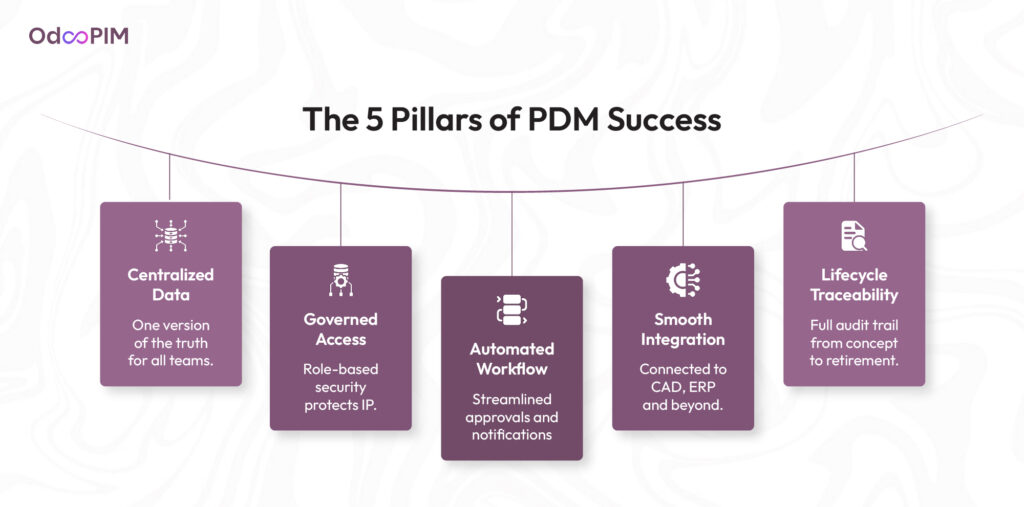
Product data management (PDM) is the system for centralizing, controlling, and distributing product information. This isn’t about organizing files; it’s about governing the product data management process from concept through to retirement. The implementation of product data management software transforms how teams operate. It automates workflows, enforces standards, and secures property. This discipline is foundational for product management, ensuring decisions, from engineering changes to marketing launches, are informed by accurate data. Understanding the meaning of PDM is to recognize it as the framework that synchronizes people, processes, and information.
Key Product Data Management Capabilities
Version control and collaboration across teams
Product data management solves two organizational problems, namely, chaotic version control and fractured team collaboration. Without a definitive system, product development devolves into a maze of conflicting file versions, duplicated efforts, and communication breakdowns. A product data management platform eliminates this chaos by establishing version authority. Product data management tracks the iteration of a design file, specification, or document, maintaining a digital thread. Team members don’t waste time searching for the release or risk modifying components.
PDM product data management capabilities break down departmental silos, providing engineering, procurement, manufacturing, and marketing access to the centralized data hub. Changes made by one team are visible to others within permissions, enabling rather than sequential workflows. A manufacturing engineer can see an engineering change order, while a marketer can pull the approved specifications for a launch. This transparency prevents errors that occur when teams operate in isolation.
Integration with CAD, ERP, and e-commerce systems
A PDM system functions as the central nervous system of product information, but its intelligence is realized when it connects with other enterprise platforms such as CAD, ERP, and e-commerce systems. This connectivity transforms a departmental tool into an enterprise-wide engine for efficiency and accuracy. A product data management system is embedded within the design environment, capturing new parts, assemblies, and drawings as they are created. This eliminates data entry errors and ensures the master bill of materials originates from the design source. This connection is a pillar of PDM product data management capabilities, guaranteeing that engineering’s source of truth is shared enterprise-wide.
The product data management platform feeds accurate part data, attributes, and BOMs into the ERP. This automates the creation of items, routings, and cost models, ensuring manufacturing, procurement, and finance operate with the information that drove the design. This prevents production delays, purchasing errors, and financial miscalculations caused by data re-entry or reliance on outdated spreadsheets.

Multi-channel product data distribution
Commerce demands a static repository for information; it requires a system for data distribution. PDM product data management capabilities transform a centralized data vault into a broadcasting engine, ensuring consistency, accuracy, and speed across the customer touchpoint. Launching a new product or updating specifications no longer triggers a manual update cycle across systems. With product data management, a change approved in the master record is propagated to connected channels.
The challenge in multi-channel distribution is maintaining a product truth while adapting its presentation for platforms, from B2B portals and online marketplaces to print catalogs, mobile apps, and in-store digital kiosks. It acts as the source, syndicating product information, including specifications, marketing copy, digital assets, and compliance data, to required endpoints according to pre-defined channel rules.
Analytics and reporting
A product data management system’s value extends beyond organization and control; it lies in transforming data into intelligence. The analytics and reporting capabilities of a PDM platform move teams from managing information to understanding it. This evolution turns the system from a library into an engine, uncovering insights that drive efficiency, quality, and innovation.
The foundation of this intelligence is the data repository that product data management provides. Design iteration, change order, approval cycle, and part relationship are captured and contextualized. PDM product data management capabilities unlock this potential by offering tools to analyze this digital thread. Teams can generate reports on engineering change order (ECO) cycle times, identify bottlenecks in review processes, and audit part reuse rates across product lines.
Product Data Management (PDM) serves as the backbone system for controlling product design data and managing changes throughout development.
— Gartner
PDM vs. PLM: What’s the Difference?
Defining the Distinction: Product Data Management vs. PLM
Product Data Management (PDM) and Product Lifecycle Management (PLM) are distinct, complementary disciplines. Understanding their relationship is important for selecting the correct technological foundation. PDM forms the essential, operational core. It is the system for managing the what, the product information, files, and specifications. Product data management cannot manage the lifecycle without mastering the data. PDM provides the accurate, controlled information that PLM systems leverage to optimize everything from compliance and sourcing to service manuals and sustainability reporting.
PDM governs the product data management process for design and engineering data. It provides version control, secure access, and change workflows for CAD files, drawings, and bills of materials. This creates the source of truth necessary for effective, data-driven product management. The benefits of product data management are tangible, such as, the elimination of errors, acceleration in design cycles, and enforcement of standards.
PDM vs. PLM vs. PIM Decoded
| Dimension | PDM (Ideal for Product & Parts) | PLM (Ideal for Process & Lifecycle) | PIM (Ideal for Marketing & Sales) |
| Focus | Product & parts | Process & lifecycle | Marketing & sales |
| Key Question | What is it? | How is it made? | How is it sold? |
| Primary Users | Engineering | Cross‑functional teams | Marketing & sales |
Scope Differences: Product-Centric vs Lifecycle-Centric
Product Data Management (PDM) is product-centric. Its purpose is to serve as the source for technical information about the product itself. This mission answers the question: What is PDM software? It is the vault and governance system for CAD models, engineering drawings, specifications, and the bill of materials (BOM). The product data management process ensures the integrity, revision control, and secure access for design and engineering teams. It creates the foundation for product management within the product development phase.
PLM is lifecycle-centric; its scope extends far beyond the product’s technical definition to encompass the business process and stakeholders involved from initial concept through to end-of-service and disposal. While PDM manages the “what” of the product, PLM manages the “how,” “when,” “where,” and “who” of its journey. PLM systems integrate and orchestrate data and workflows from sourcing, manufacturing, quality, compliance, service, and sustainability.
Case Study: The Strategic Impact of Product Data Management and PLM for a Manufacturing Company
Consider a manufacturing firm struggling with errors and delays in their engineering change orders. Their legacy system of shared drives and email approvals caused version confusion and rework. Implementing a targeted product data management solution transformed their workflow. This PDM system centralized CAD files and BOMs, automating a formal product data management process. The benefits of product data management were dramatic: a 40% reduction in ECO cycle time and the near-elimination of manufacturing errors from outdated drawings. This case answers what PDM means in practice, operational excellence through data control. The firm established the foundation for data-driven product management.
A global medical device company required coordination far beyond engineering. Their challenge was navigating regulatory compliance, global supply chains, and serialized tracking from production to patient. They implemented a full-scale PLM system, with a PDM module at its core to master technical data. This platform enabled data product lifecycle management, connecting design history files to manufacturing execution systems and post-market surveillance. The result was not just faster design but accelerated time-to-market, audit trails, and proven regulatory submission integrity.
The first company’s success with focused product data management software solved a critical, department-specific pain point, delivering rapid ROI. The second, leveraging PLM, solved enterprise-scale strategic challenges. The medical device firm’s PLM success was predicated on the reliable product management data provided by its PDM core. One demonstrates mastery of the product record; the other demonstrates mastery of the product’s life.
Benefits of Product Data Management
1. Data Consistency and Accuracy in Product Data Management
In product development, inconsistencies and inaccuracies are not inconveniences. They drain profitability and speed. Scattered files, conflicting versions, and unsynchronized information create rework, procurement errors, and manufacturing delays. This chaos underscores the answer to what PDM stands for, it is the solution for establishing and maintaining data integrity. Effective product data management eradicates these issues by enforcing a single version of the truth for components, assemblies, and documents.
Product data management prevents manufacturing and purchasing errors caused by incorrect part numbers or specifications. This foundational integrity is a prerequisite for broader initiatives, such as data product lifecycle management. You cannot manage a product’s lifecycle effectively if you cannot trust the accuracy of its core definition. Investing in product data management software is not an IT cost, but a business strategy.

2. Accelerating Market Entry: How Product Data Management Drives Launches
A PDM system automates the product data management process, from version control and change orders to secure distribution, compressing timelines. Procurement receives accurate bills of materials, not after weeks of manual cleanup. This orchestration of product management data is the engine for data-driven product management, where decisions are swift because the information is reliable.
Implementing product data management software is an investment in market agility. It transforms the development cycle from an error march into a synchronized sprint. By providing access to information and automating bureaucratic overhead, PDM doesn’t make processes faster; it redefines the pace at which a company can refine and deliver value to its customers.
3. Minimizing Risk: How Product Data Management Cuts Errors and Manual Work
This system automates and enforces the product data management process, it eliminates manual version tracking by providing a controlled source for technical information. When an engineer updates a CAD model, the system creates a new revision, archives the old one, and notifies stakeholders. This approach prevents the catastrophic errors that occur when manufacturing builds from a drawing or procurement orders the wrong component.
Teams are released from administrative drudgery, no more chasing approvals via email, manually compiling bills of materials, or reformatting data for different departments. This automation feeds a data-driven product management culture, as personnel can put their efforts from data janitorial work to value-added analysis and innovation. The operational benefits of product data management in this area translate to reduced errors, less physical scrap, fewer field failures, and compliance penalties. A manual workload lowers operational costs and boosts team morale and capacity.
4. The Strategic Edge: Product Data Management Enables Data Decisions
Product success depends on moving from instinct to insight. This transition requires more than data; it demands trustworthy, contextualized, and accessible information. The role of product data management is to transform scattered files into a reliable asset base for strategic choices. The benefits of product data management for decision-making are clarity, speed, and confidence. Teams spend less time debating which data is correct and more time analyzing what it reveals. By providing a record of the product’s evolution, PDM empowers leaders to make decisions that are not just faster but better.
They can perform product management data analysis to answer key questions: Which components are frequently revised, indicating a design flaw? What is the average cycle time for engineering change orders? Which product configurations are cost-effective to manufacture? These insights inform resource allocation, process improvement, and design strategy.
The Cost of Chaos vs. The Value of Control
| Aspect | Without PDM | With PDM |
| Icons / Themes |
|
|
| Impact / Stats | 30% of engineering time spent searching for data* | Reduce ECO cycles by up to 50% |
Types of Product Data Management Solutions
1. Product Information Management (PIM)
While product data management serves as the engineering backbone, Product Information Management (PIM) functions as its commercial counterpart. It manages product descriptions, localized marketing copy, digital assets (images, videos, manuals), SEO metadata, and channel pricing. The distinction lies in their domains: PDM governs the truth of what a product is from an engineering and manufacturing standpoint, while PIM manages the story of what a product means for sales and marketing.
Together, PDM and PIM form the data pipeline for data product lifecycle management. PDM manages the product from concept to factory floor, while PIM manages it from the digital shelf to the customer’s hands. Integrating these systems closes the loop between creation and commercialization, ensuring that customer interaction is informed by a source of product truth.
Learn more about PIM Platform.
2. The Visual Engine: Digital Asset Management and Product Data Management
While Product Data Management (PDM) governs the technical and structural definition of a product, Digital Asset Management (DAM) specializes in the curation, storage, and distribution of its visual and media components. A DAM system is the library for rich media, high-resolution images, 3D renderings, marketing videos, audio files, logos, and branded graphics. Its function is to ensure these vital assets are organized, version-controlled, and accessible across the organization, particularly for marketing, sales, and creative teams.
The relationship between PDM and DAM is one of specification and presentation. The definitive product data management process creates the authoritative bill of materials and technical specifications. This product management data defines what the product is. The DAM system then houses the visual proof and narrative that show what the product looks like and how it functions in the real world. For example, the PDM system holds the CAD model for a new smartphone housing; the DAM system stores the photorealistic renders, lifestyle photography, and feature demonstration videos derived from that model.
3. The Strategic Framework: Product Lifecycle Management
Product Lifecycle Management (PLM) is the framework that manages a product’s journey from concept and design, through manufacturing and service, to its final retirement. It is an approach that orchestrates people, processes, business systems, and data across the extended enterprise. PLM transforms product management from a departmental tactic into an enterprise-wide strategy. It provides the structure to leverage data for strategic advantage, optimizing sourcing, ensuring regulatory compliance, managing costs, and accelerating innovation.
A product data management process, executed through PDM software, forms the foundation. It answers the question of what PDM stands for in this context, the system of record for technical data. PLM then builds upon this product management data, extending its reach and context. PLM ensures that the correct data drives subsequent business activity. What PDM means for data integrity, PLM means for business process integrity. One provides the source of truth; the other ensures that truth drives critical decisions across the product’s lifespan.
Learn more about Top 10 PIM Platform.
How to Choose the Right Product Data Management Software
Selecting a product data management platform is a strategic decision. Use this table to evaluate key criteria and align the software’s capabilities with your operational and business goals.
| Evaluation Criteria | Key Considerations for Your PDM Choice |
| Scalability | Can the system handle increased users, more complex product structures, and larger data volumes without performance loss? A scalable product data management solution prevents costly future migrations. |
| Integration | Evaluate native integrations with your CAD, ERP, and CRM systems. Effective PDM product data management acts as a data hub, enabling a data product lifecycle management flow. |
| User Experience | The PDM software interface should be intuitive for the users, from engineers to managers. |
| Data Security | Check for role-based access control, audit trails, and encryption. A robust PDM offers controlled access and security features. |
| Vendor Support | Assess the vendor’s reputation for responsive technical support, training quality, ongoing system updates, and reliable support. |
| Cost-Effectiveness | Consider the total cost of ownership: implementation, training, maintenance, and potential customization. The correct product data management software delivers value that exceeds its cost. |
| Customization | Can the platform adapt? While heavy customization is costly, some flexibility to match your product data management process is essential for integration into existing workflows. |
| Data Governance | Evaluate how the solution manages revision control, change approval workflows, and data ownership. S |
| Analytics & KPIs | Built-in reporting and dashboards for product management data analysis are important. This transforms your system into a tool for product management. |
Leading Product Data Management Software Providers
The product data management software landscape offers solutions tailored to different business sizes and needs. The table highlights key providers, emphasizing what PDM software is for one organization may differ for another based on its main focus, be it engineering integration or commercial product information enrichment.
| Provider | Focus & Key Differentiators |
| OdooPIM | Natively built on Odoo ERP. AI-powered OdooPIM excels as a hub for product information and complements product data management systems to create a highly automated, secure data flow from onboarding product information to distribution on sales channels. |
| PTC Windchill | An industry-standard for engineering-centric product data management. It offers capabilities for product data management process control, CAD integration, and data product lifecycle management, serving manufacturers. |
| Siemens Teamcenter | A comprehensive PLM platform with a PDM core. It is designed for enterprises requiring global collaboration, stringent data governance, and integration from engineering to manufacturing execution. |
| Dassault Systèmes ENOVIA | Part of the 3DEXPERIENCE platform, it provides an environment for data-driven product management. It connects 3D design, simulation, and product management data in a system for product development. |
| Oracle Agile PLM | An enterprise solution that scales product data management to manage global product records, quality processes, and compliance. It is well-suited for regulated industries like life sciences and high-tech electronics. |
| Salsify | A leader in Product Experience Management (PXM), focusing on the commercial side. It powers omnichannel sales by enriching and syndicating product content, consuming the foundational data from a product data management system. |
| Akeneo | A PIM platform to streamlining the management and distribution of marketing and sales product information. It complements technical PDM by handling customer content and channel data. |
| Infor | Offers product data management capabilities within its industry ERP suites (e.g., Infor LN, CloudSuite Industrial). This provides embedded data management for manufacturing and supply chain operations. |
| Pimcore | An open-source platform unifying PIM, DAM, and e-commerce capabilities. It is a hub for managing and distributing digital product information, acting as a strong downstream partner to an engineering PDM system. |
Selecting a provider requires matching their strength, whether engineering PDM or commercial content orchestration with your business needs to realize the benefits of product data management.
Best Practices for Implementing Product Data Management
First, establish Data Governance Policies before launch. Define ownership, access controls, and standardized workflows for your product data management process. This framework answers what PDM means for daily operations, turning policy into practice and ensuring data integrity from day one. Teams should understand not just how to use the PDM software, but why the discipline matters. Effective training transforms the tool from an administrative burden into an enabler, helping users realize the benefits of product data management in their daily work.
The chosen product data management software should align with your technical needs and business scale. It should integrate with existing systems to support a data product lifecycle management approach, avoiding new data silos. Commit to Continuous Monitoring and Optimization. Use built-in analytics for ongoing product management data analysis. Track adoption metrics, process cycle times, and data quality. This practice embodies data-driven product management, allowing you to refine workflows, address bottlenecks, and evolve your PDM system to meet changing business demands, ensuring it remains a strategic asset.
The Role of Automation in PDM
1. Automated Data Validation and Enrichment: Elevating Product Data Management
A product data management system doesn’t just store information, it improves it. Automated validation and enrichment are capabilities that transform data into a high-quality asset. Advanced product data management software can append metadata, classify parts against internal standards, or pull in compliance information from connected systems. This process enhances the context and usability of the data, making it more powerful for downstream product management data analysis and data-driven product management.
Rules can be configured to check for missing attributes, enforce formatting standards, and ensure logical consistency within bills of materials upon entry. This prevents corrupt or incomplete product management data from entering the system, eliminating downstream errors in manufacturing and procurement. Together, these functions ensure the system is not a repository but a steward of quality. They create a cycle where the PDM core cleans and augments the product data management foundation. This reliable data is important for data product lifecycle management, providing downstream teams, from engineering to marketing, with information they can trust and act upon with confidence.
2. Reducing Manual Errors with Product Data Management
Manual processes are the source of costly errors in product development. Relying on spreadsheets, email, and shared drives for product management data inevitably leads to version confusion, incorrect data entry, and misplaced files. This chaos is what disciplined product data management eliminates. Eliminating manual errors reduces physical scrap, prevents compliance issues, and avoids field failures. It also liberates engineering talent from administrative drudgery, allowing them to focus on innovation rather than data reconciliation. This reliable data foundation for data-driven product management, as accurate analysis depends on inputs.
The function of PDM software is to replace manual tracking with automated versioning, enforces check-in/check-out protocols to prevent overwrites, and provides a source of truth. When everyone works from the authoritative data set, the risk of building from an outdated drawing or procuring the wrong component disappears. Investing in product data management software is an investment as it removes the human error inherent in manual workflows, transforming product development from an error-prone activity into a streamlined, predictable, and high-quality engine.
3. Accelerating Updates and Workflow Efficiency with Product Data Management
A product data management process replaces approvals and manual notifications with defined, automated routing. When an engineer initiates a change, the system notifies required reviewers, tracks their input, and archives the decision. This compression of the approval cycle is a benefit of product data management, accelerating the time from change conception to implementation.
What does PDM mean for efficiency? It means eliminating the friction that bogs down development. By providing access to the correct information and automating bureaucratic overhead, product data management software doesn’t just make individual tasks faster, it re-engineers the workflow. This efficiency is important for scaling operations and is a key enabler for broader data product lifecycle management initiatives that require rapid data flow across the enterprise.
Addressing Key Challenges in PDM
1. Handling Large SKU Volumes with Product Data Management
Managing thousands of Stock Keeping Units (SKUs) is a data challenge. Spreadsheets and shared drives collapse under the weight, leading to crippling errors and inefficiency. Scalable product data management is the solution for this complexity. A PDM system enforces a standardized product data management process for creating, classifying, and linking SKUs and its variants. It automates the generation of derivative items based on rules (e.g., size, color), ensuring consistency and eliminating data entry errors.
What does PDM mean for high-SKU operations? It means replacing chaos with a repeatable, reliable system. The right product data management software can handle growth without an increase in administrative overhead. This capability is essential for data product lifecycle management in consumer goods, retail, or manufacturing, ensuring product variation, from conception to retirement, is tracked, managed, and viable.
2. Managing Complex Product Hierarchies with Product Data Management
A product data management process establishes a logical framework, defining parent-child relationships, dependencies, and permissible configurations within the system. This allows teams to manage a product platform as a data set rather than thousands of disconnected files. The ability to visualize and control this structure is a benefit of product data management, preventing errors in BOM roll-ups and ensuring consistency across product families.
What does PDM mean for complex products? It means mastering relationships, not just parts. Specialized product data management software enables organizations to design and scale efficiently. This capability supports data product lifecycle management by ensuring that product iteration and derivatives, from the variant to the complex system, are built on an accurate, governable source of truth.
3. Integrating with ERP/CAD/E-commerce Systems via Product Data Management
A product data management system offers limited strategic value. Its power is unleashed as the hub in a connected enterprise ecosystem. Integration with CAD, ERP, and e-commerce platforms is what transforms controlled data into operational velocity and commercial advantage. Approved specifications, attributes, and digital assets are syndicated to sales channels, ensuring market content is accurate and on-brand. This flow embodies data product lifecycle management, where information moves from engineering to the end customer.
The integration with CAD software automates the product data management process by capturing parts, assemblies, and bills of materials as they are designed. This creates a source of truth that answers what PDM means for engineering accuracy, eliminating transfer errors. Connecting this truth to an ERP system bridges the gap between design and execution. Product management data flows to drive procurement, production planning, and cost accounting. This closed loop is essential for data-driven product management, ensuring business systems act on correct information.
Future Trends in Product Data Management
AI and ML for Data Enrichment: The Future of Product Data Management
The future of product data management lies in moving beyond manual data stewardship to intelligent, automated systems. Artificial Intelligence (AI) and Machine Learning (ML) are pivotal trends in PDM, transforming these platforms from repositories into data partners that enhance information quality and utility.
AI-driven product data management systems can automate complex enrichment tasks. For instance, ML algorithms can analyze CAD geometry, technical drawings, and existing part libraries to automatically classify new components, suggest standard parts for reuse, and tag items with relevant metadata. AI and ML elevate the role of product data management, and they enable a system that not only stores information but also understands it, making product data management a source of insight rather than control.
Cloud adoption and SaaS PDM solutions
Cloud-based product data management delivers operational advantages. It eliminates the capital expenditure and maintenance burden of physical servers, replacing them with subscription pricing. It provides universal, secure access to the source of truth from any location, enabling collaboration across global teams and external partners.
SaaS solutions accelerate implementation and innovation. Vendors manage updates, security patches, and infrastructure, ensuring users have access to the features without upgrade cycles. This model allows organizations to scale their product data management capacity up or down, aligning cost with need.
This evolution changes how companies deploy and benefit from product data management. It lowers the barrier to entry for mid-sized firms and allows enterprises to focus resources on using data rather than managing software infrastructure. The cloud is not just a hosting choice; it is the enabling platform for an agile, connected era of product data management.
Real-Time Analytics and Updates: The Future of Product Data Management
The lag between data creation and decision-making is a competitive disadvantage. The future of product data management demands eliminating this delay. Leading trends in PDM prioritize systems capable of delivering real-time analytics and updates, transforming data repositories into operational dashboards.
Cloud-native product data management platforms provide live visibility into the development process. Instead of waiting for weekly reports, managers can monitor approval bottlenecks, track change order status, and analyze team workloads as events happen. This insight allows for course correction, preventing small issues from escalating into major delays.
When a design change is approved, the revised data can sync to connected manufacturing, procurement, and quality systems. This closed-loop communication is a hallmark of product data management, ensuring departments operate from the current information, reducing the cycle time from change to implementation.
Enhance Your Product Data Management with OdooPIM
How OdooPIM solves PDM challenges
OdooPIM addresses a gap in the product data management ecosystem. While traditional PDM systems excel at controlling engineering data, they fall short in managing the commercial information needed for sales and marketing. OdooPIM functions as the bridge, extending the benefits of product data management into the commercial sphere.
It solves the challenge of fragmented data by serving as a hub. OdooPIM ingests the technical specifications and bills of materials from a PDM system, then enriches this product management data with marketing descriptions, digital assets, localized content, and channel attributes. OdooPIM complements product data management software to achieve a data product lifecycle management strategy. It ensures the technical truth defined in the product data management process is translated and amplified for customer engagement.
Key Features: Centralized Data, Automation, and Multi-Channel Syndication
First, a data hub eliminates scattered spreadsheets and conflicting file versions by creating a source of truth for technical and commercial product information. It answers the question of what PDM means in practice, control over the product record.
Second, automation streamlines the product data management process by automating workflows for change approvals, data validation, and notifications. This reduces manual workload, enforces compliance with governance rules, and accelerates cycle times.
Third, multi-channel syndication automates the distribution of enriched, accurate product information to necessary sales and marketing endpoints, e-commerce platforms, marketplaces, print catalogs, and digital signage. This feature closes the loop for data product lifecycle management, ensuring the product story told to the customer is synchronized with the product built from the engineering data.

See Strategic Product Data Management in Action
Understanding what product data management can achieve is one thing; experiencing how it transforms your operations is another. Benefits of product data management, like accelerated launches, error reduction, and data-driven product management, become tangible when you see a platform tailored to your workflows.
We’ve explored the product data management process, from centralizing product management data to enabling data product lifecycle management. The question is no longer what does PDM mean, but what it can mean for your efficiency, innovation, and competitive edge.
Frequently Asked Questions
1. What does PDM stand for?
PDM stands for Product Data Management. In a practical business context, what does PDM mean? It represents the methodology and technology for controlling information related to a product. This includes technical specifications, engineering drawings, CAD files, bills of materials (BOMs), and associated documentation. The PDM meaning is the establishment of a source of truth.
It is a product data management process that ensures data integrity, version control, and secure access throughout the product development lifecycle. By answering what PDM stands for with action, organizations enforce standards, automate workflows, and eliminate the errors that arise from using outdated or conflicting information. This control is the layer for efficient operations.
2. What is product data management software?
Product data management software is the application that centralizes files, automates workflows, and enforces the rules of the product data management process. When asking what PDM software is, you are identifying the tool that transforms theoretical data governance into actionable practice.
This software provides functionalities critical to engineering and manufacturing. It manages version control to prevent overwrites, facilitates formal change approval workflows, secures access through permissions, and maintains relationships between components in assemblies. The benefits of product data management, such as reduced errors and accelerated cycles, are delivered through these capabilities within the PDM software.
3. What is data-driven product management?
Data-driven product management focuses on the creation, maintenance, and delivery of a data asset for internal or external consumers. It applies product management principles, like user design and development to data assets. This practice involves identifying data within systems like PDM product data management platforms, then cleaning, structuring, and enriching it for use cases. A “data product” could be a live feed of approved component specifications for procurement, a validated product taxonomy for an e-commerce site, or a forecast model based on historical design changes. The goal is to make data findable, accessible, interoperable, and reusable (FAIR).
4. What is product management data analysis?
Product management data analysis is the practice of extracting insights from product information to guide decisions. It moves beyond having data, such as that stored in a product data management system, to interrogating it. This analysis uses the product management data secured through the product data management process to answer business questions.
It can involve analyzing engineering change order (ECO) cycle times to identify process bottlenecks, evaluating part reuse rates to inform standardization strategies, or assessing the cost impact of different design choices. It transforms data on revisions, workflows, and component usage into charts, trends, and KPIs that shows what is happening in the development lifecycle.
The value of product management data analysis is its role in enabling data driven product management. A PDM system provides the data; analysis provides the insight.
