


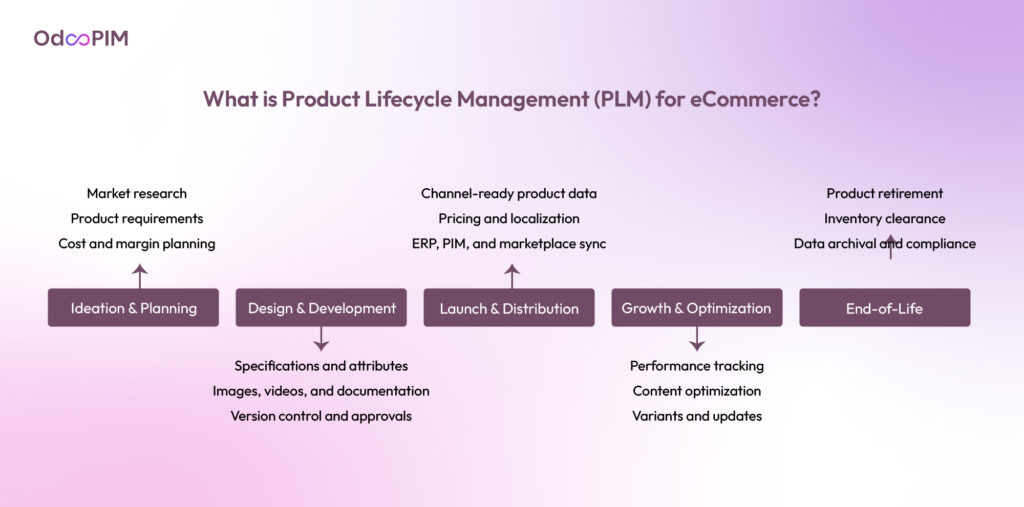
What is Product Lifecycle Management (PLM) for eCommerce?
Product Lifecycle Management (PLM) for eCommerce is the systematic, data product management discipline for overseeing a product from concept to sunset. This product lifecycle management strategy utilizes specialized product lifecycle management software to centralize product management data analysis. The core of product data lifecycle management, extending product data management (PDM), ensures accuracy. Adopting product lifecycle management best practices streamlines operations and fuels innovation. These product lifecycle management benefits translate to market speed and reduced costs, defining product lifecycle management (PLM) success.
Product Lifecycle Management Definition
Product lifecycle management is the backbone for overseeing a good’s existence. A product lifecycle management definition centers on unified data product management from inception to retirement. Product lifecycle management software enables this by mastering product data lifecycle management. This process integrates core product data management (PDM) with product management data analysis. Implementing product lifecycle management best practices delivers key product lifecycle management benefits, including accelerated launch cycles.
Why Product Lifecycle Management Matters in eCommerce
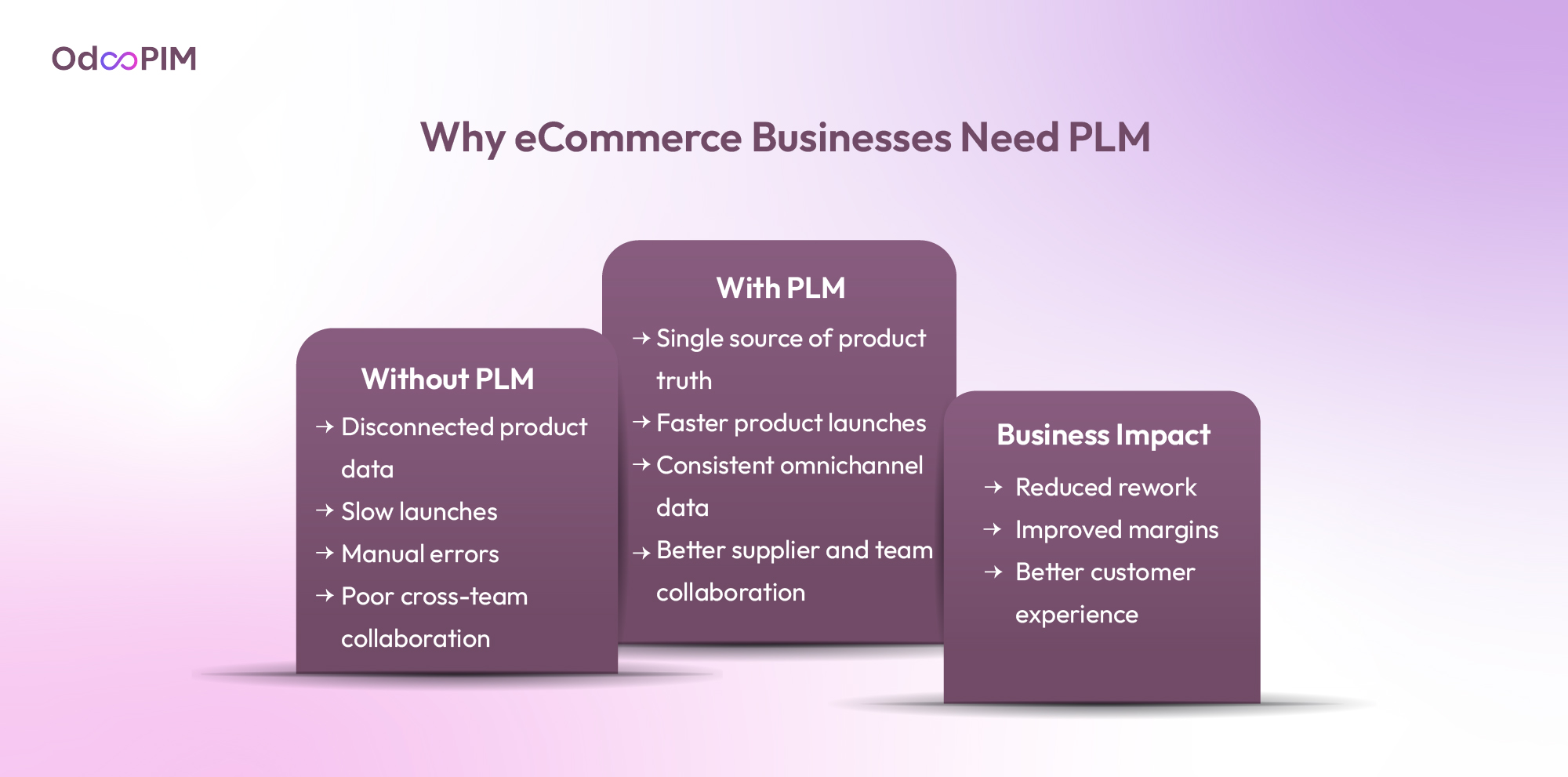
Multi-channel Product Launches
A product lifecycle management strategy is important for orchestrating perfect launches across sales channels. This requires a system for product data management (PDM), which serves as the technical core of product lifecycle management (PLM). By mastering product data lifecycle management, brands guarantee that descriptions, images, and specifications remain consistent from Amazon to their own online storefront, eliminating errors and customer confusion.
Frequent Updates and Seasonal Changes
The pace of eCommerce demands a data product management approach, where decisions are informed by performance analytics. Implementing product lifecycle management best practices through specialized product lifecycle management software allows teams to execute updates, manage limited editions, and pivot seasonal collections. This agility transforms the pressure to refresh assortments into a competitive edge.
Collaboration Between Product, Marketing, and Operations
Operational excellence requires coordination, which is the promise of the product lifecycle management definition. An integrated product lifecycle management (PLM) system acts as the hub, synchronizing product development, marketing campaigns, and inventory logistics on a data platform. This breakdown of departmental silos delivers key benefits in product lifecycle management, including faster decision-making and reduced cross-team miscommunication.
Data Inconsistency and Time-to-Market Pressure
Legacy, manual processes create bottlenecks and data corruption that sabotage speed and accuracy. Strategic product lifecycle management confronts this by eradicating information silos and automating workflows. The integration of product management data analysis within the PLM framework compresses development cycles and provides visibility. This control is the solution for brands to slash time-to-market while ensuring customer touchpoint is powered by reliable product information.

The Product Lifecycle Stages in eCommerce
1. Concept & Ideation
In this phase, product lifecycle management transforms ideas into viable product concepts. This involves market evaluation and initial feasibility studies, with direction set by product lifecycle management best practices. The framework for product data lifecycle management is established, ensuring decision aligns with a data-driven product management philosophy from the beginning.
2. Design & Development
This stage is where concepts gain form through technical specifications, prototyping, and sourcing. A product lifecycle management (PLM) platform is indispensable, providing the environment for product data management (PDM). Centralizing CAD files, material lists, and supplier data, this approach to the product data lifecycle management process prevents version chaos and ensures design integrity, embodying the practical product lifecycle management definition in action.
3. Data Enrichment & Validation
This phase is the heart of product data lifecycle management, focused on transforming technical data into compelling commercial content. Teams enrich product records with imagery, detailed descriptions, localized copy, and SEO metadata. Specialized product lifecycle management software automates validation rules and format compliance, guaranteeing that information meets the requirements of the retail platform before launch, a non-negotiable product lifecycle management best practice.

Product Launch & Distribution
Product lifecycle management orchestrates the release of product information across chosen sales channels and geographic markets. The PLM system acts as the command center, pushing accurate data to eCommerce websites, marketplaces, and ERP systems. This execution of the product data lifecycle management sequence delivers a key product lifecycle management benefit: accelerated, error-free market entry.
Performance Analysis & Optimization
Product lifecycle management shifts to an improvement engine driven by product management data analysis. The PLM system consolidates sales data, customer feedback, and inventory metrics to generate insights. This data product management approach informs decisions on pricing adjustments, promotional strategies, and inventory replenishment, closing the loop on the product data lifecycle management process to maximize profitability and product longevity.
Product lifecycle management solutions are required to manage product data and related processes through their entire life cycle.
What Is Product Lifecycle Management Software?
Product lifecycle management software is the digital engine that operationalizes the product lifecycle management definition. This technology centralizes the product data lifecycle management process, from product data management (PDM) to enrichment. It enforces product lifecycle management best practices by automating workflows and gateways. The platform enables product management data analysis, forming the foundation for data product management. Investing in product lifecycle management (PLM) software unlocks a spectrum of benefits, making PLM scalable and efficient.
PLM vs PDM vs PIM – Key Differences Explained
| System | Purpose & Scope | Key Focus & Data |
| Product Lifecycle Management (PLM) | Lifecycle governance and strategic execution across the product process, from ideation to end-of-life. This embodies the product lifecycle management definition, coordinating people, processes, and data. Specialized product lifecycle management software applies product lifecycle management best practices to enable data product management and deliver product lifecycle management benefits. | End-to-end process & cross-functional collaboration. It manages the complete product data lifecycle management, integrating technical specs, schedules, supply chain data, and product management data analysis for holistic decision-making. |
| Product Data Management (PDM) | Engineering data control and version mastery for design and development teams. It serves as a technical subsystem within a broader product lifecycle management (PLM) strategy, handling the “engineering bill of materials.” | CAD files, technical drawings, and engineering BOMs. The focus of product data management PDM is securing the integrity and revision history of design data, forming the foundation for manufacturing. |
| Product Information Management (PIM) | Commercial product data enrichment and multi-channel distribution for sales and marketing. A PIM system is fed by upstream PLM and product data management PDM systems to transform data into customer content. | Marketing descriptions, digital assets, sales attributes, and channel content. It ensures brand accuracy across eCommerce platforms, catalogs, and retail channels. |
Product Management Data Analysis in PLM
1. Performance Metrics Across Lifecycle Stages
Comprehensive product management data analysis tracks a product’s health at a phase, from launch velocity to maturity profitability. This rigor operationalizes the product lifecycle management definition, transforming operational data into an asset. Leveraging this intelligence is a product lifecycle management best practice.
2. Sales, Returns, Enrichment Completeness
Data-driven product management hinges on correlating commercial outcomes with data quality. Advanced product management data analysis within a PLM platform links sales performance and return rates to the completeness and accuracy of product information. This goes beyond basic product data management (PDM), analyzing how enriched content influences customer decisions.
3. Feedback Loops for Continuous Improvement
The product lifecycle management benefit is a self-optimizing system. Integrated product management data analysis creates feedback loops, where post-launch performance data informs future concept and design phases. This closes the circle on the product data lifecycle management process, ensuring that lessons from the market are fed back into development.

Product Lifecycle Management Benefits
Faster Time-to-Market
A product lifecycle management benefit is the compression of development cycles. By automating workflows and centralizing information, product lifecycle management software eliminates bottlenecks and manual handoffs. This execution of product lifecycle management best practices ensures products move from concept to launch with unprecedented speed.
Improved Data Accuracy
- Establishes a source of truth for product information.
- Integrates product data management (PDM) with commercial data.
- Enforces validation rules throughout the product data lifecycle management process.
This controlled environment, central to the product lifecycle management definition, eradicates errors in specifications, pricing, and listings.
Enhanced Cross-Team Collaboration
Product lifecycle management (PLM) breaks down departmental silos by providing a unified digital workspace. This alignment between design, marketing, sourcing, and sales is a product lifecycle management benefit, ensuring teams operate from synchronized data and shared timelines, reducing miscommunication and rework.
Reduced Operational Costs
The efficiency driven by a product lifecycle management strategy lowers expenses.
Key gains include:
- Minimized product recalls and returns due to data errors.
- Lower compliance risks.
- Optimized resource allocation through data-driven product management.
These savings validate the investment in a comprehensive PLM platform.
Stronger Omnichannel Consistency
An outcome of product lifecycle management is brand presentation everywhere. The system ensures that the sales channel receives identical, validated product information. This capability is a product lifecycle management benefit for maintaining customer trust and meeting retailer requirements across the digital shelf.
Product Lifecycle Management Best Practices
1. Centralize Product Data Early
Implement a source of truth from the initial concept phase. This product lifecycle management best practice prevents data fragmentation and ensures teamwork from the authoritative information, supporting the product lifecycle management definition. Centralizing product data management (PDM) and commercial assets within your product lifecycle management software platform sets the stage for product data lifecycle management.
2. Define Ownership at Each Lifecycle Stage
Clarify responsibilities for phase, from ideation to retirement. Assigning explicit ownership is a non-negotiable product lifecycle management best practice that eliminates ambiguity and accelerates decision-making. This governance model operationalizes the strategic product lifecycle management (PLM) framework, ensuring accountability and smooth progression through defined gateway.
3. Automate Approvals and Validations
Automation enforces product lifecycle management best practices by guaranteeing that no product advances without meeting predefined criteria for data completeness, cost, or compliance. This rigor within your product lifecycle management process is essential for maintaining quality and achieving key product lifecycle management benefits like reduced errors.
4. Align PLM with PIM for eCommerce Readiness
Bridge the gap between engineering and commerce by integrating your product lifecycle management (PLM) system with a Product Information Management (PIM) solution. This alignment ensures technical data from product data management pdm is transformed into enriched content. It is a product lifecycle management best practice that enables data-driven product management for the digital shelf.
5. Track Lifecycle KPIs
Measure what matters through ongoing product management data analysis. Monitoring performance metrics like time-to-market, cost variance, and launch success is the capstone product lifecycle management best practice. This analytical discipline closes the feedback loop, allowing for the refinement of your product lifecycle management strategy and maximizing long-term ROI.
PLM for eCommerce Brands – Real-World Use Cases
Fashion & Seasonal Catalogs
For fashion brands, the value of product lifecycle management is mastering the tempo of collections. Specialized product lifecycle management software manages the product data lifecycle management process for hundreds of fleeting SKUs, from initial trend concept to final markdown. This system enforces product lifecycle management best practices, synchronizing design, material sourcing, and supplier collaboration on a timeline. The product lifecycle management benefit here is the ability to execute error-free seasonal launches turning creative vision into commercial velocity.
Electronics & Compliance-Heavy Products
In electronics, product lifecycle management (PLM) is the framework for managing complexity and regulatory risk. It provides the environment to handle product data management (PDM) for components, certifications, and region compliance documents. This approach embodies a product lifecycle management definition, where governance is paramount. The platform enables data-driven product management by linking product management data analysis on failure rates or component costs back to design and sourcing decisions. A product lifecycle management strategy is the only way to ensure product safety, manage sustainability directives, and accelerate updates in a technical market.
Choosing the Right Product Lifecycle Management PLM Solution
1. eCommerce Readiness
A product lifecycle management PLM solution should be built for the digital shelf. It should handle the complete product data lifecycle management process, from technical specs to channel-ready marketing content, ensuring data handoff to your eCommerce platforms. This capability is non-negotiable for achieving the product lifecycle management benefits of speed and omnichannel consistency.
2. Workflow Flexibility
The system adapts to your processes, not forcing you into a template. Seek what is product lifecycle management software that allows you to configure automated gates, approvals, and task assignments that mirror your operations. This configurability is central to implementing your product lifecycle management best practices and supporting data-driven product management across teams.
3. Integration Ecosystem
Your product lifecycle management PLM platform cannot be an island. It requires pre-built connectors to systems like ERP, PIM, and major marketplaces. This ecosystem ensures an exchange of data, uniting product data management pdm with commercial and logistical systems to realize the strategic product lifecycle management definition.
4. Scalability
The solution grows with your portfolio and ambition. It handles a volume of products, attributes, and user concurrency without performance degradation. A scalable product lifecycle management foundation is for supporting international expansion and more product lines without operational collapse.
5. Reporting & Analytics
Advanced reporting transforms the platform from a system of record into a system of intelligence. Built-in tools for product management data analysis should provide insights into timelines, cost tracking, and launch performance. This power is what unlocks the potential of your product lifecycle management investment.
How OdooPIM Supports Product Lifecycle Management
1. Centralized Product Data Hub
OdooPIM provides the foundational source of truth required for product lifecycle management. It consolidates technical data from upstream product data management pdm systems with marketing and sales information, mastering the product data lifecycle management process. This centralization embodies the product lifecycle management definition, ensuring teams operate from synchronized, accurate information.
2. Attribute and Variant Modeling
The platform excels at modeling product structures with attributes and unlimited variants. This capability supports key product lifecycle management best practices in industries such as fashion, medical devices, art works, sanitaryware, and electronics, where managing SKU families is essential. By structuring data from the start, it prevents complexity from derailing your product lifecycle management strategy.
3. Workflow Automation
OdooPIM automates the approval gates and validation rules that define professional product lifecycle management (PLM). It enforces progression through data enrichment, translation for localization, and publishing stages. This AI-based automation is the engine for data-driven product management.
4. Version Control and Audit Trails
Maintaining a complete history of product change is a product lifecycle management best practice. OdooPIM’s version control and audit trails provide transparency over who changed what and when. This functionality is indispensable for product management data analysis, compliance reporting, and ensuring data integrity throughout the product lifecycle, solidifying its role within a comprehensive product lifecycle management ecosystem.

Is Product Lifecycle Management Right for Your Business?
Investing in product lifecycle management is a strategic decision that moves beyond basic product data management pdm. The comprehensive product lifecycle management definition, namely, orchestrating people, processes, and data from concept to end-of-life, provides the framework for sustainable scale.
If your operations are hampered by data errors, launch delays, or departmental misalignment, adopting product lifecycle management best practices is the correction. The right product lifecycle management software automates the product data lifecycle management process, turning chaos into a controlled, repeatable system.
The tangible product lifecycle management benefits include accelerated market entry, slashed operational costs, and omnichannel execution. Integrated product management data analysis enables data-driven product management, creating a competitive moat.
Frequently Asked Questions
1. How does product lifecycle management improve collaboration between marketing, product, and operations teams?
Product lifecycle management breaks down departmental silos by establishing a single source of truth for product data. This system, central to the product lifecycle management definition, synchronizes timelines and information across teams. Marketing accesses approved assets, product teams manage specifications, and operations track inventory, within the product lifecycle management software platform. This enforced alignment is a product lifecycle management best practice, eliminating miscommunication and enabling workstreams. The resulting efficiency is a product lifecycle management benefit, accelerating launches and ensuring cohesive execution from concept to customer.
2. Can product lifecycle management support omnichannel and marketplace selling?
Systematic product lifecycle management is the backbone of a successful omnichannel strategy. It governs the complete product data lifecycle management process, transforming technical data into enriched channel content. A product lifecycle management (PLM) system ensures product information is validated and consistent before distribution. This control allows for the error-free publishing of listings across multiple marketplaces and sales channels. Mastering this process is a key product lifecycle management benefit, building brand trust and meeting stringent retailer requirements on the digital shelf.
3. What are the 4 phases of PLM?
The universal phases of product lifecycle management are Concept & Design, Development & Sourcing, Launch & Production, and Maturity & Sunset. This framework operationalizes the product lifecycle management definition, providing a pathway from ideation to end-of-life. The phase within product lifecycle management (PLM) has goals, required data, and defined stakeholders. Implementing product lifecycle management best practices within this model ensures disciplined progression and governance. This phased approach is what enables comprehensive data-driven product management and maximizes product success.
4. What challenges do eCommerce businesses face without a structured product lifecycle management process?
Without product lifecycle management, businesses grapple with crippling data silos, launch delays, and rampant listing errors. The absence of a product data lifecycle management process leads to conflicting information between teams. This chaos prevents data-driven product management and negates potential product lifecycle management benefits. Operations become reactive, struggling with rework, compliance risks, and an inability to scale. In short, they lack the control and visibility that defined product lifecycle management (PLM) provides, sacrificing market speed and profitability.
5. How does integrating PLM with PIM impact product launch speed and accuracy?
Integrating product lifecycle management (PLM) with a PIM creates a data pipeline from engineering to eCommerce. The PLM system handles the product data management pdm and development workflow, then feeds validated technical data into the PIM for commercial enrichment. This handoff is a paramount product lifecycle management best practice, eliminating manual transcription errors. It compresses the timeline between finalizing a product and publishing it across channels. The result is the achievement of key product lifecycle management benefits: accelerated time-to-market and data accuracy on the digital shelf.
