


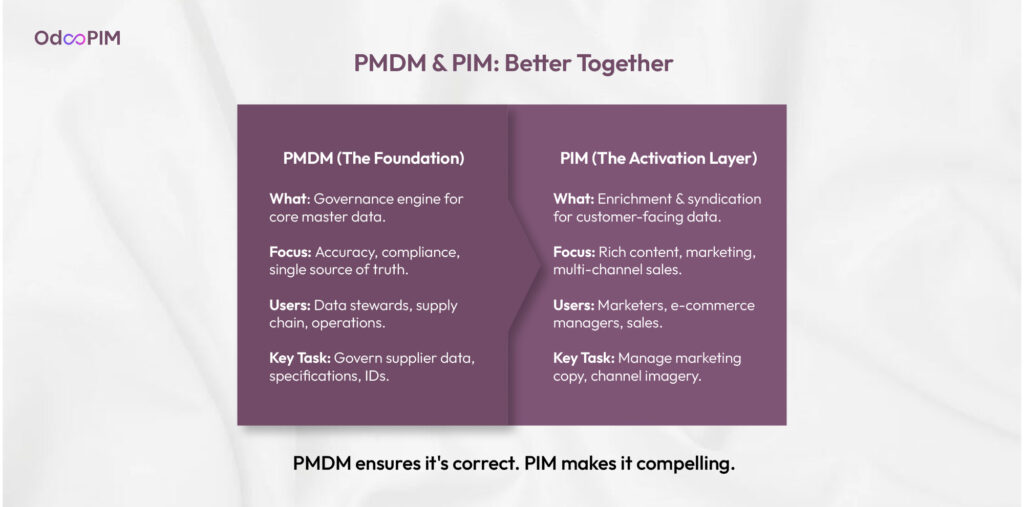
Product Master Data Management (PMDM) is the process of creating an authoritative source of truth for product information. It is the framework that governs how product data is defined, aggregated, harmonized, and distributed across an organization. A PMDM system moves beyond spreadsheets or disparate databases, enforcing governance and quality controls to ensure consistency and reliability.
Implementing Product Master Data Management best practices enables accurate analytics, omnichannel launches, and superior customer experiences. While a PIM (Product Information Management) system is an application for managing PIM master data, especially for sales and marketing, a Product Master Data Management strategy encompasses a broader enterprise scope. Solutions are delivered via a Product Master Data Management cloud platform, offering scalability and agility.
Key Components of Product Master Data Management
Attributes and Classification in Product Master Data Management
Product Master Data Management transforms facts into a sellable narrative; this transformation hinges on two concepts: detailed product attributes and a logical classification hierarchy. Attributes are the descriptors, dimensions, materials, colors, and warranties. Classification is the organizing schema that groups products by type, category, or market segment.
PMDM standardizes attribute definitions and values enterprise-wide, ensuring that a marketing team and a logistics partner reference the same “weight” or “compatibility.” This product data is the fuel for PIM master data management, enriching customer channels with trusted information. Product Master Data Management best practices mandate that classification schemes are designed for business use, like filtering search results or targeting promotions, not as arbitrary technical lists.
The Role of Supplier Data in Product Master Data Management
Product master data management is impossible without control of supplier and vendor information. Suppliers are the source of product data, and their details affect supply chain integrity, compliance, and costs. A Product Master Data Management framework extends its governance beyond the product itself to include authoritative records for manufacturers, distributors, and sources.
Product master data management treats supplier information as an asset, aligning with principles of data product management. Governed vendor data ensures that enriched PIM master data reflects reliable availability and sourcing details for customer channels. Implementing this via a product master data management cloud solution ensures synchronization across global operations. Governing supplier data is not a separate task; it is the foundation that makes product master data management a system of record for commerce.

Governing Inventory and Pricing in Product Master Data Management
Product Master Data Management is incomplete if it does not integrate foundational inventory and pricing information. While stock levels and variable prices are managed in transactional systems, a Product Master Data Management strategy should define and govern the harmonized data attributes that these systems rely on. This includes definitions for warehouse locations, units of measure, pricing hierarchies, and base cost structures. Without this discipline in product master management, systems such as ERP and e-commerce platforms interpret and act on inconsistent data.
A product master data management cloud platform enables this by providing a central hub where business rules for pricing tiers or inventory classifications are established. This reliable data then flows to enrich PIM master data, ensuring customer portals display accurate availability and correct promotional pricing. Unlike a technical PDM system focused on design files, comprehensive product master data management orchestrates the commercial truth that drives revenue and fulfills customer promises.
Orchestrating Digital Assets in Product Master Data Management
Product Master Data Management expands its authority beyond alphanumeric fields to govern the digital assets that define product storytelling. Images, datasheets, and videos are not peripheral attachments; they are fundamental components of your product information. Product master management ensures these assets are linked, version-controlled, and governed with the same rigor as descriptive text or SKU numbers.
A product master data management system provides the source for which asset belongs to which product variant, in which region, and for which sales channel. It establishes governance for file formats, naming conventions, and approval workflows. These rules form a component of product master data management best practices, ensuring marketing, e-commerce, and sales teams utilize only the brand-compliant assets. This control fuels downstream PIM master data management, where these visuals and technical files are syndicated to digital storefronts.
Benefits of Product Master Data Management
Uncompromising Accuracy: The Benefit of Product Master Data Management
Product Master Data Management enforces governance, resulting in improved data accuracy and consistency across systems and departments. By centralizing control, product master management eradicates the errors, duplicates, and contradictions that plague decentralized spreadsheets and legacy databases.
Implementing product master data management best practices means defining and enforcing standardized formats, valid values, and mandatory attributes for product information. This governance ensures that the team, from procurement to marketing, works from an identical, reliable dataset. The outcome is trustworthy product data that flows from your product master data management cloud platform into ERP, e-commerce, and analytics systems. This reliability is the foundation for any downstream PIM master data management initiative, as enriched customer content should originate from accurate records.
Accelerating Multi-Channel Commerce with Product Master Data Management
A product master management strategy is the operational engine for multi-channel success. It orchestrates the flow of enriched PIM master data to digital storefronts, enabling product launches and consistent promotional campaigns across platforms. Key product master data management best practices, such as defining channel attribute rules within a product master data management cloud platform, allow for tailored presentations while maintaining a source of truth. This agility is impossible with fragmented product data or a siloed PDM system designed for engineering files.
By treating product information as a high-quality, reusable asset, a tenet of data product management, Product Master Data Management transforms specifications into a competitive commerce driver. It moves beyond product data management by establishing the enterprise-wide governance needed for complex, omnichannel execution. Investing in a comprehensive Product Master Data Management framework is the step to ensuring your commerce experience is scalable, reliable, and effective everywhere your customers are.
Streamlined Operations and Faster Product Launches through Product Master Data Management
A structured product master data management framework standardizes the product onboarding process. It provides templates, automated workflows, and governed approval chains within a product master data management cloud environment. This approach, aligned with product master data management best practices, ensures that new items are introduced with complete and consistent information from day one. Accurate product data is available to feed downstream systems like ERP and to power PIM master data management for customer channels.
This operational excellence distinguishes product master data management from a technical PDM and product data management. It embodies the principles of data product management by creating a reliable, reusable information asset that fuels business velocity.

Enabling Confident Compliance and Reporting with Product Master Data Management
Product Master Data Management is the infrastructure for navigating regulatory landscapes and delivering business intelligence. It transforms scattered, contradictory information into an auditable system of record. This discipline ensures that product’s compliance status, safety certifications, and material disclosures are defined, maintained, and accessible, turning product master management into a risk mitigation tool.
This strategic approach elevates Product Master Data Management beyond the scope of a basic PDM. It aligns with the principles of data product management by ensuring the product information asset is not only high-quality but also financially sound. This governed master data ensures that downstream PIM master data disseminated to customers is always accurate and compliant. A mature product master data management framework provides the evidence and accuracy required for confident operational reporting and unwavering regulatory adherence.
Learn about Best PIM Software.
According to recent research referenced in Gartner analysis, poor product data costs businesses up to $15 billion annually due to errors, mismatches, and missing information—highlighting how critical structured product master data management is for enterprise success.
– Gartner study cited in industry analysis on product data management impact
Best Practices for Product Master Data Management
The Foundational Imperative: Governance in Product Master Data Management
Product Master Data Management fails without a bedrock of enforceable data governance policies. Governance is not a secondary feature; it is the operational blueprint that defines how product data is created, owned, validated, and maintained. Establishing these policies transforms an aspirational system into a practical, authoritative source of truth.
Product master data management best practices mandate that governance starts with assigning data stewardship. It designates who defines a product’s technical attributes, who approves its marketing copy, and who validates supplier information. These policies establish standardized formats, mandatory fields, and controlled vocabularies for product master data, ensuring consistency whether an item is viewed in engineering or e-commerce. A product master data management cloud platform then codifies and automates these rules.
Unifying Your Strategy: Centralize with a PIM like OdooPIM
To leverage Product Master Data Management, you should consolidate and activate your information. A Product Information Management (PIM) system, such as OdooPIM, serves as the central hub for this work. It is the engine where enriched, market-ready product data is finalized, managed, and distributed. This centralization is a product master data management best practice, enabling efficient PIM master data management for sales and marketing channels.
While product master management governs the creation and quality of records, a PIM like OdooPIM is where that data becomes commercial power. It transforms specifications and supplier details into narratives, digital assets, and channel content. Utilizing a product master data management cloud platform for governance, and a PIM for enrichment and syndication, creates a two-tier architecture. This separation of concerns is key: the product master data management system ensures accuracy, and the PIM ensures relevance and impact.
Maintaining Integrity: The Imperative of Regular Audits in Product Master Data Management
Product Master Data Management preserves its value, you should implement a program for auditing and cleansing your product master data. This proactive maintenance is non-negotiable, as even the initial setup will degrade over time due to human error, system changes, and shifting business rules. Without scheduled audits, the “source of truth” becomes a repository of outdated and conflicting information.
How OdooPIM Simplifies Product Master Data Management
The Foundational Hub: A Centralized Product Master Data Repository
The product master data repository is the authoritative system of record where product information is aggregated and maintained. This hub eliminates the fragmentation of data across disparate spreadsheets, legacy databases, and departmental systems, creating one version of the truth for the organization. Establishing this repository is the first practical step in implementing product master data management best practices. It provides the foundation for governance, quality controls, and distribution workflows.
It represents the execution of product master management, transforming intent into an accessible asset. By consolidating information, the repository enables data product management, allowing the business to treat its master data as a reusable, high-value commodity. A centralized repository is not a storage location; it is the engine that drives consistency, efficiency, and reliability across your product information ecosystem.
Powering Omnichannel Commerce with Product Master Data Management
Product Master Data Management is the engine for multi-channel data syndication. It provides source data that can be transformed and distributed to any sales or marketing endpoint. A product master management system ensures your website, marketplaces, retail partners, and digital catalogs receive consistent information. It automates the delivery of enriched PIM master data from a central platform to diverse channel requirements.
This distribution strategy is where Product Master Data Management delivers business value. It moves beyond the scope of a PDM system, which handles design files, and elevates product data management into a dynamic commercial function. By treating syndicated information as a high-quality asset, it aligns with the principles of data product management. Mastering multi-channel syndication through product master data management is how you ensure your brand story is told correctly and compellingly, everywhere your customers are.
Maximizing Efficiency: Automation in Product Master Data Management
Product Master Data Management achieves its potential only when manual processes are replaced with intelligent automation. Automating updates, validation, and enrichment transforms a repository into a self-correcting system. This shift is a product of master data management best practice for achieving scale, accuracy, and operational agility.
Challenges in Product Master Data Management
The Challenge: Managing Supplier Data in Product Master Data Management
A Product Master Data Management strategy is important for handling information from multiple suppliers. Suppliers are the source of your vital product data, yet they provide information in inconsistent formats. Without a structured product master management system, this incoming data creates chaos: duplicate items, conflicting specifications, and unreliable attributes that corrupt your supply chain and sales channels.
This governance of supplier data separates advanced Product Master Data Management from a basic PDM or rudimentary product data management effort. It applies the principles of data product management to external data streams, treating supplier information as a component of your overall data asset. By controlling this inflow, your product master data management framework ensures product integrity, reduces procurement errors, and builds a foundation for downstream commerce.
Scaling Your Catalog: Product Master Data Management for High-Volume SKUs
Managing a portfolio of thousands or millions of SKUs is an operational impossibility without Product Master Data Management. Spreadsheets and databases collapse under this scale, leading to inconsistencies, update paralysis, and rampant errors. Product master management provides the framework and automated processes necessary to govern complexity without sacrificing accuracy or speed.
A product master data management system handles volume through automation and governance, it employs classification to manage families and variants, not as disconnected entries. Product master data management best practices for scale include implementing automated validation at point of entry and update capabilities within a product master data management cloud platform. This ensures changes to attributes, pricing, or supplier data are applied uniformly and correctly across the catalog. This discipline is what separates enterprise Product Master Data Management from a departmental PDM system or limited product data management.
Eliminating Costly Manual Processes with Product Master Data Management
Product Master Data Management eliminates this inefficiency by automating the aggregation, validation, and distribution of product information. It replaces spreadsheets and repetitive keying with workflows, transforming product master management from an administrative burden into a controlled, automated process.
Future Trends in Product Master Data Management
The Next Frontier: AI-Powered Enrichment in Product Master Data Management
Product Master Data Management leverages artificial intelligence and machine learning to enhance governance and automate processes. AI transforms the enrichment process, moving from manual research to predictive data generation. It analyzes existing product data, external catalogs, and digital content to suggest or populate missing attributes, categorize products, and generate descriptive copy, turning product master management into a proactive engine.
Unleashing Global Operations: The Power of Cloud-Based Product Master Data Management
Product Master Data Management is the architecture for enterprise-scale, providing elastic scalability and universal access that systems cannot match. It delivers a source of truth that distributed teams across the globe can access, collaborate on, and trust. This infrastructure turns product master management into a collaborative discipline rather than a restricted, centralized function.
Adopting a product master data management cloud platform is a product master data management best practice for commerce. It ensures that stakeholders in procurement, logistics, marketing, and sales in any region operate from the authoritative product data in real-time. The cloud’s inherent scalability allows the system to absorb new product lines, acquisitions, or surges in data volume without performance degradation or costly hardware projects. This foundation is essential for powering reliable, wide-scale PIM master data management across diverse international channels. This model advances beyond the limitations of a legacy PDM or product data management solution.
Learn about Product lifecycle Management.
Build Your Foundation: Implement a PMDM System Like OdooPIM
To execute a winning strategy, you need a system engineered for this purpose. OdooPIM provides the comprehensive platform to operationalize product master data management best practices and realize the value of your product information. A solution like OdooPIM delivers the environment required for product master management. It combines the governance of a product master data management cloud hub with the capabilities of a PIM master data management engine. This approach solves the challenge: ensuring your product data is governed and activated for commerce.
Stop letting tools and manual processes constrain your growth. Choose a platform that transcends a limited PDM and embodies the principles of data product management. Implementing OdooPIM is the decision to turn your product catalog from an operational burden into your competitive asset. Build on a foundation designed for accuracy, speed, and scale.
Transform Insight into Action: See OdooPIM in Practice
OdooPIM operationalizes product master data management best practices in an environment. It provides the product master data management cloud foundation to create your golden record and the advanced PIM master data management capabilities to activate it across the channel. This integration is what defines product master management, bridging the gap between data governance and commercial execution.
See how a built system transcends product data management and fulfills the promise of data product management. Witness how automation enriches product data, how governance is enforced, and how multi-channel syndication operates with precision. This is the step to replace outdated PDM limitations with enterprise control.

Frequently Asked Questions
1. How does cloud-based product master data management work?
Product Master Data Management operates as a centralized service hosted on remote servers. It functions by aggregating product data from internal and external sources, like ERPs, supplier portals, and legacy systems, into a secure online repository. This product master data management cloud platform is the system of record where governance occurs: data is cleansed, standardized, validated, and enriched according to business rules. Authorized users from any location access this golden record through a web browser, enabling collaboration and updates. The cloud architecture ensures elastic scalability to handle data volume growth and provides integration via APIs to feed accurate PIM master data to downstream channels. This model is superior to on-premise solutions, as it deploys faster, reduces IT overhead, and embodies product master data management best practices for agility and global access. It transforms product master management from a static IT project into a business utility.
2. What is the difference between product data and product master data?
Product master data is product data, but not product data qualifies as master data. This distinction is foundational for product master management. Product data is a broad, generic term encompassing any information related to a product, from informal notes and transient social media comments to transactional records like individual sales invoices or inventory snapshots. Product Master Data Management governs the shared, non-transactional identifiers and descriptors that define a product’s essential business identity. This master data includes persistent attributes like SKU, global trade item number, specifications, approved supplier details, and regulated compliance certifications. It is the authoritative “golden record” that should remain consistent across the enterprise. While product data management might handle information, product master data management best practices focus on stewarding this core to ensure it is accurate and reliable for operational and analytical purposes, forming the trusted source for PIM master data management.
3. Can product master data management help with multi-channel e-commerce?
Product Master Data Management is the backbone for successful e-commerce. It solves the challenge of maintaining consistency across websites, marketplaces, mobile apps, and physical retail systems. A product master data management strategy creates one version of the truth, a golden record of attributes. From this source, enriched and channel information is syndicated to the touchpoint. This process is a product master data management best practice. It ensures a product’s dimensions, materials, and features are identical everywhere, while allowing for channel adaptations in marketing copy or imagery managed through PIM master data management. Without this discipline, product data becomes fragmented, leading to conflicting prices, inaccurate availability, and brand-damaging customer experiences. Implementing a product master data management cloud platform provides the scalability and automation needed to manage this distribution efficiently. Product master management is not just helpful; it is the infrastructure that enables scalable, trustworthy, and agile omnichannel commerce.
4. How does automation support product master data management?
Automation is the force multiplier that transforms Product Master Data Management from a framework into a scalable operation. It supports product master management by eliminating manual tasks across the data lifecycle. Key product master data management best practices now mandate automation for ingestion, validation, enrichment, and stewardship. A product master data management cloud platform can pull product data from supplier feeds and internal systems, apply validation rules to flag inconsistencies, and trigger workflows for data steward review. It can also automate enrichment by cross-referencing external data sources to fill attribute gaps. This ensures the golden record is maintained and improved without human intervention. Automation is what makes governing thousands of SKUs feasible, ensuring PIM master data is always fed from a source. This capability distinguishes product master data management from legacy product data management or a PDM, aligning it with the proactive principles of data product management. It shifts the team’s role from data entry clerks to governors of a self-correcting system.
5. What future trends should businesses watch in product master data management?
Businesses must monitor several converging trends that will redefine Product Master Data Management. First, the integration of AI and machine learning will shift PMDM from governance to predictive intelligence. Systems will not only clean data but will proactively suggest classifications, generate descriptions, and predict attribute values, making product master management more efficient. Second, product master data management cloud platforms will evolve into ecosystems, featuring connectors for integration with a vast supply chain, IoT, and sustainability tracking applications. Third, there will be a tighter fusion with data product management philosophies, treating master data as a product with its own lifecycle, user experience, and measurable ROI. Finally, heightened regulatory demands for sustainability (ESG) and circular economy data will make product master data management best practices essential for compliance, requiring new attributes and audit trails embedded into the product golden record. These trends will elevate product master data management from a backend utility to a central nervous system for the enterprise.
