


Why Product Information Management Matters Today
Product Information Management (PIM) is the single source of truth for all your product data, be it product descriptions, specs, images, pricing, variants, and compliance details. In eCommerce, where customers shop across websites, apps, marketplaces, and social channels, inconsistent product information kills conversions.
Spreadsheets, shared drives, and platform-native tools worked fine for 100 products. Now with thousands of SKUs across Shopify, Magento, WooCommerce, Amazon and eBay stores, and chaos sets in. PIM software fixes this by automating product listing management, enabling product catalog management at scale, and powering omnichannel retail where one product update flows across channels instantly.
Businesses choose PIM solutions based on their SKU size, sales channels, and technology maturity. The best PIM software for small businesses starts with SaaS PIM, which is affordable, quick to deploy, and perfect for growing catalogs. Cloud-based PIM like OdooPIM scales as you add channels. Enterprise PIM handles complex organizations with multiple brands, markets, and offers AI-powered features like auto-enrichment.
What Is PIM Software and How Does It Work?
Product Information Management (PIM) software is a centralized system designed to collect, manage, enrich, validate, and distribute product data consistently across multiple sales channels. Unlike ERP systems that focus on managing inventory, financials, and operations, or DAM systems that manage digital assets like images and videos, a PIM system focuses on information that supports marketing, sales, and eCommerce. Unlike simple spreadsheets, which are prone to errors and disorganization, PIM software offers automation, validation, and collaboration features to keep product data channel-ready.
A PIM system’s core components include:
- Data import: Channel product information from various sources, such as spreadsheets, ERPs, supplier feeds, and legacy systems, into one central catalog.
- Data enrichment:Add detailed product descriptions, custom attributes, pricing, technical specs, and media assets like images and videos to create compelling product content.
- Data validation:Ensure product information is complete, consistent, and compliant with business rules using automated validation and quality checks.
- Data syndication: Publish and distributing optimized product data to various sales channels, including eCommerce websites, marketplaces like Amazon and eBay, and omnichannel retail platforms.
Product catalog management for eCommerce is a primary use case for PIM software. It helps manage everything from product attributes, SKU data, and pricing to rich media and content tailored for different markets and languages.
Popular deployment models include cloud-based PIM, SaaS PIM, and enterprise PIM options like odooPIM, which integrate easily into an existing tech stack. For small businesses and large enterprises alike, the best PIM software delivers unified control over product content, helping them expand to omnichannel retail with consistent and trusted product data that drives sales and customer engagement.

Key Benefits of Using a PIM System for eCommerce
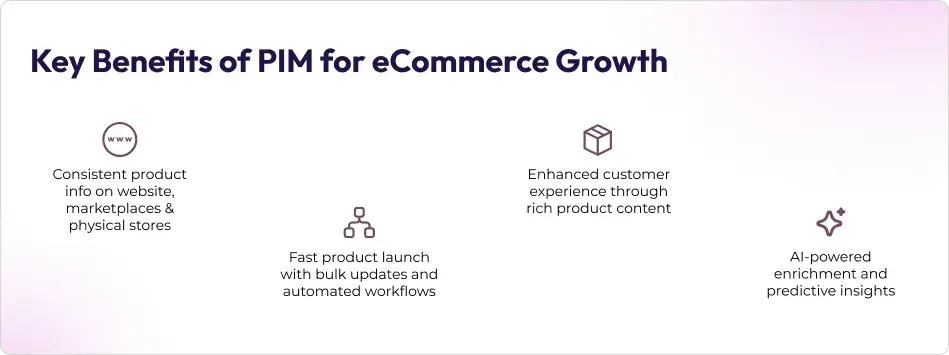
A Product Information Management (PIM) system is essential to build trust with customers and provide a smooth brand experience. Unlike fragmented product data stored in multiple disconnected systems, a PIM system centralizes and harmonizes all product information.
Implementing PIM software accelerates time-to-market through automated product listing management and bulk updates. Instead of manually updating hundreds or thousands of SKUs across multiple platforms, product managers can make changes once in the PIM system and have them syndicated instantly. Cloud-based PIM and SaaS PIM solutions enable businesses of all sizes to manage their product catalogs efficiently without heavy IT investments. Whether you are looking for the best PIM software for small businesses or an enterprise relying on an OdooPIM solution, the automated workflows support faster launches, seasonal promotions, and rapid expansion to new sales channels. This agility translates directly into a competitive advantage in fast-paced eCommerce environments.
Product data enriched with SEO-friendly attributes, keywords, and localized content boosts organic search visibility and drives more traffic to eCommerce websites. AI-powered PIM solutions like OdooPIM automate content enrichment and product classification, enabling precise targeting and personalization.
Why PIM is Essential for Modern eCommerce
- Product catalog management for eCommerce: PIM systems excel at complex product data, such as technical specs, multiple images, videos, and localized content for global marketplaces. This makes them ideal for businesses that sell diverse product lines across multiple platforms.
- integrations:The best PIM solutions offer native connectors and APIs for popular eCommerce platforms like Shopify, Magento, WooCommerce, and marketplaces such as Amazon and eBay. This enables smooth product data flow and automated listing management across all sales channels.
- Scalability with cloud-based and enterprise PIM: Cloud-based PIM models like OdooPIM provide flexibility, eliminate infrastructure hassles, and support growing catalogs. Enterprise PIM solutions provide advanced workflows and role-based access for larger organizations with complex product data needs.
- AI-powered enhancements: OdooPIM integrates AI to automate data enrichment, improve classification, and offer insights into product performance.
- Tailored for all business sizes: Whether you want the best PIM software for small businesses or an enterprise seeks robust OdooPIM features, PIM systems scale to meet different needs with automated product listing management.
Types of PIM Solutions: Cloud-Based, SaaS, and Enterprise PIM
When choosing a Product Information Management (PIM) system, understanding the types of PIM solutions is crucial to align technology with your business needs.
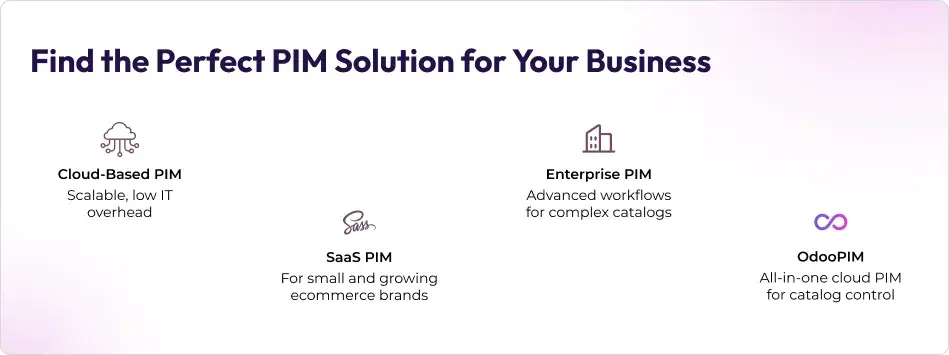
Cloud-based PIM solutions: Offer unmatched agility and scalability compared to traditional on-premise systems. Cloud-based PIM also supports automated product listing management and PIM integration with WooCommerce, Shopify, Magento, and marketplaces like Amazon and eBay with minimal technical friction.
SaaS PIM solutions: Are ideal for small and mid-sized eCommerce brands seeking cost-effective, easy-to-deploy, and instantly scalable PIM software options. SaaS PIM delivers the best PIM software for small businesses by removing the need for upfront capital investment and ongoing system management. Brands benefit from regular updates, security patches, and AI-powered PIM for eCommerce features such as automated data enrichment and advanced analytics, all built-in without additional effort. This makes SaaS PIM the perfect choice for eCommerce product data management on diverse platforms, from Shopify stores to Magento storefronts.
For large organizations with multiple brands, catalogs, and global markets, enterprise PIM systems provide the advanced capabilities necessary to manage complex product information landscapes. Enterprise PIM supports extensive collaboration workflows, governance, and role-based access controls that ensure data quality and compliance across varied product lines. Solutions like OdooPIM enable scalable product catalog management for eCommerce, integrating product data with omnichannel retail strategies and automated product listing management efficiently. Enterprise PIM excels in consolidating data from diverse sources to fuel consistent product experiences worldwide.
Choosing the Best PIM Software for Small Businesses
Small businesses need PIM software that balances ease of use, costs, and quick implementation. The best PIM solutions for small businesses are designed with intuitive interfaces that don’t require a dedicated IT team, enabling teams to focus on catalog management and eCommerce product data management. Cloud-based PIM and SaaS PIM options shine here because they eliminate complex setup and maintenance, offering immediate access to automated product listing management.
A scalable SaaS PIM solution is ideal when small teams face growing product catalogs. It supports expansion without the headaches of system upgrades or performance slowdowns that come with spreadsheets or outdated tools. SaaS PIM software adapts flexibly to increasing SKU counts, adding AI-powered PIM for eCommerce features like automated data enrichment which helps keep content fresh.
Indicators that a company has outgrown spreadsheets and needs a dedicated PIM system include frequent data errors, disorganized product updates, slow time-to-market, and inconsistent customer experiences across channels. When manual catalog management consumes too much time and causes sales bottlenecks, it’s time to upgrade to a centralized PIM system like OdooPIM.
Best PIM for eCommerce Websites: Features That Matter
The best PIM for eCommerce websites packs essential features like multi-store support, variant management, and localization to handle complex product catalogs across platforms. Multi-store support lets you manage PIM for every type of online store integrate with Amazon and eBay from one dashboard, pushing consistent data to every sales channel. Variant management organizes products with sizes, colors, or configurations into structured families, localization tailors content for languages, currencies, and regions to boost global sales in PIM for omnichannel retail.
Role-based access and workflow management empower merchandising and content teams to collaborate efficiently in a PIM system. Merchandisers approve attributes and pricing, content teams enrich descriptions and media, all tracked through customizable workflows that enforce data quality. This setup in cloud-based PIM or SaaS PIM prevents errors and speeds up product catalog management for eCommerce, ensuring only approved, enriched data reaches customers.
PIM software boosts site search, navigation, and conversions by enriching product information with detailed attributes, high-quality media, and SEO-optimized content. Rich, structured data improves on-site search relevance, guides better navigation through smart categories, and lifts conversions with compelling, trustworthy listings that answer buyer questions instantly. AI-powered PIM for eCommerce automates this enrichment, turning basic SKUs into high-performing assets that drive traffic and sales.

Platform-Specific PIM: Shopify, Magento, and WooCommerce
PIM for e-commerce platforms goes far beyond native platform tools, which fall short when managing large, complex catalogs at scale. Native features may handle basic product listings, but they lack the automation, data consistency, and cross-channel synchronization needed as businesses grow.
1. OdooPIM for Shopify Stores
PIM for Shopify stores offers unified product data management across multiple themes, storefronts, and international sites. This is crucial for brands operating several Shopify stores or Shopify Plus accounts targeting different regions or customer segments. A PIM system like OdooPIM syncs product names, descriptions, variants, pricing, and media to keep storefronts up-to-date. It also supports localization workflows, handling translations and regional pricing.
2. OdooPIM for Magento Stores
Magento supports complex catalogs with configurable, bundled, and grouped product types. The best PIM solutions for Magento integrate, enabling businesses to manage these product complexities in a centralized PIM system instead of juggling disconnected spreadsheets or ERP modules. PIM systems automate the enrichment of product data, including technical specifications, pricing tiers, and rich media, streamlining catalog management and reducing manual intervention. This level of control helps Magento merchants deliver better shopping experiences and tailor offerings for multiple storefronts or global markets. Automated product listing management through PIM software also helps handle promotional events and seasonal updates with greater ease.
3. OdooPIM Integration with WooCommerce
WooCommerce users benefit from PIM integration that syncs product attributes, images, pricing, and inventory. This integration updates data directly on WooCommerce stores. The synchronization ensures that changes made in the PIM system reflect instantly on the storefront. Combining with AI-powered OdooPIM for eCommerce enhances content quality and drives higher conversions across WooCommerce sites.
Platform-specific PIM systems solve the limitations of native tools by providing enterprise-grade product catalog management for eCommerce platforms.
4. OdooPIM for Marketplaces and Omnichannel Retail
PIM for omnichannel retail centralizes product information to deliver consistent experiences across websites, marketplaces, social commerce, and in-store channels. Customers switch between browsing your Shopify store online, checking Amazon listings, discovering products on social media, or visiting physical locations, expecting the same details, images, pricing, and availability.
5. OdooPIM for Amazon and eBay Integration
PIM for Amazon and eBay integration uses channel-specific templates, attribute mapping, and built-in compliance rules to meet each marketplace’s strict requirements. Amazon demands detailed bullet points, A+ content, and backend search terms; eBay requires optimized titles, categories, and images, PIM software handles these formats automatically, transforming your core product data into marketplace-ready feeds. Cloud-based PIM (SaaS PIM) solutions like OdooPIM push updates via APIs, supporting automated product listing management and adapting attributes for variations, pricing tiers, and platform-specific promotions.
Preventing Errors, Rejections, and Penalties
PIM systems prevent listing errors, rejections, and costly marketplace penalties through automated validation, data quality checks, and real-time compliance monitoring. Incomplete attributes or mismatched SKUs trigger instant alerts before syndication, avoiding Amazon suppressions that halt visibility or eBay violations leading to account suspensions and fines. By enriching data centrally and testing feeds pre-publish, PIM software reduces rejection rates dramatically—businesses save thousands in lost sales and recovery efforts, maintaining high seller ratings essential for algorithmic favoritism.
Key Advantages for Omnichannel Success
- Consistent branding and data accuracy across PIM for e-commerce platforms, social channels, and POS systems boosts customer loyalty.
- Real-time synchronization cuts time-to-market for promotions and new launches on Amazon, eBay, and beyond.
- Scalable workflows in enterprise PIM or AI-powered PIM for eCommerce handle growing catalogs without errors.
- Enhanced analytics from unified data improve inventory decisions and cross-sell opportunities in PIM for omnichannel retail.
AI-Powered PIM for eCommerce: The Next Generation
AI-powered PIM for eCommerce integrates machine learning and automation to handle auto-enrichment, content suggestions, and smart validations that transforms raw product data into high-performing assets. This next-generation PIM software scans incomplete SKUs, fills missing attributes like materials or dimensions by analyzing similar products, and suggests optimized titles, descriptions, and keywords tailored for SEO and marketplaces. Smart validations catch inconsistencies in real-time, ensuring data accuracy before syndication.
Real-World AI Examples in Action
AI automates attribute filling by extracting details from images, supplier feeds, or unstructured text, identifying colors, sizes, or features instantly to complete product profiles. Title and description optimization uses natural language processing to generate compelling, SEO-rich content that matches top-performing listings, boosting click-through rates on eCommerce platforms. Keyword recommendations pull from market trends and competitor analysis, embedding high-intent terms that improve search rankings on Google, Amazon, and social channels supporting PIM for omnichannel retail.
These capabilities shine in catalog onboarding, where AI processes thousands of products in minutes instead of weeks, auto-categorizing items and enriching media tags for better site search. Continuous optimization runs ongoing audits, suggesting updates based on sales data or seasonal trends, which accelerates automated product listing management and keeps product catalog management for eCommerce dynamic.
Acceleration Through AI in PIM Workflows
AI in PIM slashes onboarding time by 5x through bulk imports with instant enrichment, letting small businesses using the best PIM software for small businesses launch catalogs rapidly without manual labor. Cloud-based and SaaS PIM solutions embed these features, scaling for enterprise PIM needs, such as OdooPIM, in complex setups. Teams focus on strategy AI handles repetitive tasks, driving higher conversions via richer, personalized content across all channels.
Key AI Features Driving eCommerce Growth
- Auto-enrichment: Fills gaps in eCommerce product data management using image recognition and pattern matching for complete listings.
- Content generation: Crafts variant-specific descriptions and A+ content optimized for PIM for e-commerce platforms.
- Smart categorization: Groups products into families automatically, streamlining PIM for omnichannel retail workflows.
- Validation and insights:Flags errors and predicts trends to enhance best PIM solutions for ongoing catalog management.
Spotlight on OdooPIM: A Modern Cloud-Based PIM Solution
OdooPIM is a cutting-edge cloud-based PIM designed for growing eCommerce businesses that need streamlined product data management without the complexity and cost of legacy systems. This PIM software offers a unified platform to handle catalog management, product data enrichment, and omnichannel publishing from a single, user-friendly interface. Whether you’re managing a few hundred SKUs or tens of thousands, OdooPIM scales with your business and integrates seamlessly into your existing eCommerce infrastructure.
With OdooPIM, product catalog management for eCommerce becomes effortless because the system centralizes product data, attributes, descriptions, media assets, and pricing all in one place. It supports AI-powered PIM for eCommerce features to automate content enrichment, validation, and SEO optimization, ensuring your product data is always rich, and ready for any channel. Automated product listing management lets you quickly syndicate product updates across multiple sales channels, reducing time-to-market and eliminating manual errors.
Key use cases for OdooPIM cover eCommerce product data management for popular platforms like Shopify, Magento, and WooCommerce with native connectors that ensure real-time synchronization of inventory, pricing, and product variants. Integration extends to marketplaces too, with built-in support for PIM for Amazon and eBay integration, handling channel-specific templates and compliance to keep your listings optimized and penalty-free. As a cloud-based PIM that combines the agility of SaaS PIM with enterprise-grade capabilities, OdooPIM empowers businesses of all sizes—from startups needing the best PIM software for small businesses to enterprises managing complex omnichannel retail strategies—to succeed in competitive markets.
Getting Started on Implementing a PIM System
Implementing a PIM system transforms chaotic product data into a competitive advantage, but success starts with selecting the best PIM solutions that match your business size and tech stack. Small businesses prioritize SaaS PIM or cloud-based PIM like OdooPIM for quick setup and low costs, enterprises choose robust enterprise PIM for complex workflows. Map your needs—catalog size, channel count, and growth plans—then demo shortlisted options to confirm PIM for your eCommerce site.
Essential Preparation Steps
These steps are followed for a smooth OdooPIM rollout:
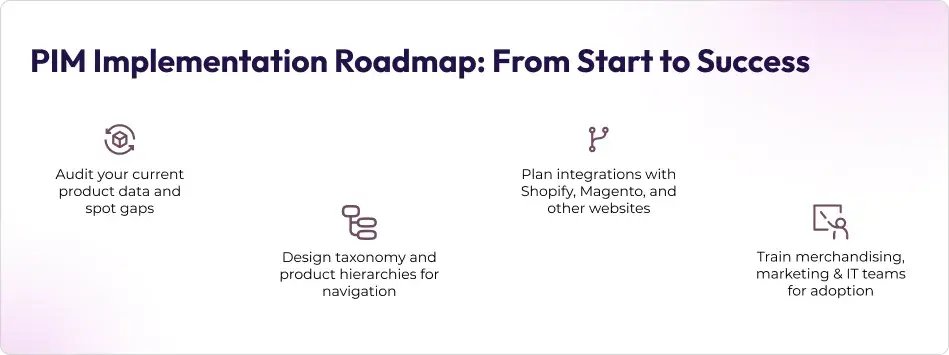
- Conduct a data audit:Inventory all product data sources, spreadsheets, ERPs, supplier feeds, and identify gaps in attributes, images, and pricing to build a clean foundation for eCommerce product data management.
- Design taxonomy and categorization: Create logical product hierarchies, attributes, and variants that support PIM for omnichannel retail and automated product listing management across channels.
- Plan integrations: Set up APIs and connectors for PIM for e-commerce platforms, testing real-time syncs for inventory, pricing, and media to ensure product catalog management for eCommerce flows without disruptions.
Driving Team Adoption
Merchandising teams embrace OdooPIM software through intuitive interfaces and role-based dashboards that simplify enrichment and validation tasks. Marketing gains from AI-powered OdooPIM for eCommerce features like content suggestions and SEO tools, IT appreciates no-code integrations and cloud scalability. Run hands-on training sessions, assign clear ownership, merch for attributes, marketing for descriptions, and track quick wins like faster marketplace listings to build momentum across teams. Celebrate reduced errors in PIM for Amazon and eBay integration as proof of value.

Key Implementation Use Cases
- eCommerce product data management for Shopify: Centralize variants and themes for multi-store consistency.
- PIM for Magento stores: Handle configurable products with bulk updates and compliance mapping.
- PIM integration with WooCommerce:Sync attributes and media bidirectionally for headless setups.
- PIM for Amazon and eBay integration: Automate channel-specific feeds to avoid rejections and penalties.
- Scalable catalog management:Grow from the best PIM software for small businesses to enterprise PIM without rework.
Execute these steps methodically, and your OdooPIM system becomes the backbone of efficient best PIM for eCommerce websites operations, powering growth through unified, high-quality product data where customers engage.
Future-Proofing Your eCommerce Business With OdooPIM
A Product Information Management (PIM) software is the foundation for omnichannel growth in eCommerce. As your product catalogs, sales channels, and international markets expand, a PIM system ensures consistent, high-quality product data reaches customers. Investing in the best PIM solutions prevents operational chaos and inefficiencies that arise from disconnected data, manual updates, and siloed teams.
The best PIM software for small businesses grows with you, supporting your transition from simple online storefronts to managing complex product data across Shopify stores, Magento platforms, WooCommerce integrations, and marketplaces such as Amazon and eBay. Automated product listing management eliminates bottlenecks, accelerates time-to-market, and safeguards against costly listing errors or marketplace penalties. AI-powered PIM for eCommerce adds continuous optimization capabilities, keeping your catalogs fresh and competitive through smart content enrichment and data validation.
Choosing a scalable PIM for omnichannel retail means future-proofing product catalog management for eCommerce. It centralizes control, accelerates data syndication, and strengthens team collaboration across merchandising, marketing, and IT. Your system stays flexible to accommodate new channels, evolving market demands, and global expansion without disruptive overhauls. This strategic investment turns product data into a competitive asset that fuels customer satisfaction, sales growth, and sustained eCommerce success.
Frequently Asked Questions
1. What is Product Information Management (PIM) and why is it important for eCommerce?
Product Information Management (PIM) is a centralized PIM system that collects, enriches, validates, and distributes all product data, including descriptions, images, prices, specifications, and variants, across multiple sales channels like websites, marketplaces, and social platforms. This PIM software acts as the single source of truth for eCommerce product data management, automating catalog management to keep consistent and up-to-date, no matter where customers shop.
PIM drives eCommerce success by slashing time-to-market through automated product listing management, reducing manual errors that hurt conversions, and powering PIM for omnichannel retail with rich, localized content. Customers get details, from PIM for Magento stores to in-store displays, boosting trust, SEO rankings, and sales, cutting returns from misinformation. For growing brands, the best PIM solutions like cloud-based PIM or OdooPIM scale, turning product data into a growth engine rather than an operational headache.
2. How does PIM software differ from ERP, DAM, and spreadsheets?
PIM software focuses exclusively on structured product information for marketing, sales, and customer-facing channels, unlike ERP systems that handle backend operations like inventory, finance, and supply chain without deep content enrichment. ERP provides raw operational data, PIM transforms it into compelling, channel-ready assets with attributes, media, and SEO optimization—making PIM integration with WooCommerce or PIM for omnichannel retail possible without ERP’s complexity. This specialization lets PIM excel in product catalog management for eCommerce where ERP falls short on front-end polish.
DAM manages digital assets like images and videos in isolation, but PIM software orchestrates complete product experiences by combining those assets with text, pricing, and variants for the best PIM for eCommerce websites. Spreadsheets crumble under scale with no automation, validation, or real-time syncing, causing errors in PIM for Shopify stores or enterprise PIM setups, PIM systems like SaaS PIM or AI-powered PIM for eCommerce fix this with workflows, bulk updates, and the best PIM software for small businesses that grows without breaking.
3. What are key benefits of using a PIM system for small businesses?
Small businesses benefit immensely from implementing Product Information Management (PIM) systems. Affordable SaaS PIM or cloud-based PIM solutions offer simple, intuitive catalog management that eliminates the chaos of spreadsheets or disconnected tools. These PIM systems speed up product launches by automating content enrichment, validation, and syndication, allowing small teams to manage product data efficiently across platforms.
By reducing manual tasks and streamlining eCommerce product data management, the best PIM software for small businesses frees up time and resources to focus on growth and customer engagement. Improved data quality reduces errors that lead to customer frustration and costly returns, enabling automated product listing management for faster time-to-market. As your product catalog expands, these scalable PIM solutions adapt, supporting omnichannel retail strategies and powering your transition from a small business to an enterprise-level eCommerce operation.
4. Which PIM solutions are best for complex enterprise eCommerce operations?
Enterprise eCommerce operations demand robust Product Information Management (PIM) systems capable of handling vast, multi-brand product portfolios across global markets. Enterprise PIM solutions like OdooPIM offer advanced workflows that automate complex data validation, enrichment, and syndication processes, ensuring governance and compliance. These systems excel in multi-catalog management, localization for different languages and currencies, and omnichannel retail integration. This product catalog management for eCommerce empowers enterprises to centralize product information and distribute it across diverse platforms.
The best PIM solutions for enterprises combine AI-powered PIM for eCommerce features to continuously optimize data quality and product content dynamically. Automated product listing management reduces manual labor across massive SKUs. Cloud-based PIM setups provide the flexibility and scalability required for evolving product lines and expanding channels.
5. How does AI-powered PIM improve eCommerce product data management?
AI-powered Product Information Management (PIM) significantly enhances eCommerce product data management by automating critical processes like auto-enrichment of product attributes, title optimization, and keyword recommendations. Instead of relying on manual data entry, AI algorithms analyze existing data points and external sources to fill gaps in product descriptions, select relevant features, and suggest customer-friendly language. This level of automation speeds up catalog onboarding dramatically, reducing the time it takes to prepare thousands of SKUs for multiple channels.
Beyond onboarding, AI-powered PIM provides smart validations that detect inconsistencies, missing attributes, or compliance issues before product data is published. This continuous optimization lowers the risk of errors across marketplaces improving SEO performance by dynamically tailoring product content based on customer search behavior and trends. The result is a personalized product catalog management for eCommerce.
6. What are best practices for successfully implementing a PIM system?
Successful implementation of a PIM system begins with a thorough data audit to understand current product information sources, identify data gaps, and assess quality. Designing a clear taxonomy and product hierarchy ensures your catalog is easy to navigate and supports detailed product attributes, variants, and localization. Planning integrations is essential, ensuring your PIM system connects with your key eCommerce platforms and marketplaces.
It’s important to pilot the PIM software with a representative subset of your catalog before a full rollout to test workflows and identify potential issues early. Driving adoption across merchandising, marketing, and IT teams requires dedicated training and communication, emphasizing how the PIM system reduces manual workloads and improves accuracy. Choosing the best PIM solutions tailored to your business size, from SaaS PIM for small businesses to enterprise PIM like OdooPIM for complex operations, ensures scalability and long-term success in product catalog management for eCommerce.