

Introduction: Fashion Moves Fast, Data Must Move Faster
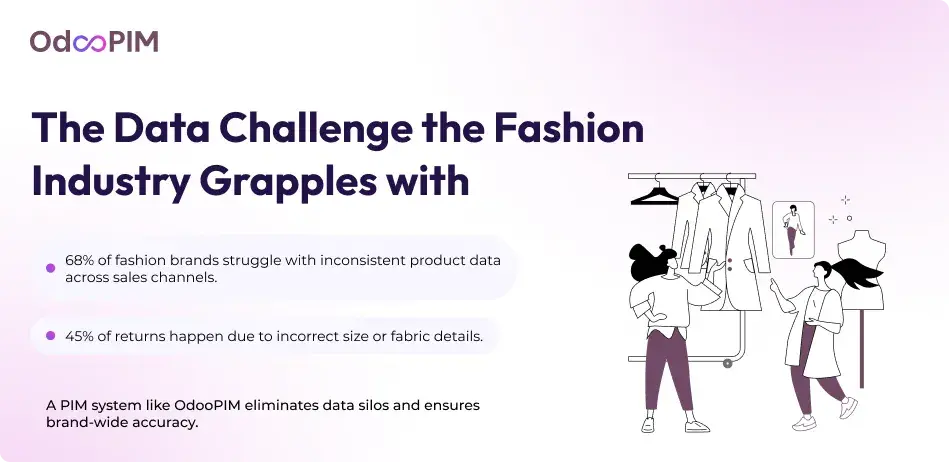
Fashion trends change overnight, but fashion brands don’t stumble on design, they stumble on data. Product names, colors, sizes, fabrics, and images get scattered across PLM, ERP, spreadsheets, and agency folders, then need to be pushed into multiple websites, marketplaces, and regions in record time. As collections, capsules, and collaborations multiply, so does the risk of inconsistent descriptions, missing size charts, wrong images, and outdated pricing. That chaos drives returns, damages brand perception, and slows new drops across clothing, footwear, and luxury fashion eCommerce.
Product Information Management (PIM) gives fashion businesses a way to keep up with this pace by centralizing and structuring details about each SKU, styles, colorways, fits, size runs, fabric compositions, care instructions, and campaign imagery, in one PIM system. Fashion PIM software supports apparel product catalog management, size and variant management, and multi-region product data management from a single hub, so channels get accurate, enriched content. AI-driven trend-based product categorization and automation features help teams tag products by style, season, and occasion at speed, which is essential for PIM for seasonal fashion collections, PIM for clothing brands, PIM for footwear industry players, and even PIM for textile and fabric manufacturers supplying the supply chain.
OdooPIM sits in this landscape as a dedicated PIM software layer that connects creative, merchandising, and digital commerce inside the broader Odoo ecosystem. It acts as a Cloud-based PIM front-end for product content, integrating with Odoo ERP, inventory, POS, and web store to keep catalog management tightly aligned with operations. For brands evaluating Best PIM solutions, OdooPIM offers Enterprise PIM capabilities, variants, multi-language support, multi-region catalogs, and rich media handling, without disconnecting from daily workflows, making it a choice for PIM for luxury fashion eCommerce as well as fast-moving retail and D2C labels.
What Is Product Information Management (PIM) for Fashion?
Product Information Management (PIM) for fashion is the technology used to manage details of clothing, footwear, and accessories in one structured, commerce-ready hub. PIM software stores and organizes style codes, SKUs, descriptions, size runs, colorways, fabrics, care instructions, pricing, and rich media so teams are not scrambling through spreadsheets and shared drives. Fashion PIM software is built to serve PIM for clothing brands, PIM for footwear industry players, and PIM for luxury fashion eCommerce, where speed, accuracy, and storytelling matter as much as the design itself.
A fashion-focused PIM system centralizes SKUs, styles, colors, sizes, fabrics, and imagery and links them in a way that reflects how buyers shop. Each style can hold multiple variants (size and color combinations), size guides, fit notes, and region content, digital asset management for fashion PIM ensures the right images, lookbook shots, and videos are tied to the right variants. The Best PIM solutions support size and variant management with PIM, multi-region product data management for fashion, and PIM for seasonal fashion collections, including capsules and limited editions. With AI-driven trend-based product categorization, teams can tag products by style, occasion, and trend themes at scale, which is critical for fast-fashion and content-heavy brands.
This goes far beyond a generic database that simply holds product codes and a few attributes. A standard table in ERP or a basic CMS cannot handle nuanced Apparel product catalog management like regional sizing conversions, gender fits, layered categories (collection → line → style → variant), and rich merchandising relationships such as looks, bundles, and cross-sells. Fashion-ready PIM for textile and fabric manufacturers and retail brands needs rules, workflows, completeness checks, and channel outputs for websites, marketplaces, and wholesale portals. That is the space where Cloud-based PIM, and Enterprise PIM platforms like OdooPIM excel, giving fashion businesses a purpose-built catalog management engine instead of forcing them to stretch generic tools beyond their limits.

Why Fashion Needs Specialized PIM, Not Just Generic Tools
Fashion runs on rapid trend cycles, frequent drops, and relentless SKU churn, and generic tools simply cannot keep up with this pace. Product lines flip season, colorways change mid-campaign, collaborations launch overnight, and old collections move to outlets or archives. Spreadsheets, basic ERPs, or generic databases crack under this pressure because they are not built for catalog management, complex Apparel product catalog management, or PIM for seasonal fashion collections. Fashion PIM software gives brands a dedicated Product Information Management (PIM) layer where styles, variants, and collections live in one structured PIM system that can adapt as quickly as the creative team does.
Return rates in fashion spike because customers do not get clear information on size, fit, fabric, and product details. When size charts are inconsistent, materials are poorly described, or imagery does not match reality, shoppers buy “blind” and send items back. Specialized PIM software solves this by enabling rich size and variant management with PIM, detailed fit notes, fabric composition, care instructions, and region size conversions, all maintained centrally and pushed consistently to channels. The Best PIM solutions support PIM for clothing brands and PIM for footwear industry players with dedicated structures for size runs, widths, and fit profiles that generic tools cannot model properly.
Brand dilution is another hidden cost of weak product data. When the same dress or sneaker looks and reads differently on your website, marketplace listings, and social shop, customers question the brand’s professionalism and authenticity. Fashion PIM software, especially Cloud-based PIM platforms and Enterprise PIM options like OdooPIM, maintains one source of truth for titles, descriptions, visuals, and campaign messaging. With robust digital asset management for fashion PIM, curated imagery and video assets are attached to the right SKUs and variants, preserving brand storytelling and visual consistency across D2C, marketplaces, and wholesale portals.
Fashion has unique multi-market and upstream complexity that demands specialized Product Information Management (PIM). Multi-region product data management for fashion requires different languages, currencies, sizing systems, and sometimes even different compliance or labeling requirements. PIM for textile and fabric manufacturers needs to expose detailed technical attributes, composition, weave, weight, certifications, to brands and designers, then simplify that for end consumers. AI-driven trend-based product categorization adds another layer of differentiation: fashion-focused PIM can automatically tag products by trend, style, and occasion, better discovery and merchandising. Generic tools do not offer this level of category intelligence.
Core PIM Capabilities Fashion Brands Can’t Ignore
Central catalog management sits at the heart of effective Product Information Management (PIM) for fashion. A Fashion PIM software platform gives you one place to manage style, variant, and collection instead of scattering data across spreadsheets, PLM exports, and ad hoc tools. In a dedicated PIM system, each style can be linked to seasons, capsules, campaigns, and channels, enabling clean Apparel product catalog management for PIM for clothing brands, PIM for footwear industry players, and PIM for luxury fashion eCommerce operations. This centralization supports smarter catalog management decisions, such as which products to push, pause, or retire, without losing control of the underlying data.
Size and variant management with PIM is another non-negotiable capability. Fashion lives in colorways, size runs, fits, and special cuts, and PIM software needs to model these realities natively. A robust PIM setup lets you define size curves per region, handle half-sizes and widths for footwear, manage petite, tall, and plus-size fits, and attach variant images and attributes. The Best PIM solutions support AI-driven trend-based product categorization, so you can automatically tag variants by style, occasion, or trend, making it easier to merchandise collections and improve product discovery without manually micromanaging SKU.
Multi-region product data management for fashion rounds out the core capabilities that brands cannot ignore. When you sell in several markets, you face different currencies, languages, regulatory notes, and even distinct assortments per country or region. Cloud-based PIM, and Enterprise PIM platforms allow you to localize product names, descriptions, care instructions, and pricing, maintaining a single global record as the master. This approach is critical for PIM for seasonal fashion collections that launch at different times in different regions, PIM for textile and fabric manufacturers supplying multiple markets, and omnichannel retailers running complex, localized assortments. Solutions like OdooPIM bring these capabilities together, offering Fashion PIM software that supports centralized catalog management, granular variant control, and region content from one integrated environment that can scale with your brand.

Digital Asset Management for Fashion PIM
Digital asset management for fashion PIM starts with controlling the flood of images and media that collection generates. Fashion PIM software needs to handle packshots, on-model shots, lookbook spreads, close-up fabric textures, 360-degree spins, campaign videos, and social cuts in one place, rather than scattering them across shared drives and ad hoc folders. When a PIM and DAM system sit together, teams upload once, tag once, and reuse assets, which simplifies Apparel product catalog management for PIM for clothing brands, PIM for footwear industry players, and PIM for luxury fashion eCommerce.
A PIM system links each asset to the exact style, colorway, size, and collection it belongs to, not just to a product ID. This is the essence of digital asset management for fashion PIM: variant can have its own imagery, size charts, and videos so the red, petite, or wide-fit versions display accurately on channels. The Best PIM solutions support Size and variant management with PIM alongside DAM, ensuring that product pages always show the correct visual, whether it is for PIM for seasonal fashion collections or evergreen core lines.
Integrated PIM and DAM directly support editorial storytelling and a consistent visual identity across markets and channels. PIM software holds the structured data, names, descriptions, specs, and AI-driven trend-based product categorization, DAM curates the campaign imagery and video narrative, and together they allow teams to assemble on-brand lookbooks, landing pages, and marketplace listings quickly. Cloud-based PIM, and Enterprise PIM platforms such as OdooPIM give global brands a single hub for catalog management, Multi-region product data management for fashion, and creative assets, which extends to PIM for textile and fabric manufacturers that need to share technical visuals and marketing-ready content with partners.
PIM for Clothing Brands, Footwear, and Luxury Fashion eCommerce
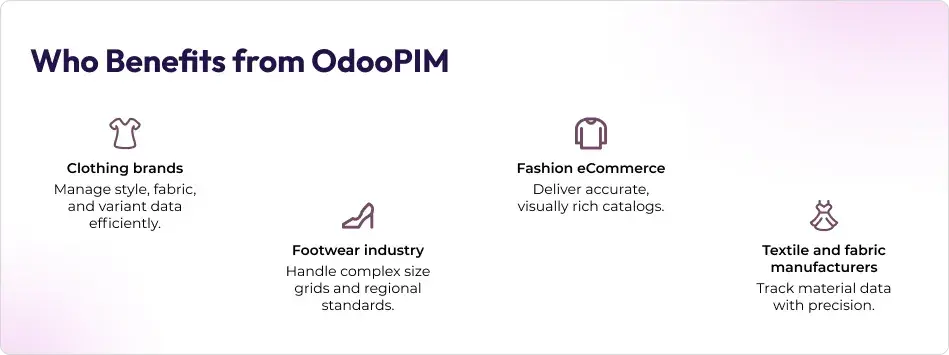
PIM for clothing brands, footwear, and luxury fashion eCommerce shares the same foundation but solves different merchandising problems. Fashion PIM software needs the flexibility to handle basics, bold statement pieces, technical footwear, and high-end couture within one Product Information Management (PIM) layer, still keeping catalog management clean for channels.
PIM for clothing brands must manage styles across capsules, collaborations, and permanent collections without losing sight of fundamentals like fit, fabric, and seasonality. A PIM system lets merchandisers group products by collection, drop, and campaign, distinguish basics from statement pieces, and use AI-driven trend-based product categorization to tag looks by trend, occasion, or aesthetic. This gives teams Apparel product catalog management, supporting PIM for seasonal fashion collections and evergreen lines in the same workspace.
PIM for footwear industry players introduces an additional layer of complexity: sizes, half-sizes, widths, and specialized materials all affect comfort and performance. PIM software purpose-built for footwear supports Size and variant management with PIM so each shoe can carry regional size scales, width options, arch or support notes, and detailed material and care information for leather, synthetics, or performance fabrics. The Best PIM solutions centralize this data so that PIM ecommerce, marketplaces, and wholesale partners all present consistent, accurate information.
PIM for luxury fashion eCommerce raises the bar further by demanding elevated storytelling, premium imagery, and strict brand guidelines. Enterprise PIM and Cloud-based PIM platforms allow luxury houses to encode voice, terminology, and visual rules directly into workflows, ensuring that product description, translation, and media set stays on-brand across regions. With integrated digital asset management for fashion PIM, luxury teams can pair meticulous copy with cinematic imagery and campaign videos, multi-region product data management for fashion PIM architectures like OdooPIM maintain consistency across boutiques, ecommerce sites, and curated marketplace presences worldwide.
Seasonal and Capsule Collections: PIM for Fashion’s Constant Change
Seasonal and capsule collections keep fashion in constant motion, and Product Information Management (PIM) must match that rhythm. PIM for seasonal fashion collections lets brands structure Spring/Summer, Fall/Winter, resort, holiday, and limited drops as distinct yet connected entities inside Fashion PIM software, instead of treating them as one long, flat list of SKUs. A robust PIM system allows merchandisers to assign style to a season, pre-season, or capsule, control launch and sunset dates, and maintain clear Apparel product catalog management as collections move from “new in” to sale and then archive.
Managing carry-overs versus new styles becomes much easier when this logic lives inside PIM software rather than scattered across spreadsheets. Carry-over heroes can retain their core data, receiving refreshed campaign assets, pricing, and messaging for each season, truly new styles get built out from templates that encode best-practice attributes, imagery, and compliance.
AI-driven trend-based product categorization turns seasonal chaos into a structured opportunity. Instead of manually tagging piece as “Y2K,” “quiet luxury,” “festival,” or “office-ready,” AI within an Enterprise PIM or a Cloud-based PIM platform analyzes attributes and imagery to assign style, occasion, and trend themes automatically.

Multi-Region, Multi-Channel Fashion Commerce with PIM
Multi-region, multi-channel fashion commerce demands a PIM backbone that understands how products change across borders and touchpoints. Fashion PIM software provides multi-region product data management for fashion by holding one global record generating EU, US, UK, and other localized views with different size charts, measurement systems, and even body-shape assumptions. A PIM system helps support region compliance, such as EU requirements for fabric composition, care labeling, origin, and upcoming digital product passport rules, so PIM for clothing brands, PIM for footwear industry players, and PIM for luxury fashion eCommerce can scale internationally without risking non-compliance.
To win across channels, brands need one content engine feeding endpoints. Cloud-based PIM, and Enterprise PIM platforms push structured, channel-ready data into DTC ecommerce sites, marketplaces, social commerce, and wholesale portals from a single central hub. The Best PIM solutions let teams define channel assortments, attributes, and media rules, so the same master product powers high-control DTC experiences and tightly structured marketplace listings, maintaining clean Apparel product catalog management.
Consistent product storytelling across online stores, marketplaces, and physical retail comes from combining data with assets. PIM manages the product truths, names, descriptions, specs, prices, sizing logic, and AI-driven trend-based product categorization, integrated digital asset management for fashion PIM. Solutions like OdooPIM give fashion businesses a single Fashion PIM software layer for catalog management, ensuring that shoppers see the same story and quality standard whether they browse a flagship site, a marketplace listing, or a store associate’s tablet in a physical boutique.
Beyond Retail: PIM for Textile and Fabric Manufacturers
PIM plays a role upstream for mills, weavers, knitters, and finishing houses that supply fashion brands and designers. PIM for textile and fabric manufacturers gives these businesses a structured way to present complex fabric libraries, organized by fiber type, construction, application, and availability, instead of relying on static PDFs, spreadsheets, and email attachments. With the right PIM software, manufacturers can maintain channel-ready data that feeds internal teams and B2B buyers, and supports cleaner catalog management.
PIM for textile and fabric manufacturers captures composition, weave or knit structure, weight, width, finish, performance metrics, and compliance information, along with related certifications like organic, recycled, or fair-trade standards. The Best PIM solutions pair this structured data with DAM for fashion PIM, linking swatch images, drape shots, test reports, and 3D renders so designers and sourcing teams see the numbers and the visual behavior of each material in one software environment.
Enterprise PIM is valuable when fabric libraries need to scale across sample books, sales reps, and B2B eCommerce catalogs. Cloud-based PIM platforms allow manufacturers to publish tailored digital catalogs by customer, region, or application, with real-time updates to availability, lead times, and pricing, instead of reprinting sample binders every season. Solutions like OdooPIM and other Best PIM solutions support Apparel product catalog management for finished products and raw materials, enabling Multi-region product data management for fashion, AI-driven trend-based product categorization for fabric use-cases, and a smoother data flow between PIM for clothing brands, PIM for footwear industry players, and their upstream textile partners.
Where OdooPIM Shines for Fashion Brands
OdooPIM gives fashion businesses a Product Information Management (PIM) layer that sits natively inside the Odoo stack. Instead of bolting on an external PIM system and juggling multiple vendors, OdooPIM lets teams manage Fashion PIM software capabilities—attributes, variants, media, channels—from the same ecosystem that runs finance, inventory, purchasing, and marketing. For PIM for clothing brands, PIM for footwear industry players, and PIM for luxury fashion eCommerce, this tight integration removes friction between product data, operations, and customer touchpoints.
As a Cloud-based PIM offering, OdooPIM delivers centralized catalog management with native links to Odoo eCommerce, inventory, POS, and CRM out of the box. Product records enriched in OdooPIM flow directly into web shops, marketplaces (via connectors), store POS interfaces, and sales teams’ quoting tools, without manual re-entry or brittle spreadsheets. This architecture gives fashion brands Enterprise PIM capabilities, such as multi-channel syndication, governance, roles, and approvals, retaining the agility of a single, modular Odoo environment.
Odoo’s native product variant engine, combined with OdooPIM, makes Size and variant management with PIM practical for even complex assortments. Teams can configure attributes such as color, size, fit, material, and embellishments once at the template level, then manage prices, barcodes, and inventory per variant, OdooPIM handles the enrichment and catalog logic. For Apparel product catalog management, this means style templates for T-shirts, denim, outerwear, dresses, or sneakers become reusable structures that OdooPIM can replicate and adapt across drops, collaborations, and regions.
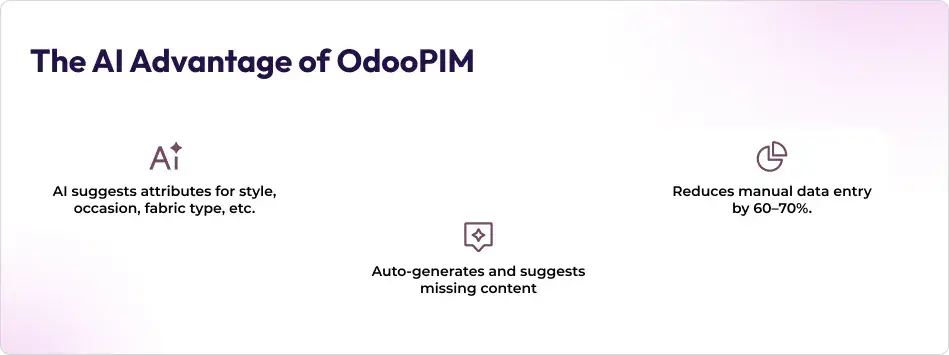
Fast-fashion and high-SKU environments benefit from OdooPIM’s dynamic catalog management capabilities. Merchandisers can spin up PIM for seasonal fashion collections (Spring/Summer, Fall/Winter, resort, capsules) by tagging styles by season, drop, and channel, keeping carry-over essentials in the same PIM software workspace. AI-driven trend-based product categorization and auto-enrichment features further reduce manual workload by suggesting categories, attributes, and related products that speed up launch cycles without sacrificing quality.
Premium labels and luxury fashion houses need control over story, imagery, and compliance, and this is where OdooPIM’s integration with digital asset management for fashion PIM workflows matters. Product data in OdooPIM can be tied to high-resolution imagery, lookbook shots, and campaign assets, then orchestrated into consistent narratives across brand sites, curated marketplaces, and physical stores. Combined with Multi-region product data management for fashion, this supports PIM for luxury fashion eCommerce experiences that stay strictly on-brand.
Multi-brand retailers and distributors gain a different advantage: OdooPIM can act as the central hub that normalizes supplier feeds from brands. Instead of wrestling with inconsistent spreadsheets and import templates, teams use OdooPIM to standardize attributes, merge overlapping categories, and align data with in-store POS and online navigation structures.
Because OdooPIM lives close to inventory and order data, it reduces the disconnect between “what is published” and “what is available.” Stock levels, lead times, and back-order logic from Odoo inventory inform Product Information Management (PIM) decisions, so discontinued variants get retired, low-stock items can be throttled by channel, and new arrivals are prioritized dynamically.
OdooPIM in Action: Fashion-Focused Use Cases
OdooPIM proves its value when it starts handling real fashion scenarios inside an existing Odoo stack. As Fashion PIM software, it turns Odoo into a PIM environment rather than just an ERP with product fields. Apparel product catalog management, footwear variant complexity, and multi-region product data management all talks natively to sales, inventory, POS, and ecommerce.
For PIM for clothing brands, OdooPIM gives structure to styles, fits, washes, and size guides instead of leaving them buried in spreadsheets or ad hoc notes. A shirt, jean, or dress starts as a product template with attributes such as fit (slim, regular, relaxed), wash (light, mid, dark, vintage), and length, Odoo’s variant engine generates the actual SKU combinations, and OdooPIM drives enrichment and catalog management. Size guides become reusable assets that link to families of products via size-chart modules and website widgets.
OdooPIM strengthens size and variant management with PIM by leveraging Odoo’s proven variant matrices and extending them with smarter data and automation. Merchandisers see size and color grids in familiar matrix views for textile or apparel products, pricing, inventory, and content stay aligned per variant. AI-driven trend-based product categorization from OdooPIM layers on top of this, suggesting tags like “workwear,” “streetwear,” or “occasionwear,” which accelerates navigation setup and improves merchandising for PIM for clothing brands and PIM for luxury fashion eCommerce.
PIM for footwear industry use cases push variant logic further, and OdooPIM handles that complexity without breaking UX. Footwear templates can hold attributes for size, half-size, width, and sometimes arch type, Odoo’s size-matrix add-ons present these choices clearly to sales and operations. Regional conversions (EU/US/UK) become attribute sets or derived fields that OdooPIM can expose to different channels based on locale, so shoppers and wholesale buyers see their native sizing, the system maintains a single internal logic.
As a Cloud-based PIM, OdooPIM supports multi-region product data management for fashion with multi-language, multi-currency, and multi-channel controls. Teams define locale titles, descriptions, size labels, and compliance notes in one place, then publish localized campaigns across DTC sites, marketplaces, and regional microsites without duplicating work. This is critical for PIM for luxury fashion eCommerce and multi-brand retailers who need to launch regional stories, staying aligned on a global master catalog.
Digital asset management for fashion PIM workflows benefit from OdooPIM’s integration with Odoo Website and ecommerce. Variant-related images, lookbook visuals, and size-chart graphics can be associated with the right SKUs, ensuring that each color or fabric shows the correct photos on the storefront and in marketplace feeds. Combined with AI-driven enrichment and omnichannel publishing, OdooPIM enables Best PIM solutions practices, centralized data, automated syndication, and consistent branding.
AI in Fashion PIM: From Trend Detection to Smart Tagging
AI is redefining how fashion brands manage and enrich product data within their PIM systems. In an industry driven by ever-changing trends, AI bridges the gap between creativity and data accuracy, automating what once required hours of manual catalog updates and merchandising coordination.
Fashion PIM software like OdooPIM leverages AI-driven trend-based product categorization to automatically assign tags for style, season, occasion, and even mood. Instead of teams manually sorting apparel into complex hierarchical structures, AI models continuously analyze market data, influencer content, and eCommerce trends to suggest appropriate categorizations. This level of automation powers smarter apparel product catalog management, especially for dynamic collections that refresh multiple times a year.
With AI at its core, cloud-based PIM platforms can drive automated enrichment. Machine learning algorithms generate consistent fabric descriptions, styling suggestions, and cross-sell recommendations. A system like OdooPIM can identify garments that complement each other based on material, color palette, or seasonality.
AI enables multi-dimensional catalog enrichment, supporting multi-region product data management for fashion brands that operate across diverse markets. By learning buyer preferences in different geographies, AI can tailor tags and descriptions to regional style nuances, aiding localized personalization, and maintaining a unified brand voice.
In areas like size and variant management with PIM, AI makes it easier to standardize inconsistent data from different suppliers and automate variant grouping. Digital asset management for fashion PIM with AI, automatically links product images, lookbooks, and videos to relevant items in the catalog based on visual recognition and metadata detection.
For businesses managing seasonal fashion collections, PIM for clothing brands, PIM for footwear industry, and PIM for luxury fashion eCommerce, integrating AI into their PIM system means faster go-to-market cycles, cleaner data workflows, and smarter analytics. This shift transforms PIM from a passive repository into an intelligent merchandising hub that informs assortment decisions, product bundling, and pricing strategies.
In essence, AI inside a PIM for textile and fabric manufacturers or fashion retailers turns catalog management into a strategic asset, making the supply-to-sale cycle intelligent, efficient, and aligned with customer intent.

Implementation Blueprint: Rolling Out PIM in a Fashion Organization
Implementing a PIM system in a fashion enterprise requires precision, clarity, and strategic phasing. The smartest approach begins with a controlled rollout, focusing on a single brand, category, or region before expanding across the organization. This staged method allows teams to refine their data models, workflows, and integrations before scaling globally.
A successful rollout begins with a complete data audit. This step exposes inconsistencies across product attributes, images, and regional catalogs. For fashion companies managing vast assortments and seasonal shifts, this audit provides the baseline for a sustainable data governance framework. Once data gaps are identified, the next focus is attribute model design, defining critical elements like fit, style, occasion, fabric composition, and seasonality. These attributes offer accurate apparel product catalog management and ensure that consumers find products that match their preferences with reduced friction.
During this stage, mapping digital assets like lookbooks, swatch images, and videos to their respective SKUs is essential. Digital asset management for fashion PIM guarantees that item in the PIM system carries a complete, media-rich representation. This precision directly impacts brand storytelling and online conversion rates in PIM for luxury fashion eCommerce environments.
Once the attribute foundation is established, integration becomes the next critical step. A fashion organization must connect its PIM software with adjacent systems, such as PLM, ERP, and eCommerce platforms. This creates a synchronized ecosystem where design, sourcing, and digital teams operate from a single source of truth. In this architecture, OdooPIM acts as the central orchestration layer, distributing clean, enriched data to online stores, marketplaces, and internal merchandising tools.
Cloud-based PIM frameworks support multi-region product data management for fashion, enabling localization by market, maintaining consistency in naming conventions, attribute structures, and visual identity. This is crucial for global fashion retailers handling diverse markets, regulatory variations, or distinct sizing standards. Features like size and variant management with PIM streamline complex assortments, ensuring accurate inventory visibility across channels.
For PIM for clothing brands, PIM for footwear industry, or PIM for textile and fabric manufacturers, data uniformity and process integrity drive measurable ROI. Automating data synchronization between product development and sales channels reduces rework, supports AI-driven trend-based product categorization, and accelerates time-to-market for PIM for seasonal fashion collections.
The best implementation strategies adopt robust governance practices, clear ownership, and ongoing data quality monitoring. Leveraging enterprise PIM platforms such as OdooPIM, one of the best PIM solutions available, fashion organizations gain long-term agility and resilience. The result is a unified digital solution that supports scalable catalog management, richer consumer experiences, and informed merchandising decisions across region and brand line.
Here’s a detailed and results-focused section for your blog, written in a confident, insight-rich tone with integration of fashion and PIM-related keywords for SEO optimization and clarity.
Fashion PIM ROI: What Leading Brands Gain
Fashion companies that invest in advanced Product Information Management (PIM) platforms are realizing measurable returns across operational efficiency, sales performance, and brand experience. The competitive advantage lies in how intelligent PIM systems unify product data, accelerate go-to-market, and deliver buying confidence to consumers who demand precision and personalization.
Faster time-to-market is one of the immediate gains. With Fashion PIM software such as OdooPIM, brands can streamline collection launches, automate catalog updates, and synchronize product information across design, sourcing, and eCommerce systems. Instead of juggling fragmented spreadsheets, teams manage product attributes, images, and descriptions within a single, connected environment. This integration shortens the cycle between product design and online availability, critical in fast-paced segments like seasonal fashion collections and limited-edition drops.
A cloud-based PIM platform reduces costly product returns by delivering better information about size, fit, and fabric. Through smarter size and variant management with PIM, apparel and footwear brands can guide shoppers toward the right choices, preventing mismatched expectations. Combined with AI-driven trend-based product categorization, PIM systems can personalize product recommendations, aligning design intent with regional and consumer data.
Richer and consistent content directly translates into higher conversion rates. Unified digital asset management for fashion PIM ensures channel uses high-quality visuals, and contextual styling tips. This consistency builds trust and emotional connection with customers, especially in PIM for luxury fashion eCommerce, where storytelling and visual appeal are equally important.
From an operational standpoint, enterprise PIM solutions enhance multi-region product data management for fashion, allowing global retailers to maintain brand coherence, tailoring language, currency, and compliance attributes for each market. This flexibility supports multinational fashion houses as well as textile and fabric manufacturers, who rely on accurate material data to power downstream catalog distribution and sourcing.
The financial impact compounds over time. The best PIM solutions like OdooPIM minimize manual work, eliminate duplication, and accelerate digital merchandising workflows. Improved data governance leads to fewer delays, faster season launches, and cross-sell opportunities, key outcomes for clothing brands and footwear industry players competing in online marketplaces.
By centralizing and enriching information through a PIM system, fashion organizations convert data discipline into tangible ROI. They achieve operational scalability, brand consistency, and market responsiveness.
Why OdooPIM Is the Future-Ready PIM System for Fashion
OdooPIM represents the next generation of Product Information Management (PIM)—a flexible, intelligent, and scalable platform purpose-built for the dynamic fashion ecosystem. From emerging labels managing their first product lines to global retailers handling multi-brand portfolios, OdooPIM adapts as business needs evolve. It combines robust catalog management with AI-driven automation, helping fashion companies create and deliver, engaging product stories across channels.
Designed as a cloud-based PIM, OdooPIM offers elastic scalability, allowing businesses to start small and expand into a full enterprise PIM framework. Its modular architecture supports diverse operations—whether an independent designer managing 500 SKUs or a multinational apparel group dealing with hundreds of thousands of variants. This flexibility positions OdooPIM among the best PIM solutions for fashion companies looking to unify their digital infrastructure.
For fashion brands, OdooPIM acts as the single source of truth for product and visual data. It centralizes design details, technical specs, and creative assets, ensuring channel, region, and partner works from consistent, enriched information. Through advanced digital asset management for fashion PIM, teams can align imagery, lookbooks, videos, and swatches directly with the products they represent.
OdooPIM brings structure and intelligence to complex data domains such as size and variant management with PIM, where fashion retailers handle continuous product refreshes and multiple fit standards. Its configuration capabilities empower users to manage PIM for seasonal fashion collections, ensuring that timing, availability, and product narratives align perfectly with campaign objectives and consumer expectations.
Advanced deployments leverage AI-driven trend-based product categorization to automate tagging for fit, style, occasion, and material. Combined with Odoo’s integration strength, this intelligence connects with ERP, PLM, and digital commerce tools to maintain end-to-end consistency—from the design floor to the storefront. Whether supporting PIM for clothing brands, PIM for footwear industry, or PIM for luxury fashion eCommerce, OdooPIM ensures that SKU carries accurate metadata, beautiful imagery, and localized details ready for instant distribution.
For PIM for textile and fabric manufacturers, OdooPIM provides traceability at scale, making it easier to link raw materials and production data with finished goods across B2B and retail networks. The system’s intuitive interface and automation capabilities reduce manual intervention, freeing merchandising teams to focus on creativity and differentiation instead of data cleanup.
In an era where agility defines success, OdooPIM stands out as a foundation for intelligent, connected fashion businesses. It embodies what the industry demands—a unified, AI-empowered PIM software that drives efficiency, consistency, and innovation across touchpoint of the global fashion value chain.
Frequently Asked Questions
1. What is a Product Information Management (PIM) system, and why is it critical for fashion brands?
A Product Information Management (PIM) system is the central hub for organizing, enriching, and distributing all product-related data within a fashion business. It consolidates product descriptions, attributes, and images into a unified repository. For fashion brands managing broad assortments and frequent style updates, this single source of truth eliminates data duplication, minimizes manual entry, and ensures that touchpoint, from websites to marketplaces and print catalogs, reflects accurate, synchronized information.
Fashion thrives on speed, accuracy, and visual impact, which is why a PIM system is foundational to digital operations. Fashion PIM software such as OdooPIM empowers teams to manage complex SKU structures and multidimensional attributes like fit, color, size, fabric composition, and regional variations. This capability is essential for efficient apparel product catalog management, enabling consistent product storytelling across global eCommerce and retail channels. By integrating digital asset management for fashion PIM, brands can connect media-rich assets directly to their product data, enhancing operational efficiency and consumer engagement.
In a competitive market where agile merchandising defines success, a robust PIM transforms raw data into a strategic advantage. Adopting the best PIM solutions, such as OdooPIM, which can evolve from small business workflows to enterprise PIM scale, allows brands to accelerate go-to-market cycles and strengthen omnichannel consistency. Whether it’s PIM for clothing, footwear, or luxury fashion eCommerce, centralized data control drives performance, supports personalization, and builds shopper trust—a crucial factor in driving conversion and long-term brand loyalty.
2. How does OdooPIM help fashion brands manage large and dynamic product catalogs?
OdooPIM is engineered to simplify catalog management for fashion organizations dealing with vast assortments, multiple brands, and fast-moving collections. It offers the flexibility to structure attributes, variants, and relationships efficiently, ensuring accuracy and consistency across digital and physical channels. Through automated AI-driven trend-based product categorization, OdooPIM classifies products based on evolving fashion insights, allowing teams to tag products by style, season, and occasion without manual intervention. This intelligence transforms catalog operations from reactive to predictive, positioning OdooPIM as one of the best PIM solutions for a fast-paced fashion industry.
The platform’s architecture makes it scalable and configurable, ideal for emerging designers and global enterprises. Its cloud-based PIM deployment models empower brands to expand, supporting multi-region product data management for fashion. Features like size and variant management with PIM are tailor-made for fashion, enabling teams to manage SKUs that differ by color, fit, or region with precision. For complex assortments, OdooPIM ensures data accuracy, faster product launches, and reduced administrative burden.
Beyond structure, OdooPIM enhances creativity and brand presentation through advanced digital asset management for fashion PIM. It links media assets directly to product metadata, accelerating content updates across eCommerce, marketplaces, and wholesale platforms. Whether used for PIM for clothing brands, PIM for footwear industry, or PIM for textile and fabric manufacturers, this integration creates a visually rich, consistent shopping experience at scale. Combined with real-time data synchronization and automation, Enterprise PIM capabilities make OdooPIM a core enabler.
3. What are the main benefits of implementing OdooPIM in a fashion organization?
OdooPIM delivers measurable business impact by streamlining how fashion organizations manage and distribute product information. Its centralized Product Information Management (PIM) framework unifies descriptions, attributes, and digital assets across all channels, drastically reducing manual errors and improving operational speed. By combining product and visual data under one roof, OdooPIM eliminates silos between design, sourcing, and sales teams. This synergy leads to faster apparel product catalog management, consistent branding across digital touchpoints.
A major advantage lies in its ability to accelerate go-to-market execution. With intelligent automation and real-time synchronization, OdooPIM empowers fashion brands to launch seasonal collections or regional assortments swiftly and accurately. Integration with ERP, PLM, and eCommerce systems ensures department accesses up-to-date product data. Its automation reduces returns by improving size and variant management with PIM and ensuring product pages communicate accurate fit and fabric details.
As a cloud-based PIM, OdooPIM scales from niche labels to global enterprise operations. It supports multi-region product data management for fashion, enabling localization maintaining centralized data governance. Whether for PIM for luxury fashion eCommerce, PIM for seasonal fashion collections, or PIM for textile and fabric manufacturers, the system provides a resilient foundation that grows with business demands. Its adaptability, automation, and integrations position OdooPIM among the best PIM solutions for fashion enterprises that value agility and data integrity.
4. Can OdooPIM support niche segments like footwear, textiles, or luxury fashion?
Absolutely. OdooPIM stands out for its modular design and adaptability across niche fashion verticals. It’s engineered to accommodate the diverse data models, workflows, and product hierarchies that define different segments. For PIM for clothing brands, it supports complex catalog management with multiple variants, styles, and fits. In the PIM for footwear industry, it handles granular attributes such as material composition, heel type, or regional sizing standards. Its flexibility allows brands to tailor models that reflect the nuances of their collections, eliminating the inefficiencies of one-size-fits-all systems.
For PIM for textile and fabric manufacturers, OdooPIM centralizes technical specs like weave, thread count, and color variants, linking them to production and sourcing data. Through digital asset management for fashion PIM, textile producers can connect product imagery, swatch scans, and certification documents directly to corresponding SKUs, ensuring instant access and traceability throughout the supply chain. This creates a transparent, data-driven infrastructure that meets the precision demands of textile production and B2B trade, improving collaboration with partner brands and designers.
In high-end retail, PIM for luxury fashion eCommerce depends on emotional storytelling supported by precision data. OdooPIM’s AI-driven trend-based product categorization assists merchandising teams in dynamically tagging products for season, style, and occasion, maintaining current, curated collections online. The system’s enterprise PIM capabilities manage localized catalogs through multi-region product data management for fashion, ensuring consistent brand identity across markets. Whether serving couture labels or sustainable fashion startups, OdooPIM enables agility, traceability, and storytelling excellence.
5. How does AI enhance product data accuracy and merchandising efficiency in OdooPIM?
Artificial intelligence transforms OdooPIM from a traditional data repository into an intelligent PIM engine. By embedding AI-driven trend-based product categorization, OdooPIM automates the repetitive and error-prone aspects of catalog creation, such as product classification, tagging, and attribute enrichment. Instead of manual data entry, AI identifies and applies relevant tags—style, fit, fabric, color palette, season, and occasion—based on historical data and visual analysis. This automation ensures that product entering the system is tagged consistently and enriched with contextual details, setting a foundation for scalable apparel product catalog management.
AI drives merchandising precision by connecting design intelligence with real-time consumer trends. Through pattern recognition and predictive analytics, OdooPIM recommends complementary products and cross-sell opportunities grounded in actual buying behavior. This helps fashion retailers align their inventories and product displays with what’s resonating in the market. Whether managing PIM for clothing brands, PIM for footwear industry, or PIM for luxury fashion eCommerce, these capabilities allow teams to curate collections intelligently.
From an enterprise perspective, OdooPIM uses AI to enhance connectivity and efficiency across the product lifecycle. Integrated within cloud-based PIM frameworks, AI eliminates redundant work through automated content matching, visual tagging, and multi-language optimization, supporting consistent multi-region product data management for fashion. Combined with digital asset management for fashion PIM, this means image, description, or video automatically aligns with the right SKU, minimizing mismatches across channels. By embedding intelligence into layer of the PIM system, OdooPIM enables merchandising teams to make faster, data-driven decisions.