


Why Retail Needs Product Information Management (PIM)
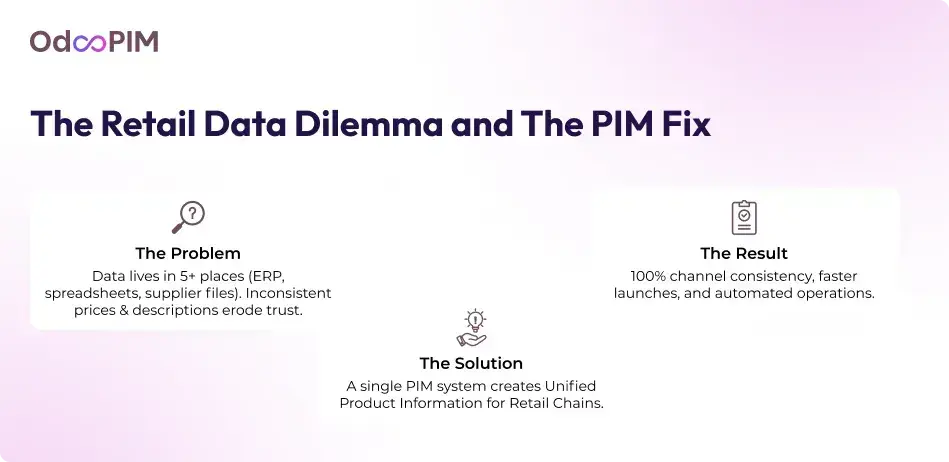
The retail industry faces relentless data chaos from juggling multiple storefronts, online marketplaces, and seasonal assortments that shift weekly. Fragmented spreadsheets and siloed systems create mismatched descriptions, outdated pricing, and inconsistent images across channels, eroding customer trust and inflating operational costs. Product Information Management (PIM) cuts through this disorder by centralizing product details, attributes, visuals, specifications, and variants, into one authoritative hub.
A PIM system like OdooPIM tackles these pain points head-on, enabling retail product data management software that powers multi-store product management and storefront product data synchronization. A PIM automates inventory and product data automation for retailers, ensuring location from PIM for brick-and-mortar stores to digital platforms displaying uniform, enriched content.
OdooPIM emerges as the best PIM for retail businesses and among the best PIM solutions, blending enterprise PIM scalability with intuitive catalogue management. Retailers gain real-time control over dynamic inventories without custom coding or endless integrations.
What Is Product Information Management (PIM) in Retail?
Product Information Management (PIM) is the software solution that controls the lifecycle of a retailer’s product information. A PIM software helps users move beyond simple spreadsheets to a unified system of record. A retail PIM system centralizes product attributes, from technical specs, pricing, and imagery to labels, compliance certifications, and localized descriptions.
A traditional item master acts as a static list of SKUs and core attributes. In contrast, an enterprise PIM is a dynamic, cloud-based PIM engine designed for commerce. It manages rich media, channel variations, seasonal campaigns, and supplier data, transforming raw information into a sales-ready asset.
For retailers, this isn’t merely about organization. Implementing one of the best PIM solutions directly fuels growth and operational agility. OdooPIM enables catalogue management and multi-store product management, ensuring that a grocery store’s online listing, a department store’s mobile app, and a supermarket’s shelf label reflect the same updated price and promotion.
Superior retail product data management software automates the synchronization of storefront product data. This automation is essential for inventory and product data automation for retailers operating online and in physical locations. The right PIM for brick-and-mortar stores bridges the digital and physical divide, creating a cohesive customer experience.
Investing in an omnichannel retail PIM solution provides a single source of truth. It delivers the unified product information retail chains require to execute cohesive strategies, whether for a niche boutique or a national supermarket chain.
Learn about OdooPIM vs. Traditional PIM Platforms.

Core Challenges in Retail Product Data Management
Product information arrives in countless formats, supplier PDFs, ERP system extracts, decentralized spreadsheets, and legacy databases. This fragmentation creates a foundational problem: there is no single version of the truth.
This inconsistency manifests directly to the customer. Prices and descriptions differ between your POS system, eCommerce site, third-party marketplaces, and print catalogues. These discrepancies erode consumer trust and degrade brand authority.
Operational costs skyrocket as teams manually reconcile these discrepancies. The consequence is painfully slow product launches, error-prone processes, and mispriced items that damage margins. In-store associates lack accurate information, online shoppers face incomplete or incorrect product details.
Attempting multi-store product management or launching an omnichannel strategy without a central command point is inefficient. Inventory and product data automation for retailers remains a distant goal when data lives in disconnected silos. The manual effort to synchronize a supermarket’s shelf tags with its mobile app, or to align a department store’s in-store kiosk with its web catalogue, becomes a full-time, error-prone task.
For grocery stores managing thousands of SKUs with frequent price changes and compliance labels, or for retail chains striving for unified product information, this fragmented approach is unsustainable. It hinders scalability, accelerates employee frustration, and directly impacts revenue through stockouts, returns, and cart abandonment.
These challenges define the urgent need for a dedicated solution. Retailers require a system to eliminate this friction and transform data from a liability into a competitive asset. This is the strategic gap that a Product Information Management (PIM) fills.
Key Capabilities of a Retail-Ready PIM System
A PIM system delivers non-negotiable capabilities.
Centralized Command and Control
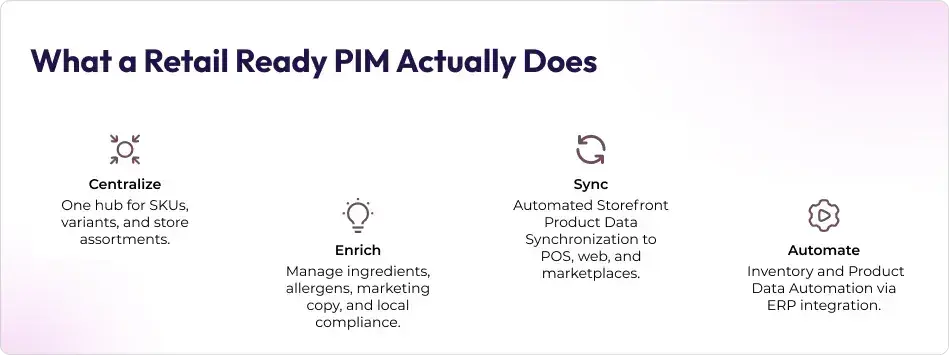
It functions as a master catalogue management hub for SKU, variant, and location assortment. This core capability enables effective multi-store product management, allowing retailers to define and control product availability and attributes by region, store format, or sales channel.
Strategic Data Enrichment and Compliance
Enterprise PIM software provides structured tools to transform raw data into compelling, compliant content. It manages detailed enrichment for ingredients, allergens, and packaging details. The system also handles promotional calendars, seasonal campaigns, and, critically, ensures adherence to local regulations, a key requirement for a PIM used in grocery stores and supermarkets.
Automated Omnichannel Distribution
A cloud-based PIM automatically pushes approved, channel-optimized information to consumer touchpoints: in-store POS systems, digital kiosks, self-checkout stations, e-commerce platforms, and mobile apps. This capability defines omnichannel retail PIM solutions.
Integrated Operational Automation
The best PIM solutions connect with core business systems. They enable inventory and product data automation for retailers through direct integration with ERP, warehouse management, and supplier platforms. This integration ensures stock levels, availability status, and logistical data flow bidirectionally, eliminating manual updates and creating a responsive operational loop.
For department stores managing complex assortments or supermarkets executing rapid price changes, these capabilities are operational necessities. They enable the agility, accuracy, and scale that retail demands. An effective PIM system isn’t just a database; it’s the central engine for retail execution.
Omnichannel Retail PIM Solutions: One View Across Touchpoint
Today’s customer moves fluidly between your website, mobile app, third-party marketplaces, and physical stores. They expect the product story to remain constant at every turn. Omnichannel retail PIM solutions are engineered to deliver this experience.
- Synchronizing the Brand Narrative
A robust PIM system disseminates a unified narrative across channels. Whether a customer views an item on their phone, a store tablet, or a marketplace listing, they encounter identical specifications, imagery, and pricing. This unified product information for retail chains eliminates confusion.
- Powering Retail Models
Advanced PIM software is the operational backbone for services like click-and-collect, ship-from-store, and endless aisle. These models depend on real-time, accurate data visibility across the network. A cloud-based PIM enables a store associate to view real-time inventory from another location, fulfilling an online order directly from the sales floor. It ensures an e-commerce site accurately reflects in-store pickup availability, and transforms inventory into a dynamic, channel-agnostic asset.
- Enabling Frictionless Experiences
Customers experience a cohesive journey when online research matches in-store reality. For the business, an enterprise PIM automates the complex synchronization of promotions, localized content, and availability updates, ensuring a department store’s app and its in-store signage are perfectly aligned. This storefront product data synchronization is non-negotiable. Whether managing a supermarket’s thousands of SKUs or a boutique’s curated collection, the principle remains: disconnected data creates a fractured experience. Implementing a dedicated PIM system consolidates control, enabling retailers to meet customers wherever they are.
Precision at Scale: Multi-Store and Multi-Format Management with PIM
A true enterprise PIM system must deliver precision control at scale, not just broad data centralization.
Granular Control at Scale
Effective multi-store product management requires the ability to define and enforce location rules within a single catalogue. This means managing distinct assortments, regional pricing strategies, and targeted promotions for each store or banner from a unified interface. A robust retail product data management software enables headquarters to govern the master catalogue delegating controlled editing rights for local adaptations. This ensures brand consistency without sacrificing local relevance.
Managing Diverse Retail Formats
The real test of a PIM system is handling divergent retail models within one organization. For example, a premium downtown flagship store requires a curated, high-margin assortment, a suburban outlet focuses on volume and value. A regional grocery chain may stock local products in markets, a national department store runs unique promotions in coastal versus inland locations. A cloud-based PIM manages these variations as rule-based exceptions to the master product record, eliminating the need for duplicate, error-prone datasets.
Operationalizing Complexity
This granular control directly fuels operational efficiency. It allows for the synchronization of storefront product data to the correct locations, ensuring each store’s signage, POS, and inventory systems reflect its planogram and pricing. This capability is for inventory and product data automation for retailers operating across diverse formats, as it ensures that replenishment and fulfillment logic are based on accurate location information.
For franchises, multi-banner retailers, or chains expanding into new regions, this is the critical functionality that separates basic PIM software from the best PIM solutions. It transforms the challenge of scaling into a strategic advantage, allowing retailers to tailor their offering to each micro-market.

Multi-Store Product Management: Scaling Across Locations and Formats
Growth creates complexity. True multi-store product management requires precision control at scale.
A capable PIM system handles this complexity from a single interface. It defines core product data once, then applies rules for each location or banner. You control regional pricing, store assortments, and targeted promotions without creating data silos. Headquarters maintains governance local managers execute within defined parameters.
A downtown flagship store needs a curated, high-margin assortment. A suburban outlet focuses on volume and family value. A cloud-based PIM like OdooPIM manages these variations as exceptions to the master record, not as separate datasets.
The operational impact is direct. This approach enables accurate storefront product data synchronization for each unique location. POS systems, shelf labels, and digital kiosks display correct local pricing and promotions. It drives inventory and product data automation for retailers, ensuring replenishment logic aligns with each store’s actual demand.
For a supermarket chain tailoring assortments to neighborhood demographics, or a department store managing holiday promotions across time zones, this capability is essential. The best PIM solutions transform location management from a logistical burden into a competitive advantage.
PIM for Different Retail Segments
Product Information Management (PIM) is not a generic tool. Its power is proven when it addresses the distinct operational demands of each retail segment.
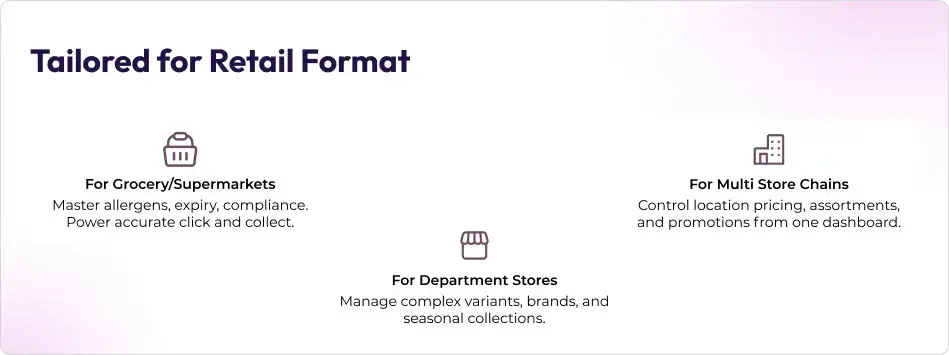
For grocery stores and supermarkets, a PIM system is a compliance and safety engine. It must manage complex attributes: ingredients, nutritional data, allergens, country of origin, and expiry codes. This data integrity is non-negotiable for consumer trust and regulatory adherence. A PIM for grocery stores also enables intelligent substitutions and powers accurate click-and-collect orders by ensuring digital descriptions match physical products. The best PIM solutions for this segment automate the synchronization of this data to shelf labels and e-commerce platforms, ensuring absolute accuracy from warehouse to checkout.
Department stores require a PIM built for complexity and curation. Retail product data management software here must handle intricate variant relationships (sizes, colors, materials), diverse brand standards, and category hierarchies. It becomes the central platform for assembling and launching seasonal catalogues and promotions across multiple brands. An enterprise PIM empowers these retailers to create compelling, consistent narratives for thousands of SKUs, driving online sales and in-store discovery through unified content.
For brick-and-mortar stores, the physical experience is key. A PIM serves as the source for dynamic signage, accurate shelf edge labels, and digital kiosk content. This storefront product data synchronization ensures the physical shelf always reflects the latest pricing, promotion, and product story. It closes the loop between digital planning and physical execution.
Across segments, from sprawling supermarket chains to specialized boutiques, the core requirement remains the same: a single, reliable source of product truth. A cloud-based PIM provides the unified product information retail chains need to operate with precision, meet segment demands, and deliver a cohesive brand experience wherever the customer engages.
Why OdooPIM Is the Best PIM for Retail Businesses
Selecting PIM software is a strategic decision that impacts the operational layer. Retail requires a solution built for its pace and complexity. OdooPIM delivers this as a purpose-built, retail-aware system.
It functions as a cloud-based PIM and provides the control and customization of an enterprise PIM. This eliminates the traditional compromise between agility and capability. You gain a system that evolves with your business, from a single store to a multi-national chain.
The decisive advantage is native integration. OdooPIM is not a standalone database; it connects directly with Odoo ERP, POS, inventory, purchasing, and eCommerce modules. This creates an automated, end-to-end data flow. A price change in the PIM updates the web store, the warehouse system, and in-store terminal simultaneously. This integration is the foundation for true inventory and product data automation for retailers.
This architecture solves core retail challenges. It provides the unified product information retail chains need for consistent branding. The platform excels at multi-store product management, enabling headquarters to control master data, permitting localized assortments and pricing. It powers omnichannel retail PIM solutions by ensuring storefront product data synchronization across websites, marketplaces, and physical stores.
Whether managing thousands of grocery SKUs, curating a department store’s seasonal collection, or unifying data for a franchise network, OdooPIM provides the control, integration, and retail intelligence to turn product information into a measurable asset.
Learn about PIM for Ecommerce
How OdooPIM Powers Retail Catalogue Management
OdooPIM transforms the catalogue from a static reference into a dynamic, actionable asset. It is the operational core for managing product lines, brands, and collections from a single, authoritative source. This centralized control is the prerequisite for scale.
The system streamlines product introduction. Onboarding new SKUs from suppliers accelerates through bulk imports and automated validation rules, ensuring data completeness and accuracy from day one. This efficiency is critical for grocery stores managing seasonal produce or department stores launching new designer collections.
Retailers create and launch seasonal catalogues, develop private-label lines with unique attributes, and orchestrate promotional assortments from within the same interface. This capability is for unified product information for retail chains, where consistency across banners must coexist with targeted campaigns.
This robust catalogue management directly fuels downstream operations. The centralized product data becomes the source for storefront product data synchronization, ensuring the channel reflects the current catalogue. It also enables inventory and product data automation for retailers by providing clean, validated data to integrated warehouse and fulfillment systems.
For supermarkets refreshing thousands of items weekly or boutique chains curating limited-edition drops, OdooPIM provides the structured control and operational agility needed to manage the retail catalogue not as an administrative task, but as a strategic commercial engine.

OdooPIM for Omnichannel & Multi-Store Retail
OdooPIM is engineered for the interconnected reality of commerce. It provides the unified foundation required to execute coherent strategies across channels and locations.
The solution guarantees consistency through automated storefront product data synchronization. A single update to an image or price in the PIM instantly flows to the e-commerce site, marketplace listings, and the in-store point-of-sale. This creates a brand experience, whether the customer shops online or in person.
It delivers precision control for complex retail networks. Multi-store product management is handled from a central interface, allowing you to define assortments, local pricing, and regional tax rules for individual stores or geographic zones. A flagship location can feature a premium collection, a discount outlet runs a separate promotional set, governed from the same core product catalogue.
As a complete omnichannel retail PIM solution, OdooPIM powers consumer touchpoints. It feeds product information to mobile applications, digital kiosks, and in-store displays, ensuring the narrative remains consistent. This unified approach is critical for implementing services like click-and-collect or endless aisle, which depend on real-time, accurate data visibility.
This end-to-end integration enables inventory and product data automation for retailers. Stock levels, availability status, and fulfillment logic are synchronized, turning a distributed network of stores and warehouses into a single, responsive organism. For retail business operating beyond a single location, OdooPIM provides the command center to manage complexity and deliver a unified customer experience.
Automation: Inventory and Product Data Automation for Retailers
Manual product and inventory management is a direct cost to your business. It creates errors, delays, and operational drag. Efficiency comes from automation, and this is where a PIM and ERP system proves its value.
With OdooPIM integrated with Odoo ERP, core retail workflows become automatic. Price updates, product activations, and seasonal deactivations are executed by rule, not by manual data entry. A supplier announces a cost increase; the system recalculates margin and updates the retail price across channels.
When stock levels fall below a defined threshold or a new assortment arrives in the warehouse, the PIM system can trigger actions. It automatically publishes new items to the web, updates store planograms, or temporarily hides out-of-stock products from sales channels. This dynamic responsiveness is the core of inventory and product data automation.
The result is a dramatic reduction in human error and acceleration of time-to-shelf. New products move from receipt to being shoppable in minutes, not days. Storefront product data synchronization happens as a background process, ensuring customer touchpoint reflects the current reality of your stock and pricing.
For grocery stores managing perishable goods or department stores executing flash sales, this automation is an operational necessity. It provides the agility to respond to market changes and the accuracy to protect margins. By removing manual bottlenecks, you reclaim time for strategic work and ensure your business operates at the speed of commerce.
OdooPIM vs Other Best PIM Solutions: What Sets It Apart for Retail
When selecting retail product data management software, generic PIM features are not enough. The critical evaluation focuses on retail performance: integration depth, operational simplicity, and true total cost of ownership.
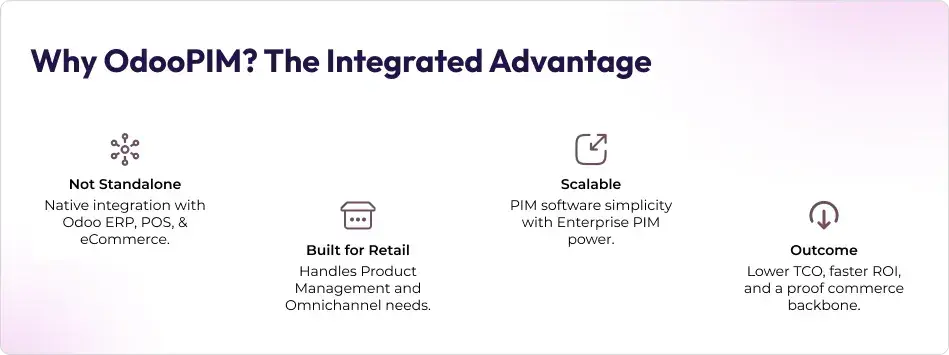
The primary differentiator is native integration. Unlike standalone PIM systems that require complex middleware, OdooPIM is built into a unified commerce platform. Its direct, pre-configured connection to Odoo’s finance, inventory, and POS modules eliminates data silos. This architecture is for achieving inventory and product data automation for retailers. A single product update flows instantly from the PIM to the ledger, the warehouse, and the checkout terminal without manual intervention or integration costs.
This inherent connectivity directly addresses core retail pain points. It enables multi-store product management by linking location assortments directly to local stock levels. It powers robust omnichannel retail PIM solutions by ensuring that changes in the central catalogue synchronize instantly across web, mobile, and in-store displays. The system delivers unified product information for retail chains respecting the operational realities of individual stores.
As a PIM software, OdooPIM offers the affordability and simplicity required by a small boutique or a startup grocery store. Yet its underlying architecture provides the extensibility and control of an enterprise PIM, capable of scaling to manage the complex needs of national supermarkets or department store chains. This flexibility means a business can adopt one system for its product lifecycle, avoiding costly and disruptive platform migrations.
Other best PIM solutions may excel in isolated features, OdooPIM’s advantage is its cohesive, retail-native ecosystem.
Implementation Blueprint: Rolling Out OdooPIM in a Retail Environment
A successful PIM implementation demands a strategic, operational plan, besides technical installation.
The process begins with a data audit. Assess the quality and structure of existing data across sources, supplier files, legacy systems, and spreadsheets. Concurrently, design a robust retail taxonomy that defines your category hierarchy, attributes, and validation rules. This structural design is needed for effective catalogue management across diverse formats, from grocery to department stores.
Integration planning is the decisive step. Map touchpoint that requires product data: your ERP, e-commerce platform, POS systems, and supplier portals.
A phased rollout mitigates risk and demonstrates value. For a supermarket chain, begin with a core category like dry goods to prove the model before expanding to perishables. A department store might launch with a single brand or seasonal collection. This approach allows teams to adapt and refine processes before scaling to full multi-store product management.
Adoption hinges on effective change management. Engage merchandising, marketing, and store operations early. Train these teams not just on software mechanics, but on the new operational workflow, how to launch products faster, how local managers can request assortment changes, and how the system enables storefront product data synchronization. Their buy-in transforms the PIM from an IT project into a core business asset.
This structured implementation turns OdooPIM into the operational backbone, delivering the control and clarity needed for retail execution.
Frequently Asked Questions
1. What is a PIM system, and how is it different from an ERP or a basic spreadsheet for retail?
A Product Information Management (PIM) system is a dedicated software platform designed to be the single, authoritative source for product-related content. Its core function is to centralize, enrich, and govern the array of data that defines a product, from technical specifications, images, and marketing descriptions to pricing, compliance certifications, and channel variations. In retail, a PIM system transforms scattered, raw data from suppliers, legacy tools, and spreadsheets into a unified, commerce-ready asset. This process is essential for accurate and compelling product storytelling, making it the foundational layer for executing omnichannel retail PIM solutions. Without a PIM, retailers are left manually stitching together information, leading to inconsistencies.
The PIM system is not an Enterprise Resource Planning (ERP) system, though they are complementary. An ERP is the financial and operational backbone, managing transactions, inventory counts, accounting, and supply chain logistics. It answers questions like “How many do we have?” and “What did it cost?” In contrast, PIM software answers “What is this product?” and “How do we sell it?” The PIM is the rich, descriptive layer that feeds customer-facing channels. When integrated, they enable inventory and product data automation for retailers: the PIM provides the enriched product content, and the ERP provides real-time stock and financial data, allowing for dynamic updates across the business. A best-in-class, cloud-based PIM like OdooPIM is built for this native integration, ensuring that a price change in the ERP flows instantly to the PIM and out to storefront and marketplace.
Abandoning basic spreadsheets for a retail product data management software is a key step for growth. Spreadsheets are static, error-prone, and unable to scale or support collaboration. They fracture data across departments, making unified product information for retail chains impossible. A robust PIM software designed for retail, provides structured workflows, permission controls, and automated validation. It enables sophisticated multi-store product management, allowing retailers to maintain a central catalogue defining location assortments and pricing for brick-and-mortar stores. This capability for storefront product data synchronization is what separates foundational item lists from a strategic enterprise PIM. For any retailer, from a boutique to a national supermarket chain, investing in one of the best PIM solutions such as OdooPIM is the move from managing data chaos to commanding a scalable, consistent, and automated commerce experience.
2. Why is OdooPIM considered one of the best PIM solutions for retail businesses?
OdooPIM is distinguished as one of the best PIM solutions because it is engineered for retail’s operational realities. Unlike standalone PIM software, OdooPIM is natively integrated within the Odoo business platform. This foundational architecture eliminates the costly and complex middleware required to connect a PIM system to core operational modules like ERP, Point-of-Sale (POS), inventory, and e-commerce. For retailers, this connectivity is transformative, enabling inventory and product data automation for retailers. A price update or new product activation in the PIM instantly cascades to the financial ledger, warehouse management system, online store, and in-store terminals. This inherent integration solves the pain point of data silos, making it a superior retail product data management software.
The platform excels in addressing the distinct needs of diverse retail formats, making it the best PIM for retail businesses of scale. It provides the granular control required for effective multi-store product management, allowing headquarters to govern a master catalogue enforcing location assortments, pricing, and promotions for individual stores or regional banners. OdooPIM’s specialized features cater to segment demands: it manages critical compliance data like allergens and expiry dates for PIM for grocery stores and supermarkets, and handles complex variants and seasonal collections for PIM for department stores. Its robust catalogue management and automated storefront product data synchronization ensure that whether a customer shops online, in a PIM for brick-and-mortar stores, or via a mobile app, they encounter a perfectly consistent product story.
OdooPIM’s cloud-based PIM delivery offers scalability and affordability, its depth of functionality meets enterprise PIM requirements. This means a growing boutique can start with the same system used by a national supermarket chain, avoiding disruptive re-platforming later. Its design as a complete omnichannel retail PIM solution ensures it powers consumer touchpoint, from marketplaces and web stores to in-store kiosks and shelf labels. By combining retail functionality, native operational integration, and scalable architecture, OdooPIM moves beyond managing data; it provides the definitive command center for retail execution.
3. How does OdooPIM handle needs like PIM for grocery stores or PIM for department stores?
OdooPIM handles the distinct demands of different retail segments by offering configurable, attribute-driven catalogue management at its core. For PIM for grocery stores and supermarkets, the system is engineered to manage critical, non-negotiable data points with precision. This includes structured fields for ingredients, nutritional information, allergens, country of origin, unit-of-measure conversions, and expiry dates. This rigorous data governance is vital for regulatory compliance, customer safety, and enabling accurate services like click and collect. As a PIM, it ensures this complex, perishable data is centrally controlled and can be dynamically synchronized to shelf labels, e-commerce listings, and handheld store devices, maintaining absolute accuracy across high-velocity SKU changes.
Conversely, for PIM for department stores, OdooPIM excels at managing complexity of a different nature. It provides the framework to handle intricate product relationships, such as extensive variants across sizes, colors, and materials, as well as brand and category hierarchies. The system supports the creation and launch of curated seasonal collections and promotional catalogues, allowing merchandisers to assemble compelling narratives from thousands of individual items. This capability for rich, brand-conscious content management is for creating a premium omnichannel experience, ensuring a cohesive story is told whether a customer is browsing online or in a flagship location.
Despite these specialized applications, OdooPIM delivers unified product information for retail chains operating mixed formats. Its architecture supports sophisticated multi-store product management, enabling a single corporate instance to define a master catalogue permitting localized assortments, pricing, and promotions tailored to a store’s format, be it a downtown flagship, a suburban outlet, or a discount banner. This granular control feeds directly into storefront product data synchronization and inventory and product data automation for retailers. By providing a single, flexible PIM system that adapts to segment needs maintaining central governance, OdooPIM proves why it is considered among the best PIM solutions for diverse retail product data management software requirements, from a local grocery to a national department store chain.
4. Can OdooPIM support a truly omnichannel strategy for a multi-location retailer?
OdooPIM is designed as an omnichannel retail PIM solution required to execute a multi-channel strategy. For a multi location retailer, this means the PIM system provides unified product information for retail chains from a centralized PIM hub. Any update to a product’s description, image, price, or promotion is managed in OdooPIM and is then programmed for distribution to predefined customer touchpoints. This architecture maintains brand consistency, whether a customer is shopping online, in a PIM for brick-and-mortar stores, or via a mobile app, making it a cornerstone of retail product data management software.
The platform’s strength is its ability to combine this central governance with localized execution, which is key for multi-store product management. Ensuring a consistent core product narrative, OdooPIM allows retailers to define location rules for assortments, pricing, and promotions for different store formats, such as distinguishing between a PIM for a department stores flagship location and a suburban outlet, or tailoring offerings for a PIM for supermarkets in a demographic region. This granular control ensures that the store’s unique strategy is reflected in its catalogue management. This control directly enables services like click and collect, ship from store, and endless aisle, which rely on real-time, accurate visibility of product data and inventory across the network.
OdooPIM’s native integration within the Odoo ecosystem is what transforms it from a data repository into an operational engine for omnichannel retail. Its connection to Odoo’s POS, e-commerce, and inventory modules enables true inventory and product data automation for retailers. This integration ensures that the product data synchronization is not a manual batch process but a real-time flow. Changes in availability from the warehouse or a local stockroom update online listings and in-store systems. By providing the centralized content command and the automated, channel distribution, OdooPIM delivers the operational integrity and agility that makes it one of the best PIM solutions for retail businesses.
5. What does implementation involve, and is it suitable for a growing retail chain?
Implementing OdooPIM is a strategic operational project, it begins with a foundational phase of data auditing and taxonomy design. This involves scrutinizing existing product data from sources, supplier sheets, legacy systems, and spreadsheets to assess quality and gaps. A retail taxonomy is built, defining the category hierarchies, attribute sets, and validation rules that will govern product information. This structured framework is crucial for effective catalogue management.
The subsequent and critical phase is integration planning. This maps how the PIM system will connect with the existing technology ecosystem, the ERP, e-commerce platform, and POS systems. For a growing retail chain, this step ensures the cloud-based PIM becomes the central hub for unified product information, enabling essential inventory and product data automation for retailers. A phased rollout strategy is then deployed to mitigate risk and demonstrate value. A chain might pilot the PIM software with a single category, a brand, or a select group of locations, proving the workflow for multi-store product management before scaling to the organization.
This phased approach makes OdooPIM exceptionally suitable for a growing retail chain. Its scalable enterprise PIM architecture supports businesses from a handful of stores to a national network. The implementation builds the infrastructure for omnichannel retail PIM solutions from the outset, ensuring that storefront product data synchronization is ingrained in operations. By starting with a solid data foundation and scalable integrations, a growing chain avoids the costly re-platforming projects that plague rapidly scaling businesses.
6. How does OdooPIM drive automation and reduce manual work?
OdooPIM drives automation by functioning as the intelligent command center for product information, eliminating repetitive data tasks at their source. Once product data is enriched and validated within this cloud-based PIM, the system automates its distribution. This means a price change, new image upload, or product description update is made in OdooPIM and then automatically propagated, a process known as storefront product data synchronization, to the connected channel. This includes e-commerce sites, marketplace listings, mobile apps, and in store POS systems, eradicating the need for teams to manually update each platform. For product management, rules can be set to automate location pricing and assortments.
Significant automation gains are achieved through OdooPIM’s native integration with the Odoo ecosystem, including its ERP and inventory modules. This connectivity is the engine for inventory and product data automation for retailers. Workflows become rule based and event driven: when inventory levels for a product drop below a threshold in the warehouse system, the PIM can automatically trigger actions like hiding the item from online storefronts or updating its availability status. When a new shipment is logged in the ERP, those items can be automatically activated and published to sales channels. This bidirectional automation closes the loop between supply chain data and customer-facing content.
OdooPIM automates complex catalogue management processes essential for diverse retail segments. For PIM in grocery stores and supermarkets, it can manage lifecycle states for perishable goods or automate the enrichment of mandatory fields, such as allergens and nutritional information. For PIM for department stores, it can streamline the launch of seasonal collections by automating the association of new products with promotional campaigns and channel placements. By handling these specialized, time-intensive processes within a centralized OdooPIM reduces human error, accelerates time to market, and liberates merchandising and operations teams from administrative data work. This operational efficiency is a key reason it is positioned among the best PIM solutions and essential retail product data management software.
