


What a PIM data model is?
A PIM data model is the architectural blueprint for your PIM database. This PIM model structures PIM data, defining attributes, hierarchies, and relationships, to form the backbone of disciplined PIM data management. Implementing a solution like OdooPIM operationalizes this model, transforming information into a product asset. This foundation is what makes AI data modeling and omnichannel distribution possible.
What Is PIM data?
PIM data refers to the complete information portfolio for your products. It includes identifiers like SKUs, technical specifications, pricing rules, marketing descriptions, digital assets, and region translations. This PIM data resides in a PIM database, organized by a formal PIM data model to enable PIM data management. This governance ensures accuracy for sales channels and creates the enriched dataset required for AI data modeling.

Key components of a PIM data model
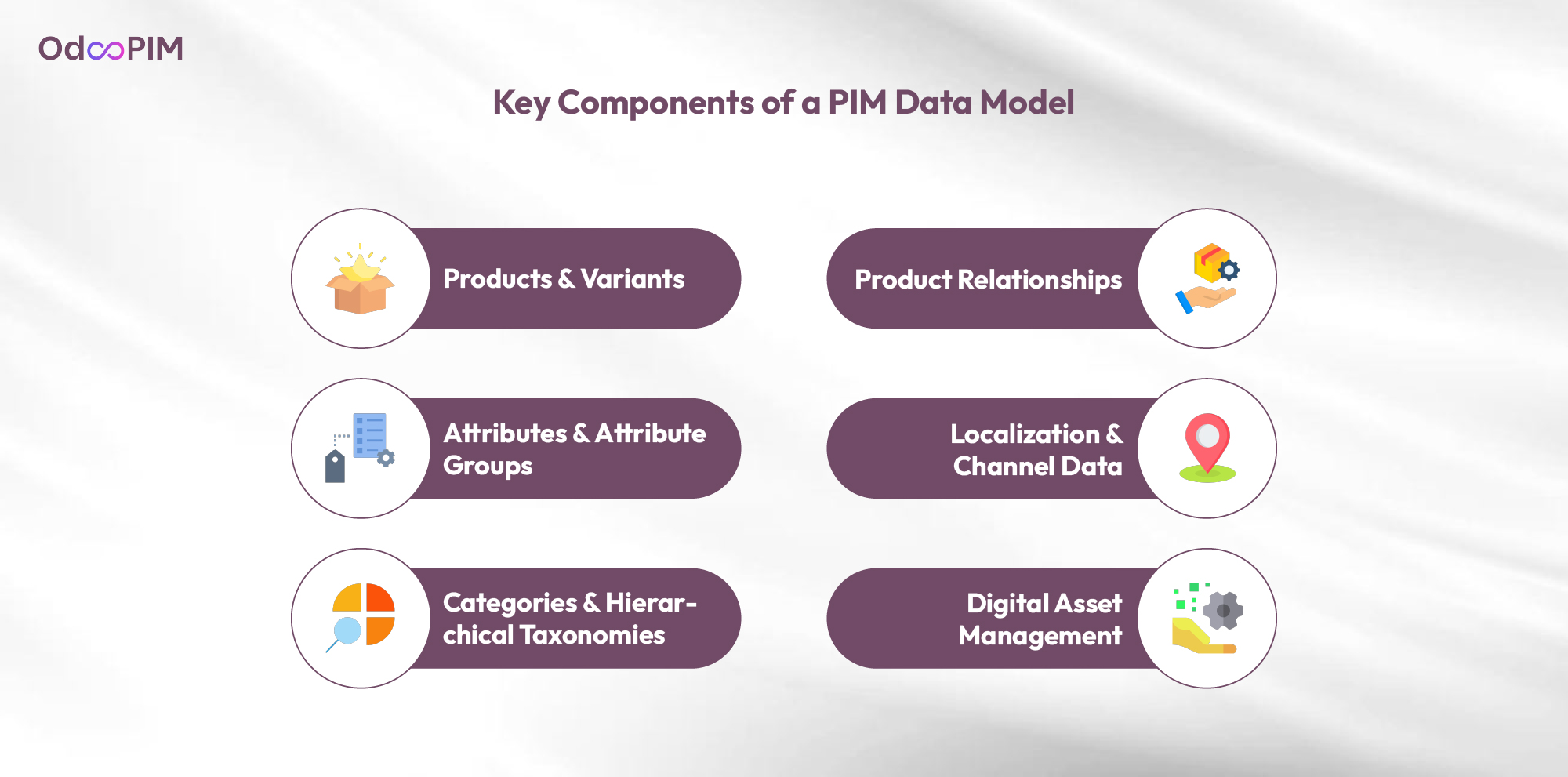
A PIM model provides the structure for your PIM database, defining how PIM data is organized and related. Its key components form the backbone of PIM data management.
1. Products & variants
The entities in the PIM database, representing a sellable item and its configurations, such as size and color.
2. Attributes & attribute groups
The defined characteristics, such as the material, and weight of products, grouped (Technical Specs, Marketing) for clarity and efficient management.
3. Categories & hierarchical taxonomies
The classification system that organizes products into logical families and sub-families for navigation, filtering, and reporting.
4. Product relationships
Explicit links between items to enable cross-selling, up-selling, and bundling, such as “spare parts for,” and “frequently bought together”.
5. Localization & channel data
Rules and fields that adapt main product information for different languages, regions, and sales channels, namely Amazon vs. B2B portal.
6. Digital asset management
Centralized linking of supporting media, images, videos, PDFs to the products and variants within the PIM data model.
Learn about PIM Master data management.
Gartner reports that poor data quality costs organizations $12.9 million annually — proving that structured PIM data modeling is not optional, but strategic.
– Gartner
Role of PIM data management
PIM data management is the discipline that brings a PIM data model to life within a PIM database. It transforms definitions into product information. Its functions are the backbone of commerce operations.
Governance & data quality: Enforces standardized formats, mandatory fields, and value consistency across PIM data, ensuring it meets a defined gold standard.
Validation & completeness: Implements automated rules that check for accuracy, such as valid GTIN and completeness, such as required images present before data publication.
Versioning & approval workflows: Maintains a historical record of changes and mandates review cycles, providing audit trails and preventing unauthorized updates.
Centralized control for multi-channel distribution: Acts as the source of truth, enabling the syndication of tailored product information to sales channels from an authoritative PIM database.
By executing these functions, PIM data management ensures the information governed by your PIM model is not just structured, but also trustworthy and actionable. This creates the organized dataset that is essential for AI data modeling, predictive analytics, and automated personalization.

How OdooPIM implements the PIM data model
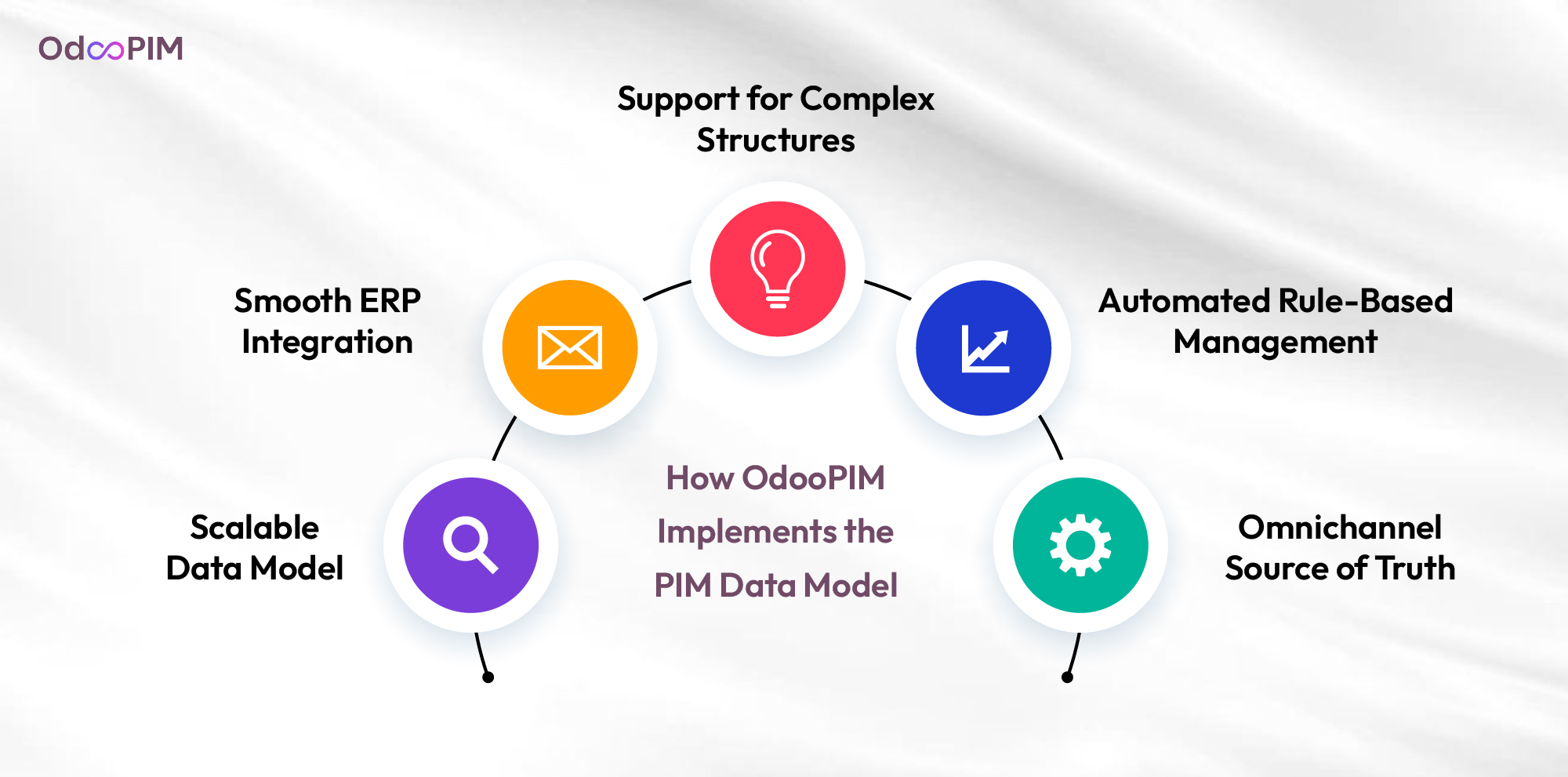
OdooPIM constructs a PIM data model that forms the core of the PIM database. This implementation provides a practical and scalable framework for enterprise PIM data management.
Scalable data model: Offers a PIM model that can be tailored with attributes, families, and categories to fit any product portfolio, from simple to highly complex.
Smooth ERP integration: The PIM data model is synchronized with Odoo’s ERP, ensuring financial data, inventory, and product information are aligned in an ecosystem.
Support for complex structures: Manages product definitions, including multi-level variants (e.g., size-color-style), configurable options, and media assets within the PIM database.
Automated rule-based management: Enforces PIM data management through automated workflows, updates, and validation rules, ensuring data quality and governance at scale.
Omnichannel source of truth: The PIM data model syndicates consistent, and channel-adapted PIM data to websites, marketplaces, and print catalogs from an authoritative point.
Learn about PDM tools.
Benefits of a strong PIM data model
A PIM data model is the engine that transforms product information into a business asset. Its design dictates the efficiency of your PIM database and the quality of your PIM data management. The benefits are significant:
Faster time-to-market: A PIM model eliminates guesswork. Onboarding new products becomes a repeatable process, accelerating launches.
Drastic reduction in data errors: Enforced governance, like mandatory fields and validation rules, ensures PIM data is accurate and complete from the start, preventing mistakes.
Efficient catalog scaling: The nature of a strong PIM data model allows for addition of new product lines, categories, or attributes without system overhaul.
Guaranteed omnichannel consistency: As the source of truth, the PIM model ensures the channel receives tailored yet consistent information, building brand trust.
Superior customer experience: Accurate product data across touchpoints reduces confusion, aids decision-making, and enhances satisfaction.

Learn about Product data management.
Best practices for designing a PIM data model
1. Start with business use cases
Define the PIM model by mapping it to your commercial goals, such as entering new markets or enabling bundles. This ensures the structure delivers value.
2. Avoid over-engineering
Resist creating attributes. A streamlined PIM data model is easier to maintain, and use, preventing user adoption issues.
3. Plan for localization & future channels:
Design the model to support multi-language content, regional regulations, and future sales channels from the outset.
4. Separate ERP and PIM responsibilities clearly
The PIM data model should govern commercial and marketing information. Keep operational data, such as real-time stock in the ERP. This maintains system integrity and clarity.
5. Build for analytics & AI
Structure attributes and relationships with AI data modeling in mind. Categorized, and interconnected PIM data is the fuel for machine learning and insights.
Your PIM data model is the blueprint for commerce success. It is the architecture that transforms PIM data within your PIM database into a scalable asset. Investing in this PIM model enables disciplined PIM data management, powers omnichannel consistency, and creates the high-quality information mandatory for AI data modeling and competitive advantage.

FAQ
1. What is a PIM data model and how does it work?
A PIM data model is the master blueprint for your PIM database, and defines the structure of your PIM data. This PIM model works by establishing rules for attributes, relationships, and governance, enabling PIM data management and creating the foundation required for AI data modeling.
2. Why is a PIM data model important for scalable product data?
A PIM data model ensures your PIM database can scale without chaos. It provides the framework for PIM data management, allowing for the addition of new products, categories, and channels. This governance is important for maintaining data integrity and enabling advanced AI data modeling at volume.
3. How is PIM data different from product data stored in an ERP system?
PIM data is commercial and marketing information designed for customer channels. In contrast, ERP product data focuses on operational, transactional details like cost and inventory. A PIM data model structures commercial PIM data in a PIM database for engagement, while ERP manages the operational backbone.
4. What types of product information are managed within a PIM database?
A PIM database manages customer product information. This PIM data includes marketing descriptions, technical specs, digital assets, pricing, localized content, and channel details. Governed by the PIM data model, this enables PIM data management and feeds omnichannel sales and AI data modeling.
5. How does a PIM data model handle complex product variants and attributes?
A PIM data model defines parent-child relationships and configurable attribute sets within the PIM database. This structure allows the PIM model to manage variants (size, color, style) systematically, ensuring accurate PIM data management and creating the data relationships vital for AI data modeling.
