



An ecommerce product data feed is the structured digital backbone containing important details about your catalog, from SKUs and descriptions to specifications, imagery, and dynamic pricing. This master file is distributed to channels like Google Shopping, Amazon, and social platforms, making its integrity a priority. Product feed management and product data feed management are crucial for maintaining accuracy, ensuring compliance with channel rules, and influencing discoverability and conversion rates for your ecommerce data feed.
Achieving Strategic Optimization with OdooPIM
Mastering product feed optimization at scale requires moving beyond manual spreadsheets to a Product Information Management (PIM) solution. OdooPIM serves as the central command hub for shopping data feed management, automating the aggregation, enrichment, and validation of product information from multiple sources. By governing data quality and relationships within a platform, OdooPIM enables product data feed optimization with AI. This approach ensures your ecommerce product data feed is not just exported, but enhanced, adapted for channel’s requirements, and performs at its peak to drive revenue.
What Is an Ecommerce Product Data Feed?
An ecommerce product data feed is the machine-readable inventory file that organizes and standardizes your product catalog for digital distribution. More than a list, this structured ecommerce data feed contains defined attributes, including SKUs, titles, detailed descriptions, high-resolution images, pricing, availability, and key specifications like size or color. It acts as the source of truth, enabling product feed management and product data feed management by ensuring absolute consistency. The integrity and accuracy of this asset fuels downstream shopping data feed management, marketing automation, and product data feed optimization efforts.
According to Gartner, businesses can lose up to 3 % of annual revenue due to errors in product information.
–Gartner via Vinculum blog
Key Channel Examples in Practice
The function of your master ecommerce product data feed is to populate and synchronize product information across diverse sales channels. For instance, a Google Shopping feed requires optimization for search algorithms, while an Amazon feed must comply with categorization and bullet-point rules.
A Facebook and Instagram product catalog feed leverages imagery and tags for dynamic ad campaigns. Other marketplaces, like eBay or niche platforms, have technical requirements. This landscape makes product feed optimization unique. Strategic product data feed management involves adapting the ecommerce product data feed for the channel’s schema, enhancing titles, refining attributes, and ensuring compliance to maximize product visibility, click-through rates, and overall performance in a digital storefront.
Learn about What is Product Master Data Management? A Foundational Definition
What Is Product Feed Management?
Product feed management is the process of governing your master ecommerce product data feed. This cycle of product data feed management involves creating, validating, enriching, and optimizing this central ecommerce data feed. The goal is product feed optimization, ensuring your shopping data feed management delivers a formatted, high-performing ecommerce product data feed to the sales channel, driving maximum visibility and conversions through product data feed optimization.

Why Ecommerce Businesses Struggle With Product Data Feeds
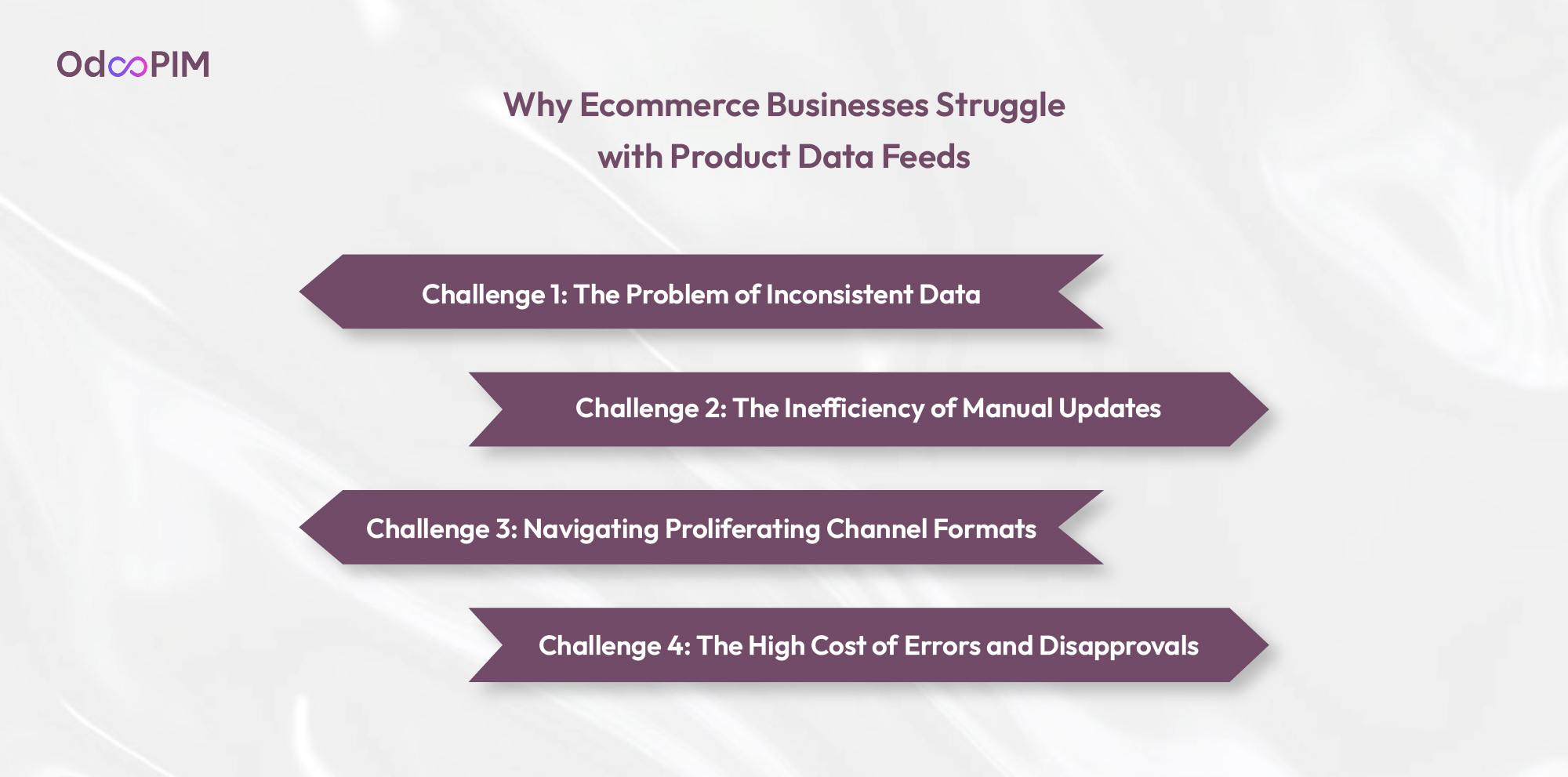
The Problem of Inconsistent Data
The foundation of your ecommerce product data feed crumbles when product information originates from disconnected sources like ERP, supplier sheets, and spreadsheets. This creates conflicting titles, images, and pricing, corrupting the ecommerce data feed before it’s distributed. It forces teams into reconciliation, crippling shopping data feed management and making product feed optimization impossible to achieve.
The Inefficiency of Manual Updates
Relying on manual spreadsheets for product data feed management is a path to obsolescence. The price change, inventory update, or seasonal promotion requires hands-on editing, guaranteeing delays and human error. This process cannot scale, locking your ecommerce product data feed in a static state and preventing the agility required for product feed optimization in a market.
Navigating Proliferating Channel Formats
A master ecommerce product data feed should be fractured to meet the distinct, conflicting, technical specifications of Google, Amazon, Facebook, and countless marketplaces. Manually creating and maintaining dozens of custom-fitted variants from one source file is a massive operational burden. This fragmentation siphons resources away from product feed optimization, turning channel expansion into a logistical quagmire.
The High Cost of Errors and Disapprovals
Channels enforce strict rules, and minor discrepancies in your ecommerce product data feed, a missing GTIN, an oversized image, or a misplaced comma, trigger listing disapprovals or suspensions. These errors halt revenue and erode channel trust, highlighting the consequences of product data feed management. Preventing them requires the validation and automation that is central to product feed optimization.
Role of PIM in Ecommerce Product Data Feed Management
A PIM system centralizes product information, establishing one authoritative source. This eliminates conflicts at the origin, fortifying your ecommerce product data feed. It transforms product feed management into a governed process, providing the data foundation required for product data feed optimization and shopping data feed management activities.
Standardizing Product Information
PIM enforces data governance, applying consistent rules for attributes, categorization, and naming conventions. This standardization is important for product feed optimization, ensuring product record in your master ecommerce data feed is complete, accurate, and structured for performance, enhancing the quality of the final ecommerce product data feed.
Automated Feed Generation
By automating the export process, PIM removes the manual burden of product data feed management. It pulls from the catalog to generate your updated ecommerce product data feed on schedule. This automation is the engine of scalable product feed optimization, ensuring your ecommerce data feed is current and freeing teams for strategic analysis.
Channel-Specific Data Management
PIM systems excel at managing channel rules within one platform. They adapt the master ecommerce product data feed, tailoring attributes, images, and titles to meet the requirements of Google, Amazon, or Facebook. This capability is the cornerstone of shopping data feed management, enabling product data feed optimization for sales endpoints without creating multiple manual files.
Delivering Accurate and Scalable Feeds
PIM ensures the accuracy and limitless scalability of your ecommerce product data feed. By automating validation and enrichment, it guarantees an ecommerce data feed. This infrastructure supports catalog expansion, making product feed management and product feed optimization sustainable as your product range and channel footprint grow exponentially.

Product Feed Optimization Explained
Product feed optimization is the process of refining your master ecommerce product data feed to maximize performance. It moves beyond basic product data feed management to enhance attributes, titles, and images within the ecommerce data feed. This work ensures your shopping data feed management delivers a high-converting ecommerce product data feed, driving visibility and sales through data-driven product feed optimization.
How OdooPIM Simplifies Ecommerce Data Feed Management
How OdooPIM Simplifies with Centralized Data
OdooPIM simplifies product data management by bringing everything into a single, centralized platform. Instead of scattered spreadsheets, disconnected systems, and inconsistent vendor files, all product information lives in one place—structured, standardized, and easy to access. Teams across marketing, sales, e‑commerce, and operations work from the same master catalog, eliminating duplication and conflicting versions. With centralized data, updates flow instantly to every channel, ensuring accuracy, consistency, and faster time‑to‑market.
How OdooPIM Simplifies with Automated Feed Generation
The platform automates the export process, eliminating manual spreadsheet work. It generates your updated ecommerce data feed on demand, transforming shopping data feed management from a repetitive task into a scheduled, error-free operation that ensures feeds are always current.
How OdooPIM Simplifies with Channel Formatting
OdooPIM manages channel rules within one interface. It tailors your master ecommerce product data feed to the specifications of Google, Amazon, or Facebook. This capability is crucial for product feed optimization, enabling compliance across platforms without manual adaptation.
How OdooPIM Enables Enterprise Scalability
OdooPIM ensures your ecommerce product data feed scales with catalog and channel growth. Its architecture automates validation and enrichment, making product feed management and product data feed optimization sustainable for thousands of SKUs, supporting enterprise expansion.

Best Practices for Shopping Data Feed Management
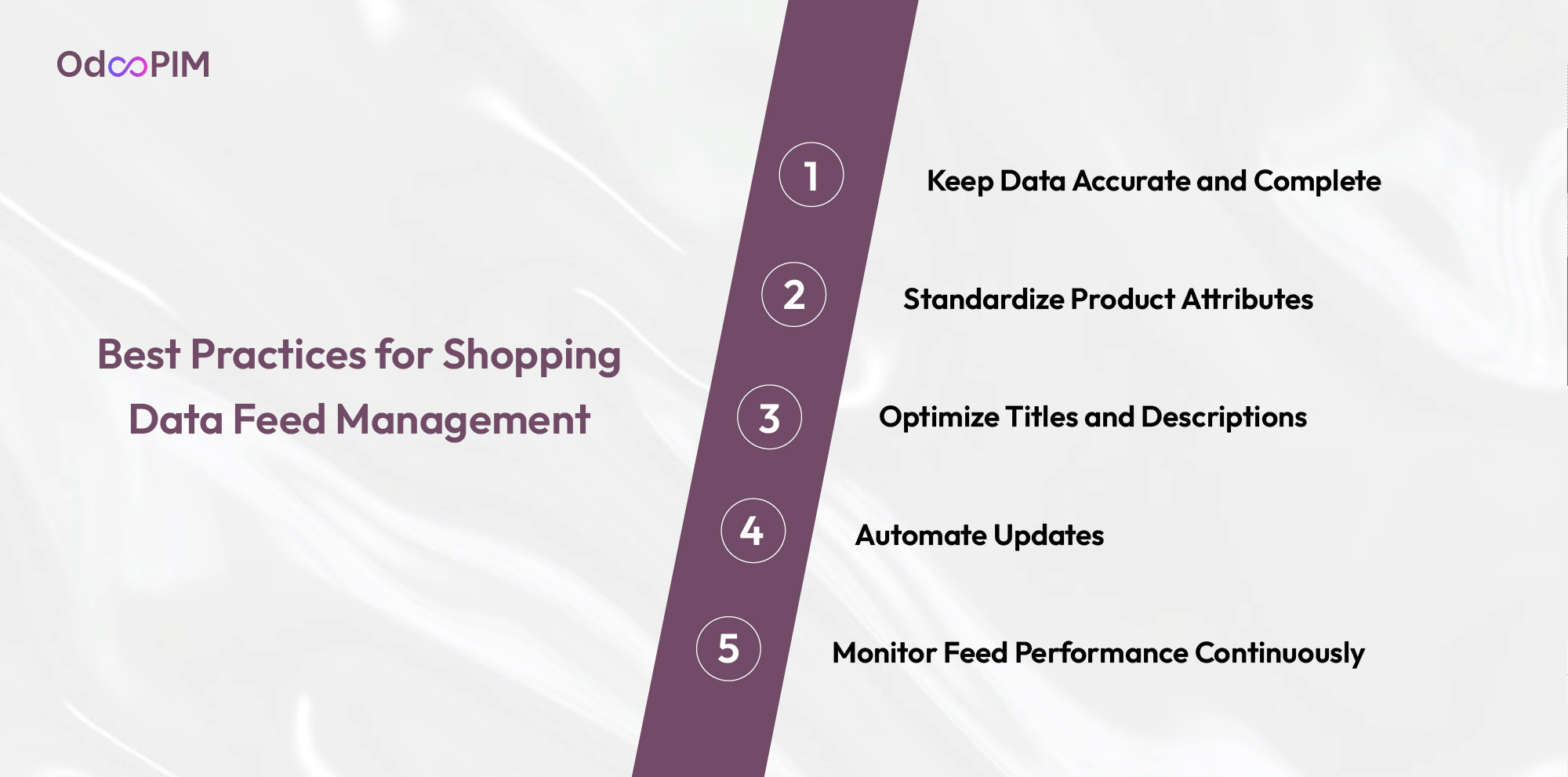
Keep Data Accurate and Complete
Validate attribute in your ecommerce product data feed. Incomplete or incorrect data guarantees channel disapproval, crippling performance. This discipline is the foundation of product feed management and product feed optimization.
Standardize Product Attributes
Enforce governance for attributes like color, size, and category across your catalog. This standardization within your master ecommerce data feed ensures parsing by algorithms, enabling product data feed management and scalable product data feed optimization.
Optimize Titles and Descriptions
Craft titles and descriptions within your ecommerce product data feed for search algorithms and customers. Incorporate keywords and value propositions. This is a tactic of product feed optimization that boosts rates and conversions.
Automate Updates
Automate the synchronization of pricing, inventory, and promotions into your ecommerce product data feed. This automation is important for shopping data feed management, ensuring accuracy and freeing resources for analysis and product feed optimization.
Monitor Feed Performance Continuously
Analyze channel reports for impressions, clicks, and errors. Use these insights to refine your ecommerce product data feed, adjusting attributes and content. This closed-loop approach turns shopping data feed management into a cycle of product data feed optimization and revenue growth.

FAQ Section
1. How can businesses manage product data feeds from a centralized system?
Businesses can manage product data feeds from a centralized system by consolidating all product information—such as descriptions, attributes, pricing, images, and SKUs—into a single source of truth like OdooPIM. Once data is imported and standardized in this central repository, businesses can define channel‑specific templates and rules, then automatically export or syndicate feeds to e‑commerce platforms, marketplaces, and internal systems. Any update made in the central system propagates instantly to connected channels, eliminating manual re‑entry and ensuring consistency. This approach reduces errors, accelerates catalog publishing, and makes it easy to maintain accurate, up‑to‑date product feeds across a complex multi‑channel landscape.
2. What role does structured product data play in successful feed optimization?
Structured data is the framework for product feed optimization. It ensures the attribute in your ecommerce product data feed is defined and categorized, allowing algorithms to parse it. This structure is the prerequisite for advanced product data feed optimization that enhances search visibility and performance.
3. How can automation reduce errors in ecommerce product data feeds?
Automation eliminates manual data entry and spreadsheet updates, the sources of human error in product data feed management. By syncing prices, inventory, and content into the ecommerce product data feed, it ensures accuracy and consistency, preventing costly listing disapproval and forming a basis for product feed optimization.
4. Can a PIM system manage ecommerce data feeds?
Yes, a PIM system can manage ecommerce data feeds effectively. It acts as a centralized hub for all product information, such as titles, descriptions, prices, SKUs, images, and attributes and then exports that data into structured feeds tailored to each ecommerce channel, marketplace, or advertising platform. A PIM like OdooPIM can map fields, apply channel‑specific rules, and automate regular exports or API‑driven updates, so any change in the central catalog instantly propagates to all connected ecommerce feeds.
5. How does OdooPIM support product feed management?
OdooPIM streamlines the product feed management process. It serves as the central hub for product data, automates the generation of your ecommerce product data feed, and manages formatting rules. This approach ensures accuracy and enables product data feed optimization, simplifying complex shopping data feed management at scale.
