



What Is Product Data for Ecommerce?
Product data for ecommerce is the digital foundation of online stores. This ecommerce product data comprises detail, from titles and descriptions to images, specs, and inventory levels, contained within your e commerce dataset. Effective ecommerce product data management transforms information into product data sheets for accuracy across channels. By interrogating this e-commerce dataset, you move beyond basic ecommerce data to drive strategic decisions on pricing, marketing, and inventory, fueling growth and customer experience.
Types of Ecommerce Product Data

Your ecommerce product data breaks down into these critical categories:
1. Main Product Information
The layer of your ecommerce data, including SKUs, titles, and pricing. This data forms the columns in the product data sheet.
2. Marketing & Descriptive Content
Persuasive copy, SEO meta descriptions, and narratives that convert browsers into buyers within the e-commerce dataset.
3. Technical Specifications
Detailed attributes like dimensions, materials, and compatibility. Specs are non-negotiable for competent ecommerce product data management.
4. Digital Assets
High-resolution images, videos, and 3D models that provide the visual proof for your product data for ecommerce.
5. Channel-Specific Attributes
Tailored fields required by platforms like Amazon or Google Shopping. Optimizing this e-commerce dataset is vital for multi-channel success and targeted ecommerce data analysis.
Learn about Master product data management.

Role of Product Data Sheets in Ecommerce
The static product data sheet, a spreadsheet is a common starting point for organizing ecommerce product data. Treating it as your central source creates operational risk.
Static vs. Dynamic: Traditional sheets are inflexible snapshots, while product data for ecommerce should be a relational e-commerce dataset that updates across the channels in real time.
Management Challenges: Spreadsheet-based ecommerce product data management is error-prone, creates version chaos, and cannot scale, crippling the integrity of your ecommerce data.
Beyond the Source: A standalone product data sheet lacks the source architecture needed for reliable ecommerce data analysis. Your source of truth must be a centralized Product Information Management (PIM) system, where the sheet is merely an output, not the foundation.
Ecommerce Product Data Management Challenges
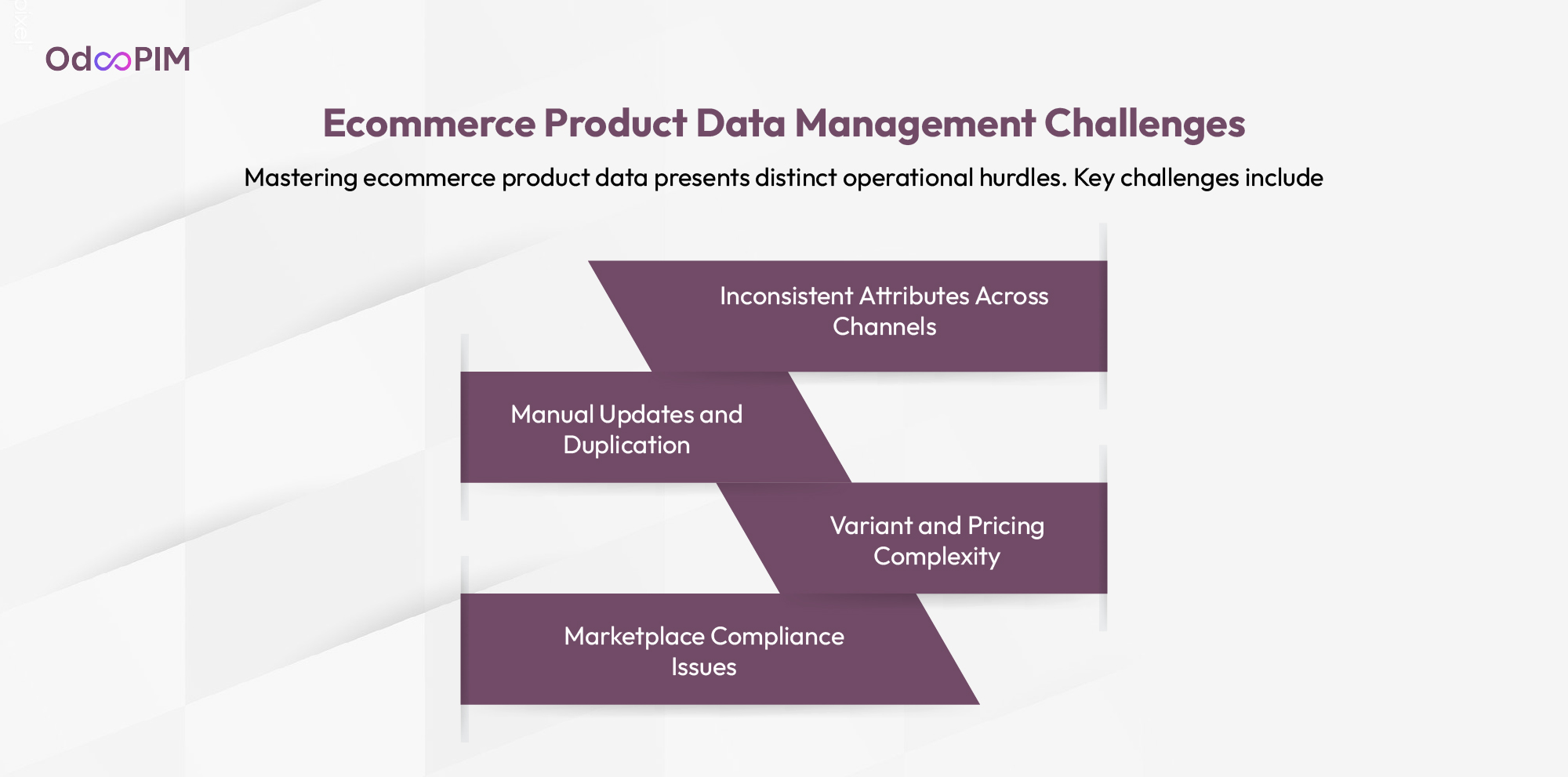
Mastering ecommerce product data presents distinct operational hurdles. Key challenges include:
1. Inconsistent Attributes Across Channels
Each sales platform demands unique specifications. Manually tailoring a product data sheet for each one fractures your e-commerce dataset, eroding brand consistency and hindering unified ecommerce data analysis.
2. Manual Updates and Duplication
Editing spreadsheets for price change or inventory update is inefficient. This manual ecommerce product data management introduces errors and creates conflicting versions, corrupting your source of truth.
3. Variant and Pricing Complexity
Managing SKUs, bundles, and regional pricing within a static e-commerce dataset becomes unsustainable, impacting customer experience and revenue.
4. Marketplace Compliance Issues
Strict, evolving marketplace requirements turn product data for ecommerce into a compliance minefield, where inaccuracies cause listing suspensions and lost sales.
Learn about product data feed management

Managing Ecommerce Datasets at Scale
Scaling ecommerce product data requires systems, not manual effort. Key considerations include:
Handling Large Product Catalogs: A growing e-commerce dataset demands ecommerce product data management. A PIM system eliminates the chaos of spreadsheets, enabling updates and taxonomy control.
Data Normalization and Validation: Standardizing formats and attributes across your ecommerce data ensures consistency. Automated validation rules enforce quality, creating a foundation for accurate ecommerce data analysis.
Preparing for Channels: Transforming your master product data for ecommerce into tailored feeds for various marketplaces and storefronts is critical. Automation ensures compliant, optimized product data sheet outputs at the required speed and scale for multi-channel growth.
Learn about PDM Tools.
Ecommerce Data Analysis Starts with Clean Product Data
Ecommerce data analysis is impossible without a foundation. Ecommerce product data quality dictates analytical accuracy.
Impact on Analytics
Inconsistent, incomplete, or incorrect product data for ecommerce corrupts your e commerce dataset. This leads to reports on sales, inventory, and customer behavior, rendering insights useless.
Enabling Structured Insights
Well-structured ecommerce product data management transforms information into an asset. An e-commerce dataset allows you to segment performance by precise attributes, uncovering drivers of success.
Actionable Examples
With accurate data, analyze which product features boost conversion, or identify high-performing attributes missing from your product data sheet. This turns ecommerce data into a roadmap.
Learn about What is Product Lifecycle Management (PLM) for eCommerce?
Data Quality Crisis 83% of businesses struggle with product data that is incomplete, inconsistent, or outdated.
How OdooPIM Simplifies Ecommerce Product Data
AI-powered OdooPIM delivers a centralized solution for mastering ecommerce product data. Natively built on Odoo, this PIM solution replaces fragmented systems with a single source of truth.
1. Centralized Product Data Hub
Consolidate the product data for ecommerce into one platform. This creates a master e-commerce dataset, eliminating scattered spreadsheets and ensuring global consistency.
2. Attribute & Variant Management
Define and manage complex product families, attributes, and variants with precision. Streamline your ecommerce product data management with a scalable approach.
3. Operations & Automation
Execute mass updates and implement rule-based changes across your catalog. This automates tasks, ensuring your product data sheet outputs are accurate and current.
4. Smooth Ecosystem Integration
Sync your ecommerce data to Odoo’s ERP, website, and major sales channels. This connectivity fuels reliable ecommerce data analysis and operational efficiency.
5. AI-powered data enrichment
Automatically enhances product information by suggesting attributes, categories, tags, and completeness scores, reducing manual effort for complex catalogs like health equipment or furniture variants. Integrated AI workflows and a real-time chatbot further validate and optimize data across languages and channels, ensuring accurate syndication to Odoo ERP, marketplaces, and e-commerce platforms.

Benefits of Centralized Product Data for Ecommerce
Product data for an ecommerce system drives business outcomes. It accelerates time-to-market by enabling catalog updates across channels from a master e-commerce dataset. This reduces listing errors and compliance issues that stem from managing disparate product data sheet exports.
This accuracy ensures a consistent brand experience, which builds trust and strengthens your omnichannel presence. An ecommerce product data foundation also boosts SEO and marketplace search visibility. Ecommerce product data management provides the scalable core required for growth and ecommerce data analysis.
Structured product data for ecommerce is the foundation for operational efficiency and data-driven growth. An e-commerce dataset powers accurate ecommerce data analysis, omnichannel execution, and scalable operations.
OdooPIM provides the solution for ecommerce product data management, transforming scattered product data sheet chaos into an automated asset.
Ready to master your ecommerce product data? Discover how OdooPIM can streamline your workflow, explore our related resources or schedule a consultation to see a tailored demonstration.

FAQ
1. How can a product data system reduce manual work in ecommerce operations?
A system automates the tasks of ecommerce product data management, eliminating manual duplication and repetitive entry. Instead of updating multiple, disconnected product data sheet exports, teams make a change in the master e-commerce dataset. This update then syncs automatically to the connected sales channels and systems. The result is a reduction in time-consuming, error-prone manual work. Staff are freed from data reconciliation and can focus on initiatives, while the integrity of the product data for the ecommerce ecosystem is maintained through automation and governance rules.
2. What’s the best way to keep product information consistent across multiple sales channels?
A PIM system acts as a master hub, housing your complete, validated e-commerce dataset. The channels, your website, Amazon, Google, pull information from this authoritative source. This architecture ensures that titles, descriptions, images, and specs are identical everywhere. It removes the risk of channel-specific product data sheet variations. Consistent ecommerce product data builds brand trust, improves customer experience, and simplifies ecommerce data analysis by providing a foundation for performance comparison across platforms.
3. How can ecommerce teams manage frequent catalog updates without breaking existing listings?
Success requires a system built for ecommerce product data management. A centralized PIM platform allows for updates and rule-based changes to the e-commerce dataset with built-in validation. Before publishing, teams can preview and test updates in an environment to ensure formatting and data integrity meet a channel’s requirements. This controlled process prevents corrupted feeds or broken listings. By managing updates at the source of your product data for ecommerce, you ensure downstream listings reflect changes and maintain marketplace compliance and avoid costly listing suspensions.
4. Why is integrating product data with ERP important for scaling ecommerce businesses?
Integration creates an operational loop, important for scaling. When your ecommerce product data hub connects to your ERP, information flows without manual intervention. Real-time inventory levels, accurate cost data, and updated pricing from the ERP enrich the product data for ecommerce. Sales data from channels feeds back into the ERP for financial reporting and demand planning. This synergy eliminates data silos, ensures absolute accuracy across systems, and provides a foundation for ecommerce data analysis. Automation replaces manual data entry, enabling the business to scale without increases in operational overhead.
5. How does a source of product data improve speed-to-market for new products?
A source of truth accelerates launch timelines by streamlining the ecommerce product data enrichment process. Asset collection, copywriting, and specification gathering occurs in one platform, the master e-commerce dataset. There is no need to duplicate efforts across multiple spreadsheets or channel portals. Once approved, the complete product record can be syndicated to the sales channels with an action. This eliminates the sequential, error-prone process of manually uploading a product data sheet to a platform, cutting days or weeks from the launch cycle and ensuring new products go live faster, everywhere.
