AI in B2B ecommerce addresses complexity that B2C systems never encounter. B2B transactions involve negotiated pricing, account-specific catalogs, multi-step approvals, and complex product configurations. Artificial intelligence in B2B commerce transforms these challenges into automated workflows rather than manual bottlenecks. Unlike consumer retail where simple recommendations suffice, AI-powered B2B ecommerce platforms must understand contract terms, volume discounts, and buyer hierarchies simultaneously.
AI in B2B ecommerce solves the fundamental problem of scale without sacrificing personalization. AI-driven product data management for B2B ensures technical specifications remain accurate across thousands of SKUs. B2B ecommerce automation using AI handles quote generation, reorder reminders, and subscription management autonomously. AI solutions for B2B online sales power self-service portals where customers find what their contracts authorize. AI for B2B product catalogs through intelligent product information management transforms complex inventory into accessible, searchable assets that drive revenue.

What AI Means for B2B Ecommerce Today
AI in B2B ecommerce transforms how buyers discover products within complex catalogs. AI-powered B2B ecommerce platforms now deliver smarter search and discovery that understands technical specifications, industry jargon, and buyer intent simultaneously. Unlike basic keyword matching, these systems interpret queries like “3-phase motor 240V” and return precise results. Artificial intelligence in B2B commerce eliminates the frustration of zero-result searches that plagued traditional B2B sites. Buyers find what they need, increasing order frequency and average transaction value.
Personalized catalogs and pricing represent another domain where AI in B2B ecommerce delivers measurable value. AI-driven product data management for B2B enables systems to show each customer only the products their contract authorizes, at the prices they negotiated. B2B ecommerce automation using AI extends to sales and procurement automation, reorder reminders triggered based on consumption patterns, quotes generated automatically, and approvals route without manual intervention. AI solutions for B2B online sales power data-driven decision making through predictive analytics that forecast demand at customer level. AI for B2B product catalogs through intelligent product information management transforms complex inventory into revenue-generating assets.
Why Product Data Is Critical in B2B Ecommerce
AI in B2B ecommerce depends on complete product data to function properly. Complex product attributes and variants define B2B transactions, industrial components have specifications, tolerances, and compliance requirements that consumer goods never approach. AI-driven product data management for B2B must capture dimensions, materials, certifications, and compatibility information accurately. AI-powered B2B ecommerce platforms cannot recommend appropriate substitutes or identify upsell opportunities without this foundational data. Missing attributes render artificial intelligence in B2B commerce ineffective.
Customer-specific pricing and catalogs add another layer of complexity that demands centralized data governance. AI for B2B product catalogs must understand that the same product appears differently to each buyer based on contract terms. Regulatory and technical documentation needs require attaching spec sheets, safety data sheets, and compliance certificates to every relevant item. B2B ecommerce automation using AI cannot distribute documentation it cannot locate. AI solutions for B2B online sales through product information management ensure every customer sees accurate information. Centralized product data transforms AI in B2B ecommerce from theoretical capability to practical reality.
“By 2028, B2B organizations using AI agents for 80% of customer-facing processes will outperform competitors.”
AI-Powered B2B Ecommerce Platforms Explained
AI-powered B2B ecommerce platforms deliver AI-driven personalization for B2B buyers that mirrors consumer experiences while respecting B2B complexity. AI in B2B ecommerce analyzes company purchase history, departmental needs, and employee roles to tailor every interaction. When a maintenance manager logs in, they see reorder suggestions for consumables they purchase regularly. When an engineer visits, the platform highlights new technical products matching their specification patterns. Artificial intelligence in B2B commerce understands that personalization means showing relevant items, not just popular ones.
Automated recommendations based on buying history extend beyond simple cross-selling. AI-driven product data management for B2B enables systems to suggest contract-compatible substitutes when preferred items face stockouts. Smarter procurement and reordering workflows trigger automatically based on consumption patterns and inventory thresholds. B2B ecommerce automation using AI generates quotes for repeat orders without human intervention. AI solutions for B2B online sales through product information management transform reactive ordering into proactive procurement. AI for B2B product catalogs ensures recommendation aligns with negotiated pricing and account-specific availability.
Learn about AI tools for ecommerce

AI for B2B Product Catalogs
AI for B2B product catalogs transforms inventory into structured, searchable assets through automated product classification. AI in B2B ecommerce analyzes images, descriptions, and technical specifications to assign accurate categories without manual effort. AI-driven product data management for B2B extracts attributes, dimensions, materials, certifications, from unstructured data automatically. Artificial intelligence in B2B commerce handles the complexity of industrial components, electronic parts, and specialized equipment that defy simple categorization. Catalog accuracy improves while setup time collapses from weeks to hours.
Attribute enrichment and normalization ensures consistency across thousands of SKUs through AI-powered B2B ecommerce platforms. Managing large catalogs and variants becomes automated as AI for B2B product catalogs identifies relationships between base products and their configurations. Multi-language and regional catalogs generate automatically from centralized data, maintaining accuracy across global operations. B2B ecommerce automation using AI through intelligent product information management ensures German customers see localized specifications while French buyers receive compliant documentation. AI solutions for B2B online sales scale globally without proportional effort increases.
Learn about AI Enrichment management software.
B2B Ecommerce Automation Using AI
B2B ecommerce automation using AI begins with automated product onboarding that eliminates manual data entry bottlenecks. When new industrial components arrive, AI in B2B ecommerce extracts specifications from supplier sheets, technical drawings, and manufacturer databases simultaneously. AI-driven product data management for B2B populates attributes, assigns categories, and validates compliance information without human intervention. Products that once required days of technical setup now process within hours through AI-powered B2B ecommerce platforms. Catalog expansion accelerates while error rates decline.
Channel-specific data formatting ensures the same product information adapts automatically to customer portals, marketplaces, and internal systems. Artificial intelligence in B2B commerce handles formatting variations without manual reformatting. Approval workflows and version control maintain governance as AI for B2B product catalogs operates autonomously, critical changes route for review while routine updates execute immediately. Reduced manual catalog operations through intelligent product information management frees technical teams for strategic work. AI solutions for B2B online sales transform product data management from labor-intensive burden to automated competitive advantage.
Learn about Agentic AI in Ecommerce

How OdooPIM Enables AI-Driven B2B Ecommerce
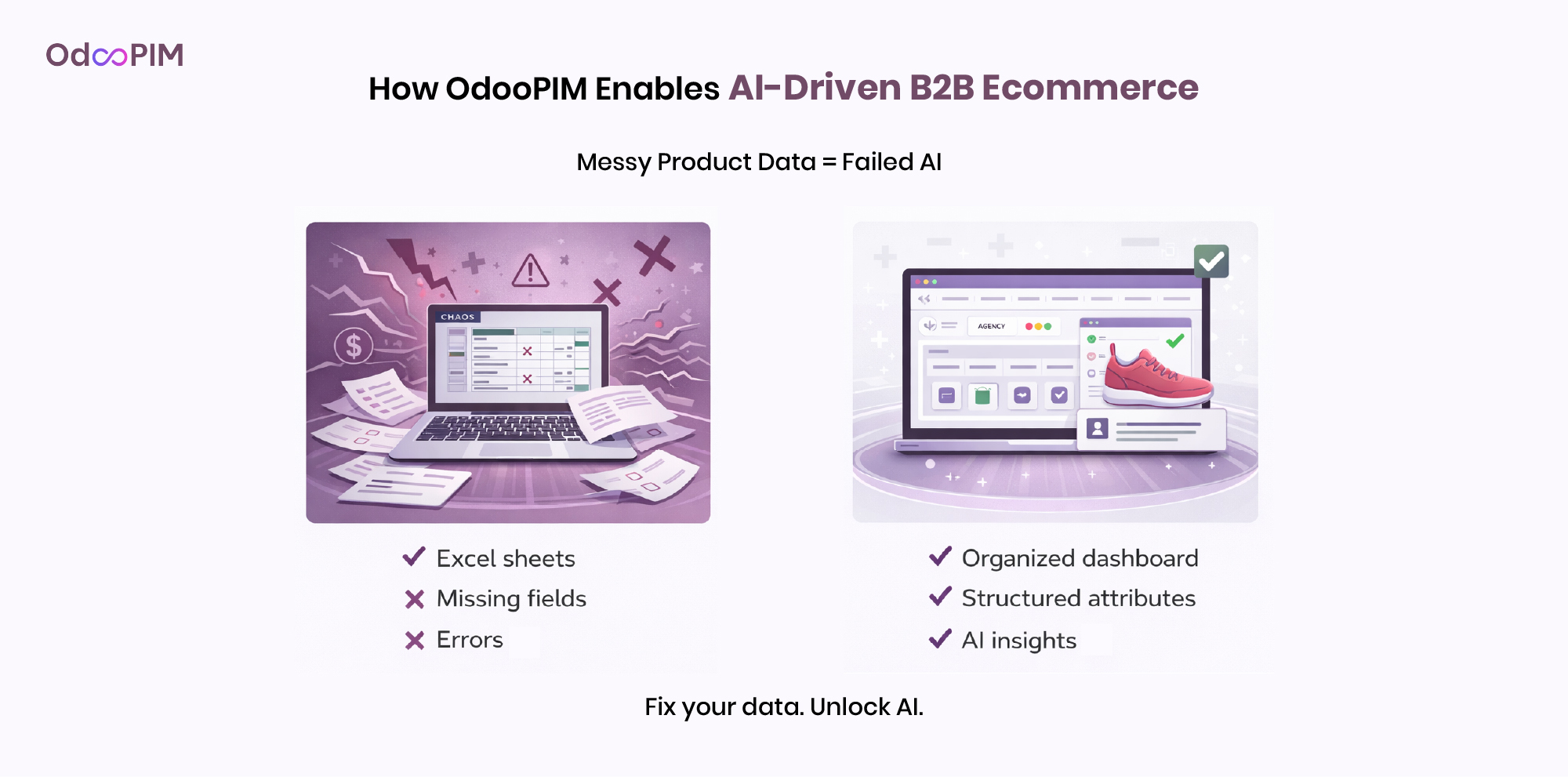
OdooPIM provides the centralized product data foundation that AI in B2B ecommerce requires for effective operation. Unlike fragmented spreadsheets or disconnected systems, OdooPIM unifies every product record into a single source of truth. Structured attributes for AI use cases ensure AI-driven product data management for B2B receives complete specifications, dimensions, materials, certifications, technical data, that recommendation engines need. AI-powered B2B ecommerce platforms connected to OdooPIM deliver accurate personalization because they access reliable, consistent information. Artificial intelligence in B2B commerce succeeds only when built on this foundation.
Workflow automation and approvals within OdooPIM enable B2B ecommerce automation using AI without sacrificing governance. Intelligent product information management handles attribute enrichment, variant grouping, and channel syndication autonomously. AI for B2B product catalogs scales through OdooPIM’s scalable architecture for growing B2B catalogs, processing 100,000 SKUs with the same efficiency as 1,000. AI solutions for B2B online sales gain consistent inputs across every customer portal and marketplace. OdooPIM transforms complex B2B inventory into AI-ready assets that power revenue growth.

Ready to Leverage AI to Simplify Your Complex Online Sales?
AI in B2B ecommerce has evolved from experimental technology to operational necessity in complex sales environments. Artificial intelligence in B2B commerce powers personalized catalogs, automated procurement, and recommendations that B2B buyers expect. Yet these capabilities depend on what feeds them. AI-driven product data management for B2B determines whether personalization engines suggest relevant substitutes or irrelevant distractions. AI for B2B product catalogs succeeds when built on complete, structured attribute data.
The path forward requires product information management as the prerequisite for everything that follows. B2B ecommerce automation using AI delivers measurable ROI only when product information remains accurate across thousands of SKUs and dozens of customer portals. AI-powered B2B ecommerce platforms connected to centralized product data outperform those relying on fragmented spreadsheets. AI solutions for B2B online sales transform complex inventory from operational burden to competitive advantage. The question is no longer whether to adopt AI in B2B ecommerce. The question is whether your product data is ready to support it.
FAQ
1. How does AI handle customer-specific pricing in B2B ecommerce?
AI in B2B ecommerce manages customer-specific pricing by linking contract terms to product records. When buyers log in, AI-powered B2B ecommerce platforms identify their account tier and negotiated rates. Artificial intelligence in B2B commerce displays the prices each customer negotiated rather than generic list prices. AI-driven product data management for B2B ensures pricing rules remain consistent across customer portals, mobile apps, and sales quotes. B2B ecommerce automation using AI handles tiered pricing and contract renewals without human intervention.
2. Can AI improve B2B ecommerce without replacing sales teams?
AI in B2B ecommerce augments sales teams rather than replacing them. AI-powered B2B ecommerce platforms handle routine transactions and quote generation autonomously, freeing representatives for high-value relationship building. Artificial intelligence in B2B commerce identifies upsell opportunities by analyzing customer purchase patterns. B2B ecommerce automation using AI manages procurement workflows while sales teams focus on complex deals requiring negotiation. AI-driven product data management for B2B eliminates sales calls for product details, increasing team effectiveness.
3. What product data is most important for AI-driven B2B workflows?
Technical attribute data ranks highest for AI in B2B ecommerce workflows. AI-driven product data management for B2B requires complete specifications, dimensions, certifications, compatibility information to power recommendations. AI for B2B product catalogs depends on consistent taxonomy across inventory. Artificial intelligence in B2B commerce needs pricing rules linked to customer tiers. Intelligent product information management must capture documentation attachments that AI-powered B2B ecommerce platforms distribute automatically.
4. Is AI-powered B2B ecommerce suitable for mid-size businesses?
AI in B2B ecommerce has become essential for mid-sized operations competing with enterprise suppliers. AI-powered B2B ecommerce platforms offer tiered pricing accessible to businesses with 1,000-50,000 SKUs. AI-driven product data management for B2B handles technical complexity previously managed through spreadsheets. B2B ecommerce automation using AI costs less than a sales administrator while delivering greater consistency. AI for B2B product catalogs scales with business growth, preventing operational breakdowns at expansion points.
5. How does PIM support AI-driven automation in B2B commerce?
Intelligent product information management through PIM provides the foundation for AI in B2B ecommerce automation. AI-driven product data management for B2B requires centralized attributes that PIM systems deliver consistently. AI-powered B2B ecommerce platforms connected to PIM receive complete specifications that recommendation engines need. B2B ecommerce automation using AI scales effectively because PIM maintains quality across thousands of SKUs. AI solutions for B2B online sales depend on PIM as the single source of truth preventing data fragmentation.