
The numbers don’t lie, AI in the retail and e-commerce market is projected to hit $398.65 billion by 2034, growing at a staggering 40.3% annually. One in three ecommerce brands already use AI agents to convert sales, and 76% report lower customer acquisition costs as a result . Yet despite this momentum, most stores are hobbled by product data.
Poor product data costs organizations an average of $12.9 million annually. Only 33% of brands say their product data is consistent across channels, and just 36% report fully structured, machine-readable information. This is the real growth blocker.
Generative AI in eCommerce is changing how teams manage, enrich, and distribute product content. AI product content generation tools create compelling descriptions from raw specifications. eCommerce AI automation 2026 handles what used to require content teams. But these tools only perform when connected to AI-powered PIM software. Generative AI for product data management enables automated product enrichment with AI, transforming how catalogs come to life. The brands winning at AI use cases in ecommerce started with one thing, clean, structured product data that makes everything else possible.
Use Case 1: AI-Powered Product Description Generation
Manual copywriting at scale is broken. Writing hundreds or thousands of product descriptions by hand simply doesn’t happen. Most stores end up with thin, repetitive copy that hurts SEO and fails to convert. You cannot hire enough writers to keep pace with catalog growth.
Generative AI in eCommerce solves this by creating SEO-optimized, channel-ready descriptions in bulk. An AI product content generation tool pulls specifications from your product data and crafts compelling narratives in seconds. The same base description adapts automatically for Amazon, your website, and social channels, each version optimized for that platform’s requirements.
This is where AI for eCommerce product management delivers measurable ROI. eCommerce AI automation 2026 means descriptions that used to take days now generate instantly. But the magic happens when connected to AI-powered PIM software. OdooPIM lets you generate and manage descriptions within your PIM workflow. No exporting, no manual transfers. Generative AI for product data management becomes native to your catalog operations. Automated product enrichment with AI transforms how products come to market. These AI use cases in ecommerce turn catalog maintenance from a bottleneck into background automation.

Use Case 2: Automated Product Data Enrichment
Missing attributes equal lost conversions. When product listings lack specifications, size, material, color, technical details, shoppers cannot find what they need and cannot purchase what they find. Incomplete data impacts search visibility, recommendation accuracy, and conversion rates.
Generative AI in eCommerce solves this through automated product enrichment with AI. The technology analyzes raw supplier data, spec sheets, images, unstructured descriptions, and auto-fills specs, tags, and categories automatically. What used to require manual data entry now happens in seconds, with AI identifying and populating missing fields continuously.
This is where AI for eCommerce product management transforms catalog operations. AI product content generation extends beyond descriptions to complete attribute sets. eCommerce AI automation 2026 means catalogs improve themselves over time rather than degrading. OdooPIM makes this practical by enabling you to enrich incomplete catalog data without manual effort within your workflow. AI-powered PIM software becomes the engine that maintains data quality at scale. Generative AI for product data management ensures every product page contains the information customers need to buy. These AI use cases in ecommerce turn data cleanup from a project into a continuous, automated process.
Learn about How to Boost eCommerce Sales with Generative AI Using OdooPIM
Use Case 3: Smart Product Categorization & Tagging
Miscategorized products kill discoverability. When items land in wrong categories or lack proper tags, customers never find them. Search returns irrelevant results. Navigation frustrates rather than guides. The best product in the world sells nothing if shoppers cannot locate it.
Generative AI in eCommerce solves this through automated product enrichment with AI that classifies and tags products accurately at scale. The technology analyzes product images, descriptions, and specifications to determine appropriate categories and relevant tags. A hiking backpack receives outdoor gear classification. A formal handbag lands in accessories with style tags attached. No manual sorting required.
This is where AI for eCommerce product management ensures catalog organization scales with growth. eCommerce AI automation 2026 means thousands of products categorize instantly rather than waiting weeks. OdooPIM enables auto-taxonomy mapping across channels, the same product automatically fits Amazon’s category structure, your website’s navigation, and marketplace requirements simultaneously. AI-powered PIM software maintains consistent organization everywhere. Generative AI for product data management turns taxonomy from a headache into background automation. These AI use cases in ecommerce ensure customers always find what they seek.

Use Case 4: AI-Driven Product Image Alt Text & Metadata
Accessibility plus SEO in one shot. Image alt text serves two purposes, it makes your site accessible to visually impaired users and provides search engines with context about your content. Yet most stores skip this or add generic phrases that help no one.
Generative AI in eCommerce solves this by creating contextual alt text and image metadata automatically. The AI analyzes each image, recognizing products, colors, settings, and usage, then generates descriptive text that actually describes what appears. A running shoe photo shows a “blue and white athletic shoe with reflective details on a forest trail.” This level of detail serves accessibility requirements and SEO rankings.
This is where AI for eCommerce product management delivers compounding returns. AI product content generation extends beyond descriptions to every content element. eCommerce AI automation 2026 means thousands of images receive complete metadata instantly. OdooPIM enables you to manage digital assets plus AI metadata in one place, images live alongside their generated descriptions within your AI-powered PIM software. Generative AI for product data management ensures every asset works harder. Automated product enrichment with AI transforms images from passive visuals into active sales tools. These AI use cases in ecommerce improve customer experience and search visibility.
Learn about AI in B2B Ecommerce
Use Case 5: Multilingual Product Content Generation
Global commerce requires localized content. Selling across borders means more than translating words, it means adapting to how different markets search, shop, and perceive value. A description that works in Chicago may fall flat in Berlin. Manual localization at scale is prohibitively expensive.
Generative AI in eCommerce solves this by handling translation and localization simultaneously. The AI doesn’t just convert words, it adapts tone, adjusts units, and respects cultural nuance for each market. Measurements convert automatically. Idioms adjust appropriately. Local search terms integrate naturally. French customers see content written for France, not French content written for everywhere.
This is where AI for eCommerce product management enables global scale. AI product content generation creates market-specific versions from your master data. eCommerce AI automation 2026 means expanding to new regions adds catalog work, not content bottlenecks. OdooPIM lets you push localized content to each market channel, Amazon France receives French descriptions, your German site gets German content, all from one source. AI-powered PIM software maintains consistency while enabling localization. Generative AI for product data management through automated product enrichment with AI makes global commerce practical for any size business. These AI use cases in ecommerce turn language barriers into background automation.

Why a PIM Is the Foundation for AI in eCommerce
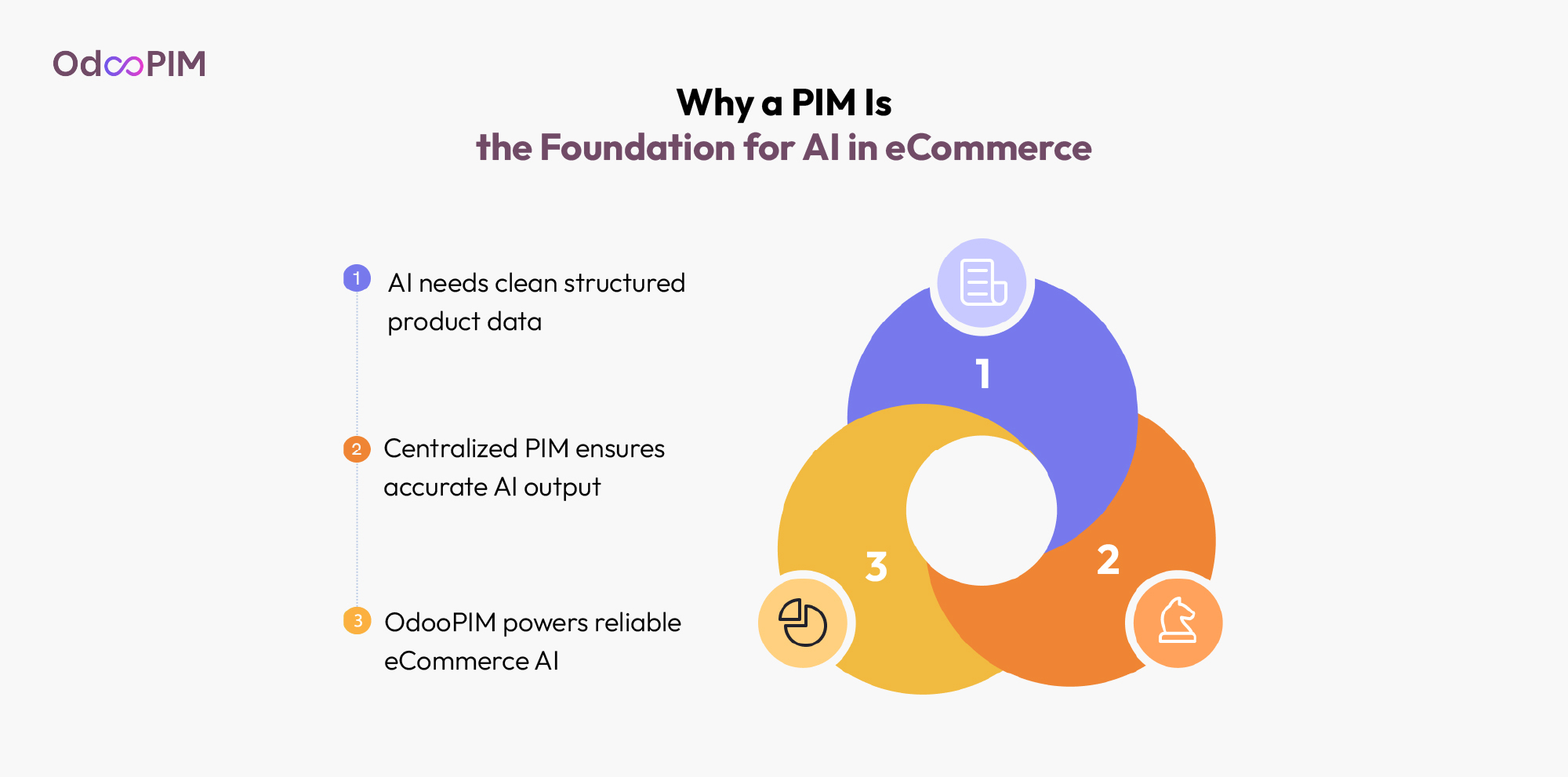
AI is only as good as the data it works with. This is the hard truth that separates AI success stories from expensive failures. An AI product content generation tool fed incomplete specifications produces descriptions that miss details. Generative AI for product data management cannot enrich attributes it cannot find. Automated product enrichment with AI fails when source data lacks structure. The technology delivers what its inputs allow, nothing more, nothing less.
Centralized, clean product data in a PIM equals better AI outputs. When product information lives in one place with consistent attributes and complete specifications, generative AI in eCommerce performs as promised. AI for eCommerce product management tools access standardized data across every product. Descriptions generated reflect features. Recommendations identify genuine relationships. Categorization matches real product attributes. The AI succeeds because the foundation is solid.
OdooPIM serves as the single source of truth that powers AI workflows. Unlike spreadsheets or disconnected systems, OdooPIM centralizes every product record with complete, structured attributes. AI-powered PIM software becomes the engine room for eCommerce AI automation 2026. When you connect AI tools to OdooPIM, they access reliable data that produces reliable results. AI product content generation pulls from accurate specifications. Generative AI for product data management enriches from complete baselines. These AI use cases in ecommerce transform from experimental to essential when built on OdooPIM. Start with clean data. Then let AI accelerate everything else.
Conclusion
Five AI use cases, one foundation. From AI product content generation to automated product enrichment with AI, from smart categorization to multilingual localization, each capability delivers real results. But none work without clean, centralized product data. Generative AI in eCommerce only performs when powered by reliable information.
OdooPIM provides that foundation. As AI-powered PIM software, it transforms catalogs into structured assets that AI for eCommerce product management tools actually use. Generative AI for product data management becomes practical rather than theoretical. eCommerce AI automation 2026 starts here.
See how OdooPIM plus AI helps you launch faster, sell smarter, and scale without chaos. These AI use cases in ecommerce are ready for your business today. Book a demo or calculate your ROI to see the difference clean data makes.

FAQ
1. Is generative AI accurate enough to trust for live product listings without human review?
Generative AI in eCommerce trained on clean, complete product data generates descriptions that reflect actual specifications. When connected to AI-powered PIM software, the AI pulls from trusted attributes rather than guessing. However, AI still benefits from oversight, not to catch factual errors, but to refine tone and catch edge cases. The smart approach combines automated product enrichment with AI for volume with human review for brand alignment. This balance scales content creation while maintaining quality. For stores using AI for eCommerce product management, the question shifts from “can we trust it” to “how do we supervise it effectively.”
2. How is generative AI in eCommerce different from traditional automation or rule-based tools?
Generative AI in eCommerce creates new content rather than simply executing predefined logic. A rule-based tool might insert a standard disclaimer into every description. AI product content generation crafts descriptions for each product based on its specific attributes. This difference matters because AI for eCommerce product management produces content that feels human rather than templated. eCommerce AI automation 2026 represents this shift from execution to creation. Generative AI for product data management doesn’t just move data, it transforms data into narratives, recommendations, and experiences that rule-based systems cannot match.
3. Do I need a large product catalog to see ROI from generative AI?
While generative AI in eCommerce scales beautifully for large catalogs, smaller stores see immediate returns too. Even with fifty products, AI product content generation saves hours of writing time and produces better copy than most owners can create alone. AI for eCommerce product management tools handle the descriptions, metadata, and categorization that get skipped in smaller operations due to time constraints. eCommerce AI automation 2026 makes professional-grade content accessible to any size business. The math works, if you spend any time on product content, AI saves you time. If that time has value, you see ROI. Catalog size matters less than current content effort.
4. What happens to AI-generated content when product specs or pricing change?
When connected to AI-powered PIM software, AI-generated content updates automatically. The relationship works like this, OdooPIM stores your master product data. Generative AI in eCommerce creates content from that data. When specifications or pricing change in the PIM, the content foundation changes too. AI product content generation tools can regenerate descriptions reflecting new attributes. This integration separates AI for eCommerce product management from static content creation. Generative AI for product data management ensures your descriptions, metadata, and channel content stay synchronized with actual product information. Automated product enrichment with AI includes ongoing maintenance, not just one-time generation. Your catalog stays current without manual review of every change.
5. Can generative AI maintain brand voice consistency across thousands of SKUs?
Generative AI in eCommerce learns your brand voice from existing content and style guidelines. AI product content generation then applies that voice across every description it creates, whether for ten products or ten thousand. AI-powered PIM software stores voice parameters alongside product data, ensuring every AI tool accesses the same guidance. AI for eCommerce product management maintains consistency because the same rules apply to every generation. For eCommerce AI automation 2026, brand voice isn’t a limitation, it’s a specification. Generative AI for product data management delivers uniformity that human teams struggle to achieve across large catalogs. These AI use cases in ecommerce prove that consistency scales with automation.