
Omnichannel inventory management centralizes stock visibility and synchronization across sales channels, your website, marketplaces, and physical stores. An omnichannel inventory management system prevents overselling by updating inventory in real time when any channel sells a product. Real-time inventory visibility ensures customers see accurate stock levels whether they shop online or in-store. Inventory sync across channels eliminates manual reconciliation. Unified inventory management routes orders to the optimal fulfillment location. Multichannel inventory management without centralization guarantees data drift. Ecommerce inventory management fails at scale without automation. Omnichannel stock management is essential infrastructure for growing brands.
Learn about Omnichannel Management.
What Is Omnichannel Inventory Management?
Omnichannel inventory management is the practice of centralizing stock visibility and synchronization across sales channels from a single system. Unlike multichannel inventory management where each channel maintains separate stock counts, omnichannel creates a unified view. Your website, Amazon, and physical stores all read from and write to the same inventory record. When a customer buys the last unit in your retail store, your website reflects that change instantly, not after someone reconciles reports. An omnichannel inventory management system prevents overselling, reduces manual reconciliation, and enables intelligent order routing. Real-time inventory visibility ensures customers see accurate stock levels wherever they shop. Inventory sync across channels eliminates the data drift that plagues disconnected operations. Unified inventory management is the foundation for scalable ecommerce.

Why Omnichannel Inventory Management Breaks Down in Practice
The 5 Most Common Omnichannel Inventory Failures
- Product sold simultaneously on two channels, only one unit in stock. Your website and Amazon show the last unit as available. Two customers order at the same time. One order cancels. One customer never returns. Real-time inventory visibility would have prevented this.
- Inventory update lag between warehouse and storefront (12–24 hour sync cycles). Your warehouse shipped the last unit six hours ago. Your storefront still shows “in stock.” Customer orders. You cancel. Inventory sync across channels cannot wait for batch updates.
- BOPIS showing in-stock items that are physically unavailable in-store. Your system says you have three units. A customer orders for pickup. Your team cannot find any. Theft, damage, or misplacement, your system never knew. Omnichannel stock management requires perpetual accuracy.
- Marketplace listings showing availability after a product is discontinued. You discontinued the product last month. Amazon still shows it. Customer orders. You cannot fulfill. Ecommerce inventory management must sync discontinuations instantly.
- Manual reconciliation between ERP stock counts and ecommerce platform listings. Your team spends 10 hours weekly comparing spreadsheets. Errors still slip through. Unified inventory management automates what manual processes cannot scale. Multichannel inventory management without automation guarantees these failures. Inventory management system ecommerce with real-time sync eliminates them.
56% of retailers say inventory accuracy is a problem, while 65% cite issues with their inventory planning systems.
– Forrester & NRF, The State of Omnichannel Retail
The Hidden Root Cause: Inaccurate Product Data Feeding Inaccurate Inventory
Most inventory failures trace to a root cause that operations teams overlook: inaccurate product data. If a SKU has incorrect weight or dimension data, your omnichannel inventory management system routes it to the wrong fulfillment node, oversized items go to standard-packing locations, damaging product and delaying shipments. If a variant (size, color, bundle) is incorrectly attributed in your PIM, it creates phantom inventory or false availability signals. Your system thinks you have three units of size “medium,” but those records actually belong to size “large.” Real-time inventory visibility cannot fix what it cannot correctly identify.
Clean inventory starts with clean product data. If a discontinued product record isn’t updated in your PIM, it continues to appear as active across every channel, your website, Amazon, and wholesale portals all show availability. Customers order. You cannot fulfill. Inventory sync across channels propagates bad data faster, not better. Unified inventory management depends on product data accuracy as its foundation. Fix the data first. Then your ecommerce inventory management system can do its job. Multichannel inventory management without PIM integration guarantees these failures. Omnichannel stock management succeeds when product data and inventory share the same source of truth. An inventory management system ecommerce is only as reliable as the product information feeding it.
Learn about omnichannel management software

The 6 Pillars of Effective Omnichannel Inventory Management
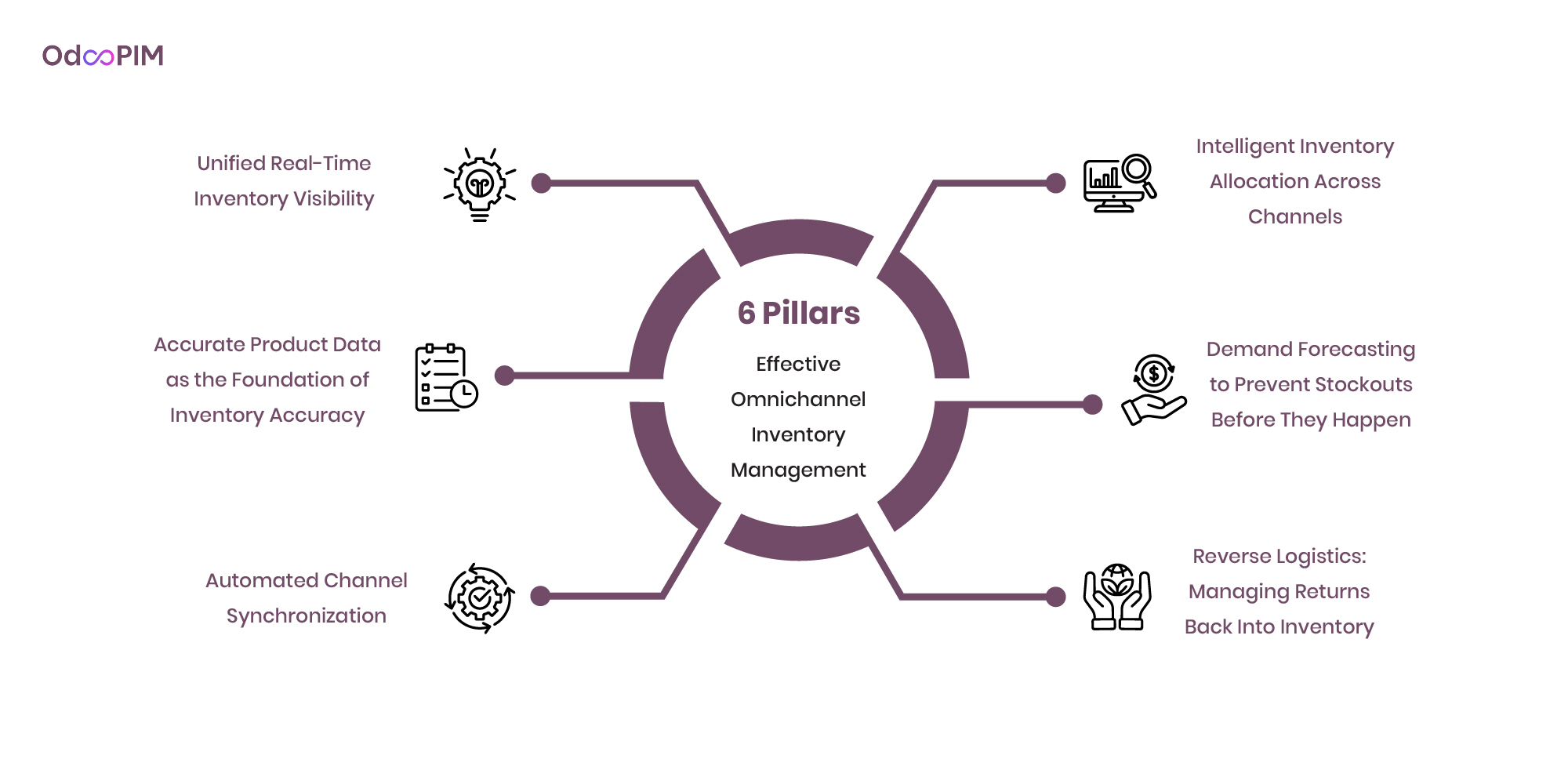
1. Unified Real-Time Inventory Visibility
Omnichannel inventory management starts with a single view of stock across every channel. Your website, Amazon, retail stores, and warehouses must read from the same inventory record. Real-time inventory visibility means when a customer buys the last unit in-store, your website reflects that change instantly, not after a batch update. Multichannel inventory management without unification guarantees overselling and customer frustration.
Inventory sync across channels cannot tolerate delays. A 12-hour sync window means 12 hours of potential overselling. Unified inventory management eliminates data drift by maintaining one source of truth. Every channel updates simultaneously when any channel sells a product. Your omnichannel inventory management system should make real-time visibility its core capability, not an optional feature.
Learn about omnichannel order management.
2. Accurate Product Data as the Foundation of Inventory Accuracy
Ecommerce inventory management depends on accurate product data. If a SKU has incorrect weight or dimension data, your system routes it to the wrong fulfillment node. If a variant is incorrectly attributed, it creates phantom inventory or false availability signals. Omnichannel stock management without PIM integration cannot achieve accuracy at scale.
Inventory management system ecommerce is only as reliable as the product information feeding it. A discontinued product record not updated in your PIM continues to appear active across all channels. Customers order. You cannot fulfill. Unified inventory management requires clean product data as its foundation. Fix the data first. Then sync inventory. Otherwise, you’re just propagating bad information faster.
3. Automated Channel Synchronization
Inventory sync across channels must be automated, not manual. Your team cannot reconcile stock counts across five channels via spreadsheets. Errors multiply. Hours vanish. Omnichannel inventory management with automation eliminates manual reconciliation. When your warehouse ships an order, every channel updates simultaneously.
Real-time inventory visibility depends on automation. Batch updates create data drift. Manual entry creates errors. Multichannel inventory management without automation guarantees overselling and stockouts. Configure your omnichannel inventory management system to sync instantly, not on a schedule. Manual updates are not a backup plan, they are a failure plan. Automation scales. Manual processes break.
4. Intelligent Inventory Allocation Across Channels
Unified inventory management must decide which channel gets which inventory. Your best-selling product has 100 units. Should all 100 go to your website? Should you reserve 50 for Amazon and 20 for your retail stores? Omnichannel stock management with intelligent allocation prevents stockouts on high-priority channels while maintaining availability everywhere.
Ecommerce inventory management without allocation rules defaults to first-come, first-served, which mostly means your least profitable channel drains inventory from your most profitable one. Configure allocation rules based on channel priority, sales velocity, and margin. Inventory management system ecommerce should support percentage splits, safety stock reserves, and dynamic reallocation as conditions change.
5. Demand Forecasting to Prevent Stockouts Before They Happen
Omnichannel inventory management should predict demand, not just react to it. Historical sales data, seasonality, promotions, and market trends all inform future requirements. Real-time inventory visibility tells you what you have now. Demand forecasting tells you what you will need next week.
Multichannel inventory management without forecasting guarantees either stockouts or overstock. Too little inventory loses sales. Too much inventory ties up capital and increases carrying costs. Your omnichannel inventory management system should integrate with forecasting tools that analyze channel-specific demand patterns. A product that sells quickly on Amazon may move slowly on your website. Treat each channel’s demand profile separately.
6. Reverse Logistics: Managing Returns Back Into Inventory
How you manage them determines whether inventory accuracy holds or breaks. Unified inventory management must process returns through any channel, online return portal, physical store, mail-in, and update stock counts instantly. A sweater returned in-store should show as available online immediately.
Omnichannel stock management without reverse logistics integration creates inventory blind spots. Your system thinks you have less stock than you actually do. You order more. You overstock. Ecommerce inventory management with return processing automates restocking, quality checks, and inventory updates. Inventory sync across channels must include returns as a first-class citizen, not an afterthought. Configure return workflows before your first return arrives. Otherwise, you’ll build them under pressure, and make mistakes.
Learn about Best Omnichannel Software for Ecommerce Brands (2026 Guide)

Why Product Data and Inventory Management Cannot Be Managed Separately
Every inventory decision, routing, allocation, forecasting, return processing, depends on accurate product data. Your omnichannel inventory management system decides where to send an order based on product weight and dimensions. If those attributes are wrong, the order routes to the wrong fulfillment node. Your real-time inventory visibility shows stock counts for SKUs. If variant relationships are incorrect, phantom inventory appears. Multichannel inventory management without PIM integration means your system of record for product attributes and your system of record for stock counts are permanently out of sync. The result: overselling, misrouted orders, and customer frustration.
When product data and inventory management live in separate systems, every attribute update requires manual reconciliation. A product weight changes in your PIM. Your inventory sync across channels never receives the update. Shipping calculations remain wrong. Ecommerce inventory management fails because the data foundation is broken. Omnichannel stock management succeeds when product data and inventory share the same ecosystem. OdooPIM lives inside the same Odoo database as the inventory module. A single attribute update instantly reflects real-time stock levels, dynamic pricing engines, and automated order fulfillment across POS, Shopify, Amazon, and B2B portals. No sync delays. No data drift. Unified inventory management starts with unified systems. Separate them, and you guarantee failure. Integrate them, and you enable scale.
How OdooPIM Supports Omnichannel Inventory Management
OdooPIM provides the product data foundation that omnichannel inventory management requires. Native Odoo ERP and inventory module integration means product attributes, stock counts, and order routing share the same database. No middleware, no API lag, no data drift between your PIM and your inventory management system ecommerce. Centralized product data feeds accurate inventory records across every channel.
Inventory sync across channels happens automatically through OdooPIM’s native connectors to Shopify, WooCommerce, Magento, and Amazon. When a product weight changes, shipping rules recalculate instantly. When a product is discontinued, channel eligibility rules prevent it from appearing as in-stock anywhere. Real-time inventory visibility ensures your website, Amazon, and stores all reflect the same stock levels simultaneously.
Customer proof point: A sporting goods retailer managing 15,000 SKUs across Shopify, Amazon, and three warehouses implemented OdooPIM to unify product data and inventory. Inconsistent variant attributes caused 12% phantom inventory before implementation. After OdooPIM, phantom inventory dropped to near zero. Multichannel inventory management became accurate without manual reconciliation. Unified inventory management turned disconnected channels into a coordinated network processing 50,000+ monthly orders with zero overselling.
Omnichannel Inventory Management Best Practices for Ecommerce Teams
1. Audit Your Inventory Accuracy Per Channel Before Implementing Anything
Before deploying any omnichannel inventory management system, audit your current accuracy channel by channel. Your website may show 95% accuracy while Amazon lags at 80%. Real-time inventory visibility cannot fix what you haven’t measured. Run cycle counts. Document discrepancy patterns. Identify which channels drift most. Multichannel inventory management without baseline metrics means you won’t know whether your new system improves accuracy or just automates existing errors.
Ecommerce inventory management audits should compare system counts against physical stock for each location. A 5% error rate on a single channel can cost thousands in overselling annually. Your inventory management system ecommerce is only as reliable as the data you feed it. Audit first. Implement a second. Otherwise, you’re just automating inaccuracy faster.
2. Establish Product Data Standards Before Connecting Your Inventory System
Unified inventory management depends on consistent product data across every system. Define SKU naming conventions, variant relationships, and attribute requirements before connecting your PIM to your OMS. Omnichannel stock management fails when a product has different SKUs in your ERP than your ecommerce platform. Inventory sync across channels cannot reconcile what it cannot match.
A shirt size “Medium” must be “M” everywhere. A product discontinued in your PIM must stop appearing in stock across channels immediately. Omnichannel inventory management without data standards guarantees phantom inventory, overselling, and reconciliation headaches. Establish rules before implementation. Enforce them with your PIM. Your inventory accuracy depends on product data quality.
3. Set Channel-Specific Safety Stock Thresholds, Not One Universal Buffer
Different channels have different demand patterns and margin profiles. Your website may sell 50 units daily. Amazon may sell 200. A universal safety stock buffer starves one channel while overstocking another. Multichannel inventory management requires channel-specific thresholds based on sales velocity, lead time, and profit margin. Real-time inventory visibility helps you monitor each channel independently.
Ecommerce inventory management with channel-specific allocation prevents stockouts on high-priority channels while maintaining availability everywhere. A product that sells quickly on Amazon may move slowly on your wholesale portal. Treat each channel’s demand profile separately. Configure your omnichannel inventory management system to reserve safety stock per channel, not just per total inventory. Your customers will notice the difference.
4. Automate Reorder Points: Never Rely on Manual Stock Checks
Manual stock checks fail at scale. Your team cannot monitor reorder points across thousands of SKUs and multiple channels. Inventory sync across channels must trigger purchase orders automatically when stock falls below threshold. Unified inventory management automates what manual processes cannot maintain. Set reorder points based on historical demand, lead time, and safety stock requirements.
Omnichannel stock management without automation guarantees stockouts. Your best-selling product sells out while your team reviews reports. You reorder late. Customers go elsewhere. Configure your inventory management system ecommerce to generate purchase orders automatically when thresholds trigger. Manual review should handle exceptions, not routine replenishment. Automation scales. Manual processes break. Choose accordingly.
5. Treat Returned Inventory as a Separate Workflow, Not an Afterthought
How you manage them determines whether your omnichannel inventory management holds or breaks. Returned inventory requires inspection, grading (sellable vs. damaged), and restocking. Real-time inventory visibility must reflect returned units only after they pass inspection and return to sellable stock. A sweater returned in-store should not show as available online until inspected.
Ecommerce inventory management without return workflows creates inventory blind spots. Your system thinks you have less stock than you actually do. You reorder unnecessarily. You overstock. Configure your omnichannel inventory management system with return processing stages: received, inspected, restocked, or disposed. Multichannel inventory management with separate return workflows maintains accuracy while processing inevitable returns. Plan for returns before your first return arrives.
6. Monitor Inventory Distortion Metrics: Not Just Stock Counts
Stock counts tell you what you have. Inventory distortion metrics tell you why your counts are wrong. Unified inventory management requires tracking shrinkage, phantom inventory, and synchronization errors. Inventory sync across channels should include alerts when channel counts diverge beyond acceptable thresholds. A 2% difference between your ERP and Amazon may indicate a systemic sync issue.
Omnichannel stock management metrics to monitor: overselling rate (orders cancelled due to stockout), inventory turnover by channel, days between stock count reconciliations, and return-to-stock lag time. Real-time inventory visibility without distortion metrics hides problems until they become customer-facing. Establish weekly reviews of distortion metrics. Catch issues before they cause overselling or stockouts. What gets measured gets improved. What goes unmeasured guarantees failure.

Frequently Asked Questions
1. What is omnichannel inventory management?
Omnichannel inventory management centralizes stock visibility and synchronization across sales channels, your website, marketplaces, and physical stores. An omnichannel inventory management system prevents overselling by updating inventory in real time when any channel sells a product. Real-time inventory visibility ensures customers see accurate stock levels whether they shop online or in-store. Inventory sync across channels eliminates manual reconciliation. Multichannel inventory management without centralization guarantees data drift. Unified inventory management is essential infrastructure for growing brands.
2. What are the 4 types of inventory management?
The four types of inventory management are: raw materials (unprocessed inputs), work-in-progress (partially completed goods), finished goods (ready-to-sell products), and MRO supplies (maintenance, repair, operating supplies). Ecommerce inventory management focuses primarily on finished goods but must track all four for manufacturing businesses. Omnichannel stock management applies to finished goods across sales channels. Inventory management system ecommerce usually handles finished goods inventory. Multichannel inventory management coordinates stock counts across channels for finished products only.
3. How does omnichannel affect inventory management?
Omnichannel transforms multichannel inventory management from independent channel stock counts to unified visibility. Real-time inventory visibility across channels prevents overselling, when a store sells the last unit, your website reflects it instantly. Inventory sync across channels eliminates manual reconciliation. Omnichannel inventory management enables intelligent order routing, fulfilling website orders from store stock when warehouses run low. Unified inventory management turns every location into a fulfillment node. Ecommerce inventory management alone cannot achieve this. Omnichannel connects what multichannel keeps separate.
4. Can a small ecommerce business benefit from omnichannel inventory management, or is it only for large retailers?
Small ecommerce businesses benefit significantly from omnichannel inventory management. The problems it solves, overselling, manual reconciliation, inventory drift, hurt small teams more because they lack dedicated staff to fix them. An omnichannel inventory management system automates what manual processes cannot scale. Real-time inventory visibility prevents the cancellations that erode customer trust. Inventory sync across channels frees your small team from spreadsheet reconciliation. Multichannel inventory management without automation guarantees errors. Unified inventory management levels the playing field with larger competitors. Start before you outgrow spreadsheets.