The best catalog management software centralizes your product data, automates enrichment, and distributes accurate listings across every sales channel. The right tool depends on your catalog size, channel complexity, and tech stack. Among catalog management tools, ecommerce catalog management software must integrate with your operations. For businesses running Odoo, or looking for best product information management tools that connect to ERP, OdooPIM is built for that. It functions as a catalog management solution for ecommerce with native SKU management system capabilities, making it the ideal multichannel catalog management software for product catalog optimization.
What is Product Catalog Management?
Does your distribution, retail, or e-commerce business manage large numbers of SKUs via spreadsheets? Do you create a new product catalog for every sales channel? Is your team busy customizing the product catalog for each sales channel and repeating the task every time there are new products or updates?
The effort of managing a product catalog manually is humongous, time-consuming, and expensive. That’s why most businesses adopt a tool that lets them automate product catalog management, all the way from a single product till when that information reaches the customer.
With automation, users can quickly identify missing information, edit product information in bulk using AI tools, and ensure it’s accurate before it is published across channels.
From a planning perspective, catalog management software centralizes control. It replaces the need to maintain and manage several spreadsheets.
The benefits are obvious, the business launches new products faster, customers get the right information, and returns drop significantly.
The Product Catalog Management Process
Step 1: Foundation Through Comprehensive Data Collection
Successful product catalog management begins by aggregating raw product information management from suppliers, manufacturers, and internal teams into a repository. This foundational phase of product catalog management transforms scattered data points, from technical specifications and marketing copy to compliance certificates and digital assets, into a structured master list. Product catalog management software is essential here, as it provides the framework to standardize this influx of data, preventing chaos from the start. The quality of this collection dictates the efficacy of product catalog optimization efforts. Data gathering establishes the accurate, comprehensive baseline required to build a scalable enterprise product catalog.
Step 2: Creating Value Through Strategic Data Enrichment
Data enrichment is the phase where product information is transformed into sales content. This stage of product catalog management involves augmenting specifications with images, descriptions, bullet points, and keywords to boost discoverability. Specialized product catalog management software includes tools to automate and standardize this enrichment, ensuring brand consistency. This process is the essence of product catalog optimization.
Step 3: Building Usability Through Organization and Categorization
Organization is the structural phase of product catalog management, where products are grouped into a hierarchy of categories and subcategories. This stage of product catalog management dictates the user experience, enabling intuitive browsing and effective site search. Advanced product catalog management software uses taxonomy tools to enforce tagging and attribute application across the enterprise product catalog. This systematic organization is a fundamental aspect of product catalog optimization, as it determines how customers can find what they need. A framework within your product catalog management system transforms a collection of items into a discoverable, shoppable inventory.
Step 4: Achieving Omnichannel Reach Through Distribution
Distribution is the core of product catalog management, where the master data is pushed to sales channels and touchpoints. This phase of product catalog management relies on automated syndication to ensure instant, error-free updates across your website, marketplaces, and partner platforms. A product catalog management system handles the complex technical mappings required for catalog management in e-commerce, formatting data to meet a channel’s specifications. This publishing capability is an output of product catalog optimization, ensuring product availability and accuracy where customers shop. Effective distribution, powered by product catalog management software, is what transforms a managed internal asset into live, revenue-generating listings.
Step 5: Driving Performance with Continuous Monitoring
Product catalog management is a discipline demanding analysis and refinement after publication. This final, ongoing phase of product catalog management involves tracking key metrics like search performance, conversion rates, and data accuracy across channels. Product catalog management software provides dashboards to identify underperforming listings and errors, enabling product catalog optimization. This feedback loop is what separates catalogue management from governance. By acting on these insights within your product catalog management system, you enhance the shopper experience and commercial results. Proactive monitoring is not a task; it is the essential engine of improvement in product catalog management, ensuring your catalog remains a high-performing asset.
Learn about Amazon Catalog Management
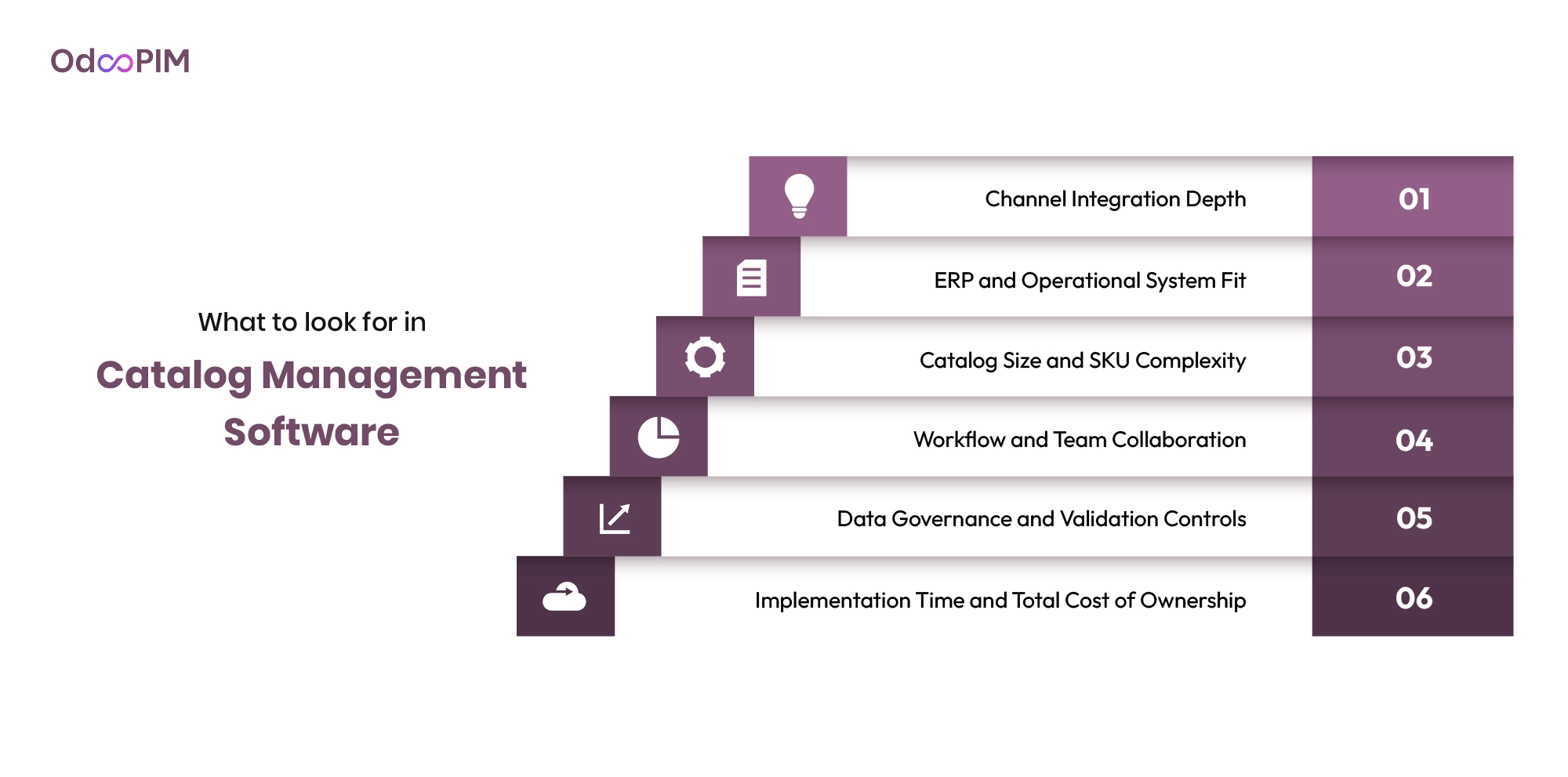
What to Look for in Catalog Management Software
1. Catalog Size and SKU Complexity
Your catalog management solution for ecommerce must handle your volume. A tool managing 500 SKUs often buckles at 50,000. Best catalog management software scales without performance degradation as your product count grows. SKU management system capabilities need to support variants, relationships between products, and bulk operations across thousands of items. When evaluating, ask vendors how their platform handles 100,000 products with 20 attributes each. The answer reveals whether you’re buying a solution or a future bottleneck.
Catalog complexity extends beyond raw count. Products with size variations, color options, and material differences demand multichannel catalog management software that understands relationships. A blue medium shirt relates to the same item in red large, your system must maintain these connections automatically. Product catalog optimization depends on accurate variant handling. Without it, customers see disconnected options and lose confidence. The right catalog management tools treat complexity as normal, not exceptional.
Best product information management tools offer bulk import capabilities and automated enrichment to accelerate setup. Manual data entry for thousands of products is not viable. Your ecommerce catalog management software should include tools for mass updates, attribute mapping, and validation at scale. Catalog size determines infrastructure requirements. Choose software built for the volume you have today and the growth you expect tomorrow.

2. Channel Integration Depth
The best multichannel catalog management software connects to where you sell, Amazon, Shopify, Google Shopping, wholesale portals, social commerce. Ecommerce catalog management software that requires manual exports for each channel defeats its purpose. Your team shouldn’t spend time downloading CSVs and reformatting content for different platforms. Look for pre-built connectors, not promises of custom API work that adds cost and complexity. Integration depth determines whether you scale channels or accumulate maintenance burden.
Amazon wants flat descriptions under 2000 characters with keyword placement. Google Shopping requires optimized titles following strict formulas. Your website supports rich formatting and custom fields. Catalog management solutions for ecommerce must adapt content automatically, not expect you to maintain separate versions. Product catalog optimization across channels requires software that understands these nuances and handles them without manual intervention.
When you update a product in your SKU management system, does the change propagate to channels or require manual sync? Best catalog management software offers real-time syndication that eliminates the “did we update Amazon?” uncertainty. For businesses with complex tech stacks, API-first architecture matters. Your catalog management tools should connect with existing systems rather than forcing you to replace working infrastructure.
Learn about How eCommerce AI Agents Are Transforming Product Data Management in 2026.
3. ERP and Operational System Fit
Catalog management tools don’t operate in isolation. Your best product information management tools must sync with ERP for inventory, accounting, and order management. Disconnected systems create the very problems catalog software aims to solve. When your ecommerce catalog management software doesn’t talk to your ERP, someone becomes the human bridge manually transferring data. That someone makes errors and creates delays. Integration with operational systems separates professional catalog management from perpetual spreadsheet management.
SKU management system data should flow smoothly to your ERP for accurate inventory tracking and financial reporting. When a product sells, inventory updates. When costs change, margins recalculate. For businesses already using Odoo, OdooPIM provides native integration without middleware. For others, evaluate API capabilities carefully. Multichannel catalog management software that requires complex custom integrations may cost more in development than the software itself. The best catalog management solution for ecommerce fits your existing tech stack.
Your product catalog optimization efforts require data from suppliers, manufacturing systems, and warehouse management. Catalog management tools that can’t ingest data from these sources create new silos rather than solving existing ones. Evaluate how your best catalog management software connects to the systems that generate product information. The goal is consolidation, not another disconnected tool. Integration depth determines whether catalog software becomes your central source of truth or just another system to reconcile.

4. Data Governance and Validation Controls
Without governance, your catalog management tools become chaos accelerators. Best catalog management software enforces data rules at entry, not after errors propagate to live channels. Required fields must be required. Format rules must apply automatically. Product catalog optimization requires consistent inputs to produce reliable outputs. Your ecommerce catalog management software should prevent incomplete or incorrectly formatted products from ever reaching customers. Governance turns catalog management from reactive cleanup into proactive quality control.
Completeness scoring helps teams prioritize what needs attention. A catalog management solution for ecommerce should show you which products meet standards and which need work. A dashboard revealing that 40% of products lack dimensions focuses effort effectively. SKU management system with visibility into data quality transforms vague “improve the catalog” goals into concrete tasks. What gets measured gets improved. Without measurement, your team guesses where to focus.
Multichannel catalog management software should route new products or significant changes through defined reviewers. Marketing signs off on descriptions. Compliance verifies certifications. Leadership approves pricing. Best product information management tools track who approved what and when, creating accountability and audit trails. Workflows that match your processes prevent the “who approved this?” confusion that plagues spreadsheet-based catalog management.
Learn about 5 Generative AI Use Cases in eCommerce
84% of US online adults rely on website search to find products they intend to buy or browse, highlighting the importance of accurate, structured product data behind ecommerce search.
– Forrester
5. Workflow and Team Collaboration
Catalog management involves multiple people with different expertise. Ecommerce catalog management software must coordinate them without creating bottlenecks. Merchandisers create product briefs, copywriters craft descriptions and photographers deliver assets. Compliance ensures certifications exist. Best catalog management software provides role-based access so each person sees only what they need. A copywriter shouldn’t navigate inventory fields. A compliance officer shouldn’t edit marketing copy. Proper access controls keep teams focused.
Task assignment features ensure nothing falls through cracks. Catalog management solution for ecommerce should let you assign products or attributes to specific team members with due dates and notifications. When a product is ready for description, the copywriter knows. When images are uploaded, the merchandiser reviews. The SKU management system with workflow capabilities eliminates the “I thought you were handling that” conversations that delay launches. Workflow automation keeps projects moving without constant check-ins.
Collaboration features become essential as teams grow. Multichannel catalog management software should include commenting, version history, and approval tracking. Team members need to discuss products within the system, not through email chains that lose context. Best product information management tools maintain audit trails showing who made which changes and when. When questions arise about why a description changed, the answer lives in the system. Workflow capabilities determine whether software accelerates or hinders your team’s productivity.
6. Implementation Time and Total Cost of Ownership
The best catalog management software delivers value without hidden costs. Implementation timelines vary, some platforms require months of consulting, others weeks. SKU management system complexity affects setup time. Catalog size, attribute complexity, and channel count all influence how long implementation takes. Be realistic about your organization’s capacity for change. A six-month implementation that never finishes delivers less value than a six-week implementation that launches successfully.
Calculate total cost of ownership, not just subscription fees. Multichannel catalog management software costs include implementation services, ongoing maintenance, required integrations, and training. Catalog management solution for ecommerce that costs less upfront but requires extensive customization exceeds budget. Factor in internal time, how many hours will your team spend on setup, data migration, and learning? Best product information management tools should reduce workload, not add to it.
Balance capabilities against realistic implementation effort. Ecommerce catalog management software with every possible feature but impossible complexity helps no one. The right product catalog optimization tool is the one you can deploy successfully. Consider phased implementation, start with core products and channels, then expand. Catalog management tools that support rollout reduce risk and deliver early wins. Implementation time and cost determine whether catalog software becomes an asset or a budget line item that never delivers. Choose accordingly.
Learn about AI in B2B Ecommerce.
The Best Catalog Management Software for Ecommerce in 2026
Selecting the best catalog management software requires evaluating catalog management tools on integration depth, multichannel capability, and SKU management system strength. The best product information management tools excel differently based on your tech stack, OdooPIM offers native integration for Odoo users, while Akeneo dominates enterprise catalogs. Ecommerce catalog management software must handle channel-specific requirements automatically, not create manual work. Your catalog management solution for ecommerce choice should align with catalog size, team capabilities, and existing systems. This shortlist evaluates leading options against these criteria; it is not a sponsored ranking.
| Tool | Best For | Ecommerce Fit | Odoo Integration | Pricing Model |
| OdooPIM | Odoo-native ecommerce teams | Strong | Native | Transparent |
| Akeneo | Large enterprise catalogs | Strong | Via connector | Enterprise |
| Pimcore | Dev-heavy, open-source needs | Moderate | Custom | Open source + paid |
| Sales Layer | Marketing-led SMB teams | Strong | Limited | SaaS subscription |
| Plytix | Small catalogs, B2B brochures | Limited | Limited | SMB-friendly |
| Salsify | Brand manufacturers, retail compliance | Strong | Limited | Enterprise |
The Real Cost of Poor Product Content Quality
The financial impact of poor catalog content management is staggering. According to industry research, poor data quality costs organizations an average of $12.9 million annually. In ecommerce specifically, returns driven by inaccurate product information, missing specifications, misleading images, or inconsistent descriptions, add significant reverse logistics costs, typically 5-7% of order value.
Consider a mid-sized ecommerce brand with 2,000 SKUs managing catalog content in spreadsheets. Marketing updates descriptions in one file. Operations maintain inventory in another. Sales tweaks pricing in a third. When someone changes a product attribute, no single source of truth tracks the update. The result: version conflicts, channel mismatches, and products launching with incomplete information. Product data enrichment becomes impossible at scale.
Ecommerce catalog management done poorly hits every metric that matters. Customers abandon carts when missing attributes force them to guess. Returns spike when delivered products don’t match descriptions. Time-to-market stretches as teams manually reconcile spreadsheets. Centralized product data through a multichannel product catalog eliminates these costs. Catalog syndication ensures consistent, complete information everywhere customers shop. Product content management transforms chaos into control and turns hidden costs into recovered revenue.
Learn about Best PIM software for small retail business.
Time-to-market drops from weeks to days, or even hours.
Structured vs. Unstructured Product Content: Why Both Matter
Structured product content is data that fits into fields: attributes, specifications, dimensions, pricing rules, and compliance codes. Computers read structured content, filters depend on it, search algorithms rank by it. Unstructured product content is everything else, marketing copy, descriptions, imagery, video, and installation guides. Humans consume unstructured content, it builds trust, answers questions, and drives conversion. When these live in separate systems, they drift. Your specifications say one thing; your marketing copy says another. Customers notice. Returns follow.
Product catalog management done right unifies both types in one centralized product data repository. Multichannel product catalog syndication pushes structured and unstructured content to every channel simultaneously. Product data enrichment applies to both. Catalog content management without this unity creates fragmentation, your product team updates attributes while marketing rewrites descriptions, with no single source of truth. Ecommerce catalog management at scale requires treating structured and unstructured content as equal partners. Most competitors skip this distinction. You shouldn’t.
Learn about best catalog management software.
Product Catalog Management Challenges
1. Eliminating Revenue Leaks by Shattering Data Silos
Data silos and fragmentation create incompatible versions of product truth across departments, causing errors, operational delays, and poor customer experiences. Effective product catalog management exists to dismantle these barriers by establishing an authoritative source for item information. A centralized product catalog management system consolidates data from marketing, sales, and procurement, replacing disparate spreadsheets and databases. This unification is the first step in strategic product catalog optimization, as accurate data precedes any enhancement.
2. Ending Customer Confusion Caused by Inconsistent Information
Inconsistent product information across channels, differing prices, specs, or imagery destroys consumer trust and sabotages sales. Strategic product catalog management solves this by enforcing a single golden record for each item, ensuring uniformity wherever it’s sold. This governance is the purpose of a product catalog management system, which syndicates approved data to endpoints. Implementing disciplined product catalog management software eliminates manual updates and the human error they introduce.
3. Erasing Costly Mistakes from Manual Data Entry
Manual data entry is a source of catalog corruption, introducing typos, misplaced decimals, and outdated information that impact sales and operations. Product catalog management is designed to eliminate this vulnerability by automating data ingestion and updates. A product catalog management system integrates with supplier feeds, PIM tools, and ERPs, ensuring information flows without human transcription. Deploying product catalog management software is an investment in data integrity and operational efficiency.
4. Scaling Your Catalog Without Operational Breakdown
A scalable product catalog management system uses rules, templates, and actions to maintain control and consistency even as volume explodes. This capability is important for a growing enterprise product catalog, ensuring catalogue management remains efficient. Investing in advanced product catalog management software is essential for any business with expansion plans.
5. Conquering the Chaos of Multi-Channel Selling
Sales channel enforces technical requirements, data formats, and update frequencies, creating immense operational complexity. Effective product catalog management is designed to master this environment by serving as a central command hub. A product catalog management system adapts your product data to meet the rules of Amazon, Google, Shopify, and other endpoints. This orchestration is a function of catalogue management, ensuring a consistent brand presence across the board.
6. Ending Lost Sales from Stale Product Information
Product catalog management eliminates this latency by enabling automated data synchronization. A cloud-based product catalog management system ensures any edit to your central enterprise product catalog is reflected everywhere in real time, a main requirement for catalog management in e-commerce. This is an important advantage provided by advanced product catalog management software, turning data into a live business asset. Implementing a responsive product catalog management strategy is essential to maintaining accuracy, capturing demand, and protecting revenue in a fast-paced market.
Learn about Automotive catalog management
Best Practices for Product Catalog Optimization
1. Establishing Foundational Governance for Your Catalog
Data governance policies are the rulebook for your enterprise product catalog, defining ownership, quality standards, and update workflows. Effective product catalog management operationalizes these policies within the product catalog management system, automating enforcement and approvals. This governance is the bedrock of sustainable product catalog optimization, ensuring enhancements adhere to brand and compliance standards. Instituting rules is the first strategic action in professional product catalog management, transforming your catalog from a passive repository into a controlled, high-integrity business asset.
2. Enforcing Consistency with Standardized Templates
Standardized templates serve as the blueprint for product entries, ensuring data collection and presentation across your enterprise product catalog. Implementing these templates is a function of product catalog management, eliminating formatting and incomplete listings. Advanced product catalog management software enforces these templates at the point of data entry, guaranteeing required attributes, from dimensions to keywords, are populated correctly. Deploying standardized templates is not a minor step but a fundamental discipline within professional product catalog management, enabling a superior customer experience.
3. Automating to Eliminate Inefficiency and Error
Automated workflows replace manual, error-prone tasks with processes for updating, approving, and publishing product data. A product catalog management system uses these workflows to route changes through proper governance, sync information with supplier systems for catalog management in procurement, and push updates to sales channels. This automation is the engine of proactive product catalog optimization, allowing teams to focus on strategy rather than repetitive data entry.
4. Designing Your Catalog for the Mobile Majority
Mobile optimization demands scannable product information, fast-loading media, and touch-friendly interfaces, requirements that shape your data strategy. Effective product catalog management mandates this mobile-first approach, structuring and trimming content for smaller screens. Your product catalog management system should format listings for mobile, a key aspect of catalog management in e-commerce. This focus is part of ongoing product catalog optimization, affecting the majority of your traffic and conversions. Prioritizing mobile is not a superficial design choice but a requirement of contemporary product catalog management, ensuring your enterprise product catalog delivers a device experience.
5. Automating Accuracy with AI-Powered Categorization
AI-driven auto-categorization analyzes product attributes and descriptions to assign accurate, consistent tags and category placements at scale. This technology is revolutionizing product catalog management, eliminating the subjective, labor-intensive work of manual taxonomy application. Product catalog management software embeds these AI tools into the system, ensuring your expanding product catalog remains organized. This intelligent automation is a powerful form of product catalog optimization, enhancing internal searchability and external SEO performance.
6. Building Discoverability Through SEO-Optimized Content
SEO-friendly descriptions are a commercial asset, embedding relevant keywords naturally to make products discoverable in organic search. Integrating this practice into your product catalog management strategy transforms listings from inventories into powerful marketing tools. Advanced product catalog management software includes SEO guidance and analytics, enabling data-driven product catalog optimization for search performance. This focus on discoverability is a function of catalog management in e-commerce, bridging the gap between your enterprise product catalog and customer intent. Crafting SEO-optimized descriptions is not a marketing task but a fundamental discipline within professional product catalog management, essential for driving qualified traffic and sales.
7. Powering Product Discovery with Intelligent Search
Effective on-site search and filtering rely on structured, tagged, and enriched product data behind the scenes. This makes product catalog management the foundation, as it generates the attribute-rich data these tools require. Your product catalog management system organizes the enterprise product catalog into a format, assigning consistent values for color, size, material, and other key facets. This data structuring is an aspect of product catalog optimization that reduces bounce rates and guides customers to purchase.
8. Converting Browsers with Compelling Visual Media
Strategic product catalog management treats these assets as data points, governing their format, resolution, and association with product variants. A professional product catalog management system centralizes and organizes this media, ensuring fast delivery and consistent presentation across the channel. This visual enrichment is a powerful driver of product catalog optimization, lifting conversion rates and average order value. Managing visual assets is not a creative task but an integral component of comprehensive product catalog management, essential for building a persuasive and trustworthy enterprise product catalog.
Learn about product content enrichment
OdooPIM — Best Catalog Management Software for Odoo-Based Ecommerce Teams
- What sets OdooPIM apart: It is not a standalone PIM technologies bolted onto your stack. Built inside the Odoo ecosystem, best catalog management software means product data, inventory, pricing, and ERP data live in one unified platform, no middleware, no sync delays, no reconciliation work.
- What it is and who it is built for: OdooPIM functions as ecommerce catalog management software designed for businesses running Odoo ERP. It serves as the central catalog management solution for ecommerce where product information flows to sales, inventory, and accounting without manual transfers.
- Key catalog management capabilities: Centralized product data, attribute management, channel-specific publishing, and multichannel catalog management software syndication. The SKU management system handles variants, relationships, and bulk operations. Product catalog optimization becomes continuous rather than project-based.
- Native Odoo integrations: Inventory updates automatically when products sell. Sales orders reference accurate product data. Accounting sees cost and margin in real time. Best product information management tools that share a database with your ERP eliminate integration complexity entirely.
- Connector support: Native connectors for Shopify, WooCommerce, Magento, and Amazon extend your catalog management tools reach beyond Odoo channels. One product entry, optimized for every destination.
- Who it is best suited for: Mid-market to enterprise ecommerce teams already on Odoo, or evaluating Odoo as their ERP. If your operational backbone is Odoo, OdooPIM is the natural best catalog management software choice.
- Honest limitation: Teams with no Odoo footprint face a steeper onboarding curve. OdooPIM excels within the Odoo ecosystem; standalone PIM use cases may find better fits elsewhere.
Read the Paracord story

Akeneo — Best for Large Enterprise Catalogs With Complex Taxonomies
Akeneo ranks among the best product information management tools for large brands managing thousands of SKUs with complex data modeling and localization needs. Its strengths in completeness scoring and enterprise workflow management make it a market leader for catalog management solutions for ecommerce at scale. SKU management system capabilities handle taxonomies and attribute structures that smaller tools cannot support. For organizations with dedicated IT resources and budget, Akeneo delivers product catalog optimization across global markets, but it is not a lightweight or low-cost catalog management tool.
Read the full OdooPIM vs Akeneo vs inriver comparison.
Pimcore — Best for Teams With Strong Technical Resources
Pimcore offers the flexibility of open-source best product information management tools for organizations with developer capacity to customize. As a catalog management solution for ecommerce, it delivers powerful data modeling and multichannel catalog management software capabilities for technical teams. The SKU management system can be tailored to any requirement, but this flexibility demands significant development investment. For businesses with internal technical resources, Pimcore ranks among catalog management tools that scale with custom development, but implementation overhead eliminates it for lean teams.
Sales Layer — Best for Marketing-Led Teams Managing Smaller Catalogs
Sales Layer functions as cloud-based best catalog management software with a user interface and strong channel syndication that appeals to marketing-led teams. As ecommerce catalog management software for SMBs, it prioritizes content quality and speed over complex data governance. The multichannel catalog management software capabilities let teams publish across platforms without technical overhead. For teams managing smaller catalogs where product catalog optimization matters more than enterprise integration, Sales Layer delivers catalog management tools that content teams can adopt.
Plytix — Best for Small Ecommerce Catalogs and B2B Brochures
Plytix offers best catalog management software value for businesses with under 5,000 SKUs, combining ease of use with SMB-friendly pricing. As ecommerce catalog management software, it provides a catalog management solution for ecommerce that small teams can implement without technical overhead. However, multichannel catalog management software capabilities are limited, and scalability challenges emerge as catalogs grow. For organizations with product catalog optimization needs, Plytix ranks among accessible catalog management tools. It is not suited for complex ecommerce operations requiring advanced SKU management system functionality.
Salsify — Best for Brand Manufacturers Managing Retailer Compliance
Salsify leads among best product information management tools for brands syndicating content to major retailers like Walmart and Target with demanding compliance requirements. Its multichannel catalog management software ensures product data meets each retailer’s specific format standards automatically. However, pricing sits firmly in enterprise territory, and implementation requires significant investment. The platform is over-engineered for mid-market ecommerce businesses without retail compliance needs. Smaller teams will find catalog management tools like OdooPIM or Sales Layer more accessible.
What’s the Difference Between Catalog Management and PIM?
Catalog management solutions refer to the process and tools for organizing and publishing product information across channels. A Product Information Management solution is the engine that powers advanced catalog management. Think of catalog management solutions as the visible capability; PIM as the infrastructure behind it. Ecommerce catalog management solutions built into platforms handle basic needs, while digital catalog management solutions with PIM at their core deliver centralized product data, product data enrichment, and product taxonomy management that scales.
Understanding this distinction helps you identify your needs. If you’re managing under 300 SKUs across one or two channels, basic catalog management solutions may suffice. But if you need catalog automation, complex SKU management, or product data syndication across multiple channels, you need the depth of a PIM. Enterprise catalog management solutions are PIM-powered. OdooPIM provides this depth while integrating natively with your Odoo ERP, making it a product catalog management solutions platform that combines catalog visibility with PIM power. Choose based on complexity, not terminology.
Learn about multichannel ecommerce platform
Signs Your Ecommerce Business Has Outgrown Basic Catalog Management
1. Manual spreadsheet updates across channels
You export product data to Amazon, Shopify, and Google Shopping, each requiring separate reformatting and manual adjustments. Hours disappear weekly as your team manually reconciles what should be automated. This is why catalog management solutions with product data syndication exist, to eliminate channel-by-channel manual work.
2. Inconsistent product descriptions across platforms
The same item reads differently on your website versus marketplaces because data lives in disconnected spreadsheets. Customers notice these inconsistencies, eroding trust and driving them to competitors. Product catalog management solutions ensure centralized product data delivers consistent messaging everywhere, maintaining brand integrity across channels.
3. High return rates from missing or inaccurate specifications
Returns spike because dimensions, materials, or compatibility details were missing from listings. Manual product data enrichment fails at scale, leaving critical gaps that frustrate customers. Digital catalog management solutions with automated product taxonomy management ensure every product page contains complete specifications that reduce returns.
4. Slow time-to-market for new product launches
New products take weeks to launch because data lives in spreadsheets requiring manual enrichment before publication. Your competitors launch faster because they use ecommerce catalog management solutions with catalog automation. Catalog management solutions that automate SKU management and product data enrichment compress launch cycles from weeks to days.
5. No single source of truth across your organization
Different team members work from different spreadsheet versions, marketing has one file, operations another, sales a third. Chaos follows as decisions get made based on outdated information. Enterprise catalog management solutions provide centralized product data that every department trusts, eliminating version conflicts.
6. The breaking point threshold
Basic catalog management solutions break around 300–500 SKUs across three or more sales channels. Beyond this, spreadsheets and native platform tools cannot keep up with complexity. Dedicated product catalog management solutions with product data syndication, catalog automation, and product taxonomy management become important infrastructure for continued growth.
Learn about 15 Best AI Tools for Ecommerce Business in 2026
What Makes a Catalog Management Tool Right for Multichannel Ecommerce?
Selling across Amazon, Shopify, Google Shopping, and wholesale portals demands more than basic product data management. Multichannel catalog management software must handle channel-specific field mapping, Amazon requires flat descriptions under specific character counts, Google Shopping needs optimized title formulas, and your website supports formatting. Without automated syndication, teams manually reformat content for each platform, creating errors and consuming hours. The right catalog management solution for ecommerce adapts content automatically, not through manual exports.
Real-time inventory sync separates professional multichannel operations from constant firefighting. When ecommerce catalog management software doesn’t reflect stock across channels, overselling becomes inevitable. A SKU management system that updates inventory across every marketplace prevents the “we sold what we didn’t have” customer service nightmare. Product catalog optimization extends beyond content to availability, customers need accurate stock information as much as compelling descriptions.
OdooPIM delivers multichannel capabilities without middleware complexity. Its Odoo-native architecture means inventory, pricing, and product data stay synchronized automatically because they share the same database. Best catalog management software for Odoo users eliminates the sync delays and reconciliation work that plague standalone catalog management tools. When product data lives alongside inventory and sales in one platform, multichannel selling becomes manageable rather than chaotic. This integration depth is what makes OdooPIM the best product information management tools choice for businesses already running Odoo ERP.

Frequently Asked Questions About Catalog Management Software
1. What is catalog management?
Catalog management is the process of organizing, maintaining, and enriching product information so customers can easily find what they need. It involves structuring product data like titles, descriptions, prices, images, and specifications into a clean, searchable format. Catalog management software like OdooPIM automates this work, replacing messy spreadsheets with a central system where all product details live. Instead of hunting through different files, teams manage everything from one place. This makes catalogs accurate, consistent, and ready to publish across sales channels.
2. What is the best catalog management software for ecommerce?
The best catalog management software depends on your tech stack and catalog size. For Odoo-based businesses, OdooPIM offers native integration where product data and inventory share one database. Enterprise brands choose Akeneo for complex data modeling, while SMB teams prefer Sales Layer for its clean interface. Catalog management tools excel differently based on context, evaluate on integration depth, scalability, and team capabilities.
3. What is the difference between catalog management software and a PIM system?
Catalog management software focuses on organizing product data for sales channels with editing and syndication. PIM systems, or best product information management tools, provide deeper data governance, attribute modeling, and workflow management. Catalog tools manage what customers see; PIM manages how data is structured behind the scenes. The best catalog management solution for ecommerce combines capabilities. OdooPIM exemplifies this convergence with PIM depth and channel-specific publishing.
4. How much does catalog management software cost?
Catalog management tools pricing varies widely by features and catalog size. Entry-level options like Plytix start around $100-200 monthly for smaller catalogs. Mid-market catalog management solutions for ecommerce like Sales Layer ranges $500-2,000 monthly. Enterprise best product information management tools like Akeneo exceed $2,000-5,000 monthly plus implementation. OdooPIM offers transparent pricing within the Odoo ecosystem without per-SKU fees. Total cost includes implementation and training, not just subscriptions.
5. Can catalog management software integrate with Shopify and WooCommerce?
Leading multichannel catalog management software offers native connectors for Shopify and WooCommerce. OdooPIM, Akeneo, and Sales Layer provide pre-built integrations with real-time sync capabilities. Integration depth varies, some offer bidirectional updates while others rely on scheduled exports. For Odoo users, OdooPIM delivers the integration because product data and inventory share the same database. Verify field-level mapping and real-time sync when evaluating best catalog management software.
See the Shopify PIM integration and WooCommerce PIM integration
6. What is a SKU management system and is it the same as catalog management software?
A SKU management system tracks inventory units, identifiers for product variations, stock levels, and locations. Catalog management tools encompass this but extend far beyond to include attributes, descriptions, images, and channel publishing. Ecommerce catalog management software includes SKU management as a core function, while best product information management tools add data governance and workflow automation. OdooPIM functions as a complete catalog management solution for ecommerce where SKU management integrates with inventory and ERP.