What Is Catalog Automation?
Catalog automation is the use of software to handle repetitive product data tasks, attribute population, content formatting, channel syndication, and quality validation, that would consume thousands of manual hours across large ecommerce catalogs. This guide focuses exclusively on ecommerce product catalogs, not industrial automation catalogs, data catalogs, or IT service catalogs. OdooPIM applies product data automation specifically to the ecommerce catalog domain, automating the mechanical work of product data management within the Odoo ERP framework where your operational data lives.
Scope of This Guide
This article addresses product data management automation for ecommerce teams managing product catalogs across websites, marketplaces, and distributor channels, not factory automation, data warehousing, or IT asset management. Keeping this scope clear ensures the automation strategies discussed here apply to the product content challenges that ecommerce and marketing teams face daily. OdooPIM provides product data automation tools purpose-built for this exact domain, connecting governed product information to every sales channel.
Rules vs. Workflows vs. Integrations
Rules are automated decisions that fire instantly, blocking syndication when required attributes are empty or flagging prices below margin thresholds, operating as the silent guardians of data quality. Workflows are automated sequences, routing tasks between people and approval stages, while integrations synchronize data between ERP, PIM, and ecommerce platforms without manual export-import cycles. OdooPIM embeds the three product information workflow automation mechanisms natively within Odoo, so governance, approvals, and syndication operate as one connected system.

Where Manual Catalog Work Actually Goes
1. Supplier Data Reformatting
Every supplier sends product specifications in their own format, different column headers, different attribute names, different file types, and your team manually reshapes each file to match your catalog structure. This task alone consumes more hours than most organizations admit. OdooPIM automates supplier feed ingestion with product data automation mapping templates that transform incoming data to your standard format without manual intervention.
2. Repetitive Attribute Entry
The same specifications get typed again and again across hundreds of similar products because there is no inheritance mechanism to populate shared attributes automatically. Team members waste their expertise copying voltage ratings, material grades, and dimensional data between nearly identical product records. OdooPIM applies product data enrichment automation through attribute inheritance, populating shared specifications across product families in seconds.
3. Category Assignment
Every new product needs a home in your taxonomy, and someone manually decides whether this particular valve belongs in “Industrial Valves” or “Hydraulic Components.” Category assignment becomes a bottleneck when one person holds the taxonomy knowledge. OdooPIM enables rule-based categorization through product data management automation, assigning products to the correct categories based on their existing attributes.
4. Channel-Specific Reformatting
Amazon wants your product data structured one way, Shopify another, and your wholesale portal demands something completely different, so your team reformats the same information three times. Each reformatting session introduces the human errors that trigger listing rejections. OdooPIM automates channel-specific formatting with product information workflow automation, pushing structured data to every channel simultaneously.
5. Chasing Missing Information
Product records reach your team with empty fields, and someone must track down the missing specifications from suppliers, engineers, or product managers. The chasing process stalls product launches while the team waits for responses. OdooPIM enforces completeness rules that flag missing data early through catalog automation validation, preventing the downstream scramble to fill gaps before publication.
| Task | Typical Time per 100 SKUs | Automation Potential |
| Supplier data reformatting | 8-12 hours | High |
| Repetitive attribute entry | 10-15 hours | High |
| Category assignment | 2-4 hours | High |
| Channel-specific reformatting | 6-10 hours | High |
| Chasing missing information | 3-5 hours | Partial |
Learn about ecommerce catalog management.
What Catalog Automates Cleanly
Supplier Feed Ingestion and Mapping
Scheduled imports automatically pull product data from supplier files, applying column mapping templates that transform each supplier’s unique format into your standardized structure. Once the mapping template is configured for a supplier, every subsequent feed processes automatically without manual intervention. OdooPIM provides native product data management automation for supplier feed ingestion within the Odoo ecosystem.
Attribute Validation
Required-field rules automatically block incomplete product records from advancing to publication, catching missing specifications the moment they occur rather than after channels reject listings. Validation rules operate silently in the background, enforcing data quality standards without manual oversight. OdooPIM embeds product data enrichment automation validation directly within enrichment workflows, preventing incomplete data from reaching customer-facing channels.
Bulk Updates
Filtered batch edits apply attribute changes across hundreds or thousands of products simultaneously, updating a compliance certification, adjusting dimensional specifications, or modifying category assignments in one operation. The bulk capability transforms product data maintenance from individual record editing into strategic catalog management. OdooPIM enables bulk catalog automation updates on the Odoo data model.
Rule-Based Categorization
Pattern matching on existing attributes automatically assigns products to the correct taxonomy nodes based on their specifications and characteristics. Products with specific voltage ranges, material types, or dimensional profiles route to their appropriate categories without manual review. OdooPIM supports rule-based product data automation categorization that keeps taxonomies consistent as catalogs grow.
Channel Syndication
Scheduled, format-specific exports push enriched product data to every sales channel in the structure each platform requires, Amazon, Shopify, wholesale portals, and print catalogs. Syndication eliminates the manual reformatting that consumes hours and introduces listing errors across channels. OdooPIM automates channel syndication as a core product information workflow automation capability within the Odoo framework.
Completeness Scoring
Automatic flags identify product records falling below defined quality thresholds, enabling teams to prioritize enrichment efforts systematically. The scoring system tells you which products need attention before they become visible problems on live channels. OdooPIM provides product data enrichment automation completeness scoring that guides teams toward the highest-impact enrichment work.
Learn about best catalog management software

What Catalog Automates Partially
Product Descriptions
AI generation creates initial product descriptions from attributes and specifications, accelerating the first draft process for large catalogs. Human review remains essential for regulated products, technical specifications, and brand-critical copy where accuracy cannot be compromised. OdooPIM supports product data enrichment automation with governed workflows where AI-generated content routes through human approval before publication.
Image Assignment
Automated rules can suggest product images based on SKU patterns, color attributes, and category context, but humans must verify that the correct image matches the correct variant. The automation handles the heavy lifting of asset-to-product linking while human oversight prevents the wrong-image-on-wrong-variant errors that damage customer trust. OdooPIM manages catalog automation for image assignment with governed asset-to-SKU linking.
Deduplication
Automated matching algorithms surface potential duplicate records with high accuracy, but merge decisions require human judgment about which record holds the authoritative attributes. The automation eliminates the manual searching; the human makes the final call. OdooPIM provides product data management automation for deduplication that balances algorithmic efficiency with human oversight.
Cross-Sell Relationships
Data patterns can suggest logical product relationships, items frequently purchased together, compatible accessories, replacement parts, but merchandising decisions benefit from human understanding of customer behavior. Automation surfaces the candidates; human judgment validates the commercial logic. OdooPIM supports product information workflow automation for relationship management within governed product records.
Learn about Catalog Management Solutions
PIM’s role is expanding beyond core operations: It increasingly fuels omnichannel product experiences.
– Gartner
What Shouldn’t Be Automated
Pricing Approvals
Strategic pricing decisions involve margin analysis, competitive positioning, and customer relationship considerations that no algorithm can fully evaluate. Automation can flag pricing anomalies and suggest adjustments, but the approval decision must remain human. OdooPIM reads pricing from Odoo pricelists while keeping approval authority in the right hands.
Compliance and Regulatory Attributes
Safety certifications, material declarations, and regulatory classifications carry legal consequences when incorrect, automation should populate these fields only from validated source data, never generate them. The final validation must involve someone who understands the regulatory framework. OdooPIM enforces product data management automation rules that prevent unverified compliance data from reaching channels.
Brand-Critical Copy
The product descriptions, taglines, and positioning statements that define your brand voice require human creativity and strategic judgment. Automation can assist with factual attribute-based content but should never independently publish the words that shape customer perception. OdooPIM supports product data enrichment automation workflows where brand content receives human approval before syndication.
Final Publish Approval
The decision to release product data to live channels should involve human sign-off because the consequences of incorrect information reaching customers outweigh the efficiency of fully automated publishing. Automation prepares everything for publication; a person confirms readiness. OdooPIM embeds product information workflow automation with configurable approval gates before any product data reaches customer-facing channels.
Learn about PIM for automotive
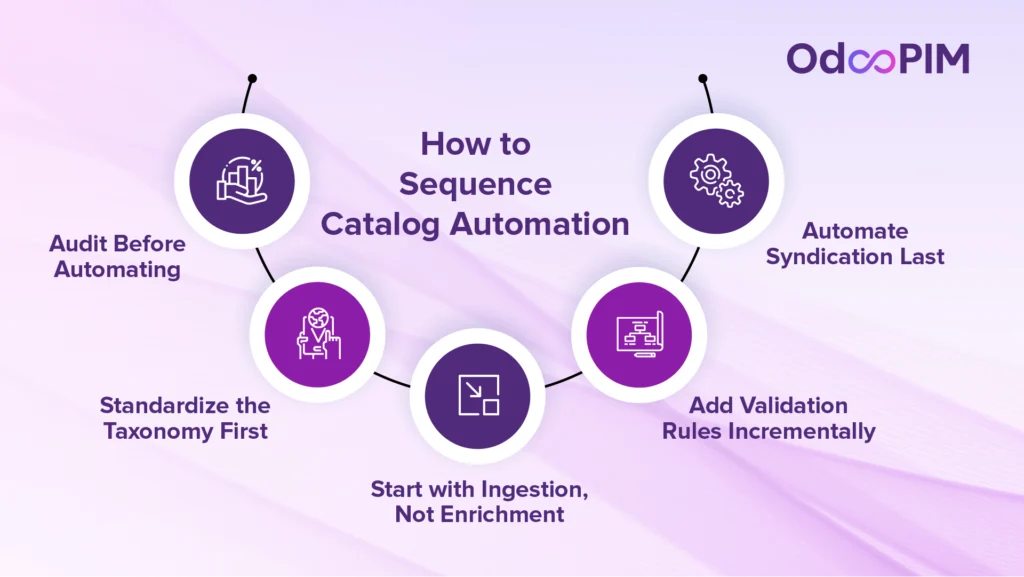
How to Sequence Catalog Automation
Audit Before Automating
Automating a broken process does not fix it, it scales the breakage across your catalog faster than manual processes ever could. Audit your current product data workflows to identify inconsistencies, bottlenecks, and the specific tasks consuming the most team hours before implementing any product data automation. OdooPIM provides visibility into existing product data quality, giving you the audit baseline needed before automation begins.
Standardize the Taxonomy First
Your category structure, attribute definitions, and controlled vocabularies must be consistent before automation can reliably categorize products or populate attributes. A messy taxonomy automated produces consistently messy results. OdooPIM provides the product data management automation framework for taxonomy governance, ensuring your category structure is solid before layering on automation.
Start with Ingestion, Not Enrichment
Automate the inbound flow of supplier data and ERP product records before tackling enrichment automation, because clean ingestion creates the reliable data foundation enrichment depends upon. Automating enrichment on top of messy ingestion just enriches bad data faster. OdooPIM prioritizes catalog automation for supplier feed ingestion and ERP synchronization as the logical first automation phase.
Add Validation Rules Incrementally
Build validation rules one attribute group at a time, starting with the mandatory fields that impact channel publication success. Adding the rules simultaneously overwhelms teams with flag fatigue and rejection notifications. OdooPIM supports incremental product data enrichment automation validation, allowing teams to build governance maturity gradually.
Automate Syndication Last
Channel syndication automation should be the final phase because distributing product data automatically only creates value when the underlying data is accurate, complete, and validated. Automating syndication before establishing data quality sends errors to every channel simultaneously. OdooPIM sequences product information workflow automation so syndication activates only after governance and enrichment automation are established.
| Phase | What to Build | Prerequisite | Typical Timeline |
| Audit | Current process mapping, data quality baseline | None | 1-2 weeks |
| Taxonomy | Category structure, attribute standards | Audit complete | 2-4 weeks |
| Ingestion | Supplier feed automation, ERP sync | Taxonomy defined | 3-6 weeks |
| Validation | Required-field rules, completeness scoring | Ingestion live | 2-4 weeks |
| Syndication | Automated channel output | Validation rules active | 2-4 weeks |
Product Data Automation Tools and Approaches
Spreadsheets Plus Scripts
Spreadsheets with custom scripts handle basic catalog automation for very small catalogs and technically proficient teams, but collapse when SKU counts exceed a few hundred or multiple team members need simultaneous access. The approach works for startups testing product data processes but becomes the bottleneck that prevents scaling. OdooPIM replaces spreadsheet dependency with a governed platform before the breaking point arrives.
Integration Platforms
iPaaS tools excel at moving product data between systems but lack the governance, validation, and enrichment workflow capabilities that product data management demands. Integration platforms handle the movement layer of product data management automation while leaving the quality layer unaddressed. OdooPIM provides both integration connectivity and product data governance within one native Odoo platform.
PIM Platforms
Purpose-built PIM platforms like Akeneo, Pimcore, Salsify, and Contentserv combine rules, workflows, and validation into unified product data automation environments designed specifically for product content governance. These platforms provide the enrichment workflows, completeness scoring, and channel syndication that general-purpose tools cannot match. OdooPIM delivers these PIM capabilities natively within Odoo, eliminating the integration layer that standalone platforms require.
What Determines the Right Fit
SKU count drives the scalability requirements, channel count determines syndication complexity, update frequency dictates automation urgency, and team size shapes whether you need governed workflows or can manage with lighter tools. The right product data automation tools fit your current operations while providing headroom for catalog growth. OdooPIM serves mid-market businesses running Odoo who need PIM capabilities integrated with their operational systems.
Learn about automotive catalog management
Case Studies
Case Study 1: Industrial Safety Equipment Distributor Sequences Automation Correctly and Cuts Enrichment Time by Seventy Percent
Challenge
An industrial safety equipment distributor with twelve thousand SKUs had attempted product data automation by scripting their supplier feed ingestion, but the automation amplified errors because the underlying data had never been audited or standardized. Supplier specifications arrived in fifteen different formats, and the scripts pushed inconsistent attribute names into their ecommerce platform, creating the listing errors they had hoped automation would eliminate. Leadership wanted to attempt catalog automation again but needed an approach that would not repeat the first failure.
Solution
The distributor followed a phased product data management automation approach, starting with a thorough audit of existing product data to identify inconsistencies and quality gaps. They standardized their taxonomy and attribute definitions first, then deployed OdooPIM within their existing Odoo environment to provide governed product information workflow automation. Channel syndication automated last, once the team confirmed that underlying product data met quality thresholds after validation rules enforced completeness standards.
Results
Weekly enrichment hours were reduced from thirty to nine as product data automation handled supplier ingestion, attribute validation, and channel syndication. Product description generation configured as partial product data enrichment automation, with AI-generated drafts routing through human approval for technical accuracy. The operations manager noted that sequencing catalog automation correctly, audit first, standardize second, automate third, was the critical lesson from their initial failure.
Case Study 2: Consumer Electronics Brand Balances Automation and Human Judgment to Scale Product Launches
Challenge
A consumer electronics brand with five thousand SKUs selling through Shopify, Amazon, and two retail partners manually managed product data across channels, consuming twenty-five hours weekly. Their marketing team wrote every product description from scratch while manually formatting technical specifications for each channel. The brand needed product data automation that accelerated mechanical tasks while preserving human oversight where it mattered most.
Solution
The brand deployed OdooPIM to implement product data management automation that distinguished between tasks suitable for full automation and those requiring human judgment. Product descriptions configured as partial product data enrichment automation, with AI-generated initial drafts routing through marketing team approval before publication. Pricing approvals and compliance attributes remained entirely manual, protected by governance rules that prevented automated changes to regulated product data.
Results
Weekly product data hours were reduced from twenty-five to seven as product data automation handled the mechanical tasks the team had previously performed manually. Channel consistency improved immediately because catalog automation syndication pushed identical product data to Shopify, Amazon, and retail partners simultaneously. The marketing director credited the balanced product data automation tools approach with delivering efficiency gains without sacrificing the creative control that differentiated their brand.
Learn about online catalog management tools

How OdooPIM Approaches Catalog Automation
OdooPIM delivers catalog automation through native Odoo architecture where product data, inventory, pricing, and orders share one database without integration layers. Automated catalog updates require no reconciliation step between PIM and ERP because both capabilities operate on the same data foundation. Approval workflows and validation rules configure against the existing Odoo user and role structure, embedding product data automation governance within the systems your team uses daily. OdooPIM fits mid-market ecommerce businesses on Odoo or teams consolidating a multi-tool stack who need governed product information workflow automation connected to their operational systems. The platform provides a realistic automation approach, automating what works cleanly, supporting what automates partially, and respecting where human judgment must remain.
Learn more about how OdooPIM brings governed product data management automation to your Odoo environment on our product page.
Learn about Best Automotive Parts Catalog Software
FAQ’s
1. What is catalog automation?
Catalog automation is the use of software to handle the repetitive product data tasks, attribute population, content formatting, channel syndication, and quality validation, that would otherwise consume thousands of manual hours across large ecommerce catalogs. It focuses on ecommerce product catalogs, not industrial automation, data catalogs, or IT service catalogs. OdooPIM applies product data automation directly within the Odoo ERP framework, automating mechanical catalog work while keeping your team focused on strategic decisions.
2. Which catalog tasks can be fully automated?
Supplier feed ingestion, attribute validation, bulk updates, rule-based categorization, channel syndication, and completeness scoring all automate cleanly because they follow predictable patterns that software handles reliably. These are the tasks where product data management automation delivers immediate time savings with minimal risk of errors. OdooPIM automates these clean tasks natively within Odoo, freeing your team for work that requires human judgment.
3. Can AI automate product descriptions?
AI can generate initial product descriptions from attributes and specifications, accelerating the first draft process for large catalogs. Human review remains essential for regulated products, technical specifications, and brand-critical copy where accuracy cannot be compromised. OdooPIM supports product data enrichment automation with governed workflows where AI-generated content routes through human approval before reaching customer-facing channels.
4. Do I need a PIM to automate catalog work?
Scripts and spreadsheets handle basic catalog automation for very small catalogs but collapse when SKU counts grow, channels multiply, or multiple team members need simultaneous access. A PIM platform provides the rules, workflows, validation, and syndication capabilities that make product information workflow automation reliable at scale. OdooPIM delivers these PIM capabilities natively within the Odoo ecosystem, eliminating the integration complexity of standalone product data automation tools.
5. Where should catalog automation start?
Start by auditing your current product data processes because automating a broken workflow simply scales the breakage across your catalog faster than manual processes ever could. Standardize your taxonomy and attribute definitions first, then automate supplier feed ingestion as the logical initial automation phase. OdooPIM provides the governed product data management automation foundation for this phased approach, ensuring automation builds on clean, validated product data.