What Product Information Actually Includes
The obvious layer of Product information is the descriptive content product titles, bullet points, long-form descriptions, and marketing copy tailored to different audiences and channels. Beneath that sits the structured data layer: dimensions, weights, materials, technical specifications, compatibility attributes, and the category-specific fields that platforms like Amazon require to index and rank your listings correctly. Then there are the digital assets, primary images, lifestyle photography, instruction manuals, videos, and CAD files, all of which need to be linked to the right product records and delivered in the right format for each destination.
Product information management for retailers also encompasses locale-specific translations, regulatory compliance fields, country-of-origin declarations, hazardous material flags, and SEO metadata. A mature product information management system tracks all of these as structured, governable attributes. A product catalog management software treats product information as a living, multi-dimensional asset that needs to be maintained, validated, and distributed. The breadth of what lives inside a well-managed PIM is exactly why the discipline exists in the first place.
PIM market valued at USD 19.95 billion in 2026, projected to hit USD 37.39 billion by 2031 at a 13.38% CAGR
– Mordor Intelligence
The Difference Between Product Information Management as a Process and as Software
Product information management as a process is the set of workflows, governance rules, and team responsibilities that determine how product data gets created, approved, enriched, and published. This includes decisions like who owns the master record for a SKU, what completeness standards a product must meet before it goes live, and how incoming supplier data gets validated before it enters your catalog.
PIM software, tools like the OdooPIM system and other dedicated product information management tools is the technology layer that makes the process scalable, auditable, and fast. A product information management system does not replace the need for clear process thinking; it operationalizes it. When teams implement PIM software without first defining their data governance process, they end up with an expensive system that replicates the same chaos digitally. When they define the process first, the software becomes a multiplier, accelerating enrichment workflows and enforcing quality rules automatically.
Learn about Best PIM software
How Product Information Management Works
Stage 1 — Collecting Product Data From All Sources
Every product information management system begins with an intake problem. Product data arrives simultaneously from supplier portals, internal teams, content agencies, creative teams, and third-party data pools, almost never in the same format or to the same standard. For retailers managing thousands of active SKUs, product information management is a constant operational challenge that even the best product catalog management software cannot solve without a structured collection process behind it. What is PIM doing at this stage? It acts as an aggregation layer that accepts data across flat files, spreadsheets, XML feeds, and direct ERP integrations, normalizing incoming fields against a standardized internal schema, flagging missing attributes, identifying duplicates, and quarantining suspect data before it reaches the master catalog. The OdooPIM system handles this through its integrated supplier and inventory modules, giving teams a governed pipeline from raw supplier data through to publishable product records.
Stage 2 — Centralizing Data Into a Single Repository
Once data has been collected and normalized, a product information management system consolidates it into one authoritative record per product that every team and every channel draws from replacing the fragmented reality where multiple versions of the same product record live simultaneously in the ERP, the ecommerce platform, a marketing spreadsheet, and several individual inboxes, each drifting independently and requiring constant manual reconciliation. This is the architectural core of what is product information management workflow as a discipline: the ERP retains ownership of pricing and inventory, while all content descriptions, attributes, assets, and channel-specific variants live in the PIM and flows outward from there. This is the critical PIM vs ERP distinction at the systems level. These tools are not competing for the same data, they are governing different domains of it, and product information management tools that integrate cleanly with ERP infrastructure give businesses operational accuracy on the transactional side and content consistency on the customer-facing side simultaneously.
Stage 3 — Enriching Product Content Across Teams
Centralization creates the foundation, but enrichment is where the commercial value of product information management is actually built, transforming a raw supplier record containing a SKU and a basic description into a publish-ready listing with persuasive brand copy, SEO-optimized titles, complete attribute sets, high-resolution imagery, and localized variants that convert browsers into buyers across every market. This enrichment work is one of the most tangible product information management benefits because it directly correlates with listing quality, search visibility, and conversion rates and PIM software structures it by assigning attributes to specific teams, setting completeness thresholds, and making it immediately visible which products are ready to publish and which are not. Product catalog management software with role-based enrichment interfaces means copywriters, SEO specialists, and compliance teams each see only the fields relevant to their function, eliminating the coordination overhead that slows enrichment workflows down at scale. The OdooPIM system supports this collaborative model through configurable product templates and attribute management, enabling retailers with large assortments to define exactly what a publish-ready record looks like and track progress toward that standard across every SKU in the catalog.
Stage 4 — Governing Data With Workflows and Approvals
Enrichment without governance is organized chaos at a faster speed, which is why a mature product information management system establishes workflow controls that route product records through the right review steps before publication, tracking category manager sign-offs, compliance reviews, and channel-specific completeness checks inside the PIM rather than across email chains and shared documents. Product information management tools with robust governance capabilities maintain a full audit trail of every change made to every record, including who changed what, when, and why, which is critical for product information management for retailers operating in regulated categories where attribute accuracy carries legal implications, or for brands managing content contributions from multiple agencies and internal teams simultaneously. The workflow layer is also where quality scoring becomes actionable: rather than simply flagging that a portion of the catalog is incomplete, a well-configured product information management system routes those records back to the responsible team with specific resolution instructions.
Stage 5 — Distributing to Every Sales Channel
The distribution stage is where every upstream investment in product information management pays off commercially. A PIM system takes your enriched, governed, and approved product records and publishes them automatically to every channel you operate, including Amazon, Shopify, Walmart Marketplace, wholesale portals, and distributor feeds handling each platform’s unique formatting requirements, field conventions, and attribute taxonomies without manual reformatting. The Odoo PIM technologies system supports channel-specific content variants, allowing businesses to manage different titles, truncated descriptions, and market-specific pricing without duplicating the underlying product record. For growing businesses, this is often the clearest ROI proof point, catalog exports that previously took days now take hours, with fewer errors, fewer returns, and a compounding efficiency gain that multiplies across every product launch and every catalog update.
Learn about PIM for Shopify

Why Businesses Struggle Without Product Information Management
Product Data Scattered Across Spreadsheets, ERPs, and Shared Drives
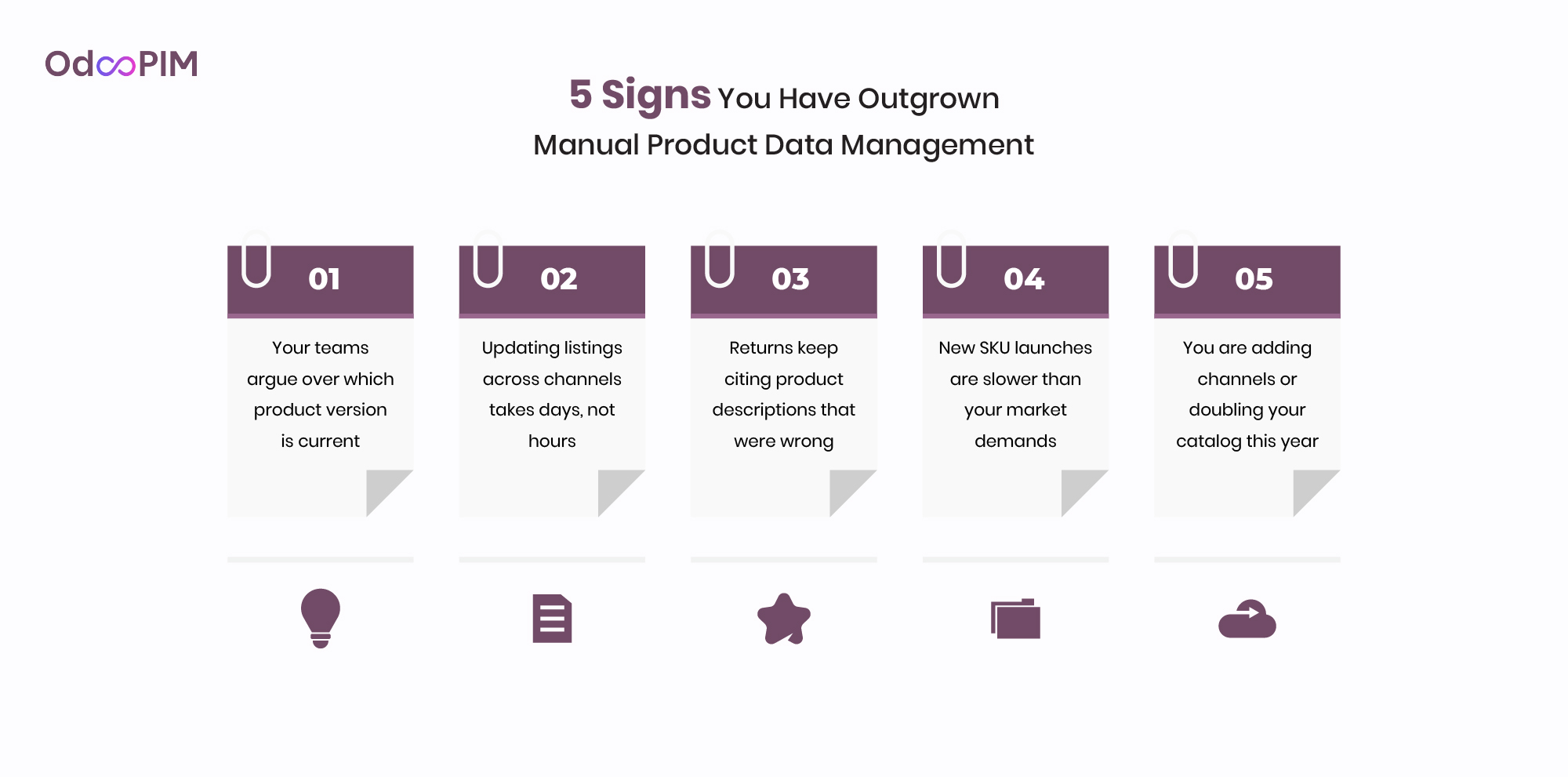
A category manager has the most recent spec sheet in a spreadsheet on their desktop. The ERP holds pricing and SKU codes, but nothing resembling a publishable description. A shared drive contains imagery, but folder structures vary by team, and file naming conventions were abandoned years ago. The supplier sent updated dimensions in an email that three people have saved locally, and one person has already deleted. This is the operational reality for the majority of retailers and brands that are still asking what is PIM and whether they actually need it. The answer is visible in how their team answers the question: “Where is the latest version of this product’s data?”
Without product information management tools to consolidate these sources, teams spend a disproportionate share of their working hours locating, reconciling, and manually re-entering data that already exists somewhere in the organization. This is a particularly acute problem in the PIM vs ERP debate. Many businesses assume their ERP is sufficient as a product data repository, only to discover that ERPs are optimized for transactional fields like cost, quantity, and lead time, not for the rich content attributes that drive e-commerce performance.
Learn about WooCommerce Product Information Management — Why Your Store Needs a PIM
Inconsistent Product Listings Across Channels Hurting Conversions
When product data has no authoritative source, inconsistency across channels is inevitable. The product title differs, dimensions differ between the marketplace listing and the brand website. The material composition is correct on one channel and outdated on two others. For customers encountering your brand across multiple touchpoints, this inconsistency is a trust signal that actively works against conversion.
This is a commercially damaging consequence of operating without product information management, and a compelling product information management benefit that businesses report after implementation. A PIM system for e-commerce ensures that every channel draws from the same enriched master record, so when a title is updated, a specification is corrected, or a new image is approved, that change propagates to every destination simultaneously rather than requiring a manual update on each platform individually. Product information management for retailers is particularly critical in this respect, because retail assortments are large, channels are numerous, and the margin for listing error is thin in competitive categories.
Manual Updates That Slow Down Product Launches
Manual product data workflows are one of the most reliable destroyers of speed to market, requiring teams to extract ERP data, reformat it per channel, route files for review, and upload separately to each platform, a process that simply doesn’t scale as launch volumes grow. PIM software solves this by replacing that sequential, error-prone cycle with a single system where data enrichment, review, and channel mapping happen in parallel, and publishing across all connected channels happens in one action, compressing what once took days into hours. For category teams racing to hit seasonal windows or respond to competitor moves, that speed difference isn’t an operational nicety; it’s a direct and largely untapped revenue lever.
High Return Rates Caused by Inaccurate Product Descriptions
Returns are among the most expensive outcomes in e-commerce operations, and inaccurate product information is consistently one of their leading causes. Product information management for retailers addresses this at the source rather than at the symptom. A product information management system that enforces attribute completeness, validation rules, and approval workflows before a listing goes live is doing the quality control work that prevents these downstream failures. PIM software that flags a missing dimension, an unverified compatibility claim, or a description that references a superseded product version is saving the business from a return that would have cost multiples of what the PIM investment costs to operate. Understanding what product information management is in this context reframes it from a content management tool into a returns reduction and margin protection strategy.
Teams Working From Different Versions of the Same Data
When there is no single authoritative product record, every cross-functional interaction involving product data becomes a negotiation about which version is correct. The OdooPIM system and comparable product information management tools resolve this by making the single master record not just technically available but operationally unavoidable — every team that touches product data does so through the same system, seeing the same fields, working from the same approved content. This alignment has benefits that extend well beyond data accuracy. It reduces the volume of internal queries that slow down category managers and product owners. It eliminates the redundant enrichment work that happens when two teams independently update the same record in different systems. And it creates organizational clarity on data ownership, making onboarding new team members and scaling into new categories dramatically faster. The PIM vs ERP framing often focuses on technology capabilities, but the more honest framing for most businesses is simpler: a product information management system is the infrastructure that allows your teams to stop arguing about which spreadsheet is right and start focusing on the work that actually drives growth.
Key Benefits of Product Information Management
1. One Source of Product Data
This single-source model also transforms the relationship between PIM software and every other system in your technology stack. In the PIM vs ERP conversation, the single source of truth principle is what clarifies each system’s role most cleanly: the ERP owns transactional data, the PIM owns content data, and both are authoritative within their domain. Product catalog management tools that integrates bidirectionally with your ERP means that pricing and inventory accuracy flows in from one direction, while enriched, publish-ready product content flows out in all others. For product information management for retailers managing thousands of active SKUs across multiple brands and categories, this architectural clarity is not a luxury; it is the prerequisite for operating at scale without a proportional increase in headcount dedicated to data reconciliation.
2. Faster Time to Market for New Products
Speed is a measurable benefit of product information management, and its value compounds as you launch more products and sell through more channels. A product information management system collapses that relay into a parallel workflow where enrichment, review, approval, and multi-channel publishing all happen inside a single governed environment. The OdooPIM system demonstrates this particularly well for growing businesses. Product templates with pre-configured channel mappings mean that once the workflow is set up, every subsequent launch follows the same path automatically, with none of the reformatting overhead that consumed so much time before. What is product information management’s commercial impact here? For seasonal retailers, this means hitting peak windows with complete assortments rather than publishing listings in batches after the season opens. For brands responding to competitor moves or trend-driven demand, it means capturing opportunity in days rather than weeks. The time-to-market advantage of product catalog management software is not a one-time efficiency; it is a structural acceleration that applies to every product launch for the lifetime of the system.
3. Improved Product Data Quality and Consistency
Data quality degrades under the pressure of catalog growth, team turnover, supplier changes, and channel expansion. Data consistency across channels is key. When a product information management system governs what goes out to each channel, the title, description, specifications, and imagery a customer sees on your Amazon listing, your Shopify store, and your wholesale portal are not just similar — they are derived from the same master record, which means they are identical in substance even where they are formatted differently for each platform’s requirements. For product information management for retailers competing in categories where customers research across multiple touchpoints before purchasing, this consistency is a conversion factor that is easy to underestimate. What is PIM doing in these moments? It is building the brand trust that turns a product page visit into a completed purchase, by ensuring that every encounter with your product data reinforces.
4. Reduced Returns and Customer Complaints
Returns represent one of the clearest financial cases for investing in product information management tools. Reverse logistics, restocking labor, repackaging costs, potential markdown on returned inventory, and the customer lifetime value lost compound across every return event triggered by a gap between what your listing promised and what the customer received.
The mechanics of preventing product returns sit inside the governance and validation layer of PIM software. The completeness rules that ensure no listing goes live without verified dimensions, the approval workflows that require a subject-matter sign-off on regulated attributes, and the audit trail that surfaces when a product specification is changed without a corresponding update to the live listing. Product information management for retailers in high-return-rate categories finds that even a modest improvement in listing accuracy has an outsized impact on returns as a percentage of revenue. The Odoo PIM system’s attribute management and validation capabilities address this directly, giving teams the governance infrastructure to enforce accuracy standards across every SKU before the customer ever sees the listing.
5. Better Collaboration Between Product, Marketing, and Sales Teams
When product, marketing, and sales teams are working from different systems with no shared source of truth, every collaborative task begins with a synchronization exercise that should be unnecessary. A product information management system restructures this collaboration by making the shared product record the natural workspace for every team that contributes to it. PIM software with role-based interfaces means the product team manages technical attributes, the marketing team owns copy and creative assets, the compliance team controls regulatory fields, and the sales team accesses channel-specific pricing variants — all within the same governed environment, with full visibility into what each team has completed and what is still outstanding. This transparency is one of the underappreciated product information management benefits: it replaces the status update meeting with a completeness dashboard, and it replaces the “did you get my email?” with a workflow notification. For product information management for retailers with complex assortments spanning multiple brands and categories, this collaborative infrastructure is what makes cross-functional product launches repeatable and predictable.
6. Scalability as Your Catalog and Channels Grow
What is product information management’s role in scaling commerce operations? It is the infrastructure layer that ensures your data quality, time-to-market, and cross-channel consistency do not degrade as your catalog grows, so that adding a new product category or a new sales channel is a configuration task rather than an operational crisis. The Odoo PIM system is particularly relevant here for businesses in that growth corridor, as companies that have outgrown spreadsheet-based catalog management but are not yet at the scale to justify the implementation complexity of enterprise-tier product information management tools. Its modular architecture means businesses can scale their PIM capabilities in step with their catalog and channel footprint, adding integrations, workflows, and attributes as the business requires them rather than configuring everything upfront for a scale they have not yet reached. Product catalog management software that grows with the business protects the initial implementation investment and avoids the costly, disruptive platform migrations that happen when a tool is outgrown too quickly.
Learn about PIM benefits
What Does a Product Information Management System Do?
Data Modeling and Product Taxonomy
Before a product information management system can manage anything, it needs a structured framework for organizing what it knows. Data modeling is the foundational capability that makes everything else possible. A well-constructed taxonomy inside PIM software means that a power tool and a skincare product are governed by entirely different attribute sets, completeness rules, and validation standards appropriate to their category, while still sharing the same underlying infrastructure and distribution workflows. This flexibility is what separates purpose-built product catalog management software from generic database tools that force every product into the same flat structure regardless of category complexity. For product information management for retailers managing assortments that span multiple categories, data modeling is where the long-term scalability of the system is either built or broken. A taxonomy designed without sufficient foresight forces expensive restructuring when new categories are added or when channel requirements demand attribute granularity that the original model did not anticipate. The OdooPIM system approaches this through configurable product templates and attribute groups that can be customized per category without disrupting the broader catalog architecture a practical design choice for growing businesses.
Bulk Editing and Attribute Standardization
Bulk editing sounds like a simple feature until you have experienced a scenario where a supplier changes a material specification across four hundred SKUs, or a regulatory update requires a compliance attribute to be added to every product in a category, or a rebranding initiative requires the brand name field to be updated across the entire catalog before a launch deadline. A manual record-by-record approach is untenable at any meaningful catalog scale, and the risk of inconsistent execution compounds with every record touched by a different team member. PIM software with robust bulk editing capabilities transforms these scenarios from multi-week projects into hours-long operations, with the added assurance that every affected record receives exactly the same update through the same governed workflow. Attribute standardization works alongside bulk editing to address a related problem: the variation that accumulates over time when multiple people, teams, or data sources enter the same type of information in different ways. Product catalog management software with standardization rules and controlled-vocabulary enforcement ensures that attributes conform to defined values at the point of entry, making the bulk cleanup exercise progressively less necessary as the system matures and data hygiene becomes structural rather than periodic.
Automated Data Validation and Completeness Scoring
What separates a true PIM from a simple database is its ability to actively evaluate data against defined standards before errors reach live listings. Automated validation works at the attribute level, catching mistakes the moment they’re introduced rather than in a manual review days later. Completeness scoring extends this further, giving teams a real-time, at-a-glance measure of how publication-ready each SKU is, with channel-specific profiles that reflect Amazon’s requirements separately from Shopify’s or a wholesale portal’s. Instead of relying on individuals to remember each channel’s requirements, the system enforces them structurally, making quality compliance visible and scalable as catalog volume grows.
AI-Powered Content Enrichment
AI has moved from speculative to genuinely operational within PIM workflows, with its most significant impact at the enrichment stage, generating first-draft product descriptions from structured attributes, suggesting SEO-optimized titles, auto-tagging assets via image recognition, translating content across locales, and recommending attribute values from catalog patterns. The commercial significance isn’t that AI replaces human editorial judgment, but that it relocates where that judgment is applied: instead of copywriters starting from blank fields, they review and refine AI-generated drafts that are already structurally correct and factually grounded. That shift from creation to curation dramatically increases enrichment throughput, directly accelerating time-to-market, and for catalogs spanning tens of thousands of SKUs across multiple categories and locales, it’s what makes completeness achievable at a speed and cost that manual workflows simply cannot match.
Multichannel Syndication and Distribution
Multichannel syndication is the capability that takes enriched, approved product records and distributes them to every sales channel, marketplace, retailer portal, and distributor feed connected to the PIM. A mature PIM system for e-commerce maintains channel-specific output profiles that map the master product record’s fields to the structure each destination requires: Amazon’s flat-file templates, Shopify’s product API, Google Shopping’s feed specifications, EDI formats for wholesale partners, and custom XML or JSON exports for proprietary retailer systems. This translation layer allows a single update to the master record to propagate to every channel, without a human manually reformatting the data for each destination. What is product information management’s syndication capability delivering beyond operational efficiency? It is delivering channel confidence, the assurance that what you approved in your product information management system is exactly what your customer sees on every platform, formatted correctly and updated in real time. Product information management for retailers that operate across a mix of owned channels, third-party marketplaces, and wholesale relationships, understands how fragile that confidence is when syndication is managed manually. A single field mapping error in a manually maintained feed can propagate incorrect data to thousands of listings before anyone notices.
Role-Based Access and Data Governance
What transforms PIM from an organized spreadsheet into a genuinely scalable system is its governance architecture, defining who can view and edit which fields, which changes require approval, and what audit trail is maintained for every modification. Role-based access control implements this in practice, ensuring a supplier coordinator can populate incoming attributes without touching approved marketing copy, and a regional content manager can update locale-specific descriptions without altering the master technical spec. This governance layer is easy to undervalue during evaluation and acutely missed after a failure occurs the moment a bulk update overwrites the wrong field or a contractor corrupts an approved copy, the cost of inadequate access control becomes very tangible. Comprehensive audit trails make every change attributed, timestamped, and reversible; for retailers managing catalog contributions from multiple internal teams, agencies, and supplier portals, that structure is the operational foundation for safe, scalable collaborative catalog management.
Digital Asset Management for Product Media
Product content extends beyond text and structured attributes; imagery, video, and documentation are equally critical to customer experience and equally prone to fragmentation. Digital asset management integrated within a PIM links media files directly to their product records, creating a governed relationship between content attributes and visual assets that persists across every update, channel, and contributor; when a primary image changes after a packaging refresh, it updates automatically across every connected channel without separate manual uploads. Managing media in a disconnected shared drive or a standalone DAM reintroduces exactly the version-control and consistency problems PIM exists to eliminate. Native DAM within a PIM ensures the right asset, in the right format and resolution for each channel’s specifications, is always associated with the right product, closing the loop so that the quality standards applied to text attributes are applied with equal rigor to every visual element shaping the customer’s purchase decision.
Who Needs Product Information Management?
E-commerce Brands Managing Multiple Sales Channels
The moment a brand moves beyond a single storefront and begins publishing product data to Amazon, a branded website, a wholesale portal, and a social commerce channel at the same time, the data management complexity multiplies in ways that manual processes cannot absorb cleanly. Each channel has its own attribute requirements, character limits, image specifications, and taxonomy conventions. Managing those differences manually means maintaining parallel versions of the same product record in multiple places, and every parallel version is a divergence waiting to happen. What is product information management’s specific value for multichannel ecommerce brands beyond operational tidiness? It is the commercial compounding effect of consistent, complete, high-quality product content across every customer touchpoint simultaneously. A brand whose Amazon listing, Shopify store, and Instagram Shopping feed all present the same accurate, enriched product content is not just more efficient internally; it is more credible externally, and that credibility translates directly into conversion rates, return rates, and repeat purchase behavior. PIM software built for ecommerce brands also accommodates the channel-specific content variants that smart merchandising requires: a longer, SEO-optimized description for the brand website, a tighter bullet-point format for the Amazon listing, and a single punchy line for the social feed, all governed from the master record, all published through the same workflow, and maintained with the same quality standards that a mature PIM system enforces by design.
Manufacturers Distributing Technical Specs to Partners
For manufacturers, the product information challenge is structurally different from that of a retailer or ecommerce brand, but no less complex and considerably more consequential. Manufacturers are the origin point of product data, creating specifications, certifications, compliance documentation, and technical attributes that flow downstream to distributors, retailers, wholesalers, and ecommerce platforms. Without a product information management system to govern that outbound data flow, manufacturers have limited visibility into what version of their product information is live in the market at any given moment. An internally updated specification may take weeks to reach downstream partners, and in the interim, retailers and distributors publish outdated data to their customers. PIM software gives manufacturers the governance infrastructure to own and manage the authoritative version of every technical attribute associated with every product they make, and to distribute updates to downstream partners through structured, auditable feeds rather than email attachments and manual spreadsheet shares. Product catalog management software acts as the manufacturer’s content publishing infrastructure and ensures that a specification change, a certification update, or a new safety compliance requirement reaches every partner channel simultaneously.
Retailers With Large and Complex Product Catalogs
Retail is PIM’s most established use case for good reason — large assortments, high category complexity, variable supplier data quality, and thin margins for listing error create an attribute diversity problem no team can manage manually at scale. A furniture category demands dimension sets and assembly fields; beauty requires ingredient lists and certifications; electronics needs compatibility matrices and compliance data — each with distinct completeness requirements that only a PIM can enforce simultaneously across a catalog of meaningful size. For mid-market retailers who have outgrown spreadsheets but don’t yet justify enterprise PIM costs, the system delivers the operational infrastructure to onboard supplier data quickly, enforce category-specific quality standards automatically, and publish consistent listings across all channels — maintaining that quality as the assortment grows without a proportional increase in headcount. In this context, PIM isn’t just a content tool; it’s the operational backbone that determines whether catalog growth translates into revenue growth or simply into more complexity and more errors at a larger scale.
Wholesalers and Distributors Syncing Data With Partners
Wholesalers and distributors face a uniquely demanding PIM challenge because they sit at the intersection of two data flows: inbound from manufacturers, whose product data arrives in inconsistent formats and schemas, and outbound to retailers and platforms, whose requirements are equally varied and rarely aligned with what came in upstream. Without a PIM to normalize, enrich, and reformat that inbound data, the distributor becomes a manual translation service that eventually breaks under its own weight. PIM software built for this use case addresses both sides, with supplier portal functionality that routes manufacturer submissions into a governed intake workflow for validation and normalization, and channel mapping that reformats each enriched record to meet the specific requirements of every retail or ecommerce partner, whether an Amazon vendor feed, EDI transmission, or custom API connection. The result is a single governed infrastructure that reduces the manual translation overhead sitting between supplier relationships and customer-facing catalog performance.
Global Brands Managing Multilingual Product Content
For brands operating across multiple markets, PIM is an operational necessity rather than a convenience, given that multilingual content management extends far beyond translation to cover region-specific regulatory disclosures, unit system conversions, naming conventions, cultural adaptation, and imagery compliance standards that a centralized team cannot manage through spreadsheets and email without accumulating serious data risk. A PIM built for global operations maintains the master product record at the attribute level and manages locale-specific variants as governed overlays rather than as separate records that drift independently, meaning that a core technical specification updated once cascades correctly through every localized variant, with translation workflows triggered automatically where needed. This architecture allows a global brand to present itself as locally relevant and compliant with local regulations in every market it enters, without sacrificing the central data governance that keeps the master catalog accurate and consistent, and without rebuilding its catalog management approach from scratch in every new region it enters.
Product Information Management vs Other Systems
PIM vs ERP — What Each System Is Actually For
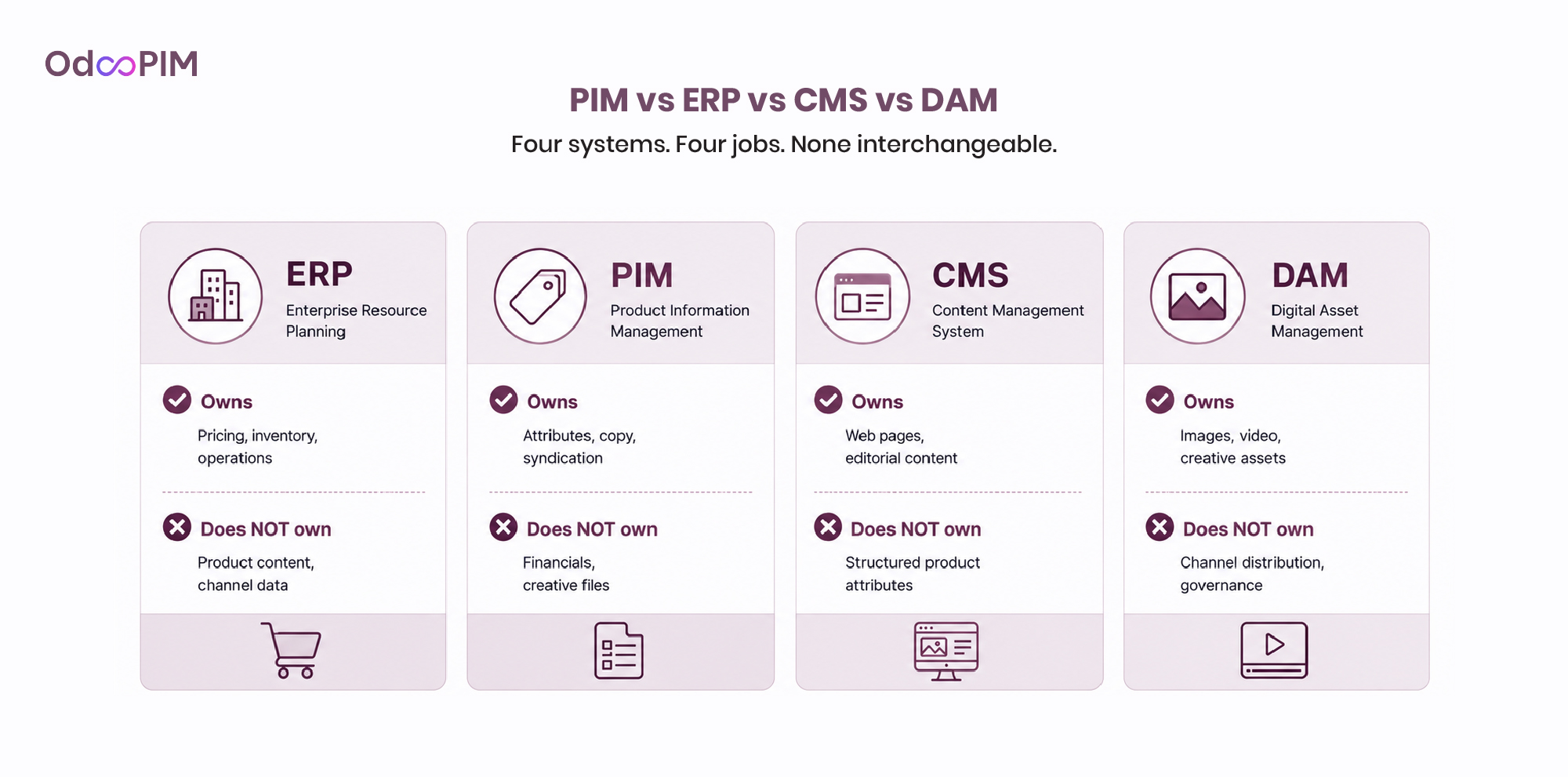
The PIM vs ERP question is a common source of confusion because both systems touch product data, but the distinction becomes clear when examining what each was engineered to do: an ERP is a transactional system optimized for financial and operational mechanics such as purchase orders, inventory, costs, and logistics, while a PIM is a content system designed to manage the rich, descriptive, customer-facing layer of product data including copy, attributes, imagery, channel-specific variants, and the governance workflows that maintain their quality over time. This means PIM vs ERP is almost never an either/or decision but a question of integration architecture, where a well-configured PIM pulls base data from the ERP and builds the content layer on top, enriching raw records with marketing copy, technical attributes, and digital assets before distributing completed product records to every connected sales channel. What PIM adds to an ERP-anchored stack is the commercial content infrastructure that turns an internally accurate product record into a customer-facing asset that drives discovery, conversion, and retention across every channel the business operates.
PIM vs CMS — Why a CMS Is Not a Substitute for PIM
A CMS is built to manage pages, organizing editorial content hierarchically and enabling non-technical teams to update site content, but it falls short as a PIM substitute because it stores product information as page content locked into a specific website’s architecture and is largely inaccessible to other systems without custom development. That approach fails the moment a brand needs to publish the same product data to a marketplace, a wholesale portal, a print catalog, and a regional ecommerce site simultaneously, each with different formatting requirements and attribute schemas. A PIM treats product data as structured, portable, channel-agnostic records with discrete typed fields that can be mapped to any channel’s requirements, which is precisely what makes multichannel syndication possible and what no CMS was designed to deliver. For retailers and ecommerce brands managing content across multiple channels, a CMS remains a valuable complement to a PIM, governing editorial content like buying guides and category pages, but it cannot replace the structured data management, validation, completeness scoring, and multichannel distribution capabilities that a PIM provides.
PIM vs DAM — How They Work Together
DAM systems and PIM systems are complements rather than alternatives, each covering a distinct layer of product content management. A DAM is purpose-built for binary file management, handling storage, format conversion, rights management, version control, and the organizational taxonomy that helps creative teams navigate libraries of hundreds of thousands of assets, but it does not maintain the relationship between an asset and its product record in a way that supports multichannel distribution, completeness scoring, or governance workflows tied to the product lifecycle. A PIM manages assets in relation to products, enforcing image completeness requirements by channel and ensuring that when a primary image is updated, that change propagates across every connected channel profile. For smaller businesses, native asset management within a PIM is sufficient, but for larger operations with complex creative libraries, the optimal architecture is a DAM handling asset storage and creative workflows feeding into a PIM that acts as the distribution intelligence layer, determining which asset goes to which channel in which format, while the DAM serves as the creative source of truth.
PIM vs MDM — Understanding the Overlap
MDM is a broader enterprise discipline governing all critical shared data entities, including customers, suppliers, employees, and products, while a PIM is best understood as a specialized form of MDM focused exclusively on the product domain and oriented toward commerce enablement rather than systems integration. MDM platforms excel at data governance fundamentals such as establishing golden records, managing hierarchies, and maintaining referential integrity across enterprise systems, but they typically fall short on the commerce-specific capabilities a dedicated PIM provides, including channel syndication, ecommerce attribute management, digital asset linkage, completeness scoring against channel-specific thresholds, and enrichment workflows designed for marketing and merchandising teams rather than data architects. For retailers and ecommerce brands, these enrichment and syndication capabilities address problems MDM was not specifically designed to solve, and for large enterprises with complex governance requirements spanning multiple domains, the two systems can coexist with clearly delineated responsibilities, MDM maintaining the canonical product record at the data architecture level and the PIM managing the content and commerce layer that MDM governs but does not enrich.
PIM vs PLM — Where the Product Lifecycle Ends and Commerce Begins
PLM governs the creation and development phases of a product’s life cycle, covering engineering specifications, design iterations, regulatory approvals, and bill of materials, while PIM governs how that product is represented and sold once it reaches market, making the two systems sequential rather than competing. PLM users are engineers, designers, and regulatory teams working on internal development; PIM users are category managers, copywriters, and channel managers working on external representation. In practice, the technical specifications captured in a PLM become the attribute foundation that a PIM enriches, validates, and distributes to commerce channels, and a well-configured integration between the two means that when a product clears its final development milestone, its base technical data flows automatically into the PIM, where enrichment and channel preparation begin immediately. That handoff is the moment a product stops being an engineering asset and becomes a commercial one, where technical accuracy is preserved while marketing relevance, channel compliance, and customer-facing quality are layered on top.

Product Information Management Across Industries
PIM for Retail and E-commerce
Retail and ecommerce is where PIM was born as a discipline, and it remains the industry where the operational case is most immediately legible, combining everything that makes product data management hard: large assortments spanning categories with entirely different attribute requirements, multiple sales channels with their own formatting standards, continuous supplier onboarding in inconsistent formats, and a competitive landscape where listing quality directly determines search visibility and conversion rate. For brands selling across an owned storefront, Amazon, a marketplace, and a wholesale portal simultaneously, every product update, new launch, and seasonal refresh needs to hit all four channels accurately and at the same time, which PIM handles through channel-specific output profiles that translate the master product record into whatever format each destination requires without manual reformatting. At any scale, PIM is ultimately what determines whether catalog growth translates into revenue growth or simply into proportionally more operational complexity.
PIM for Manufacturing and Industrial Products
Manufacturing presents a product information management challenge that is distinct from retail in its technical depth and its distribution structure. Industrial and manufactured products carry attribute sets of considerable complexity — engineering tolerances, material grades, compatibility matrices, certification references, regulatory compliance documentation, and safety data sheets that must be accurate not just for commercial reasons but often for legal and liability ones. A product information management system in a manufacturing context is doing quality-critical work: ensuring that the technical specifications distributed to distributors, OEM partners, and end-use customers are identical to the approved engineering record, and that any specification change is propagated to every downstream channel simultaneously rather than trickling out unevenly through manual update processes.
What is product information management solving for manufacturers that an ERP cannot? The PIM vs ERP distinction is particularly sharp in manufacturing because ERPs are deeply embedded in the operational fabric of most manufacturers — managing bills of materials, production scheduling, and supplier procurement with precision. What they do not manage is the outbound content layer: the product pages, technical data sheets, distributor portal feeds, and ecommerce listings that represent the product to the market. PIM software fills that gap by leveraging the ERP’s technical foundation and building the commercial and distributional content layer on top of it. Product information management tools with strong data syndication capabilities allow manufacturers to push specification updates, new certification documents, and revised compatibility data to every partner channel through a single governed workflow — replacing the email-and-spreadsheet distribution model that creates version drift and the liability exposure that comes with it.
PIM for Fashion and Apparel
Fashion and apparel is one of the most attribute-intensive categories in commerce, where a single SKU may exist across dozens of size, colorway, and fabric variants, each carrying its own imagery requirements, size guide references, care instructions, and country-specific regulatory disclosures, and where multiplying that complexity across a seasonal collection of hundreds of styles and multiple channels creates a data management challenge no manual process can handle at any acceptable standard of speed or accuracy. PIM software built for fashion manages this variant complexity through configurable product models that handle size-color matrices, material attribute inheritance, and style-level versus SKU-level content in a structured, governed way, while also addressing the seasonal velocity challenge where entire collections turn over multiple times per year, requiring rapid onboarding of new data, swift retirement of outgoing styles, and careful management of transition periods where both seasons are live simultaneously. What PIM delivers for fashion brands specifically is the speed, variant accuracy, and visual asset governance that determines whether a new collection launches cleanly across all channels on day one, or spends its first weeks being manually corrected.
PIM for Electronics and Technology
Electronics and technology products carry perhaps the highest attribute density of any consumer category, with processor specifications, connectivity standards, compatibility requirements, power ratings, regulatory certifications, software version dependencies, and safety compliance fields that vary by market and change with every product revision. The PIM challenge for consumer electronics brands is both technical, in that the attribute schemas required to represent these products accurately are extensive and highly structured, and operational, in that product revisions, firmware updates, and compatibility changes must be propagated quickly across every channel before outdated information reaches a customer and generates a return or support ticket. Unlike other categories, electronics product records are living documents updated multiple times across a product’s commercial life as hardware revisions, regional compliance requirements, and accessory compatibility matrices evolve, meaning PIM software in this context needs to be fast and flexible enough to accommodate rapid iteration cycles rather than managing static, long-lived catalog entries. The core PIM benefits for electronics brands concentrate in two areas: accuracy, which prevents the customer experience failures and return costs that flow from incorrect technical specifications, and speed, which ensures product updates reach every channel before competitors or third-party resellers publish conflicting information.
PIM for Food, Health, and Consumer Goods
Food, health, and consumer goods sit at the intersection of high commercial volume and high regulatory sensitivity, making PIM compliance-critical rather than merely operationally useful, since incorrect ingredient declarations, allergen warnings, nutritional information, country-of-origin disclosures, or health claims represent regulatory violations carrying liability, recall risk, and lasting reputational damage rather than simple data quality issues. Beyond compliance, PIM enables the speed and consistency that competitive FMCG categories demand, where new product launches require coordinating packaging copy, retailer portal submissions, ecommerce listings, and promotional content simultaneously against tight seasonal or promotional windows, where a delayed listing means lost shelf presence. PIM tools in this industry also need to handle frequent recipe and formulation changes, ensuring that when an ingredient is substituted or a nutritional profile updated, that change reaches every listing, retailer portal, and digital touchpoint before the reformulated product reaches the shelf, protecting both customer and brand from the consequences of outdated information surviving in the market.
How to Choose the Right Product Information Management System
Define Your Catalog Size and Complexity First
Every meaningful PIM evaluation must begin with an honest assessment of catalog size and complexity, not just today’s but the catalog expected in two to three years, since lightweight product catalog software that performs well at small scale may introduce performance bottlenecks and governance limitations at larger volumes, while enterprise-tier platforms built for millions of SKUs impose implementation complexity and licensing costs that are disproportionate for mid-market businesses in a growth phase. Complexity is the dimension that catches most businesses by surprise, as a catalog of 2,000 SKUs spanning 10 categories with entirely different attribute schemas, variant structures, and compliance requirements per category is a fundamentally harder data management problem than 5,000 SKUs in a single uniform category. What complexity really measures is the diversity of your attribute models, the depth of your variant structures, the number of languages and locales required, and the regulatory sensitivity of your product categories. Documenting both size and complexity clearly before requesting a single demo or reading a feature comparison is the foundation for every subsequent evaluation criterion.
Identify the Channels and Integrations You Need
A PIM that manages product data beautifully but cannot distribute it to the channels your business actually sells through is an expensive content repository rather than a commerce enablement tool, making channel connectivity a non-negotiable evaluation criterion mapped against both your current footprint and your planned expansion roadmap. For e-commerce use cases, this means assessing whether native connectors for Amazon, Shopify, Walmart, Google Shopping, and other platforms are genuinely maintained and current or legacy integrations requiring significant custom development, since the difference between an actively maintained connector and a theoretical integration is measured in months of delay and unplanned cost. Integration requirements extend beyond sales channels to every system upstream and downstream in your technology stack, with ERP integration typically the most critical dependency, requiring production-grade reliability in schema mapping, update frequency, and error handling, alongside DAM integrations, translation management systems, marketplace feed tools, and analytics platforms that need enriched product data to power performance reporting. Every integration requirement should be documented before entering vendor conversations, and any gap between your requirements and a vendor’s native capabilities should be treated as a real implementation cost that belongs in the total cost of ownership calculation.
Evaluate Data Modeling Flexibility and Workflow Capabilities
Technical capability in a PIM is most clearly revealed in two areas, data modeling flexibility and workflow governance, where the former determines whether the system can accurately represent your catalog’s full complexity without forcing products into ill-fitting attribute schemas, and the latter determines whether enrichment, approval, and publication processes can be governed inside the system or must be managed externally through email and project tools, which reintroduces exactly the coordination failures PIM exists to eliminate. Rigid data models that cannot accommodate category-specific attributes, complex variant hierarchies, or evolving regulatory fields create workarounds from day one that compound into structural problems as the catalog grows, making it essential to stress-test any system against your most complex product types and deepest variant structures rather than evaluating it against a demo environment’s sample catalog. For workflow capabilities, pay particular attention to exception handling, specifically what happens when a required attribute cannot be sourced, when an approval is rejected, or when a channel-specific completeness rule cannot be met, since robustness under those conditions is more revealing of real-world capability than performance under ideal ones.
Consider Deployment Type — Cloud, On-Premise, or Embedded
Deployment architecture affects implementation timelines, maintenance obligations, integration flexibility, total cost of ownership, and the speed at which new features become accessible, making it a more consequential evaluation dimension than it might initially appear. Cloud-based PIM has become the dominant model because it eliminates infrastructure management burden, delivers automatic updates, scales with catalog growth, and reaches production deployment faster than on-premise alternatives, while on-premise deployment remains relevant for businesses with data sovereignty requirements, existing infrastructure investments, or compliance obligations restricting where product data can be stored, at the trade-off of higher total cost of ownership and slower feature access. For businesses already in the Odoo ecosystem, an embedded deployment where PIM capabilities are native to the same platform as ERP, ecommerce, and CRM functions represents a compelling third option, eliminating the integration layer between systems entirely, reducing implementation complexity, and creating a single operational environment for functions that would otherwise require data synchronization across separate platforms. Whichever model is chosen, the right deployment decision is the one that minimizes the distance between the system going live and the business realizing the commercial benefits it invested in.
Look at Onboarding, Support, and Total Cost of Ownership
The license cost of PIM software is rarely the largest financial variable in a product information management investment, as implementation, onboarding, integration development, training, and ongoing support costs frequently exceed the platform fee itself, particularly in the first year of operation. A rigorous total cost of ownership assessment covers all of these dimensions across a realistic multi-year horizon, accounting for how costs scale with catalog size and user count to reflect what the product information management system will actually cost to operate at projected scale in year three, not just at go-live. Onboarding quality and ongoing support are evaluation criteria that are easy to underweight during vendor selection and painfully obvious in their importance during implementation, as the speed at which a team moves from signed contract to a functioning, channel-connected PIM depends heavily on onboarding methodology, support resource availability, and documentation quality. When evaluating support models, assess response time commitments, the availability of dedicated implementation consultants for complex catalog migrations, and the vendor’s track record of platform stability and update quality, because a product information management system that onboards smoothly, performs reliably, and evolves its capabilities in step with the market is not just a better operational choice but a significantly better financial one when the full cost of ownership is honestly and completely accounted for.
What Makes Odoo PIM a Strong Product Information Management Solution
How Odoo PIM Centralizes Product Data Inside the Odoo Ecosystem
The foundational strength of Odoo PIM is architectural rather than feature-based, operating as a native layer within an ecosystem where ERP, ecommerce, and sales systems already share the same data infrastructure, rather than requiring integration bridges to be built and maintained between separate platforms. Product data created or updated in Odoo PIM is immediately visible and actionable across inventory, sales, ecommerce, and purchasing modules without synchronization delays, API rate limits, or the data mapping errors that accumulate over time in integration-dependent architectures. In practical terms, the master product record is the operational record across all functions simultaneously, enriched for customer-facing channels in the PIM layer, referenced for transactional accuracy in the ERP layer, and published to the ecommerce storefront from the same governed source without a separate publishing workflow. What this delivers that standalone PIM tools cannot is a genuine single source of truth guaranteed through architecture rather than maintained through integration, a distinction that becomes commercially significant every time a product is updated, a price changes, or a new variant is added and that change needs to reach every operational system and customer-facing channel without manual intervention or synchronization lag.
Built-In Enrichment, Workflow, and Syndication Capabilities
The Odoo PIM system delivers enrichment, governance, and distribution within the same operational environment rather than requiring separate tooling for each function. On the enrichment side, configurable product templates with category-specific attribute groups allow merchandising and content teams to build rich, structured product records that capture the full attribute depth required for competitive channel performance, with variant management, attribute inheritance, and category-specific field configurations providing the flexibility to represent complex assortments accurately without forcing a one-size-fits-all schema onto the catalog. Workflow capabilities govern how records move from initial creation through enrichment, review, and approval to publication, with stage-based controls ensuring completeness standards are met before a record advances, since without those controls, enrichment quality depends on individual discipline that degrades at scale. Syndication operates through Odoo’s native ecommerce module and marketplace connectors, allowing approved records to be published to connected channels without reformatting or manual export, removing a distribution burden that standalone PIM software typically requires third-party connector tools or custom development to address.
Integration With Odoo ERP, Sales, and Ecommerce Modules
The integration story between PIM and the broader technology stack is where many implementations encounter persistent friction, and it is precisely where Odoo PIM’s embedded architecture creates its most durable advantage. In a conventional PIM vs ERP setup, API connections require configuration, maintenance, and ongoing monitoring; schema changes on either side can break mappings, update frequency limitations introduce data lag, and the cumulative maintenance cost rarely appears in initial total cost of ownership calculations. For businesses on the Odoo platform, none of this overhead exists because PIM and ERP are not integrated systems but different functional views of the same underlying data model, meaning sales quotations draw directly from PIM-governed records without a synchronization step, ecommerce storefronts render the current content layer directly rather than consuming a potentially lagged feed, and supplier products onboarded in the inventory module become immediately available for PIM enrichment without a manual import. For retailers and ecommerce brands that have chosen Odoo as their operational platform, this module-level coherence means that what PIM promises in theory, a connected, governed, single-source content infrastructure, is what the system delivers in practice, without the integration engineering that makes equivalent connectivity on multi-vendor stacks so costly to achieve and maintain.
Who Benefits Most From Odoo PIM
The Odoo PIM system delivers its strongest value to businesses that have outgrown manual product data management but are better served by an integrated operational platform than a best-of-breed assembly of specialized tools, with small to mid-size ecommerce brands and retailers managing catalogs of several hundred to tens of thousands of SKUs across multiple channels representing the core beneficiary profile. For businesses already on Odoo ERP, the return on PIM investment is disproportionately high because integration value is immediate, onboarding friction is minimal, and configuration effort concentrates on enrichment and workflow setup rather than building data connections from scratch. Retailers in fashion, consumer goods, food and beverage, and general merchandise find the configurable attribute framework well-suited to category complexity without requiring custom development, while manufacturers and distributors managing outbound product content to retail and ecommerce partners benefit from the ability to govern technical attribute accuracy and maintain consistent product records across partner channels from a single, ERP-connected source of truth.
Product Information Management Best Practices 2026
The following PIM best practices define how to build a resilient, high-velocity commerce operation.
1. Establish a Source of Truth
Centralize the information within a master PIM system. This is the step in the Product Information Management process, eliminating data silos and conflicts.
2. Design a Scalable Product Data Model
Architect a model in your PIM system to accommodate future categories and attributes, ensuring long-term product catalog management viability.
3. Separate Product Content from Transactions
Decouple product content management from transactional ERP data. This allows for independent marketing agility and streamlined operational updates.
4. Automate Validation, Enrichment, and Updates
Implement rules to enforce data quality (product data management best practices) and automate repetitive tasks, ensuring efficiency and accuracy at scale.
5. Enable Omnichannel Product Management
Use your PIM system to tailor and syndicate consistent product stories to a channel from a hub, delivering a unified customer experience.
6. Integrate PIM with ERP and Commerce Systems
Create a smooth data flow. This integration synchronizes operational facts with commercial narratives, powering a business engine.
7. Make Product Data AI-Ready
Structure and enrich your data to fuel AI tools for personalized search, dynamic content, and predictive analytics, turning your catalog into a strategic asset.
Learn about PIM pricing
Product Information Management in Practice: Three Real-World Scenarios
Use Case 1 — A Multichannel Home Goods Retailer Cuts Launch Time From 3 Weeks to 4 Days
Consider a mid-size home goods retailer managing 8,000 SKUs across a Shopify storefront, Amazon, and two wholesale portals. Every seasonal launch followed the same painful sequence: export base data from the ERP, rebuild it in a spreadsheet, reformat it four times for four channels, and route files over email for approval. A single launch consumed three weeks, and dimension errors that slipped through drove returns every quarter.
After centralizing product data in a PIM system, the workflow inverted. Supplier data now enters through a governed intake pipeline, enrichment happens in parallel across content and compliance teams, and channel-specific output profiles handle Amazon’s flat-file requirements and Shopify’s API formatting automatically. The same seasonal launch now takes four days, and because every channel draws from one validated master record, the dimension mismatches that once drove returns have been engineered out at the source — before a single listing goes live.
Use Case 2 — An Industrial Parts Distributor Ends the Spreadsheet Translation Trap
A distributor carrying 40,000 SKUs from 60+ manufacturers sat squarely in the translation trap: inbound spec sheets arrived as PDFs, Excel files, and email attachments in 60 different formats, while outbound retail partners each demanded their own feed structure. Two full-time employees did nothing but reformat data, and a superseded torque specification once sat live on three partner portals for six weeks before anyone noticed.
With product information management tools governing both sides of the flow, manufacturer submissions now route through a supplier intake workflow that normalizes attributes against a standard internal schema and quarantines incomplete records automatically. On the outbound side, channel mapping reformats each enriched record for every partner feed — EDI, API, or flat file — from the same master record. The two reformatting roles were redeployed to catalog enrichment, and specification updates now propagate to every partner channel in hours rather than weeks.
Getting Started With OdooPIM
The practical path to implementing OdooPIM is considerably more accessible than enterprise-tier alternatives, with businesses already on the Odoo platform able to activate PIM capabilities incrementally by configuring product attributes, variants, and category templates within the existing product module alongside live operations, rather than requiring a full-catalog migration before the system delivers any value. For businesses new to the Odoo ecosystem, the starting point is a data readiness assessment covering where product data currently lives, how complete and consistent it is, and which channel integrations are priority from day one, with the Odoo partner network providing implementation support ranging from guided self-implementation for technically confident teams to full-service deployments for complex catalog migrations. Implementation success is ultimately measured not by the go-live date but by the point at which the team has stopped using the legacy spreadsheets and manual processes the PIM was brought in to replace, and that transition happens fastest when scope is realistic, prioritization focuses on the highest-pain workflows first, and the implementation is supported by a partner who understands both the platform and the commerce operations it serves.

Frequently Asked Questions
Q1. What Does PIM Stand For?
PIM stands for Product Information Management. At its core, what is PIM? It’s a centralized system that collects, manages, enriches, and distributes all the data associated with your products — descriptions, specifications, images, pricing, and more — from a single source of truth. Rather than letting product data sit scattered across spreadsheets, email chains, and disconnected tools, a product information management system consolidates everything into a single, governed repository that your entire team can work from.
Understanding what is product information management also means recognizing what it replaces. Before PIM software entered the picture, most retailers and brands relied on manual, error-prone processes to keep product data consistent across channels. A PIM system for ecommerce changes that equation entirely — it acts as the operational backbone that ensures every channel, from your Amazon storefront to your D2C website, is always working from accurate, up-to-date product content.
Q2. What Is the Main Purpose of a PIM System?
The main purpose of a product information management system is to eliminate data chaos across your sales and distribution channels. When product information lives in siloed tools, inconsistencies creep in — a wrong dimension here, a missing attribute there — and those errors erode customer trust, inflate return rates, and suppress search visibility. PIM software centralizes enrichment workflows, enabling teams to build complete, channel-ready product records that go out accurately to every destination, every time. This is one of the most compelling product information management benefits for any retailer managing a large or fast-growing catalog.
Beyond accuracy, a PIM system for ecommerce dramatically accelerates time-to-market. Product catalog management software with built-in channel mapping means you can take a new SKU from raw supplier data to a fully published listing in a fraction of the time it would take using traditional methods. When evaluating PIM vs ERP, it’s worth noting that while an ERP handles financials and operations, it was never designed to manage rich content — that’s precisely the gap a PIM fills, making the two systems complementary rather than competitive.
Q3. Is Product Information Management Only for Large Enterprises?
This is one of the most persistent misconceptions around product information management tools — that they’re only viable for Fortune 500 companies with massive catalogs and dedicated IT teams. In reality, the need for clean, consistent product data scales with your channel footprint, not just your company size. A mid-market retailer selling across Amazon, Walmart, and their own website faces the same data fragmentation challenges as a large enterprise, just with fewer resources to absorb the errors. Product information management for retailers of all sizes has become increasingly accessible, with modern platforms offering tiered pricing and faster onboarding than legacy solutions.
Platforms like the Odoo PIM system demonstrate this shift well — Odoo PIM system functionality is built to serve growing businesses that need structured product data management without the implementation overhead of enterprise-only tools. Whether you’re a boutique brand or an established distributor, the right product information management solution scales with you. The question isn’t whether your business is large enough for a PIM — it’s whether the cost of bad product data has already become too high to ignore.
Q4. How Is PIM Different From an ERP System?
The PIM vs ERP distinction is one of the most important clarifications in modern commerce operations. An ERP (Enterprise Resource Planning) system is built to manage the transactional backbone of a business — inventory levels, purchase orders, financials, and logistics. A product information management system, by contrast, is purpose-built to manage the content layer of your products: descriptions, attributes, digital assets, specifications, and channel-specific variants. What is PIM in relation to ERP? Think of ERP as the system of record for your business operations, and PIM as the system of record for your product stories. They answer different questions — ERP tells you how many units you have; PIM tells the world what those units are and why someone should buy them.
This distinction matters enormously for ecommerce teams. PIM software is designed with merchandisers, content managers, and channel operators in mind — not finance or supply chain teams. A product information management system built for retail handles things an ERP will never touch: Amazon flat file formatting, SEO-optimized copy variants, image asset linking, locale-specific translations, and completeness scoring for listings. Product information management tools also integrate with ERPs, pulling in base data like SKUs and pricing, then layering on the rich content that drives conversions. Choosing between PIM vs ERP is rarely an either/or decision — the best-run ecommerce operations use both, with each doing what it was actually designed for.
Q5. How Long Does It Take to Implement a PIM System?
Implementation timelines for a product information management system vary widely depending on catalog complexity, the number of channels you’re syndicating to, and how clean your existing data is. For small to mid-size businesses using modern PIM software like the Odoo PIM system, implementations can go live in as little as four to eight weeks when product data is reasonably organized and the team has clear ownership of the onboarding process. Larger enterprises with hundreds of thousands of SKUs, multiple ERP integrations, and complex approval workflows should budget three to six months, sometimes longer. The single biggest variable is data readiness — migrating messy, inconsistent legacy data into a structured product information management system always takes longer than teams anticipate.
That said, the implementation investment pays back quickly. One of the most cited product information management benefits is the dramatic reduction in time-to-market after go-live. Product catalog management software with pre-built channel connectors — for Amazon, Shopify, Walmart, and others — means your team stops reformatting spreadsheets for every new listing and starts publishing from a single enriched record. For product information management for retailers specifically, faster onboarding of supplier data and fewer listing errors translate directly into revenue impact. The question isn’t whether you can afford to implement a PIM system for ecommerce — it’s how much revenue leakage from bad data you can afford to sustain while you wait.
Q6. Does OdooPIM Work for Small and Mid-Size Businesses?
Yes — and this is arguably where the Odoo PIM system delivers its clearest value. Unlike legacy enterprise platforms that require costly implementation partners and six-figure contracts, Odoo’s product information management tools are architected around modularity and affordability. Small and mid-size businesses can adopt just the product catalog management software components they need, then expand into additional Odoo modules — inventory, ecommerce, CRM — as they scale. This makes it one of the most accessible entry points into what is PIM as a practice, without demanding the organizational maturity that larger platforms assume you already have.
For growing retailers in particular, the Odoo PIM system removes a common barrier: the false belief that proper product information management is only for large enterprises. A business managing a few thousand SKUs across Amazon and its own webstore faces real data quality and syndication challenges — the same ones that product information management for retailers was designed to solve. Odoo’s integrated approach means that what is product information management in theory becomes a practical, day-one operational tool, not a multi-year transformation project. Teams get centralized product data, channel-ready content workflows, and the scalability to grow into a full product information management system without migrating platforms at their next inflection point.