What Is Automotive Parts Catalog Software?
Automotive parts catalog software centralizes part numbers, descriptions, compatibility data, pricing, and inventory across your product line. Unlike generic product information tools, this software handles vehicle-specific attributes like make, model, year, engine type, and trim level to ensure accurate part matching. Auto parts catalog software also manages complex relationships between parts, which components work with which vehicles, superseded part numbers, and interchange data. Parts inventory management software tracks stock levels across multiple warehouses, sets reorder points, and prevents overselling. Spare parts management software reduces return rates by ensuring customers order the right part for their specific vehicle. Without dedicated software, auto parts sellers drown in spreadsheets. Return rates climb, customer trust erodes and the right software fixes that.
Key Features to Look For in a Parts Catalog Solution
Look for vehicle fitment data, make, model, year, engine, transmission, and trim level attributes attached to every part. Automotive parts catalog software must support part interchangeability and supersession tracking. When a manufacturer discontinues a part number, the system shows the replacement. Auto parts catalog management software needs multi-warehouse inventory tracking with real-time stock visibility across locations. Image management for diagrams and installation guides matters. Bulk import and export for supplier updates. API access for ecommerce and POS integration. Spare parts inventory management software without fitment data guarantees returns. Customers order the wrong parts and trust disappears.

How It Differs from General Inventory Management Software
General inventory software tracks quantities and locations but knows nothing about vehicle compatibility. Parts inventory management software for automotive understands that part A fits Ford F-150 2015-2018 with 5.0L engine but not the 3.5L version. Auto parts inventory management software manages superseded part numbers automatically. When a supplier discontinues part number 12345 and replaces it with 67890, the system updates every reference. Spare parts management software also handles core charges, return authorizations, and warranty tracking, capabilities general inventory systems lack. Automotive parts inventory management software without fitment data is just a stock counter. Your customers need compatibility and your software must deliver it.
Learn about best catalog management software.
Why Auto Parts Businesses Need Dedicated Catalog Management
Challenges of managing large SKU volumes in the automotive sector
Auto parts businesses manage tens of thousands of SKUs, each with vehicle-specific fitment data, OE cross-references, and supersession chains. Spreadsheets collapse under this complexity. Automotive parts catalog software handles the volume. A single brake pad might fit fifty vehicle models across ten years, each with different engine and trim combinations. Auto parts catalog automation software tracks these relationships without manual duplication. Spare parts management software with structured fitment data ensures that a customer searching for 2018 F-150 brake pads sees only compatible options. Without dedicated software, your team manually maintains spreadsheets. Errors multiply and customer trust erodes.
The cost of poor parts data: stockouts, mis-ships, and lost sales
A mis-shipped part costs you shipping both ways, restocking labor, and a frustrated customer who may never return. Wrong fitment data causes returns. Parts inventory management software with accurate fitment data prevents mis-ships before they happen. Stockouts occur when inventory tracking across multiple warehouses fails. Auto parts inventory management software with multi-location visibility prevents overselling. Automotive parts inventory management software also tracks demand patterns, helping you stock the right parts at the right locations. Spare parts inventory management software without robust data costs you money every day. Returns, lost sales, and customer churn add up fast. Dedicated software pays for itself.
Learn about catalog content management.

Core Features of a Good Automotive Parts Catalog Software
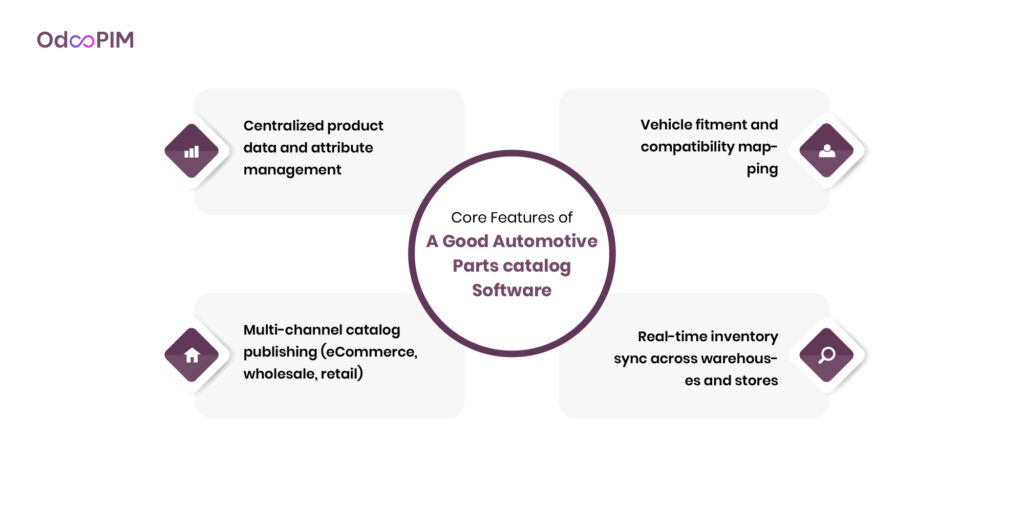
Centralized product data and attribute management
Automotive parts catalog software must centralize part numbers, descriptions, specifications, images, and pricing into one master database. Your team updates data once. Every channel, website, wholesale portal, retail store, receives the same accurate information. Auto parts catalog software with attribute management handles vehicle-specific fields like engine size, transmission type, and brake system configuration. Parts inventory management software without centralization forces your team to maintain separate spreadsheets for each sales channel. Errors multiply and time wastes. Centralized data eliminates version conflicts and reconciliation work.
Vehicle fitment and compatibility mapping
Fitment data determines which parts work with which vehicles. Spare parts management software must support make, model, year, engine, transmission, and trim level attributes. A brake pad fits a 2018 F-150 with 5.0L engine but not the 3.5L version. The software captures this distinction. Auto parts inventory management software with compatibility mapping prevents customers from ordering wrong parts. Automotive parts inventory management software also handles superseded part numbers automatically. When a manufacturer discontinues part A and replaces it with part B, the system updates every reference.
Learn about PIM for Automotive Software
Multi-channel catalog publishing (eCommerce, wholesale, retail)
Your parts catalog must feed your website, Amazon store, wholesale portal, and in-store POS system simultaneously. Automotive parts catalog software with multi-channel publishing syndicates one master catalog to every destination. Spare parts inventory management software applies channel-specific transformations. Your website shows retail pricing and consumer-friendly descriptions. Wholesale portal shows trade pricing and technical specs. Auto parts catalog software with multi-channel support eliminates manual per-channel updates. One catalog, infinite outputs and no version drift between channels.
Real-time inventory sync across warehouses and stores
Parts inventory management software must show real-time stock levels across all locations. A part available in warehouse A might be out of stock in warehouse B. Auto parts inventory management software with real-time sync prevents overselling. When a customer orders online, the system checks availability at the nearest warehouse or store. Automotive parts inventory management software also sets reorder points and generates purchase orders automatically. Spare parts management software without real-time inventory sync shows outdated availability. Customers order out-of-stock parts and cancellations follow. Real-time sync builds trust and maximizes fulfillment efficiency.
Learn about Magento Product Recommendations

How OdooPIM Solves Automotive Parts Catalog Management
Structured product sheets for complex parts data
Automotive parts catalog software in OdooPIM uses attribute families to capture vehicle-specific fields, make, model, year, engine, transmission, trim, and OE part numbers. Each part sheet includes specifications like material, dimensions, warranty terms, and supersession history. Auto parts catalog software with structured sheets ensures consistency across your catalog. A brake pad shares the same attribute layout as every other brake pad. Spare parts management software without structure forces custom fields per part. That approach breaks at scale. OdooPIM’s structured sheets keep your data clean and your team efficient.
Bulk import and enrichment of spare parts catalogs
Parts inventory management software in OdooPIM handles bulk imports from supplier spreadsheets, automated mapping to your attribute families, and AI-assisted enrichment. Upload a supplier CSV. The system maps part numbers, descriptions, and fitment data automatically. Auto parts inventory management software with bulk import cuts weeks of manual data entry to hours. Automotive parts inventory management software also validates incoming data. Missing fitment fields? Flagged. Duplicate part numbers? Blocked. Spare parts management software with bulk enrichment ensures your catalog stays complete without manual per-part entry.
Integration with Odoo Inventory and eCommerce modules
Spare parts management software in OdooPIM shares the same database as Odoo Inventory and Odoo eCommerce. No middleware. No sync delays. When your warehouse updates stock levels in Odoo Inventory, your parts catalog reflects that change instantly. Automotive parts catalog software with native inventory integration prevents overselling. Auto parts catalog software with native eCommerce integration pushes product data to your website automatically. Parts inventory management software without integration forces manual reconciliation between systems. OdooPIM eliminates that work, one database, complete visibility, accurate inventory and consistent catalog. Your team stops fighting data drift.
Implementing a PIM system can boost ecommerce conversion rates by 20 to 50% for automotive businesses managing complex parts catalogs
Automotive Parts Inventory Management Software vs. PIM: What’s the Difference?
Parts inventory management software tracks quantities, locations, and reorder points. It knows you have 50 brake pads in warehouse A but nothing about which vehicles they fit. Automotive parts catalog software adds fitment data, supersession tracking, and rich product content. A PIM knows a brake pad fits F-150 2015-2018 with 5.0L engine. Auto parts inventory management software without PIM cannot prevent wrong-part orders. Spare parts management software needs both: inventory for availability, PIM for compatibility. Together they answer the two questions every customer asks: does it fit and is it in stock? Standalone inventory tools answer only one. That is the difference.
When a standalone inventory tool isn’t enough
Parts inventory management software tracks quantities, locations, and reorder points. It knows you have 50 brake pads in warehouse A. It knows nothing about which vehicles those brake pads fit. Auto parts inventory management software without fitment data cannot prevent customers from ordering the wrong part. A customer buys a brake pad for their 2018 F-150. The inventory tool ships it. The part doesn’t fit. Return follows. Spare parts inventory management software alone ignores vehicle compatibility. Automotive parts inventory management software without a PIM cannot answer “does this part fit that vehicle?” That question drives every auto parts sale. Inventory tools cannot answer it.
Why PIM + inventory together gives you full control
Automotive parts catalog software adds fitment data, supersession tracking, and rich product content to your inventory quantities. A PIM knows a brake pad fits F-150 2015-2018 with 5.0L engine. Spare parts management software integrated with inventory shows real-time stock levels for compatible parts only. The customer sees only parts that fit their vehicle AND are in stock. Auto parts catalog software plus inventory prevents wrong-part orders. Returns drop. Customer trust rises. Parts inventory management software without PIM is blind to compatibility. PIM without inventory shows parts that may be out of stock. Together, they answer both questions: does it fit and is it available? That is full control and that is what your customers need.
Learn about PIM for automotive
Who Uses Automotive Parts Catalog Software?
OEM parts distributors and wholesalers
OEM distributors manage thousands of genuine manufacturer parts with complex supersession chains. A discontinued part number must redirect to its replacement. Automotive parts catalog software handles these relationships automatically. Wholesalers need fitment data accurate enough to serve dealerships and repair shops. Spare parts management software ensures that a distributor shipping to a Ford dealer sends the correct component every time. Parts inventory management software with OEM-level accuracy prevents costly mis-ships. One wrong part to a dealership disrupts customer repairs and damages trust.
Auto parts retailers and online stores
Retailers sell to DIY customers who enter their vehicle information online and expect accurate fitment results. Auto parts catalog software powers search and filtering by year, make, model, and engine. Automotive parts catalog software for retail includes consumer-friendly descriptions and images alongside technical data. Spare parts inventory management software shows real-time availability across physical stores and distribution centers. A customer sees that the brake pad fits their 2018 F-150 and is in stock at their local store. Pickup in two hours and that experience builds loyalty.
Aftermarket parts suppliers
Aftermarket suppliers create parts that fit multiple OEM specifications. A single aftermarket alternator might fit twenty different vehicle models across five years. Auto parts inventory management software tracks these complex fitment matrices without duplicate data entry. Automotive parts inventory management software for aftermarket suppliers also manages multiple brand lines and quality tiers (economy, standard, premium). Spare parts management software ensures that a customer searching for a budget-friendly option sees the correct tier. Parts inventory management software without fitment data cannot serve aftermarket suppliers. Your catalog complexity demands dedicated tools.
Learn about PIM for Automotive
Case Studies
Case Study 1: Reducing Wrong-Part Returns for a National Auto Parts Distributor
Challenge
A national auto parts distributor managing 85,000 SKUs relied on spreadsheets and basic parts inventory management software to track stock and publish catalogs. The company lacked dedicated automotive parts catalog software, so fitment data was scattered across supplier spreadsheets. Customers frequently ordered brake pads, alternators, and filters that did not fit their vehicles. Return rates hit 18% on web orders. The customer service team spent 25 hours weekly processing wrong-part returns and answering fitment questions.
Solution
The distributor implemented OdooPIM as their core auto parts catalog software. Supplier fitment data was imported and standardized using vehicle attribute families, make, model, year, engine, transmission, and trim. Spare parts management software within OdooPIM linked every part to its compatible vehicles. Superseded part numbers were mapped to current replacements. The enriched catalog was syndicated to the company’s website, Amazon store, and wholesale portal. Automotive parts inventory management software integration with Odoo Inventory showed real-time stock alongside fitment data.
Results
Wrong-part returns dropped from 18% to 4% within six months
Customer service time on fitment questions reduced by 70%
Catalog update time cut from two weeks to two days
New part onboarding accelerated by 65%
Distributor portal adoption increased by 40% with accurate fitment data
Case Study 2: Scaling From Spreadsheets to Structured PIM for an Aftermarket Supplier
Challenge
An aftermarket auto parts supplier with 30,000 SKUs managed product data exclusively in Excel. Each spreadsheet contained part numbers, descriptions, pricing, and fitment notes. Different suppliers sent data in varying formats. The team manually reconciled files before publishing to their website and Amazon store. Auto parts inventory management software was nonexistent, inventory was tracked in a separate system that never synced with the catalog. Product launches took three to four weeks. Fitment errors caused constant customer complaints.
Solution
The supplier deployed OdooPIM as their spare parts inventory management software and catalog hub. Supplier spreadsheets were bulk-imported using OdooPIM’s mapping tools. Attribute families were created for each product category, brakes, electrical, engine, suspension. Automotive parts catalog software features captured vehicle fitment at the SKU level. The team enriched descriptions with SEO keywords and standardized images. OdooPIM integrated with their website and Amazon seller account. Real-time inventory sync was established with their warehouse management system.
Results
Product launch time reduced from four weeks to three days
Fitment-related customer complaints dropped by 85%
Manual data entry hours cut by 75%
Website conversion rate increased by 22%
Amazon listing errors eliminated almost entirely
Case Study 3: Multi-Warehouse Inventory Sync for an OEM Parts Wholesaler
Challenge
An OEM parts wholesaler operated three warehouses stocking over 120,000 genuine manufacturer parts. The company used basic parts inventory management software that could not handle superseded part numbers or vehicle fitment. Sales staff manually checked each warehouse’s system to answer customer availability questions. Automotive parts inventory management software was disconnected from their ecommerce platform, causing overselling and backorders. Customers frequently ordered parts that were out of stock or discontinued without cross-references to replacements.
Solution
The wholesaler implemented OdooPIM integrated with Odoo Inventory to create unified spare parts management software. Supersession chains were imported from manufacturer data feeds. When a customer searched for a discontinued part number, the system automatically displayed the current replacement. Auto parts catalog software features captured fitment for every OEM part across vehicle makes, models, and years. Real-time inventory visibility across all three warehouses was established. The ecommerce platform began showing accurate stock levels per location. Customers could see which warehouse had the part and estimated delivery time.
Results
Overselling eliminated completely after integration
Backorder rate dropped from 12% to 2%
Customer service time on part lookup reduced by 80%
Inventory accuracy across warehouses improved to 99.5%
Sales increased by 28% due to accurate availability displays and proper fitment data
How to Choose the Right Solution for Your Auto Parts Business
Key evaluation criteria (scalability, integrations, ease of use)
Automotive parts catalog software must scale from thousands to hundreds of thousands of SKUs without slowing down. Test each candidate with your projected catalog size. Parts inventory management software needs native integrations with your ecommerce platform, POS system, and accounting software. Avoid solutions requiring custom middleware for every connection. Spare parts management software should offer intuitive fitment data entry. Your team will spend hours managing vehicle compatibility. Complicated interfaces kill productivity. Auto parts catalog software with bulk import, API access, and user-friendly fitment tools wins. Prioritize these three criteria and the wrong choice creates expensive technical debt.
Why Odoo-based PIM is a cost-effective choice
Auto parts inventory management software from Odoo combines PIM, inventory, ecommerce, and accounting in one database. No middleware costs. No sync delays. Automotive parts inventory management software standalone solutions require separate subscriptions for PIM, inventory, and ecommerce, plus integration connectors. Spare parts management software with Odoo starts around $3,000 to $8,000 annually for the PIM module, added to your existing Odoo subscription. Parts inventory management software from enterprise vendors like Salsify or inRiver starts at $50,000. Automotive parts catalog software built on Odoo delivers enterprise features at small business prices. Cost-effective does not mean feature-poor, it just means integrated, scalable, and affordable.

Frequently Asked Questions
1. What is the best software for managing an automotive parts catalog?
The best automotive parts catalog software depends on your business size and existing systems. For businesses already using Odoo, OdooPIM is the clear choice, it combines fitment data, supersession tracking, and inventory management in one database. For standalone needs, Akeneo and Plytix offer strong auto parts catalog software capabilities. Spare parts inventory management software must include vehicle fitment attributes (make, model, year, engine) and multi-warehouse stock tracking. Test any solution with your most complex part, one that fits fifty vehicle variations. If the software cannot handle that complexity cleanly, keep looking.
2. Can OdooPIM handle spare parts inventory management?
OdooPIM shares the same database as Odoo Inventory, so parts inventory management software capabilities come built-in. Your parts catalog in OdooPIM links to real-time stock levels across multiple warehouses. Auto parts inventory management software within Odoo sets reorder points, generates purchase orders, and prevents overselling. Spare parts management software with integrated inventory means a customer sees only parts that fit their vehicle AND are in stock. Automotive parts inventory management software standalone requires integration work. OdooPIM delivers both PIM and inventory natively.
3. Does OdooPIM support aftermarket auto parts catalogs?
Automotive parts catalog software in OdooPIM handles aftermarket fitment matrices where one part fits dozens of vehicle configurations. Create attribute families with make, model, year, engine, and trim fields. Link one aftermarket alternator to every compatible vehicle using fitment tables. Auto parts catalog software for aftermarket suppliers also manages multiple brand lines and quality tiers (economy, standard, premium). Spare parts inventory management software with OdooPIM tracks superseded OEM part numbers and cross-references automatically. Parts inventory management software without fitment tables cannot serve aftermarket suppliers. Your complex catalog is not a problem, it is what OdooPIM was built for.