What Is Product Content Enrichment?
Definition
Product content enrichment is the process of enhancing product data with marketing descriptions, technical specifications, digital assets, and structured attributes that make product listings discoverable, compelling, and complete. Unlike basic data entry that populates only mandatory fields, enriched content adds the persuasive language, detailed specifications, high-quality imagery, and relationship data that transforms a bare SKU into a fully merchandised product. This content enrichment process bridges the gap between the operational data living in ERP systems and the customer-ready information buyers need to evaluate and purchase. Understanding “what is product data enrichment” means recognizing it as the systematic effort to answer every customer question before they need to ask it. The output of effective ecommerce product data enrichment is product detail pages that accelerate purchase decisions by eliminating uncertainty.
Why It Matters
Product content enrichment determines whether your products appear in search results, convert browsing shoppers into buyers, and generate customer confidence that reduces return rates. Unenriched product listings with sparse descriptions and missing specifications force customers to competitor pages that provide the complete information needed for purchase validation. Enriched content creates the differentiation that separates your products from identical items sold by competitors who upload only the bare minimum required by channel templates. Search algorithms reward complete, structured product data enrichment with higher organic rankings and improved filtered search visibility. B2B buyers abandon suppliers whose unenriched technical specifications force them to contact sales representatives for basic product information.

What Counts as Product Content?
Descriptions and Marketing Copy
Product content enrichment produces the compelling product titles, feature bullet points, and persuasive descriptions that connect product capabilities to customer needs. This enriched content moves beyond dry technical language to articulate how specifications translate into benefits that matter to the specific buyer persona evaluating the product. Marketing copy created through content enrichment addresses the emotional and practical purchase drivers thatraw specifications alone cannot satisfy. Effective ecommerce product data enrichment tailors product stories to channel context, recognizing that an Amazon description requires different persuasion techniques than a B2B wholesale catalog. The best product data enrichment ensures every product detail page reads like a knowledgeable salesperson is guiding the customer toward confident purchase.
Specifications and Master Data
Product content enrichment populates the structured technical attributes, dimensional data, and performance specifications that power faceted search, product comparisons, and engineering validation. This enriched content layer ensures that every voltage rating, material composition, pressure tolerance, and compatibility parameter appears accurately and consistently across channels. Technical buyers rely on complete specification content enrichment to eliminate products that fail to meet their requirements before ever evaluating price or brand preference. Incomplete specifications represent the most common failure of ecommerce product data enrichment, creating invisible barriers where qualified products never surface in filtered search results. Understanding what is product data enrichment at the specification level means recognizing that technical attributes are the primary decision support tool for professional procurement.
Digital Assets
Product content enrichment encompasses the images, videos, dimensional drawings, 3D models, and downloadable documentation that provide the visual and technical validation customers require. Multiple high-resolution images showing products from every angle, in context, and at scale constitute enriched content that significantly outperforms listings with a single generic product photograph. Video demonstrations, installation guides, and exploded-view diagrams produced through content enrichment answer the practical questions that text descriptions cannot fully address. CAD files, specification sheets, and compliance certificates represent product data enrichment assets that B2B buyers download to validate products within their own engineering workflows. Ecommerce content enrichment that neglects digital assets produces text-heavy listings that fail to engage visual shoppers or provide the dimensional context needed for confident purchase.
Learn about product attributes marketing
How Product Content Enrichment Works
Taxonomies
Product content enrichment organizes products into logical category hierarchies and classification structures that determine how customers navigate and discover your catalog. A well-designed taxonomy groups similar products together, establishes parent-child relationships between categories, and creates the browsing pathways that expose customers to relevant products they might not discover through search alone. Enriched content within a structured taxonomy carries contextual meaning, a “waterproof” attribute means something specific in outdoor electronics that differs from its meaning in construction materials. Category-specific content enrichment rules define which attributes become mandatory, which become recommended, and which become irrelevant for products at each taxonomy node. The taxonomy forms the organizational backbone upon which all subsequent product data enrichment depends.
Standardized Attributes
Product content enrichment transforms inconsistent, free-form product descriptions into structured attribute-value pairs that machines can index, compare, and filter. Standardized enriched content ensures that “navy blue,” “dark blue,” and “navy” become a single controlled value, eliminating the search failures that occur when customers filter by a color term different from the one your team entered. Attribute standardization through content enrichment enables meaningful product comparison tables where customers evaluate options against identical specification dimensions. Ecommerce product data enrichment that lacks attribute standardization creates fragmented filtering experiences where customers cannot confidently narrow results because similar products carry inconsistent attribute values. The discipline of structured product data enrichment transforms subjective, human-readable descriptions into objective, machine-readable data that powers every search and filter interaction.
Cross-Sell and Bundling Relationships
Product content enrichment establishes the logical connections between related products that enable recommendations, kits, compatible accessories, and suggested alternatives. This enriched content layer defines which cables work with which devices, which replacement parts fit which models, and which complementary products customers frequently purchase together. Cross-sell relationships created through content enrichment increase average order value by presenting relevant additions at the moment of maximum purchase intent. Bundling rules embedded in product data enrichment allow automated kit creation where compatible components combine into sellable packages without manual merchandising intervention. Ecommerce content enrichment that neglects product relationships misses the revenue opportunity that occurs every time a customer purchases a primary product without discovering the accessories they need.

Common Sources of Product Data
1. ERP Systems
ERP systems contain the core operational product data enrichment foundation, SKU identifiers, basic descriptions, procurement costs, inventory levels, and warehouse locations, that feed subsequent enrichment activities. This source data provides the authoritative product identifiers and core attributes that content enrichment processes build upon with marketing language and digital assets. ERP data lacks the customer-friendly formatting and complete attribute sets required for ecommerce, making it the starting point rather than the endpoint of ecommerce product data enrichment. Understanding what is product data enrichment means recognizing that ERP extraction reveals how much additional content development each product requires before channel publication. The enriched content workflow begins when operational data passes from the ERP into a PIM where teams add the marketing layer that ERP systems were never designed to maintain.
2. Supplier Feeds
Supplier product data arrives in inconsistent formats, varying attribute standards, and uneven quality levels that demand systematic content enrichment before channel publication. Raw supplier feeds contain manufacturer-focused technical language, missing digital assets, and incomplete attribute sets that fall short of the enriched content requirements of customer-facing channels. Content enrichment standardizes supplier data into your brand’s voice, attribute taxonomy, and image standards, ensuring consistent presentation regardless of how many different suppliers contribute products. Supplier data quality varies, making product data enrichment the quality control checkpoint where incomplete, inaccurate, or substandard product information gets corrected before reaching customers. Ecommerce product data enrichment services frequently focus on supplier data normalization because it represents the most common bottleneck in catalog expansion initiatives.
3. Spreadsheets and PDFs
Spreadsheets and PDFs remain the dominant product data management tools across organizations that have not yet adopted structured product content enrichment platforms. These manual data sources introduce version control chaos where multiple team members edit different copies, creating the conflicting enriched content that reaches channels through fragmented upload processes. PDF specification sheets contain rich technical product data enrichment that remains trapped in unstructured documents, invisible to search algorithms and unavailable for channel syndication. Spreadsheet-based content enrichment collapses under catalog complexity because the manual effort required to maintain consistency across thousands of products exceeds human capacity. The migration from spreadsheets to governed ecommerce product data enrichment represents the most impactful operational improvement most organizations can make in their product data journey.
Challenges in Enriching Product Content
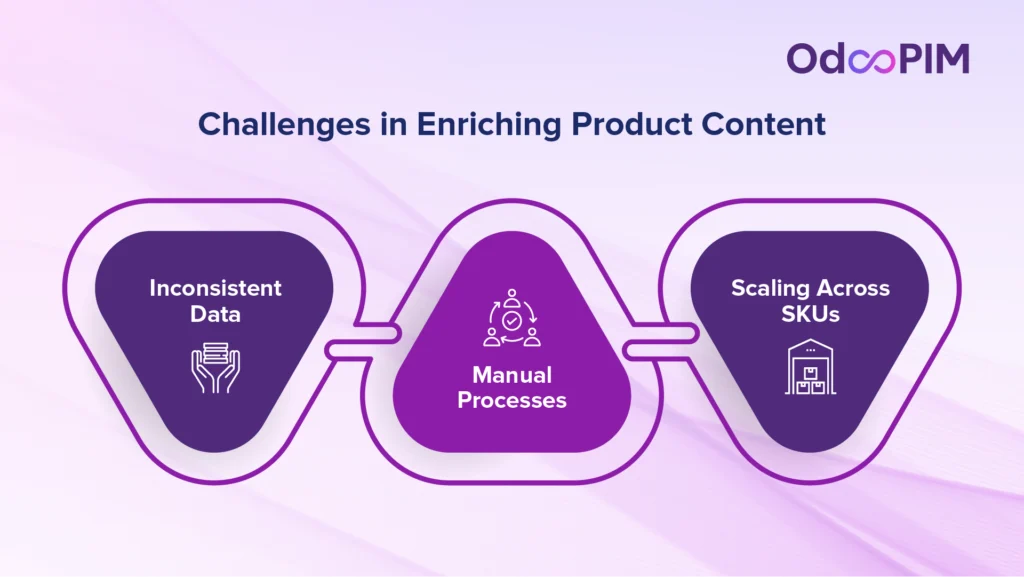
Inconsistent Data
Inconsistent product data manifests when different departments, channels, or team members apply varying standards to product content enrichment, creating the fragmented product narratives that confuse customers. A product described as “industrial grade” on one channel and “heavy duty” on another creates the specification doubt that prevents purchase decisions because customers cannot determine which description reflects reality. Attribute inconsistency in enriched content breaks filtered search when similar products carry different value formats, one listed as “2 inches” and another as “2 in”, making one invisible to filtered queries. Channel-specific formatting requirements multiply inconsistency risk as teams manually adapt product data enrichment for each platform without centralized governance. Inconsistency represents the natural entropy of ecommerce content enrichment that lacks enforced standards, requiring deliberate governance to counteract.
Manual Processes
Manual product content enrichment through spreadsheets and disconnected tools consumes team hours that compound with every catalog addition, channel expansion, and content update cycle. Copy-paste workflows between source systems and channel platforms introduce the human errors that create the listing inaccuracies customers encounter on live product pages. Manual enriched content creation limits how many products your team can enhance, forcing prioritization decisions where less strategic SKUs remain permanently under-enriched. The labor-intensive nature of manual product data enrichment means content updates lag behind product changes, creating windows where customers see outdated specifications or discontinued items. Manual processes make ecommerce product data enrichment a recurring cost that scales linearly with catalog size rather than an automated capability that delivers compounding returns.
Scaling Across SKUs
Product content enrichment processes that work for hundreds of SKUs collapse when catalogs expand into thousands or tens of thousands of products requiring consistent enhancement. Attribute inheritance across product families becomes essential for enriched content at scale, allowing category-level specifications to populate automatically across member SKUs without individual manual entry. The creative effort required for unique marketing content enrichment must be reserved for strategic products while standardized templates accelerate enhancement for commodity items. Scaling product data enrichment demands workflow automation that routes content through approval chains, enforces completeness standards, and triggers syndication without human intervention at every step. Organizations pursuing aggressive SKU growth must solve ecommerce content enrichment scalability before catalog expansion rather than discovering the bottleneck after products flood their systems without adequate content.
Learn about product attributes marketing
Benefits of Enriched Product Content
Searchability
Complete product content enrichment determines whether your products surface in the keyword searches and filtered navigation that represent the primary discovery mechanism for digital shoppers. Search algorithms index every enriched content field, titles, descriptions, attributes, backend search terms, to match customer queries with relevant products, multiplying the discovery pathways available for well-enriched listings. Faceted search depends on populated product data enrichment attributes to generate the filtering options customers use to narrow thousands of results to the handful meeting their requirements. Products with sparse content enrichment remain invisible to the long-tail search queries that carry the highest purchase intent because they lack the attribute depth to match specific customer needs. Each additional ecommerce product data enrichment field you populate creates another search entry point for qualified buyers.
Conversion
Enriched content accelerates purchase decisions by answering every product question customers need resolved before they add items to cart. Detailed product content enrichment reduces the perceived risk of online purchasing by providing the specifications, images, and usage context that substitute for physical product inspection. Product comparison tools depend on complete product data enrichment to generate meaningful side-by-side evaluations that keep customers engaged on your digital properties rather than seeking competitor alternatives. B2B buyers consistently report that thorough technical content enrichment represents the decisive factor in supplier selection when evaluating functionally similar products. Every gap in your ecommerce content enrichment creates a decision friction point where customers must choose between making assumptions, contacting support, or abandoning their research.
Reduced Errors
Complete product content enrichment reduces return rates because customers receive products matching the detailed specifications they reviewed during purchase consideration. Accurate enriched content prevents the costly scenario where outdated specifications remain visible on live listings long after products change, generating the returns and complaints that erode marketplace metrics. Consistent product data enrichment across channels eliminates the customer confusion that occurs when different platforms display conflicting specifications for identical products. The discipline of structured content enrichment catches data quality issues during the enrichment process rather than after customers discover errors on live product pages. Reduced error rates from governed ecommerce product data enrichment compound into improved seller ratings, lower customer service burden, and the brand trust that drives repeat purchase behavior.

Case Studies
Case Study 1: Industrial Valve Manufacturer Transforms Technical Specifications into Enriched Content That Drives Self-Service Purchases
Challenge
An industrial valve manufacturer with eight thousand SKUs struggled to convert website traffic into qualified sales leads because their product detail pages displayed only bare technical specifications pulled from engineering databases. Procurement engineers visiting the site encountered cryptic attribute codes, missing application context, and zero guidance on which valve suited which operating environment. The product content enrichment gap forced every potential customer to contact sales engineers for basic selection support, creating a bottleneck where eighty percent of inquiries requested information the website should have provided. Competitor catalogs offered complete enriched content with selection guides, compatibility matrices, and application-specific product groupings that enabled self-service evaluation. The company needed ecommerce product data enrichment that translated engineering specifications into the decision-support content industrial buyers required for confident independent purchase.
Solution
The manufacturer implemented a centralized PIM to govern product content enrichment workflows that transformed raw technical data into comprehensive, buyer-ready product presentations. Engineering validated the core technical specifications while a dedicated content enrichment team added application descriptions, selection criteria, industry-specific use cases, and plain-language explanations of technical attributes. The product data enrichment process created structured compatibility relationships between valves and related actuators, flanges, and gaskets, enabling automated cross-sell recommendations that multiplied order value. Digital asset enriched content expanded to include dimensional drawings, installation videos, pressure-temperature rating charts, and downloadable CAD files for every product family. Category-level ecommerce content enrichment templates ensured consistent attribute population across related valve types while allowing unique application content for specialized products.
Results
- Website conversion rate increased forty-five percent as procurement engineers found complete enriched content that enabled self-service product validation
- Sales engineer time spent answering basic specification questions dropped by sixty percent, redirecting expertise toward complex custom applications
- Average order value increased twenty-eight percent through automated cross-sell recommendations driven by compatibility content enrichment
- New product launch time reduced from four weeks to six days as product data enrichment templates automatically populated category-level content across new SKUs
- Customer feedback scores improved as buyers reported finding the ecommerce product data enrichment they needed to make confident purchase decisions without contacting sales
- The manufacturer discovered that understanding what is product data enrichment for B2B meant providing the engineering context that transforms technical specifications into purchase justification
Case Study 2: Electrical Components Distributor Standardizes Supplier Data Through Content Enrichment and Doubles Catalog Usability
Challenge
An electrical components distributor aggregated product data from over two hundred suppliers, each delivering specifications in different formats, attribute naming conventions, and quality levels. The resulting catalog contained fifteen thousand SKUs with wildly inconsistent product content enrichment, some products carried complete technical specifications while others listed only a part number and brief description. Customers searching for circuit breakers encountered different attribute structures depending on which supplier manufactured the component, making filtered search and product comparison functionally broken. The content enrichment inconsistency forced customers to download individual supplier datasheets to compare products, eliminating the convenience that the distributor’s digital platform promised. The company needed systematic ecommerce product data enrichment services that could normalize supplier data into a consistent, searchable, and comparable catalog structure.
Solution
The distributor deployed a PIM with automated product content enrichment workflows that ingested raw supplier feeds and transformed them into standardized, enriched product records. Attribute mapping rules converted each supplier’s unique terminology into the distributor’s controlled vocabulary, ensuring that “rated current,” “amp rating,” and “current capacity” mapped to a single standardized attribute for filtered search. Missing product data enrichment triggered automated supplier requests for the technical attributes required to achieve catalog completeness standards before products could publish. The enriched content process added consistent marketing descriptions, standardized technical specification tables, and unified digital asset formatting across two hundred supplier product lines. Category-level ecommerce content enrichment templates defined mandatory attributes for each product type, ensuring every circuit breaker carried identical specification fields regardless of manufacturer.
Results
- Filtered search accuracy improved by seventy percent as standardized product content enrichment ensured consistent attribute structures across supplier product lines
- Customer time-to-find-product decreased by half as consistent enriched content enabled meaningful side-by-side comparisons that previously required manual datasheet review
- Supplier onboarding time reduced from six weeks to three days as automated content enrichment rules mapped new supplier data formats to the distributor’s standard schema
- Catalog completeness scores rose from forty percent to ninety-four percent within five months of implementing systematic product data enrichment workflows
- Customer satisfaction ratings increased sharply as buyers reported the ecommerce content enrichment consistency made the distributor’s platform the preferred research destination
- The distributor identified automated ecommerce product data enrichment as the critical capability enabling their supplier aggregation strategy, noting that manual enrichment would have required thirty additional full-time content specialists
How a Unified Data Foundation Supports Content Enrichment
Single Source of Truth
A unified product data foundation establishes one authoritative repository where product content enrichment occurs, eliminating the version conflicts that plague spreadsheet-based and department-specific content management. Marketing, engineering, and sales teams contribute to and pull from the same enriched content source, ensuring specification updates propagate instantly to every team and channel. This single source prevents the dangerous scenario where marketing publishes product data enrichment based on outdated engineering specifications stored in a separate file that was updated without communication. Governance rules enforced at the data foundation level ensure content enrichment meets completeness and quality standards before products syndicate to customer-facing channels. The unified approach transforms ecommerce product data enrichment from a coordination problem between departments into a governed process with clear accountability.
Bulk Updates
A centralized product content enrichment foundation enables attribute changes across thousands of products simultaneously, replacing the manual individual updates that make spreadsheet-based processes unsustainable. Category-level enriched content updates propagate automatically to member SKUs, ensuring consistent messaging when specifications, compliance information, or marketing positioning changes. Bulk editing capabilities make product data enrichment responsive to market conditions, allowing content adjustments across product lines when competitive dynamics or regulatory requirements shift. The efficiency of bulk content enrichment operations means teams spend hours on catalog-wide updates that would consume weeks through manual per-product editing. This scalability transforms ecommerce product data enrichment from a perpetual bottleneck into a strategic capability that responds at market speed.
Native ERP Sync
Native ERP integration ensures product content enrichment stays synchronized with operational reality by connecting enriched product records to the business systems managing inventory, pricing, and core specifications. When engineering updates a technical attribute in the ERP, that change flows instantly to the enriched content layer, preventing the specification drift that occurs when operational data and marketing content live in disconnected systems. Bidirectional synchronization allows sales and marketing product data enrichment to flow back into the ERP, creating complete product records that serve both operational efficiency and commercial effectiveness. The real-time connection eliminates the manual data transfer processes that introduce the ecommerce product data enrichment errors customers encounter on live listings. Native sync ensures the content enrichment your customers see always reflects current product reality rather than a snapshot captured during the last manual update cycle.

FAQ
1. What is product content enrichment?
Product content enrichment is the process of enhancing raw product data with compelling marketing descriptions, complete technical specifications, high-quality digital assets, and structured attributes that transform bare SKUs into merchandised product listings. Understanding “what is product data enrichment” means recognizing it as the systematic effort to answer every customer question before shoppers need to ask. Enriched content bridges the gap between operational data in ERP systems and the persuasive, complete product stories that drive purchase decisions across every sales channel. Effective content enrichment eliminates the specification gaps and sparse descriptions that force customers to competitor pages for validation.
2. What is the difference between product data enrichment and product content enrichment?
Product data enrichment focuses on completing structured attributes, technical specifications, and standardized values that power search filters, product comparisons, and machine-readable catalog operations. Product content enrichment encompasses this structured data layer while also adding marketing copy, storytelling elements, digital assets, and persuasive language that creates emotional connection and brand differentiation. Ecommerce product data enrichment ensures products are findable through search and filter; ecommerce content enrichment ensures they are purchasable through persuasive, complete presentations. Both layers must work together because technically complete but poorly merchandised products convert as poorly as beautifully described products with missing specifications.
3. What sources are used for product content enrichment?
ERP systems provide the foundational operational data, SKU identifiers, core attributes, procurement costs, and inventory levels, that serve as the starting point for all product content enrichment activities. Supplier feeds deliver manufacturer specifications, technical documentation, and basic imagery that require standardization and content enrichment to match brand voice and channel requirements. Engineering databases and PLM systems contribute the authoritative technical specifications, material compositions, and compliance certifications that form the factual backbone of product data enrichment. Marketing teams produce the persuasive copy, lifestyle imagery, and brand storytelling elements that transform technical enriched content into emotionally resonant product presentations.
4. How does product content enrichment improve SEO?
Search engines index every enriched content field, titles, descriptions, bullet points, attributes, and backend search terms, to match customer queries with relevant products, multiplying discovery pathways for well-enriched listings. Complete product content enrichment populates the structured attributes that power faceted navigation and filtered search, ensuring products appear when customers narrow results by relevant specifications. Long-tail search queries carrying high purchase intent match only products whose content enrichment includes the attributes, use cases, and descriptive language those queries contain. Missing product data enrichment fields create invisible products that remain absent from search results regardless of how they match customer requirements.
5. What tools are used for product content enrichment?
Product Information Management systems serve as the central platform for product content enrichment, providing governed workflows where teams collaborate on attributes, descriptions, and digital assets before syndication. Ecommerce product data enrichment services offered by specialized agencies combine technology platforms with human expertise to accelerate content enrichment for organizations lacking internal bandwidth. Digital Asset Management tools support enriched content workflows by organizing images, videos, and technical documents in searchable repositories connected directly to product records. AI-powered ecommerce content enrichment tools increasingly generate initial product descriptions, extract attributes from images, and suggest attribute completions that human editors review and refine.