What Are Product Attributes Marketing?
Definition
Product attributes are the structured data fields that describe a product’s characteristics, spanning physical specifications, technical parameters, logistical dimensions, and marketing descriptors. These properties capture everything from tangible measurements like length and weight to technical values like voltage tolerance and material grade. Understanding what product attributes marketing requires seeing them as the building blocks that populate product detail pages, power faceted search, and enable meaningful product comparisons. Every SKU in your catalog carries dozens or even hundreds of product attributes that collectively determine whether a customer finds, evaluates, and purchases that item. The quality and completeness of your product attribution shapes the customer’s ability to confirm that your product meets their specific requirements.
Why They Matter
Product attributes determine whether your items surface in filtered search results or remain buried beneath competitors who populated the fields you left empty. Customers rely on product attributes examples like size, material, and compatibility to eliminate options that do not meet their requirements before ever comparing price or brand. Complete product attributes in marketing reduce return rates because buyers receive products matching the specifications they reviewed during purchase consideration. B2B procurement decisions hinge on technical product attributes meeting engineering specifications, making attribute completeness a revenue driver. Your product attributes list represents the primary decision support tool customers use to validate purchase decisions without contacting sales representatives.
Learn about Product Catalog Software

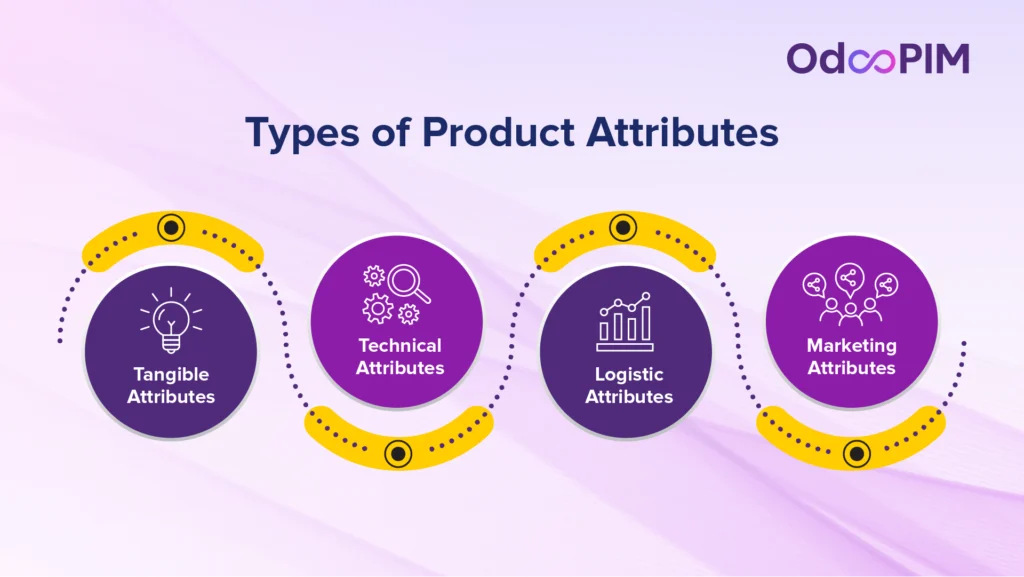
Types of Product Attributes
1. Tangible Attributes
Tangible product attributes capture the physical characteristics customers can see, touch, or measure, dimensions, weight, color, shape, and material composition. These product attributes examples form the foundational product understanding that every customer needs before committing to a purchase regardless of industry or price point. A furniture buyer requires exact dimensions to confirm fit; an apparel shopper needs material composition to assess comfort and care requirements. Complete tangible product attribution eliminates the uncertainty that prevents customers from adding items to cart despite interest in the product category. These physical specifications represent the minimum viable product attributes list that must exist before any channel will publish a listing.
2. Technical Attributes
Technical product attributes capture the performance specifications, engineering parameters, and compatibility data that dominate B2B purchasing decisions and high-consideration consumer goods. These product attribute examples include voltage ratings, pressure tolerances, data transfer speeds, chemical resistance levels, and operating temperature ranges that engineers and technical buyers require for validation. Missing technical product attribution forces qualified buyers to abandon your product for competitors who provide the specifications needed to confirm functional compatibility. These attributes often carry regulatory weight, with compliance documentation linked directly to specific technical values that must remain accurate across channels. The most technically complex products carry hundreds of product attributes that serve as the primary purchase justification for professional buyers.
3. Logistic Attributes
Logistic product attributes capture the supply chain and fulfillment data that determines how products flow through warehouses, ship to customers, and appear in inventory systems. These product attributes examples encompass package dimensions, shipping weight, hazardous material classifications, storage temperature requirements, and country of origin declarations. Logistic product attribution accuracy prevents the costly scenario where an ecommerce platform calculates shipping charges based on incorrect package dimensions that do not reflect physical reality. Warehouse management systems depend on accurate logistic product attributes to optimize picking routes, storage locations, and carrier selection. Errors in these attributes cascade through the fulfillment process, generating unexpected shipping costs and delivery delays that erode margin and customer satisfaction.
4. Marketing Attributes
Product attributes marketing capture the emotional and experiential descriptors that influence purchase decisions beyond technical specifications, lifestyle associations, design aesthetics, usage occasions, and brand storytelling elements. These product attribute examples include descriptive terms like “rustic finish,” “minimalist design,” or “professional grade” that help customers connect products to their personal preferences and aspirations. Product attributes in marketing bridge the gap between technical specifications that engineers require and the emotional language that drives consumer purchase behavior. These descriptors power product recommendations, themed collections, and lifestyle-based navigation that expose customers to products they might not discover through specification-based search alone. Effective product attribution for marketing transforms sterile technical data into compelling product stories that accelerate purchase decisions.
Learn about Product catalog management
Product Attributes List (Common Examples)
Physical Specs
Physical specification product attributes marketing include dimensions like length, width, height, and diameter that determine fit and compatibility across virtually every product category. Weight attributes span net product weight and gross shipping weight, serving distinct purposes for customer expectations and logistics calculations respectively. Material product attributes examples specify composition details, stainless steel grade, cotton thread count, plastic polymer type, that influence durability perceptions and purchase decisions. Color and finish attributes require controlled vocabulary to prevent the same shade appearing as “navy” on one channel and “dark blue” on another. These fundamental product attributes populate the specification tables and comparison charts that customers rely on during product evaluation.
Pricing and Packaging
Pricing product attributes extend beyond the retail price point to include minimum order quantities, volume discount tiers, and unit of measure specifications that govern B2B purchasing. Packaging attributes capture how products arrive, individual box, case pack, pallet quantity, along with the dimensions and weights that determine shipping calculations and warehouse slotting. These product attributes marketing examples include whether items ship individually or require assembly, impacting the customer unboxing experience. Multi-pack configurations and bundle relationships constitute product attribution elements that define how individual SKUs combine into larger sellable units. Accurate packaging attributes prevent the customer disappointment that occurs when a product photograph suggests a larger quantity than the actual package contains.
Compliance Details
Compliance product attributes marketing capture regulatory certifications, safety ratings, environmental standards, and industry-specific requirements that carry legal implications for sellers. These product attribute examples include UL listings, CE markings, FDA classifications, RoHS compliance, and conflict mineral declarations that procurement teams require for supplier validation. Hazardous material classifications, California Proposition 65 warnings, and recycling scheme registrations constitute product attribution that protects both the seller and buyer from regulatory exposure. Country of origin attributes determine tariff applicability and satisfy labeling requirements across multiple jurisdictions. Incomplete compliance attributes expose organizations to listing suppressions, fines, and liability that extend far beyond the lost revenue of a single missed sale.
Learn about Product Master Data Management

Building an Effective Attribute List
Research Competitors
Analyze the product attributes marketing lists your top competitors publish across their websites, marketplaces, and technical documentation to identify the specifications customers expect in your category. Competitor analysis reveals which product attributes examples appear consistently across leading brands, signaling the minimum information threshold customers require before considering a purchase. Study competitor product comparison charts to identify the differentiating attributes they emphasize and the standard specifications they treat as table stakes. This research prevents launching products with product attribution gaps that force customers to visit competitor listings to find missing specifications. Competitive intelligence transforms attribute selection from internal assumption into market-validated requirements that align with actual customer expectations.
Group by Product Family
Organize your product attributes marketing into logical groups based on product families, categories, and subcategories that share common specifications and measurement parameters. This grouping enables attribute inheritance where parent categories define the standard product attributes marketing list that child products automatically populate, ensuring consistency across related items. Product family attribute templates prevent the inconsistency that occurs when different team members create product attribution for similar products using varying field names and value formats. Category-specific attribute sets ensure that relevant specifications appear prominently while irrelevant fields remain hidden, preventing the overwhelming data density that buries important information. Family-based organization transforms product attributes in marketing from an ad-hoc exercise into a scalable, repeatable governance process.
Collect Customer Feedback
Gather input from customers, sales teams, and customer service representatives about which product attributes most frequently cause questions, confusion, or purchase abandonment. Sales teams know which missing specifications force prospects to request additional information before committing to purchase decisions. Customer service logs reveal which product attributes and example inconsistencies generate returns, complaints, and negative reviews that damage brand reputation. This frontline feedback identifies product attribution gaps that internal teams overlook because their product familiarity blinds them to the information customers need. Customer-driven attribute selection ensures your product attributes list addresses real purchase barriers rather than internal assumptions about what information matters most.
Product Attributes in Marketing
Discoverability
Product attributes in marketing determine whether your products appear in search results when customers filter by the specifications most relevant to their needs. Ecommerce search algorithms index product attribution fields to match customer queries, making complete attributes the difference between first-page visibility and search oblivion. Faceted navigation depends on populated product attributes marketing examples to generate the filtering options that help customers narrow thousands of results to the handful meeting their requirements. Missing attributes eliminate products from filtered searches entirely, regardless of how those products might meet the customer’s needs. Marketplace search algorithms penalize incomplete product attributes lists with reduced organic ranking, compounding the revenue impact of poor data quality.
Conversion Impact
Complete product attributes in marketing accelerate purchase decisions by answering the specification questions that would otherwise send customers to competitor listings or trigger abandoned carts. Detailed product attribution reduces the perceived risk of online purchasing by providing the dimensional, material, and compatibility information customers need to validate fit without physical inspection. Product comparison tools depend on populated product attributes marketing examples to generate meaningful side-by-side evaluations that keep customers engaged on your digital properties. B2B buyers report that thorough technical product attributes marketing represent the single most important factor in supplier selection when comparing functionally similar products. Every missing attribute creates a purchase friction point where customers must choose between making assumptions, contacting support, or abandoning their research.
Common Attribute Management Challenges
Spreadsheet Errors
Managing product attributes through spreadsheets introduces version control chaos where marketing, engineering, and sales teams reference different files containing conflicting specifications. A single mistyped value in a shared spreadsheet propagates across channels that consumes that data, creating customer-facing errors that persist until someone manually identifies and corrects them. Spreadsheet-based product attribution collapses under high SKU volumes because the manual effort required to maintain attribute consistency across thousands of products exceeds human capacity. Formula errors, accidental overwrites, and sorting mistakes corrupt product attributes marketing lists in ways that remain invisible until customers encounter incorrect information on live listings. The very flexibility that makes spreadsheets convenient for initial data collection makes them dangerous for ongoing product attributes in marketing management.
Inconsistent Attributes Across Channels
Channels require different attribute formats, naming conventions, and value structures that force teams to maintain multiple versions of the same product attributes for different platforms. Amazon requires specific product attributes marketing, example formatting that differs from Walmart requirements, which differ again from a D2C website or wholesale distributor portal. Manual channel-specific formatting creates drift where the same product carries slightly different specifications depending on where customers encounter it. This product attribution inconsistency confuses customers who cross-reference products across platforms and find conflicting information that erodes purchase confidence. Channel-specific requirements multiply the maintenance burden geometrically as each new sales channel adds another set of attribute formats to manage.
Missing or Duplicate Data
Incomplete product attributes marketing lists occur when organizations lack enforced standards for which fields require population before products can publish to customer-facing channels. Critical specifications remain empty because no governance process prevents incomplete product records from reaching ecommerce platforms and marketplace listings. Conversely, duplicate product attribution emerges when multiple systems maintain separate product records with slightly different attribute sets, creating confusion about which version represents product truth. These data quality gaps force customers to abandon their research when they cannot find the specifications needed to validate purchase decisions. Missing attributes in regulated industries expose organizations to compliance violations when required safety or environmental data does not appear alongside product listings.

How a Centralized Data Foundation Improves Attribute Management
Single Source of Truth
A centralized product data foundation establishes one authoritative repository where every product attribute lives, eliminating the version conflicts that plague spreadsheet-based management. Engineering, marketing, and sales teams access and contribute to the same governed product attributes marketing list, ensuring specification updates propagate instantly to every team and channel. This single source of truth prevents the dangerous scenario where marketing publishes product attributes in marketing content based on outdated engineering specifications stored in a separate file. Attribute governance rules enforce completeness standards before product records can syndicate to customer-facing channels, preventing the missing data that suppresses search visibility. Centralized product attribution transforms data management from a coordination problem between departments into a governed process with ownership and accountability.
Attribute Groups by Product Family
A governed data foundation enables attribute grouping by product family, ensuring consistent product attributes marketing examples across related items while accommodating category-specific requirements. Parent product templates define the standard product attributes marketing list that child SKUs automatically inherit, dramatically reducing the manual effort required to maintain consistency across large catalogs. Category-specific attribute sets ensure customers see relevant specifications prominently while technical details irrelevant to their purchase context remain properly organized. This product family approach to product attribution prevents the common failure mode where similar products carry different attribute sets because different team members created the records independently. Attribute groups transform product attributes in marketing from inconsistent individual efforts into systematic, governed processes that scale efficiently.
Real-Time Sync with ERP
Native ERP integration ensures product attributes synchronized in real time between operational systems and customer-facing channels eliminate the dangerous lag that causes specification mismatches. When engineering updates a technical specification in the ERP, that change propagates instantly to the product record governing every sales channel without manual intervention. This real-time connection prevents product attribution errors where warehouse inventory reflects updated products while digital channels still display previous specifications. Bidirectional synchronization allows sales teams to enrich product attributes in marketing content that flows back into the ERP, creating complete product records that serve both operational and commercial purposes. The integration eliminates the manual data transfer processes that consume team hours while introducing the errors that damage customer trust and marketplace standing.

FAQ
1. What are product attributes?
Product attributes are the structured data fields that define what a product is by capturing its physical characteristics, technical specifications, logistical dimensions, and marketing descriptors. Understanding “what is product” attributes means recognizing these properties as the building blocks that populate product detail pages, power faceted search filters, and enable meaningful product comparisons. Every SKU carries dozens of product attributes, size, material, color, weight, voltage, compliance rating, that collectively determine whether customers find and purchase that item. Product attribution transforms generic inventory into discoverable, comparable products across sales channels. The completeness of your product attributes marketing list determines whether customers can confirm your product meets their specific requirements without contacting sales.
2. What is the difference between product attributes and product specifications?
Product attributes encompass the broader set of characteristics describing a product, while specifications represent the narrower subset of precise technical measurements and performance parameters. Specifications provide numerical values, a processor speed of 3.2 GHz, a maximum load capacity of 500 pounds, that engineers and technical buyers require for validation. Product attributes marketing examples extend beyond specifications to include marketing descriptors like “rustic finish,” lifestyle associations, and usage occasions that influence emotional purchase decisions. The product attributes marketing list feeds the technical specification tables engineers need and the compelling product stories marketers tell. Product attribution bridges these two worlds, ensuring the precise measurements and the persuasive descriptions remain consistent across channels.
3. How many attributes should a product have?
The right number of product attributes depends on product complexity, industry requirements, and the information customers need to make confident purchase decisions. Simple consumer goods might require twenty to thirty product attributes covering basic physical characteristics, while complex industrial equipment often demands hundreds of technical specifications. Customer expectations, not internal convenience, should drive your product attributes marketing list size because missing information forces buyers to competitor listings. Every attribute you populate that competitors leave empty creates a search visibility advantage through improved faceted navigation and filtered results placement. The optimal product attribution count answers every customer question that could prevent a purchase without overwhelming shoppers with irrelevant data that buries critical specifications.
4. What are examples of product attributes?
Tangible product attributes examples include dimensions, weight, color, shape, and material composition, the physical characteristics customers can measure or observe. Technical product attributes capture performance specifications like voltage ratings, pressure tolerances, data transfer speeds, and operating temperature ranges essential for engineering validation. Logistic product attribution encompasses package dimensions, shipping weight, hazardous material classifications, and country of origin declarations that govern fulfillment operations. Marketing product attributes in marketing include lifestyle descriptors, design aesthetics, usage occasions, and brand storytelling elements that influence emotional purchase behavior. A comprehensive product attributes marketing list combines four categories to serve technical buyers, supply chain operators, and emotional shoppers simultaneously.
5. How do product attributes improve SEO and conversions?
Search engines index product attributes to match customer queries with relevant products, making complete attribute fields the difference between first-page visibility and search invisibility. Faceted navigation depends on populated product attribution to generate filtering options that help customers narrow thousands of results to relevant matches. Product attributes in marketing accelerate purchase decisions by answering specification questions that would otherwise send shoppers to competitor listings or trigger cart abandonment. Complete product attributes marketing examples reduce return rates because customers receive products matching the specifications they reviewed during consideration. Each populated attribute field in your product attributes marketing list creates another pathway for qualified buyers to discover your products through filtered search and category navigation.