Best PIM software for small retail business centralizes product data, automates enrichment, and syndicates accurate listings across sales channels. Product information management for retail handles attributes, images, and variations that spreadsheets cannot scale. Affordable PIM software exists for growing ecommerce teams. PIM for small business ecommerce ensures consistent product data across your website, marketplaces, and social channels. Retail product data management software eliminates manual updates and version conflicts. The right PIM tools for online retailers fit your catalog size and budget, enterprise features at small business prices.
Why Small Retail Businesses Need PIM Software Now
Small retailers are managing product data across Shopify, marketplaces, and physical stores, yet roughly 40% still rely on spreadsheets for product information management for retail. Adding a single new product manually consumes 20–46 minutes per SKU. For a business adding 100 products, that’s up to 76 hours of manual data entry. Spreadsheets guarantee errors, inconsistencies, and suppressed listings.
Inconsistent descriptions confuse customers. Poor product data quality leads to returns and abandoned carts. Best PIM software for small retail businesses automates what spreadsheets cannot scale. Affordable PIM software exists for growing ecommerce teams. PIM for small business ecommerce ensures consistent, complete product data across channels. Retail product data management software eliminates version conflicts and manual updates. PIM tools for online retailers turn catalog management from a bottleneck into a growth engine. The question isn’t whether you need PIM, it’s how much longer you can afford to manage without it.

What to Look for in a PIM for Small Retail Businesses
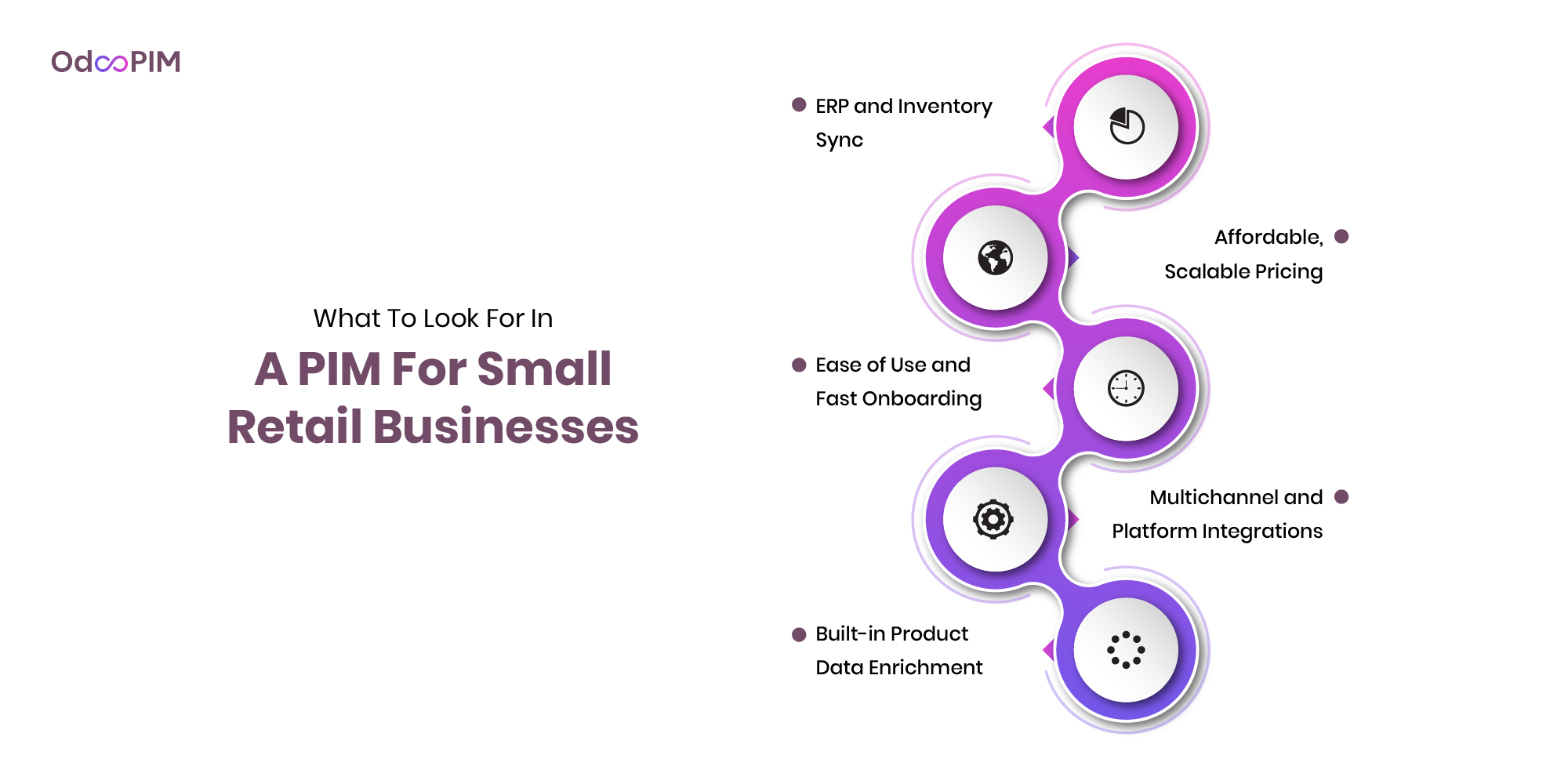
1. Ease of Use and Fast Onboarding
Best PIM software for small retail business must be intuitive enough for non-technical users to master within days. Product information management for retail with steep learning curves creates adoption resistance. Look for clean interfaces, guided workflows, and accessible support. Your team should spend time enriching product data, not learning software. Fast onboarding means faster time-to-value.
Affordable PIM software that requires expensive consultants defeats its purpose. PIM for small business ecommerce should offer self-service onboarding, video tutorials, and responsive customer support. If you need developers to configure basic features, keep looking. The right retail product data management software works for retail teams, not just IT departments.
2. Affordable, Scalable Pricing
Small businesses need affordable PIM software that grows with them, not enterprise pricing for startup needs. Best PIM software for small retail business offers tiered plans based on SKU count. Product information management for retail should be accessible at sub-$500 monthly for smaller catalogs. Avoid vendors that require annual commitments before you’ve proven value.
PIM for small business ecommerce with transparent pricing lets you scale as revenue grows. Retail product data management software should never force you into enterprise contracts before you’re ready. Look for month-to-month options and free trials that let you test before committing.
3. Multichannel and Platform Integrations
Your PIM tools for online retailers must connect where you sell, Shopify, WooCommerce, Amazon, eBay, and social channels. Best PIM software for small retail business offers pre-built connectors. Product information management for retail without native integrations creates manual export work that defeats PIM’s purpose. One product entry should feed every channel.
Affordable PIM software with limited integrations forces you to maintain spreadsheets alongside your PIM. PIM for small business ecommerce should support your platform stack. Ask about connector depth before committing. Does it support bidirectional sync? Real-time updates? Field-level mapping? The right retail product data management software makes multichannel selling easier.

4. Built-in Product Data Enrichment
Best PIM software for small retail business includes AI-assisted attribute filling, completeness scoring, and bulk editing tools. Product information management for retail should automate the work of populating missing specifications. Your team focuses on strategic content. PIM tools for online retailers without enrichment just store your existing chaos.
Affordable PIM software with automated enrichment reduces the 20–46 minutes per SKU that manual data entry consumes. PIM for small business ecommerce should validate attribute completeness before publication, not after customers notice gaps. Retail product data management software with enrichment turns catalog maintenance from bottleneck to background process.
5. ERP and Inventory Sync
Retail product data management software cannot operate in isolation. Best PIM software for small retail business integrates with your ERP or inventory system, ensuring product data and stock levels stay synchronized. PIM for small business ecommerce without ERP sync creates manual reconciliation work. When inventory updates in your ERP, your catalog should reflect it instantly.
Affordable OdooPIM software built on Odoo shares the same database as your operations. Product information management for retail with native Odoo ERP integration eliminates sync delays and overselling risks. PIM tools for online retailers that require separate integration layers add cost and complexity. The right PIM for small business ecommerce makes your catalog an extension of your operations, not another system to reconcile.
Learn about pim for pricing
Product Information Management (PIM) systems help decrease time to market for new products, acquire and grow customers/accounts, and increase customer lifetime value by reducing cost of goods sold and increasing long-tail profitability.
– Forrester
Best PIM Software Options for Small Retail Businesses in 2026
1. OdooPIM: Best for Odoo Users and Operationally Integrated Retail
Key features: Native integration with Odoo ERP means product data, inventory, pricing, and orders share one database, no middleware needed. Centralized product repository, automated enrichment, multichannel syndication, and workflow approvals.
Ideal business size: Small to mid-sized retail businesses already on Odoo or evaluating Odoo as their operational platform.
Pricing approach: Transparent pricing, no per-SKU fees, predictable costs as you scale.
What makes it suited for small-to-mid retail: For Odoo users, this is the best PIM software for small retail business because it eliminates integration costs. Your catalog, inventory, and storefront stay synchronized without sync delays or middleware. Product information management for retail becomes native to your operations.
2. Plytix: Best for Pure SMB Catalog Management
Key features: User-friendly interface, affordable pricing, strong import/export tools, and intuitive classification capabilities. Designed for SMBs needing centralized product data without enterprise complexity.
Ideal business size: Small retail teams managing under 5,000 SKUs with straightforward multichannel needs.
Pricing approach: SMB-friendly subscription tiers, transparent, predictable, no surprise enterprise fees.
What makes it uniquely suited for small-to-mid retail: Affordable PIM software that small teams can adopt. PIM for small business ecommerce without steep learning curves or implementation overhead. However, less operational depth than OdooPIM for businesses using Odoo ERP. Retail product data management software that prioritizes ease of use over integration.
3. Akeneo (Community Edition): Best for Content-Heavy Retailers
Key features: Advanced data modeling, completeness scoring, and multi-language support. Strong for retailers with rich product storytelling needs.
Ideal business size: Content-heavy retailers with larger catalogs and dedicated technical resources.
Pricing approach: Free community edition with self-hosting; enterprise edition for advanced features.
What makes it uniquely suited for small-to-mid retail: PIM tools for online retailers with product storytelling capabilities. However, a steeper learning curve can be over-engineered for very small retailers. Product information management for retail at scale requires technical investment. Not plug-and-play.
4. Pimcore: Best Open-Source Option
Key features: Open-source flexibility combining PIM, DAM, and MDM. Highly customizable data modeling.
Ideal business size: Technically resourced retail teams with developer capacity and customization needs.
Pricing approach: Open-source core free; paid enterprise options for advanced features and support.
What makes it suited for small-to-mid retail: Best PIM software for small retail business only if you have technical resources. Requires development investment. Not recommended for teams without internal IT. PIM for small business ecommerce with open-source flexibility, but implementation overhead is significant.

Comparison Table
| Software | Best For | Pricing Model | Shopify/WooCommerce Integration | Odoo Native | Onboarding Speed |
| OdooPIM | Odoo users needing operational integration | Transparent tiered | ✅ Native connectors | ✅ Yes | Fast for Odoo users |
| Plytix | Pure SMB catalog management | SMB-friendly subscription | ✅ Pre-built | ❌ No | Very fast |
| Akeneo (CE) | Content-heavy retailers | Free (self-hosted) | 🔶 Via connector | ❌ No | Moderate—technical |
| Pimcore | Open-source flexibility | Open source + paid | 🔶 Custom API | ❌ No | Slow—developer required |
Why OdooPIM Is the Smart Choice for Growing Small Retailers
1. No Integration Tax
OdooPIM eliminates the middleware costs that plague standalone PIM tools for online retailers. Unlike disconnected systems requiring separate sync tools and API mapping, OdooPIM shares the same database as your ERP, inventory, and orders. When your stock updates, your catalog reflects it instantly. No sync delays, no reconciliation work. For small retailers, this native integration means affordable PIM software without hidden integration expenses. Your catalog and operations stay synchronized.
2. Scales Without Breaking
The best PIM software for small retail businesses grows with you. OdooPIM handles hundreds of SKUs today and thousands tomorrow without platform migration. Product information management for retail that forces you to upgrade systems at growth thresholds defeats its purpose. OdooPIM scales within the same ecosystem. PIM for small business ecommerce that becomes your long-term platform.
3. Operational Unity, Not Another Silo
Retail product data management software should reduce system fragmentation, not add to it. OdooPIM brings catalog management into your operational platform, not as a separate tool requiring separate maintenance. For growing small retailers on Odoo or evaluating Odoo, OdooPIM is the natural choice. Best PIM software for small retail business when you want one source of truth across catalog, inventory, and operations. Affordable PIM software that unifies rather than fragments.

The Retail Product Journey: Why Sustainability Data Now Lives in Your PIM
Product information no longer ends at the sale. Retailers — including small ones — are increasingly expected to answer questions like: Where was this made? What is it made of? Can it be repaired or recycled? A PIM is the natural home for this data, because it’s already the single source of truth for everything else about your products.
From Linear to Circular: The Modern Product Journey
Traditionally, product data followed a straight line: supplier → catalog → sale. Today’s retail product journey is circular, and each stage generates data your customers and channels increasingly demand:
- Sourcing — supplier details, country of origin, material composition
- Enrichment — descriptions, images, specs, certifications
- Selling — consistent listings across web, marketplaces, and in-store
- Usage — care instructions, warranty info, repair guides
- Return & resale — condition grading, refurbished listings
- Recycling & disposal — material breakdown, recyclability labels
Small retailers that track this information in spreadsheets quickly lose control. Centralizing it in a PIM means every channel — from your product page to an Amazon listing — shows accurate, up-to-date sustainability details automatically.
Why This Matters Now (Not “Someday”)
Customers are checking. Shoppers increasingly compare products on sustainability attributes — recycled content, certifications, origin — before buying. Products with complete, transparent information convert better and get returned less.
Regulation is arriving. The EU’s Ecodesign for Sustainable Products Regulation (ESPR) is phasing in Digital Product Passports (DPP), which will require detailed product-level data on materials, repairability, and recyclability for goods sold in the EU. Even small retailers selling into European markets will need structured, exportable product data — exactly what a PIM provides.
Marketplaces reward it. Amazon (Climate Pledge Friendly), bol, and Zalando already badge or filter products with verified sustainability attributes. Missing data means missing visibility.
How OdooPIM Handles Sustainability Data
- Custom attributes for ESG data — add fields for material composition, recycled content %, certifications (GOTS, FSC, Fairtrade), country of origin, and repairability scores to any product family
- Certification asset management — store certificates, test reports, and eco-labels alongside product images so proof is always attached to the product
- Channel-ready syndication — map sustainability attributes to the format each marketplace expects, so a single update flows to every listing
- Odoo ecosystem link — because OdooPIM connects natively with Odoo Inventory and Purchase, supplier and origin data can flow into your product records instead of being re-typed
- Completeness scoring — flag products missing sustainability fields before they go live, so listings never ship half-finished
How to Evaluate and Choose the Right PIM for Your Retail Business
Step 1
Map your current product data pain points. Before evaluating the best PIM software for small retail business, document where your current process breaks. Are spreadsheets version-controlled? Do channel inconsistencies cause returns? Is manual enrichment consuming hours? Product information management for retail should solve problems, not just add features. Write down your top three frustrations. Use them as evaluation criteria.
Step 2
List your active sales channels. PIM tools for online retailers must connect where you sell. Your website, Amazon, eBay, social commerce, wholesale portals, each channel demands different formatting and attributes. Affordable PIM software without native connectors to your channels creates manual export work. Verify pre-built integrations exist for your platform stack before scheduling demos. Channel depth determines integration complexity.
Step 3
Check your existing tech stack (especially ERP/ecommerce platform). PIM for small business ecommerce should integrate with your operational systems, not add another silo. Are you on Shopify? WooCommerce? Odoo? Magento? The retail product data management software you choose must sync with your ERP for inventory and pricing. Native integration eliminates middleware costs and sync delays. Standalone tools require separate integration layers, factor this into your evaluation.
Step 4
Shortlist 2–3 vendors and request demos with your actual data, not sample catalogs. Best PIM software for small retail businesses reveals itself when tested with real data. Generic demos hide edge cases. Provide vendors with your messiest spreadsheet, missing attributes, complex variations, inconsistent formatting. See how their product information management for retail handles your challenges. A tool that works on clean sample data may fail with your real catalog.
Step 5
Evaluate total cost of ownership, not just monthly licensing. Affordable PIM software subscription fees tells part of the story. Factor implementation costs, training time, required integrations, and ongoing maintenance. A cheaper monthly license with expensive middleware may cost more than an integrated solution with higher subscription but zero integration overhead. PIM tools for online retailers should reduce operational costs, not shift them to different line items. Calculate loaded TCO before deciding.

Frequently Asked Questions
1. What is PIM software and do small retail businesses need it?
PIM (Product Information Management) software centralizes, enriches, and distributes product data across sales channels. Best PIM software for small retail business replaces spreadsheets with a single source of truth for product attributes, images, and variations. Small retailers need it when managing more than 200 SKUs or selling across multiple channels. Product information management for retail eliminates version conflicts, prevents listing errors, and automates enrichment. Without PIM, manual data entry consumes 20–46 minutes per SKU. PIM for small business ecommerce turns catalog management from bottleneck to growth engine.
2. What is the affordable PIM software for small retailers?
Affordable PIM software pricing varies by SKU volume and features. Plytix offers SMB-friendly subscriptions starting around $100–200 monthly for smaller catalogs. OdooPIM provides transparent tiered pricing within the Odoo ecosystem, no per-SKU fees, predictable costs as you scale. Best PIM software for small retail businesses balances capability with cost. Entry-level PIM tools for online retailers may lack enrichment automation or ERP integration. Evaluate total cost of ownership, cheapest license with expensive middleware costs more than integrated retail product data management software with higher subscription but zero integration overhead.
3. Can OdooPIM integrate with Shopify or WooCommerce?
OdooPIM offers native connectors for Shopify, WooCommerce, Magento, and major marketplaces. PIM for small business ecommerce with pre-built integrations eliminates manual export work. When you update product data in OdooPIM, sync automatically to your storefront. Unlike standalone PIM tools for online retailers requiring middleware, OdooPIM shares the same database as Odoo ERP, no sync delays, no API mapping. Best PIM software for small retail business when you want catalog, inventory, and storefront unified without middleware costs.
4. How long does it take to implement a PIM for a small retail business?
Implementation timelines vary by catalog complexity and chosen platform. Affordable PIM software like Plytix can be operational within days for small catalogs with simple attributes. OdooPIM implementation for existing Odoo users usually takes 2–6 weeks depending on catalog size and custom requirements. Best PIM software for small retail business offers fast onboarding without expensive consultants. Product information management for retail with data models implements faster than custom-built solutions. Factor data migration time, enriching incomplete attributes takes longer than system configuration. PIM for small business ecommerce should deliver value within weeks, not months.
5. What is the difference between PIM software and a spreadsheet for product data?
Retail product data management software is a living system. Spreadsheets create version conflicts, team members maintain different copies, no single source of truth. Best PIM software for small retail business centralizes data, enforces governance, and syndicates to channels automatically. Spreadsheets cannot handle channel-specific formatting, automated enrichment, or workflow approvals. PIM tools for online retailers replace manual copy-paste with structured syndication. Product information management for retail prevents the errors that spreadsheets guarantee. If your team spends time reconciling spreadsheet versions than improving content, you need PIM for small business ecommerce.