
Amazon catalog management centralizes product data, optimizes listings, and maintains consistency across your Amazon catalog. Amazon product catalog management ensures titles, descriptions, images, and attributes meet Amazon’s strict requirements. Amazon catalog management software automates enrichment, validates compliance, and syndicates updates across marketplaces. Amazon catalog best practices start with structured data, not guesswork. Effective Amazon listing management drives discoverability and conversion. Amazon catalog optimization turns product pages into sales channels. The right-managed Amazon product listings approach scales without errors.
What Is Amazon Catalog Management?
Amazon catalog management is the process of creating, optimizing, and maintaining product listings across Amazon’s marketplace. It goes beyond simple uploads, it ensures every product page contains accurate titles, compelling descriptions, high-quality images, and complete attributes that meet Amazon’s strict requirements. Amazon product catalog management also handles variations, inventory sync, and compliance documentation. Without proper management, listings become incomplete, inconsistent, or suppressed.
Effective Amazon listing management means products are discoverable, competitive, and conversion-ready. Amazon catalog optimization improves search ranking, click-through rates, and sales. The best Amazon catalog management software automates enrichment, val
idates compliance, and syndicates updates across marketplaces. Amazon catalog best practices start with structured data. When done right, your catalog works as a sales channel. Manage Amazon product listings well, and Amazon works for you.

What Does Amazon Catalog Management Cover in Practice?
- ASIN creation and structuring: Create new ASINs correctly the first time, ensuring unique identifiers map to accurate product data.
- Title and attribute optimisation: Craft titles that balance search visibility with readability, and populate every attribute Amazon requires for your category.
- Variation management: Build parent-child ASIN relationships so customers can select size, color, or style without juggling separate listings.
- Image compliance: Ensure every image meets Amazon’s technical requirements, white background, proper dimensions, zoom capability.
- A+ content management: Enhance product pages with rich media, comparison charts, and enhanced descriptions that convert.
- Backend keyword strategy: Optimize hidden search terms to capture traffic without cluttering visible content.
- Category and browse node assignment: Place products in the right categories so customers find them through Amazon’s navigation.
- Listing quality monitoring: Track suppression warnings, missing attributes, and policy violations before they impact visibility.
- Suppression resolution: Diagnose and fix suppressed listings to restore discoverability.
Bulk upload via flat files: Manage thousands of SKUs efficiently using Amazon’s bulk upload tools, but with centralized data feeding those files.
Learn about Best Catalog Management Software for Ecommerce in 2026: Compared and Ranked
Forrester’s Global Retail E-Commerce Forecast, 2024–2028 tracks global online retail sales surging from $1.3 trillion in 2014 to $4.4 trillion in 2023, with projections reaching $6.8 trillion by 2028
– Global Retail E‑Commerce Forecast
Why Amazon Catalog Management Impacts Your Sales
Search ranking rewards quality
Clean catalog data improves average search ranking by 2.1 positions on Amazon. Those marginal ranking improvements translate into visibility and revenue, higher on the page means more clicks, more sales. Amazon catalog management isn’t administrative work; it’s search engine optimization where Amazon’s algorithm is the engine. Incomplete listings get buried. Your Amazon product catalog management determines whether customers find you or your competitor.
Suppression steals sales
Suppressed listings now account for up to 10% of Amazon’s inactive products. Non-compliant listings see up to 40% less traffic compared to fully optimized ones. For a seller with 500 SKUs, 10% suppressed equals 50 invisible products actively losing sales every day. Amazon listing management failures have a direct, quantifiable cost. Every missing attribute, every policy violation, every outdated image is a sales door closed.
Compliance escalates risk
53% of Amazon sellers have faced listing compliance problems, with category rule violations being a key contributing factor. One policy violation can freeze product lines while you investigate. Amazon catalog optimization prevents these disruptions. Amazon catalog best practices keep you selling while competitors scramble to fix suppressed listings. Amazon catalog management software automates compliance monitoring, catching issues before Amazon does.
Learn about B2B Catalog Management
How Amazon’s Algorithm Rewards Well-Managed Catalogs
Amazon’s A10 algorithm evaluates listings across five weighted factors. Well-executed Amazon catalog management feeds every signal. Poor catalog management undermines the algorithm at multiple points at once.
- Listing completeness: Fully populated attributes signal relevance. Missing fields tell Amazon you’re incomplete. Amazon product catalog management ensures every required field is filled before publishing.
- Keyword relevance: Backend search terms and frontend content must align. Amazon catalog optimization places keywords where they matter most, titles, bullets, descriptions, backend.
- Sales velocity: Amazon listing management that delivers accurate, compelling content drives the sales velocity that fuels ranking.
- Customer engagement signals: Clicks, add-to-carts, and reviews follow quality listings. Amazon catalog best practices build the engagement that signals relevance to the algorithm.
- Inventory availability: Following 2025 algorithm updates, inventory consistency now plays an even bigger role in maintaining search rankings. Manage Amazon product listings with accurate availability data, or watch rankings drop when stock runs out.
The algorithm rewards listings that give shoppers everything they need to buy. Amazon catalog management software automates the completeness, accuracy, and consistency that manual processes cannot maintain at scale. Your catalog quality is your search ranking.
Learn about 5 Generative AI Use Cases in eCommerce
The Core Components of a Well-Managed Amazon Catalog
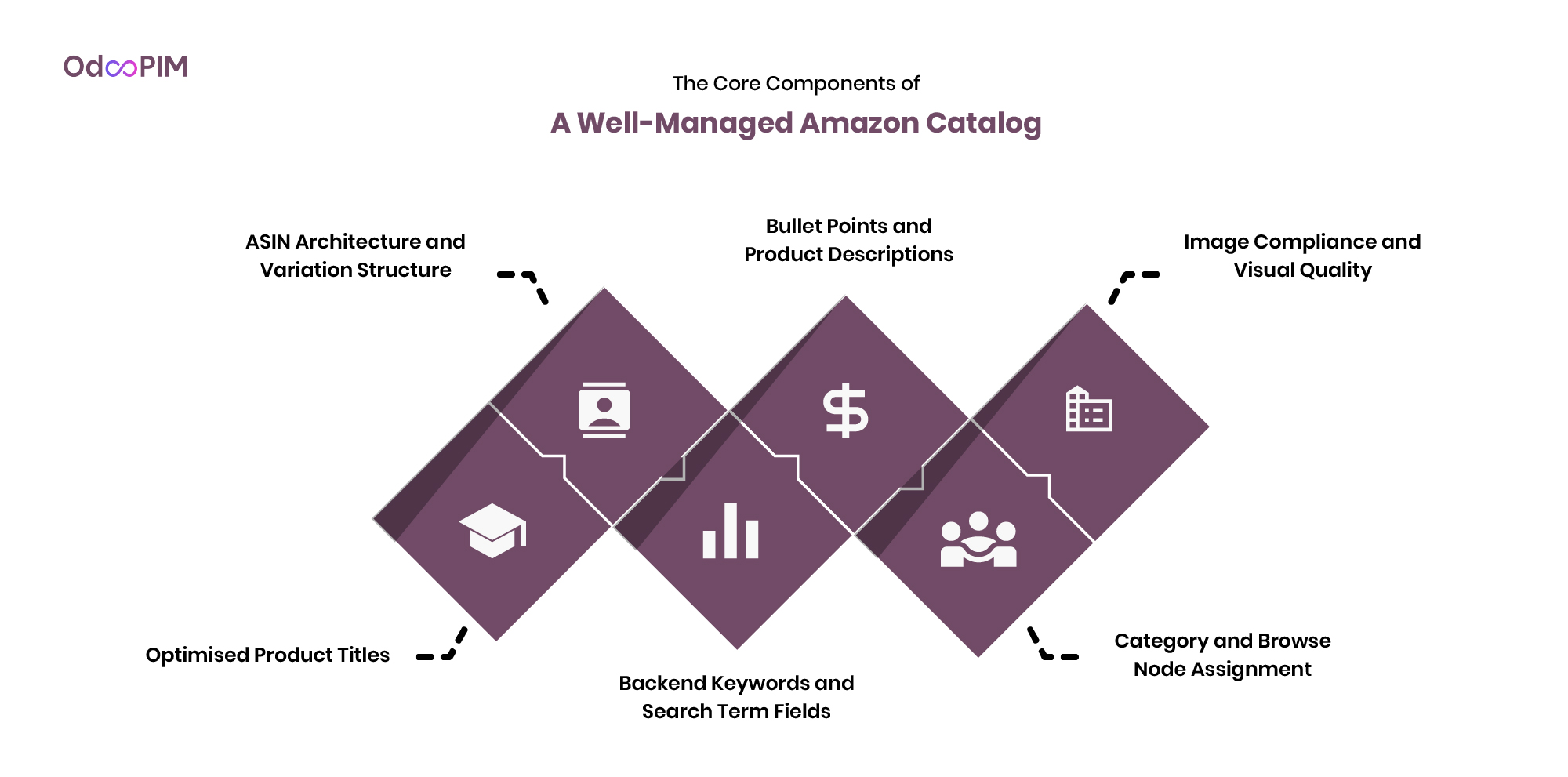
1. ASIN Architecture and Variation Structure
Proper ASIN architecture groups variations under a single parent ASIN rather than creating separate listings for each size or color. Amazon product catalog management requires clean parent-child relationships so customers select options without juggling multiple pages. Broken variation structures confuse shoppers and dilute reviews across separate listings. Amazon listing management starts with architecture that makes browsing intuitive, not frustrating.
Amazon catalog best practices treat variation structure as foundational. When variations share a parent ASIN, reviews aggregate, inventory tracks accurately, and customers see all options at once. Amazon catalog optimization ensures size, color, and style variants appear as choices within one listing, not scattered across search results.
2. Optimised Product Titles
Amazon titles follow a formula, brand + product line + key features + size/color + quantity. Amazon catalog optimization ensures titles include high-value search terms without keyword stuffing. Titles under 80 characters may truncate on mobile devices, losing critical information. Titles missing key attributes, like size or material, lose visibility in search results. Amazon listing management prioritizes title quality above most other elements.
Amazon catalog best practices treat titles as the primary ranking signal. Every word must earn its place. Front-load the most important keywords. Include variations customers search for. Amazon product catalog management ensures titles remain consistent across variations while differentiating what matters.

3. Bullet Points and Product Descriptions
Bullets should highlight benefits, not just features. Each bullet addresses a specific customer need or question, durability, compatibility, ease of use, warranty. Amazon catalog management ensures bullets avoid repetitive content and include keywords naturally without sacrificing readability. Amazon product catalog management treats bullets as conversion tools, not SEO dumping grounds.
Amazon catalog optimization extends to descriptions where bullets cannot cover everything. Use this space for technical specifications, installation instructions, warranty details, and product dimensions. Amazon catalog best practices ensure descriptions complement bullets rather than repeat them.
4. Backend Keywords and Search Term Fields
Backend search terms capture traffic that frontend content cannot accommodate. Amazon catalog management software helps optimize these hidden fields without keyword stuffing, using available characters without repeating words. Amazon listing management includes misspellings, synonyms, and use-case terms that shoppers actually type but don’t appear in visible content.
Amazon catalog best practices treat backend fields as valuable real estate. Avoid commas, they consume characters without adding value. Include singular and plural variations. Add industry terms customers might use. Amazon product catalog management ensures backend keywords expand discoverability without cluttering visible content.
5. Image Compliance and Visual Quality
Amazon requires white background for main images, zoom capability, and minimum resolution (at least 1000 pixels on longest side). Amazon catalog management ensures every image meets technical requirements while communicating value. Secondary images should show product use, dimensions, scale, details, and packaging. Amazon catalog optimization treats visuals as sales tools, not just requirements to satisfy.
Amazon listing management without image compliance leads to suppressed listings. Poor image quality leads to abandoned carts. Amazon catalog best practices invest in professional photography that shows products in context, demonstrates scale, and highlights features. The main image attracts clicks. Secondary images close sales. Amazon product catalog management ensures visual content matches what customers need to see before buying.
6. Category and Browse Node Assignment
Placement determines who finds your products. Amazon product catalog management assigns categories and browses nodes correctly, not just “close enough.” Wrong categories bury products where customers never look. Amazon catalog optimization ensures every product appears where shoppers expect to find it. Multiple browse nodes expand visibility across related departments.
Amazon catalog best practices research category placement before publishing. A blender belongs in kitchen appliances, not small appliances. Running shoes go in athletic, not casual footwear. Amazon listing management treats category selection as critical as title optimization. Amazon catalog management without proper placement means optimized listings that nobody finds. Placement isn’t optional, it’s foundational to discoverability and sales.
Learn about Amazon SEO tips
The 6 Biggest Amazon Catalog Management Challenges
Managing Suppressed Listings at Scale
The Challenge: Suppressed listings account for up to 10% of Amazon’s inactive products, 50 invisible listings for a 500-SKU catalog. Amazon catalog management without proactive monitoring means you discover suppression when sales drop.
The Solution: Use Amazon catalog management software with continuous listing health monitoring and completeness scoring. Amazon listing management that catches issues before Amazon suppresses them keeps your catalog visible and selling.
Keeping Product Data Consistent Across Thousands of SKUs
The Challenge: Spreadsheets create version chaos, marketing updates titles while operations updates inventory, and no one sees the full picture. Amazon product catalog management without centralization guarantees inconsistency across your catalog.
The Solution: Centralize all product data in a single source of truth before it reaches Amazon. Amazon catalog best practices start with one repository that feeds every channel, eliminating version conflicts.
Managing Complex Variation Structures Without Errors
The Challenge: Broken parent-child ASIN relationships scatter reviews, confuse customers, and create inventory tracking failures. Manual variation management creates errors that multiply with each new product.
The Solution: Use Amazon catalog management software with automated variation management, define themes once, and new variants link correctly without manual intervention. Amazon catalog optimization ensures customers see all options in one listing.

Staying Compliant With Amazon’s Constantly Changing Policies
The Challenge: 53% of sellers have faced compliance problems as Amazon updates category requirements and content policies regularly. Manual compliance monitoring is impossible at scale.
The Solution: Choose Amazon catalog management software that tracks policy updates and validates listings against current requirements automatically. Manage Amazon product listings proactively, and you avoid reactive account flagging.
Scaling Catalog Management Beyond What Seller Central Can Handle
The Challenge: Seller Central works for dozens of SKUs but fails for thousands. Bulk uploads become error-prone, and listing optimization becomes impossible at scale. Amazon product catalog management without dedicated tools limits growth.
The Solution: Implement Amazon catalog management software designed for scale, manage thousands of SKUs from one interface with bulk editing and automated enrichment. Amazon listing management for high-volume sellers requires moving beyond native tools.
Synchronising Amazon Catalog Data With ERP and Inventory Systems
The Challenge: Standalone Amazon tools require constant sync with ERP, creating middleware costs and sync delays that cause overselling. Data mismatches create fulfillment errors.
The Solution: Integrated platforms like OdooPIM share the same database as your ERP, inventory updates reflect instantly on Amazon. Amazon catalog best practices prioritize native integration over bolt-on connectors that add complexity.
Learn about automotive catalog management
Amazon Catalog Management Best Practices for 2026
1. Audit Your Catalog for Suppressed and Inactive Listings Weekly
Suppressed listings account for up to 10% of Amazon’s inactive products, invisible inventory losing sales daily. Amazon catalog management without weekly audits means discovering suppression when revenue drops. A 500-SKU catalog with 10% suppression equals 50 listings customers never see. Amazon catalog best practices treat suppression prevention as daily discipline. Amazon listing management with automated monitoring catches issues before Amazon flags them. Run weekly audits. Fix suppressed listings immediately.
2. Build a Single Source of Truth for All Product Data Before Publishing to Amazon
Spreadsheets guarantee inconsistency. Marketing updates titles, operations updates inventory, and no one sees conflicts. Amazon product catalog management without centralization creates version chaos that multiplies across channels. Amazon catalog optimization starts with one repository where every product record lives. Centralized data ensures consistent titles, attributes, and pricing across your website, Amazon, and marketplaces. Manage Amazon product listings from one source, and version conflicts disappear.
3. Structure Titles and Attributes to the Latest Amazon Style Guidelines
Amazon updates title formulas and attribute requirements regularly. What passed last month may fail today. Amazon catalog management software should track policy changes and validate listings against current guidelines. Front-load important keywords. Include required attributes. Follow category-specific rules. Amazon listing management that ignores style guidelines invites suppression. Amazon catalog best practices treat compliance as ongoing, not a one-time setup.

4. Prioritise A+ Content for Top-Performing and High-Traffic ASINs
A+ content converts browsers into buyers with rich media, comparison charts, and enhanced descriptions. Amazon catalog optimization means investing A+ resources where they deliver highest return, top-performing ASINs and high-traffic pages. Amazon product catalog management should prioritize enhancements that move revenue. Not every product needs A+ content. Your best sellers deserve it. Amazon catalog best practices allocate premium content to premium products.
5. Use Dynamic Pricing Within Controlled Floor and Ceiling Limits
Manual price updates cannot keep pace with market fluctuations. Amazon catalog management software with dynamic pricing adjusts within guardrails you set, never below margin floor, never above competitive ceiling. Amazon listing management that automates pricing captures demand spikes without risking margin erosion. Amazon catalog best practices use automation for what humans cannot scale. Set limits, let the system optimize, and capture revenue that manual updates miss.
6. Monitor Your Inventory Performance Index (IPI) Score Continuously
Amazon’s Inventory Performance Index impacts storage limits and account health. Low IPI scores restrict inventory capacity and increase fees. Amazon catalog management must integrate inventory data with catalog operations. Amazon product catalog management without IPI visibility leaves you vulnerable to capacity cuts. Manage Amazon product listings with accurate availability data, or watch rankings drop when inventory runs out.
Learn about online catalog management tools
When Amazon Seller Central Is No Longer Enough — The Case for a PIM
What Seller Central Does Well
Seller Central excels at managing individual listings. For a few dozen SKUs, it works. For hundreds or thousands, it breaks. Bulk upload via flat files becomes error-prone. Variation management fails. Listing optimization becomes impossible when you cannot see your catalog at once. Amazon catalog management without dedicated tools scales poorly. Amazon product catalog management needs infrastructure beyond Seller Central once you cross 500 SKUs or three channels.
What a PIM Adds to Amazon Catalog Management
A PIM adds centralized product data, automated enrichment, and governance that Seller Central lacks. Amazon catalog management software with PIM capabilities enforces completeness before publication, not after suppression flags. Workflow approvals prevent errors from reaching customers. Attribute modeling handles complex technical products. Amazon listing management becomes systematic rather than reactive. Amazon catalog optimization happens upstream, not as a cleanup exercise. PIM transforms catalog management from manual maintenance to automated infrastructure.
How OdooPIM Connects Amazon Catalog Management to Your Wider Ecommerce Operation
OdooPIM embeds Amazon catalog management within your operational ecosystem, not as a standalone tool. When your ERP updates inventory, Amazon reflects it instantly. When pricing changes, your catalog updates automatically. Amazon product catalog management shares the same database as orders, inventory, and accounting. No middleware, no sync delays. For businesses on Odoo, OdooPIM adds Amazon capabilities without introducing a new platform or integration to maintain. Amazon catalog best practices become native to your operations, not an add-on. Manage Amazon product listings well, and your catalog becomes a smooth extension of your business.
Learn about Amazon SEO services in USA

Frequently Asked Questions About Amazon Catalog Management
1. What is Amazon catalog management?
Amazon catalog management is the process of creating, optimizing, and maintaining product listings across Amazon’s marketplace. It covers ASIN creation, title and attribute optimization, variation management, image compliance, A+ content, backend keyword strategy, and listing quality monitoring. Amazon product catalog management ensures every listing is complete, accurate, and compliant with Amazon’s evolving requirements. Without proper management, listings become suppressed, inconsistent, or invisible. Amazon catalog optimization turns product pages into conversion engines. Effective Amazon listing management means your catalog works as a sales channel, not just an inventory list.
2. Why do Amazon listings get suppressed?
Amazon suppresses listings when they violate content policies or miss required attributes. Common suppression causes include incomplete product titles, missing images, incorrect category assignments, or non-compliant descriptions. 10% of Amazon’s active products face suppression at any time. Amazon catalog management without proactive monitoring means discovering suppression when sales drop. Non-compliant listings see up to 40% less traffic compared to fully optimized ones. Amazon product catalog management that catches issues before publication prevents suppression. Amazon catalog best practices treat compliance as daily discipline, not periodic cleanup.
3. How often should I audit my Amazon product catalog?
Weekly audits are essential for healthy Amazon catalog management. Suppressed listings can appear overnight after policy updates. A 500-SKU catalog with 10% suppression means 50 listings losing sales. Amazon catalog optimization requires continuous monitoring, not quarterly reviews. Amazon listing management with automated monitoring catches issues before they impact revenue. Run a full audit weekly. Check for missing attributes, image violations, and suppressed ASINs. Fix issues immediately. Amazon catalog best practices treat audits as routine maintenance, not emergency response. Your catalog health impacts your search ranking and sales.
4. What is the difference between Amazon catalog management and PIM software?
Amazon catalog management refers to the process of maintaining listings on Amazon, titles, images, variations, compliance. A PIM (Product Information Management) system is the infrastructure that powers advanced Amazon product catalog management. PIM centralizes product data, enforces governance, automates enrichment, and syndicates to multiple channels including Amazon. Amazon catalog management software with PIM capabilities handles what Seller Central cannot: bulk enrichment, workflow approvals, attribute modeling, and ERP integration. Amazon catalog best practices use PIM as the engine behind your Amazon listings, ensuring consistency, completeness, and compliance at scale.
5. How does OdooPIM help with Amazon catalog management?
OdooPIM embeds Amazon catalog management within your operational ecosystem, not as a standalone tool. Centralize product data, build variation structures, and enrich technical attributes, all before publishing to Amazon. When your ERP updates inventory, Amazon reflects it instantly. When pricing changes, your catalog updates automatically. Amazon catalog management software built on Odoo shares the same database as orders, inventory, and accounting. No middleware, no sync delays. For businesses on Odoo, OdooPIM adds Amazon capabilities without introducing a new platform or integration to maintain. Manage Amazon product listings well, and your catalog becomes a smooth extension of your business.