B2B catalog management centralizes product data, automates enrichment, and distributes accurate listings across wholesale portals, marketplaces, and customer- specific catalogs. B2B product catalog management handles complex pricing, customer-specific variants, and bulk ordering workflows that B2C tools cannot support. The best B2B catalog management software integrates with ERP systems, supports negotiated pricing, and enables customer-specific product visibility. Wholesale catalog management requires governance, approval workflows, and real-time inventory sync across sales channels. B2B product data management done right ensures buyers see what their contract authorizes, nothing more, nothing less. B2B catalog best practices start with centralized data.
What Is B2B Catalog Management?
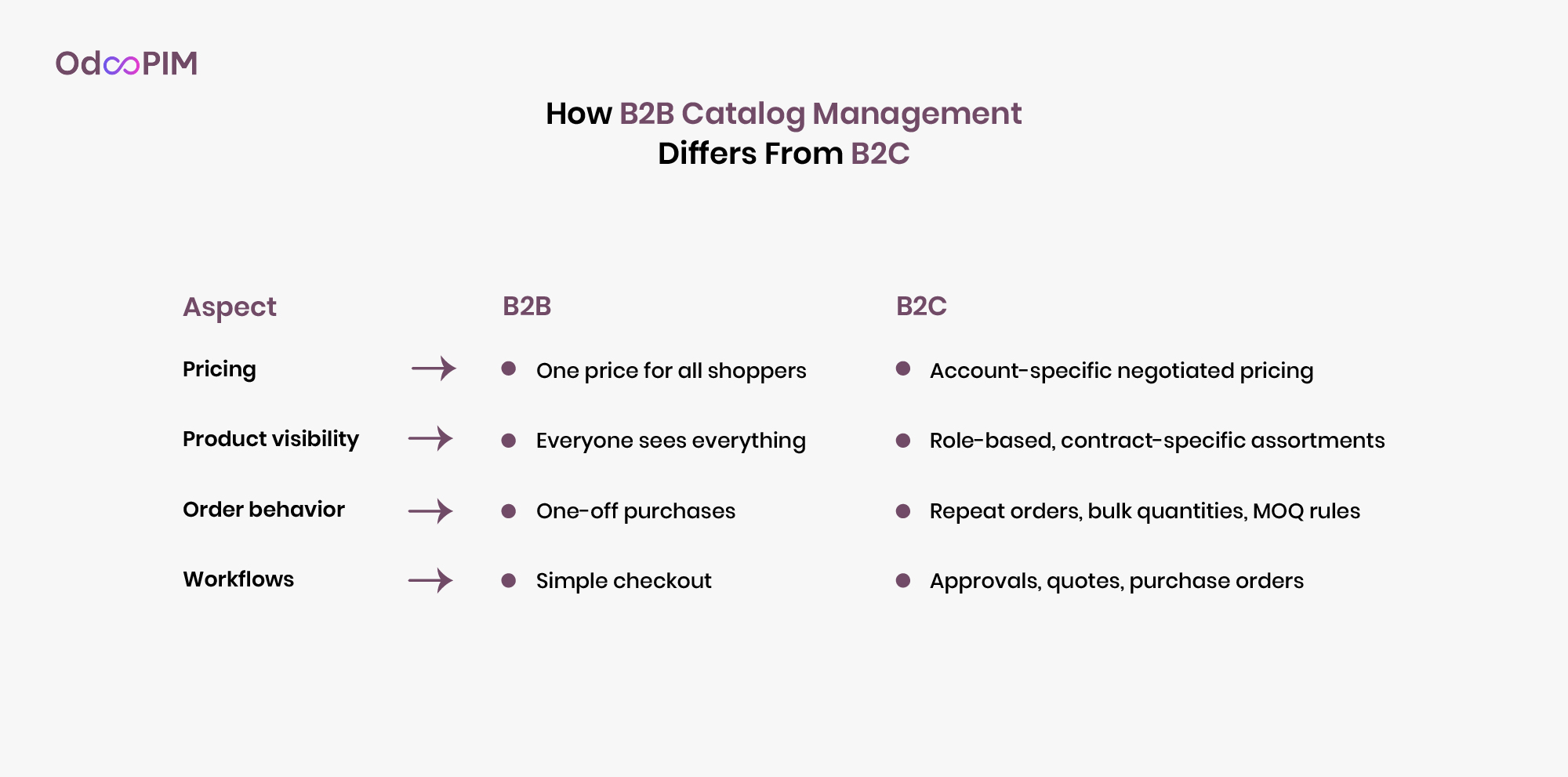
B2B catalog management is the process of centralizing, enriching, and distributing product information management to wholesale buyers, distributors, and corporate accounts. Unlike B2C, where every shopper sees identical content, B2B product catalog management must handle account-specific pricing, minimum order quantities, contract-based assortments, and role-based visibility. A single product appears differently to different buyers based on their negotiated agreements. B2B ecommerce catalog management requires governance that B2C tools simply do not provide.
B2B catalog management software must integrate with ERP systems, support negotiated pricing, and enable customer-specific product assortments. Wholesale catalog management requires real-time inventory sync, customer-specific price lists, and the ability to hide products that a buyer isn’t authorized to purchase. B2B product data management also includes customer-specific part numbers, cross-references, and compliance documentation.
B2B catalog best practices start with centralized product data that can adapt to each customer’s contract. Spreadsheets cannot handle the complexity of tiered pricing, MOQ rules, and role-based visibility. Dedicated B2B catalog management platforms automate what manual processes cannot scale, ensuring each buyer sees what their contract authorizes, at the price they negotiated.

Why B2B Catalog Management Is Getting More Complex in 2026
According to Gartner’s Future of Sales 2026 report, 80% of B2B sales interactions between suppliers and buyers will occur in digital channels by 2026. This means your B2B ecommerce catalog is your primary sales channel. When most interactions happen online, catalog quality drives revenue. Inaccurate or incomplete product information loses deals before a sales rep ever gets involved.
B2B buyers are expecting B2C experiences. 66% of B2B buyers expect personalized experiences comparable to consumer ecommerce. Generic, one-size-fits-all B2B product catalog management no longer meets buyer expectations. Account-specific pricing, role-based product visibility, and personalized assortments aren’t nice-to-have features, they’re baseline requirements.
The catalog is the sales rep now. 83% of millennial buyers prefer completing orders through self-service digital interfaces rather than interacting with sales representatives. If buyers are self-serving, your B2B catalog automation management software must be accurate, personalized, and complete, or the sale is lost. No sales rep steps in to correct bad data or explain missing specifications. B2B product data management impacts revenue. B2B catalog best practices have shifted from “nice to have” to “must have.” The complexity is real.
Learn about Best Online Catalog Management Tools for Ecommerce in 2026
The Core Components of B2B Catalog Management
1. Centralised Product Data Repository
Your B2B catalog management foundation starts with a single source of truth for every SKU, specification, and digital asset. B2B product catalog management requires centralization, no more spreadsheets, no version conflicts across teams. Without this, B2B product data management becomes reactive firefighting instead of proactive control. The repository must handle complex attributes, technical specs, and compliance documentation that B2B products typically require. Every channel and every team member must access the same data.
B2B ecommerce catalog systems without centralization accelerate chaos rather than solving it. B2B catalog best practices begin with a unified repository that eliminates the “which version is current” problem. When product data lives in one place, enrichment, validation, and syndication become systematic rather than manual. Spreadsheets cannot provide this foundation at scale. Dedicated B2B catalog management software centralizes what fragmented tools scatter.
2. Customer-Specific Pricing and Contract Rules
B2B catalog management software must handle negotiated pricing, volume tiers, and contract terms that vary by customer. Unlike B2C where one price fits all, wholesale catalog management requires account-specific price lists, quantity-based discounts, and customer-specific contract terms. The system must apply correct pricing automatically based on who is logged in.
B2B product catalog management also needs to support special pricing agreements, promotional periods, and contract expiration dates. B2B ecommerce catalog systems should apply the right price based on customer tier, order volume, and active promotions. When a contract renews or expires, pricing updates automatically across channels. B2B catalog best practices ensure the buyers see the price they negotiated.
3. Account-Based Catalog Visibility and Access Controls
Not every customer should see every product. B2B ecommerce catalog systems must enforce role-based visibility, showing each buyer only the products their contract authorizes. B2B catalog best practices include hiding restricted items, controlling access to pricing, and managing approval workflows for sensitive products. A buyer from one region shouldn’t see products unavailable in their market.
B2B product data management must also handle customer-specific part numbers and cross-references. A distributor might know a product by a different code than the manufacturer uses. B2B catalog management software bridges that gap automatically, showing each customer their familiar part numbers while maintaining internal consistency. Wholesale catalog management without access controls creates confusion and compliance risks.
4. Product Data Enrichment for Technical and Complex Products
B2B products require richer data than consumer goods. B2B catalog management must handle technical specifications, compliance documentation, CAD drawings, safety data sheets, and installation manuals. B2B product catalog management tools should automate product data quality through AI-assisted attribute completion and validation. Missing specifications mean lost sales, engineers won’t spec components with incomplete technical data.
Wholesale catalog management without enrichment tools leaves your team manually populating technical fields, a process that breaks at scale. B2B ecommerce catalog systems with automated enrichment extract attributes from supplier sheets, images, and existing documentation. B2B product data management ensures every product meets completeness standards before publication. Automation transforms manual data entry into background processes, freeing your team for strategic work.
Multichannel Syndication Across B2B Portals and Marketplaces
B2B ecommerce catalog data must reach multiple destinations, your own B2B portal, customer-specific punchout catalogs, marketplaces, and trading partner networks. B2B catalog management software handles channel-specific formatting automatically, adapting content for each destination without manual rework. What works on your website may need different formatting for a customer’s procurement system.
B2B product catalog management systems should support EDI integrations, API-based syndication, and spreadsheet exports for customers who still use purchase orders. Wholesale catalog management without multichannel syndication creates duplicate work, updating the same product across multiple destinations manually. B2B catalog best practices dictate one product entry feeds every channel.

5. ERP and Backend System Integration
B2B catalog management cannot operate in isolation. B2B product data management must integrate natively with your ERP for inventory, pricing, orders, and customer data. Standalone B2B catalog management software requires middleware and API mapping, adding cost, complexity, and sync delays. Wholesale catalog management systems that share a database with your ERP deliver real-time sync without reconciliation work.
B2B ecommerce catalog integration depth determines whether your catalog is a source of truth or just another system to reconcile. When inventory updates in your ERP, the catalog reflects it instantly. When pricing changes, every channel updates automatically. B2B catalog best practices prioritize native integration over bolt-on connectors. For businesses already on Odoo, OdooPIM provides this native advantage, catalog, inventory, and operations share one database.
Learn about catalog management solutions.
The 6 Biggest B2B Catalog Management Challenges
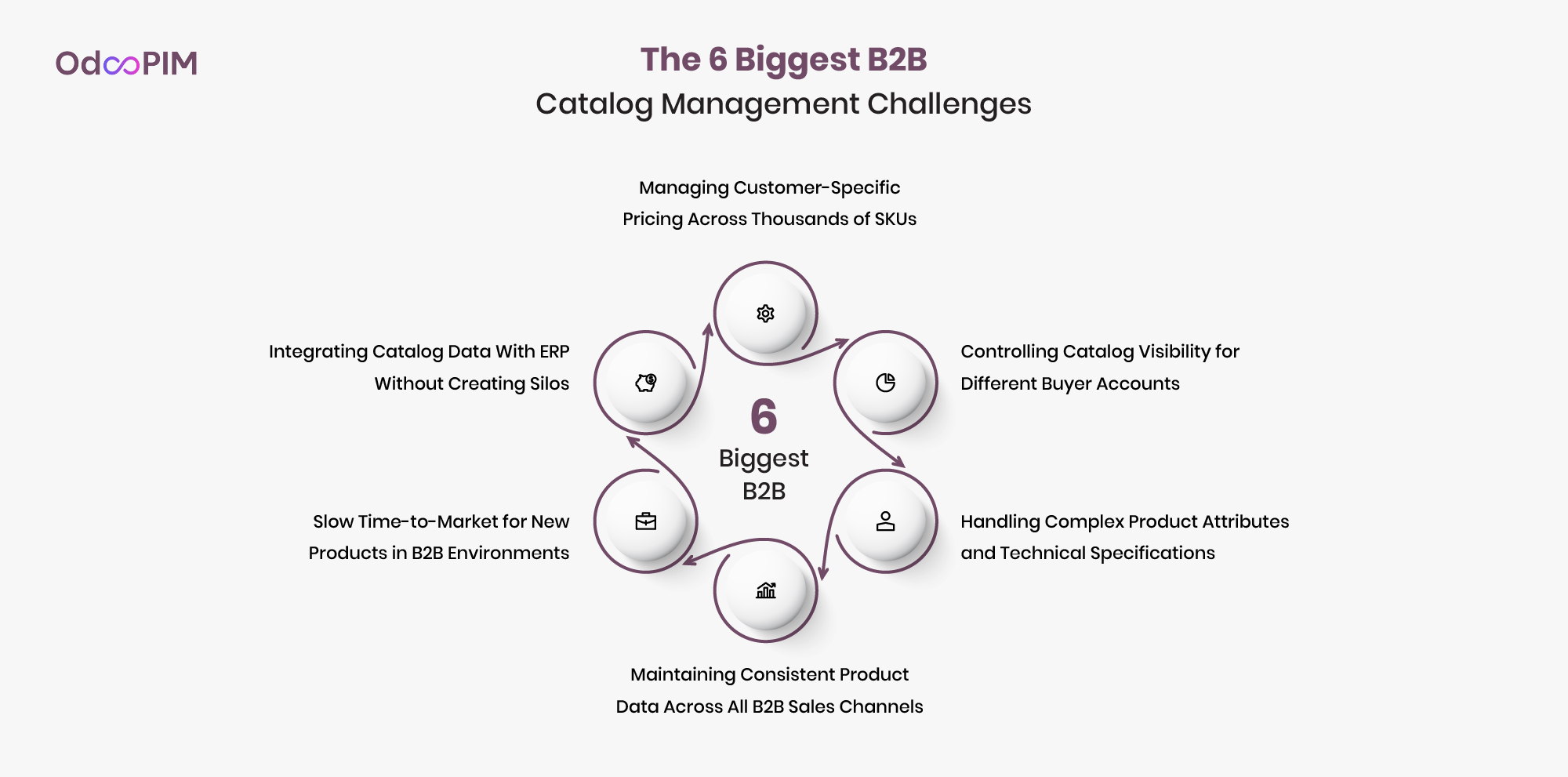
1. Managing Customer-Specific Pricing Across Thousands of SKUs
Challenge: Volume pricing, account tiers, and contract rates need storage, governance, and correct display per buyer. Spreadsheets cannot handle the complexity of negotiated pricing across thousands of SKUs. Manual management inevitably leads to errors, buyers seeing wrong prices or missing contract rates. B2B catalog management without automation breaks at scale.
Solution: A B2B catalog management software platform with native pricing rule engines and account-based catalog layers, not manual spreadsheet management. B2B product catalog management systems should apply correct pricing automatically based on customer tier, order volume, and active contracts. B2B catalog best practices dictate that buyers see what they negotiated, every time.
2. Maintaining Consistent Product Data Across All B2B Sales Channels
Challenge: 83% of companies admit their product data is outdated or incomplete. In B2B ecommerce catalog operations, this kills self-service conversion and erodes buyer trust. When buyers find inconsistent specifications across your portal, marketplace, and customer punchout, confidence disappears. B2B product data management failures cost revenue.
Solution: Centralized B2B catalog management as the single source of truth, syndicating validated data to all channels simultaneously. Wholesale catalog management platforms enforce data quality before publication, not after errors reach buyers. B2B catalog best practices prioritize consistency, one product entry, accurate everywhere.
3. Controlling Catalog Visibility for Different Buyer Accounts
Challenge: Without role-based access controls, buyers see products they cannot buy or prices that don’t apply to them, creating friction and eroding confidence. A distributor shouldn’t see manufacturer-direct pricing. A regional buyer shouldn’t see products unavailable in their market. B2B ecommerce catalog without visibility rules confuses customers.
Solution: Account-based B2B catalog management with configurable visibility rules per customer group. B2B product catalog management software should hide restricted items, control pricing access, and manage approval workflows automatically. B2B catalog best practices ensure each buyer sees what their contract authorizes, nothing more, nothing less.
4. Handling Complex Product Attributes and Technical Specifications
Challenge: B2B products, industrial, manufacturing, medical, tech, require structured attribute sets that generic ecommerce platforms cannot handle. Basic title-description-price fields fail for technical products requiring dimensions, materials, certifications, and compliance documentation. B2B product data management without flexible modeling cannot support B2B complexity.
Solution: B2B catalog management software with flexible attribute modeling and bulk enrichment tools. Wholesale catalog management platforms should support custom attribute sets per product family, automated validation, and completeness scoring. B2B catalog best practices treat attributes as structured data, not free-text fields.
5. Slow Time-to-Market for New Products in B2B Environments
Challenge: Getting a new product live across portals, EDI, marketplaces, and sales tools requires multiple manual steps across disconnected systems. Each channel demands separate formatting, separate approvals, separate uploads. B2B ecommerce catalog teams spend weeks launching what should take days. B2B product catalog management without automation creates bottlenecks.
Solution: Workflow automation with role-based approval and one-click multichannel publishing. B2B catalog management platforms route new products through defined approval steps, then syndicate to the channels simultaneously. B2B catalog best practices compress launch cycles from weeks to days through automation.
6. Integrating Catalog Data With ERP Without Creating Silos
Challenge: Catalog data managed in a standalone tool must sync with ERP for pricing, availability, and inventory, creating integration overhead and data lag. Middleware adds cost. Sync delays cause overselling. B2B product data management in isolation creates as many problems as it solves.
Solution: This is OdooPIM’s core differentiator, B2B catalog management and ERP live in the same platform, eliminating the integration problem. B2B catalog management software built on Odoo shares the same database as inventory, pricing, and orders. No middleware, no sync delays, no reconciliation work. For businesses on Odoo, this native integration is the ultimate B2B catalog best practice.
Learn about AI tools for ecommerce.
B2B Catalog Management Best Practices
Build Separate Catalog Layers for Different Customer Segments
One-size-fits-all catalogs fail in B2B. B2B catalog management requires distinct layers for distributors, enterprise accounts, and self-service buyers. Each segment sees different pricing, products, and content. B2B ecommerce catalog platforms with account-based visibility enforce these rules automatically. A distributor shouldn’t see manufacturer-direct pricing. A self-service buyer shouldn’t see contract-only products. B2B catalog best practices treat segmentation as infrastructure, not afterthought.
B2B product catalog management without segmentation confuses buyers and erodes trust. When customers see products they cannot purchase or prices that don’t apply, they leave. Wholesale catalog management systems with configurable visibility rules ensure each buyer sees what their contract authorizes. Build catalog layers before you need them.
Standardise Product Attributes Before Onboarding New Suppliers
Every supplier structures data differently. B2B product data management without standardization creates chaos that multiplies with each new vendor. Define your attribute model, required fields, formats, taxonomies, before onboarding any supplier. B2B catalog management software enforces these standards automatically, rejecting incomplete formatted submissions.
B2B catalog best practices treat attribute standardization as prerequisite, not optimization. Spreadsheets from suppliers become structured data through validation rules and automated mapping. B2B ecommerce catalog quality depends on consistent inputs.
Automate Pricing Rule Updates Across Accounts
Manual price management breaks at scale. B2B catalog management must automate pricing rules based on customer tiers, order volumes, and contract terms. When a contract renews, pricing updates everywhere automatically. When volume thresholds cross, discounts apply instantly. B2B product catalog management without automation creates errors that erode trust and margin.
Wholesale catalog management platforms with native pricing engines handle complexity that spreadsheets cannot. Tiered pricing, contract rates, promotional periods, all governed by rules, not manual entry. B2B catalog best practices dictate that buyers see correct prices every time, not just when someone remembered to update a spreadsheet.
Implement Workflow Approvals Before Any Product Goes Live
Bad catalog data reaches customers when approval workflows are optional. B2B ecommerce catalog systems must enforce quality gates before publication. Product data requires merchandising sign-off. Pricing requires finance approval. Compliance requires verification. B2B catalog management software routes new products through defined approval steps automatically.
B2B product data management without workflow control lets errors slip through. B2B catalog best practices treat approvals as prevention, not bureaucracy. The system should track who approved what and when, creating accountability. No product goes live until all conditions are met.
Monitor Catalog Completeness Per Customer Segment
What gets measured gets improved. B2B catalog management requires completeness scoring per product and per segment. A product complete for one customer may lack specifications required for another. B2B ecommerce catalog dashboards show where gaps exist, missing dimensions, incomplete documentation, absent certifications.
B2B product catalog management without measurement leaves teams guessing where to focus. Wholesale catalog management platforms with completeness scoring prioritize work by revenue impact. Missing specifications for top-selling products get fixed first.

Keep Catalog and ERP Data Synchronized in Real Time
B2B catalog management cannot operate in isolation. When catalog data and ERP data drift, customers see outdated inventory and wrong pricing. Standalone B2B catalog management software requires middleware and sync delays. B2B product data management must share the same source as your operations.
B2B catalog best practices demand native integration between catalog and ERP. OdooPIM delivers this, catalog, inventory, and operations share one database. When stock updates in ERP, the catalog reflects it instantly. When pricing changes, every channel updates automatically.
Learn about ai and ecommerce.
What Features Should B2B Catalog Management Software Include?
When evaluating B2B catalog management software, start with non-negotiables, centralized product data, customer-specific pricing rules, product visibility controls, and native ERP integration. B2B product catalog management must handle large SKU volumes, workflow approvals, and high-performance search that returns accurate results across complex product lines. B2B ecommerce catalog platforms should also support MOQ (minimum order quantity) rules, multi-catalog segmentation, and assisted selling tools that help buyers find what they need faster.
Wholesale catalog management without these capabilities creates operational drag, not efficiency. Use this as your evaluation checklist, Does the platform manage account-based pricing automatically? Can it hide products unauthorized buyers shouldn’t see? Does it sync with your ERP in real time without middleware? B2B product data management done right means these features work together smoothly, not as isolated modules. B2B catalog best practices start with software built for B2B complexity.
Learn about Best Online Catalog Management Tools
How OdooPIM Supports B2B Catalog Management
B2B catalog management within OdooPIM follows a structured workflow designed for wholesale complexity. It starts with centralizing product data in Odoo, every SKU, specification, and digital asset in one place. From there, you build customer-specific pricing layers, tiered discounts, contract rates, volume thresholds. B2B product catalog management then applies account-based visibility rules, ensuring each buyer sees only what their contract authorizes. Enrichment tools handle technical attributes, compliance documentation, and supplier-specific data. Finally, you publish to B2B portals, Shopify B2B, WooCommerce, or marketplaces, all from the same platform.
OdooPIM is embedded within the Odoo platform, not a standalone B2B catalog management software bolted on with middleware. Wholesale catalog management, contract pricing, inventory, and order management all share the same database. This eliminates the integration tax that plagues other solutions, no API mapping, no sync delays, no reconciliation work between catalog and ERP.
For businesses running procurement, inventory, and sales on Odoo, OdooPIM adds B2B ecommerce catalog capabilities without introducing a new platform or a new integration to maintain. You’re not connecting a standalone PIM to your ERP, you’re extending the ERP you use. B2B catalog best practices become built into your operational foundation. Catalog, pricing, inventory, orders, all governed in one place.

Frequently Asked Questions About B2B Catalog Management
1. What is B2B catalog management?
B2B catalog management is the process of centralizing, enriching, and distributing product information specifically for wholesale and business customers. Unlike B2C, it handles account-specific pricing, volume tiers, customer-specific product visibility, and complex technical attributes. B2B product catalog management ensures each buyer sees what their contract authorizes, the right products, pricing, and content. B2B ecommerce catalog systems automate what spreadsheets cannot scale. The goal is consistent, accurate product information across every sales channel, tailored to each customer’s unique agreement.
2. How is B2B catalog management different from B2C?
B2C catalogs show one price and one experience to all shoppers. B2B catalog management must handle account-specific pricing, volume discounts, minimum order quantities, and role-based product visibility. B2B product catalog management also supports approval workflows, repeat ordering patterns, and contract-based assortments. A B2B buyer sees different prices and products than a self-service customer. Wholesale catalog management requires governance, customer segmentation, and ERP integration that B2C tools lack. B2B catalog best practices prioritize personalization at scale, something consumer catalogs simply don’t require.
3. What are the biggest challenges in B2B catalog management?
The top challenge is managing customer-specific pricing across thousands of SKUs without errors. B2B product data management also struggles with inconsistent product data across channels, 83% of companies admit their data is outdated or incomplete. Controlling catalog visibility for different buyer accounts creates friction when systems lack role-based access. Complex technical attributes overwhelm generic platforms. Slow time-to-market for new products frustrates sales teams. And integrating catalog data with ERP without creating silos adds constant overhead. B2B catalog management software must solve all six to deliver operational efficiency.
4. What features should I look for in B2B catalog management software?
Start with centralized product data management and customer-specific pricing rules. B2B catalog management software must handle account-based catalog visibility and role-based access controls. ERP integration is non-negotiable, catalog and operations must sync in real time. Support for large SKU volumes, workflow approvals, and high-performance search are essential. Also look for MOQ rules, multi-catalog support, and assisted selling tools. B2B product catalog management without these features creates operational drag. Use this as your evaluation checklist when comparing B2B ecommerce catalog platforms.
5. How does OdooPIM support B2B catalog management?
OdooPIM embeds B2B catalog management directly within the Odoo platform. Centralize product data, build customer-specific pricing layers, and configure account-based catalog visibility, all in one system. Enrich technical attributes, then publish to B2B portals, Shopify B2B, or marketplaces. The workflow syncs automatically with Odoo ERP inventory and pricing. No middleware, no sync delays. For businesses already on Odoo, OdooPIM adds B2B ecommerce catalog capabilities without introducing a new platform or integration to maintain. Wholesale catalog management, contract pricing, inventory, and orders all share the same database. That’s B2B catalog best practices built in.