What Is a Multi-Channel Ecommerce Platform?
A multi-channel ecommerce platform connects your product catalog to multiple sales channels, Amazon, eBay, Walmart, wholesale portals, and storefronts, from a single operational dashboard. The system centralizes product data, inventory tracking, order management, and pricing controls so updates made once propagate everywhere without logging into each channel separately. This platform eliminates the operational chaos of managing disconnected channel-specific dashboards, each with its own data format, listing requirements, and inventory logic. The best solutions combine multi-channel product listing software with governed ecommerce product data management so channel expansion becomes a configuration exercise rather than a data reconstruction project. Without this centralized foundation, every new sales channel multiplies operational complexity rather than revenue opportunity.
Learn about ecommerce trends
Why Multi-Channel Selling Breaks Without Centralized Product Data
Fragmented Catalogs Across Channels
Each sales channel maintains its own product catalog with unique data formats, attribute requirements, and listing structures that diverge without centralized governance. When teams manage Amazon listings separately from the wholesale portal and the D2C website, product records drift apart until the same SKU carries different descriptions on each platform. This fragmentation makes omnichannel product catalog management impossible because no single version of product truth exists to govern what customers see. The multi-channel ecommerce platform becomes essential the moment channel count crosses the threshold where manual synchronization becomes unsustainable. Centralized product information management for ecommerce prevents the fragmentation that occurs when teams maintain channel-specific product records independently.
Inconsistent Listings and Brand Damage
Customers who cross-reference products across channels encounter conflicting specifications, inconsistent imagery, and mismatched pricing that erodes purchase confidence. A product described as “commercial grade” on one channel and “professional series” on another creates doubt about which description reflects reality. Multi-channel product listing software eliminates this brand damage by enforcing consistent product narratives from a single governed source. Inconsistent listings compound silently until customer reviews start mentioning specification discrepancies across platforms. Brand equity built over years dissolves when shoppers discover that your Amazon listing contradicts your own website.
Inventory Mismatches and Overselling
Disconnected inventory tracking across channels inevitably produces the nightmare scenario where one channel sells stock already committed to orders on another platform. Manual inventory reconciliation cannot keep pace with real-time sales velocity across multiple channels, creating windows where overselling damages seller metrics and customer trust. Multi-channel inventory and product synchronization ensures that a sale on any channel adjusts available quantities everywhere, preventing the overselling that triggers cancellations and negative reviews. Each overselling incident carries penalties beyond the immediate transaction, marketplace standing drops, advertising eligibility narrows, and customer lifetime value evaporates. Centralized inventory synchronization transforms multi-channel fulfillment from a high-risk guessing game into a reliable operational process.
Manual Updates That Don’t Scale
Updating product information across channels through manual login-and-edit workflows consumes team hours that multiply with every catalog addition and channel expansion. A specification change affecting five hundred SKUs across six channels requires manual updates in thirty different places when managed through platform-specific dashboards. Multi-channel product listing software collapses this workload into a single update that propagates everywhere automatically. Manual processes force organizations to choose between updating strategic products while neglecting commodity SKUs or hiring staff dedicated solely to listing maintenance. The scalability ceiling for manual multi-channel management arrives faster than most organizations anticipate, mostly when channel count exceeds three or SKU count surpasses a few hundred.
Learn about Omnichannel Customer Experience Management

Core Capabilities of Multi-Channel Product Listing Software
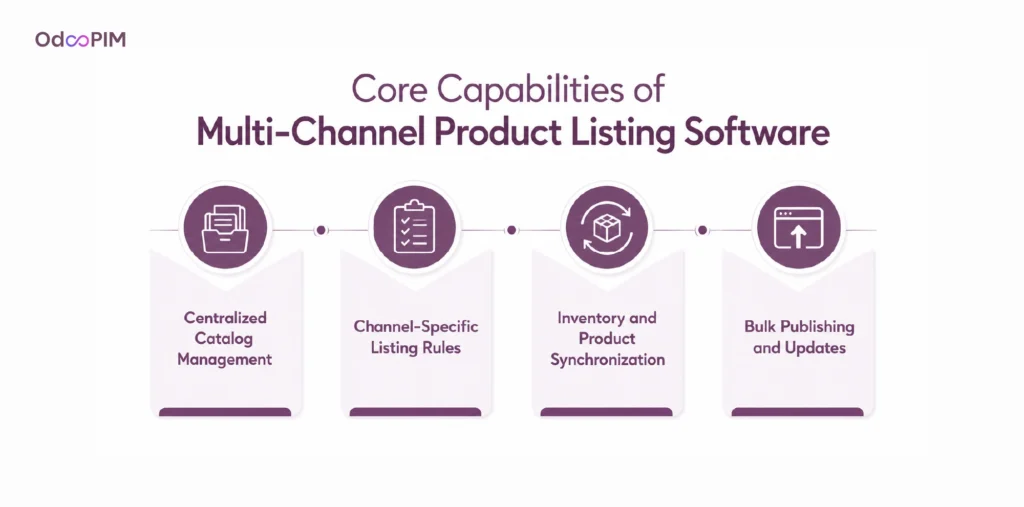
1. Centralized Catalog Management
Multi-channel product listing software provides a single interface where product data gets created, enriched, and governed before distribution to the sales channels simultaneously. This centralization means a product description written once populates your website, Amazon storefront, wholesale catalog, and social commerce channels without reformatting or manual recreation. The catalog management layer enforces data completeness standards that prevent incomplete product records from publishing to any channel. Category hierarchies, product relationships, and attribute sets maintain consistency because they originate from one governed source rather than evolving independently on each platform. Centralized catalog management transforms ecommerce product data management from a channel-specific operational burden into a unified strategic capability.
2. Channel-Specific Listing Rules
Each marketplace enforces category taxonomies, required attributes, image specifications, and content policies that demand channel-aware product data formatting. Multi-channel product listing software automatically maps your master product attributes to each channel’s specific requirements, converting your “material” field into Amazon’s required format while populating eBay’s item specifics with the same governed data. Listing rules prevent the common failure where products get rejected or suppressed because they lack channel-specific mandatory attributes. Validation engines catch formatting errors before listings go live, preventing the account health penalties that accumulate from rejected uploads. Channel-specific rules transform the complexity of multi-platform compliance from a manual research burden into an automated validation layer.
3. Inventory and Product Synchronization
Real-time multi-channel inventory and product synchronization ensures that stock level changes, price adjustments, and product status updates propagate instantly to every connected channel. A warehouse receiving new inventory triggers immediate availability updates across Amazon, eBay, wholesale portals, and your D2C site without human intervention. Synchronization eliminates the dangerous time lag where products appear available on one channel while another platform sold the last unit. Pricing changes made in response to competitor movements or promotional calendars deployed simultaneously across channels, preventing the margin erosion of stale pricing. This synchronization capability transforms multi-channel operations from reactive firefighting into proactive management.
4. Bulk Publishing and Updates
Multi-channel product listing software enables catalog-wide changes where updating a compliance certification, modifying a return policy, or adjusting product dimensions propagates across thousands of SKUs in a single operation. Bulk publishing accelerates new product launches by simultaneously pushing enriched product records to every target channel rather than requiring platform-by-platform manual upload. Seasonal catalog refreshes, promotional pricing changes, and regulatory updates become operational events measured in minutes rather than weeks. The bulk capability makes omnichannel product catalog management scalable beyond the small catalogs where manual per-product updates remain feasible. Mass editing transforms product data maintenance from a perpetual bottleneck into a routine operational task.
Learn about Best Omnichannel Software for Ecommerce Brands

The Product Data Layer: Ecommerce Product Data Management Explained
What PIM Handles vs What Listing Tools Handle
Product information management for ecommerce governs the product data itself, attributes, specifications, digital assets, and enrichment workflows, while listing tools handle the channel-specific formatting and distribution of that governed data. The PIM serves as the single source of product truth where data quality gets established; listing tools act as the distribution engine that adapts governed content to each channel’s requirements. Confusing these layers leads organizations to invest in listing software that amplifies bad data by efficiently distributing incomplete product records. A multi-channel ecommerce platform without a PIM foundation accelerates the spread of product data errors rather than solving them. The distinction matters because listing automation magnifies good data and bad data with equal efficiency.
Why Listing Automation Amplifies Bad Data
Multi-channel product listing software efficiently syndicates whatever product data you feed it, complete and accurate or sparse and inconsistent, to every channel simultaneously. Automating the distribution of poorly enriched product records means listing errors, missing specifications, and outdated imagery reach customers on every platform faster than manual processes ever could. The very efficiency that makes listing tools valuable becomes a liability when organizations automate before establishing data governance. Ecommerce product data management must precede listing automation, ensuring the product data foundation is solid before accelerating its distribution. Organizations that reverse this sequence discover their multi-channel presence expands while customer trust contracts.
PIM + ERP + Listing Software: How They Connect
The ERP serves as the operational backbone containing inventory levels, pricing data, and core product identifiers that flow into the PIM for enrichment and governance. Product information management for ecommerce adds the marketing content, technical specifications, and digital assets that transform operational data into customer-ready product presentations. Multi-channel product listing software consumes enriched product data from the PIM and distributes it to channels with appropriate formatting, while feeding order and inventory data back to the ERP. This three-layer architecture ensures each system handles its specialized function: ERP manages business operations, PIM governs product data quality, and listing software handles channel distribution. The integration between these layers determines whether your multi-channel inventory and product synchronization operates in real time or suffers from batch processing delays.
Learn about ecommerce order management
How to Choose a Multi-Channel Ecommerce Platform
Channel Coverage
Evaluate whether the multi-channel ecommerce platform supports every marketplace, wholesale portal, and digital touchpoint currently in your channel strategy, plus those planned for the next expansion phase. Pre-built integrations eliminate the custom development projects that delay channel launches and consume technical resources better directed elsewhere. Channel coverage depth matters as much as breadth, a platform that offers basic Amazon integration but cannot handle Amazon Business B2B features limits your growth in that channel. Verify that the platform supports channel-specific requirements like Walmart’s item setup process or eBay’s product identifiers before committing. The right platform covers your channel footprint today while providing a connector roadmap aligned with your expansion plans.
B2B Requirements
B2B multi-channel operations demand capabilities absent from consumer-focused listing tools, customer-specific catalogs, contract pricing tiers, bulk ordering workflows, and dealer portal syndication. Your multi-channel product listing software must handle the complex pricing matrices where different customer groups see different prices for identical products across different channels. Wholesale catalog syndication requires presenting the same governed product data through a B2B lens that emphasizes technical specifications, compliance documentation, and bulk purchase information. Dealer and distributor portals need omnichannel product catalog management that respects territorial restrictions, minimum order quantities, and negotiated pricing agreements. B2B channel complexity makes ecommerce product data management governance non-negotiable because the consequences of inconsistent product data multiply across customer-specific catalogs.
Integration Depth with Your ERP
ERP integration determines whether your multi-channel ecommerce platform synchronizes inventory, pricing, and orders in real time or through periodic batch updates vulnerable to data drift. Native integration eliminates the middleware layer that introduces latency, failure points, and ongoing maintenance costs into multi-channel operations. Real-time multi-channel inventory and product synchronization depends on ERP connectivity that pushes stock level changes to every channel the moment transactions occur. Order data must flow bidirectionally so that purchases from any channel immediately update ERP fulfillment workflows, financial records, and customer databases. Integration depth separates platforms that provide genuine operational synchronization from those that offer superficial data exchange requiring constant manual oversight.
Scalability and Governance
Your multi-channel ecommerce platform must scale beyond current operations to accommodate catalog growth, channel additions, and user expansion without performance degradation or governance breakdown. The platform should enforce data governance rules, attribute completeness requirements, approval workflows, content standards, that prevent the listing quality erosion that accompanies channel expansion. Product information management for ecommerce governance ensures that as your multi-channel footprint grows, product data quality remains consistent rather than degrading under volume pressure. Scalability means the platform handles today’s SKU count and channel load while providing headroom for the catalog size and channel complexity planned over the next growth horizon. Governance capabilities distinguish platforms built for sustained multi-channel operations from those designed for initial listing distribution without ongoing quality management.
Learn about Best Omnichannel Software for Ecommerce Brands

Case Studies
Case Study 1: Industrial Safety Equipment Manufacturer Unifies Product Data Across Eight Channels and Eliminates Listing Errors
Challenge
An industrial safety equipment manufacturer with four thousand SKUs sold through eight disconnected channels: their B2B website, Amazon Business, two distributor portals, eBay, a Walmart marketplace storefront, a government procurement platform, and a legacy EDI feed serving enterprise buyers. Each channel operated with its own product data, creating a multi-channel ecommerce platform nightmare where the same safety harness carried different weight ratings and certification references depending on where customers encountered it. The marketing team maintained Amazon and eBay listings through spreadsheets while the sales team manually entered product data into distributor portals, creating constant specification conflicts across channels. A government procurement audit flagged that the manufacturer’s GSA schedule listed outdated ANSI certifications that contradicted the current product data on their own website, threatening their federal contracting eligibility. The company needed centralized ecommerce product data management that could govern product truth across eight channels before another compliance failure triggered contract termination.
Solution
The manufacturer deployed a centralized PIM with integrated multi-channel product listing software to serve as the single source of product truth governing every channel. Engineering uploaded technical specifications, ANSI certifications, and compliance documentation into governed product records where marketing could access validated data for channel-specific enrichment without duplicating or altering source values. The product information management for ecommerce platform enforced attribute completeness standards before products could syndicate to any channel, ensuring every listing carried populated safety ratings, material specifications, and certification references. Multi-channel inventory and product synchronization connected warehouse stock levels to eight channels in real time, preventing the overselling that previously occurred when distributor portals showed inventory the D2C site had already depleted. Channel-specific formatting rules automatically mapped master attributes to each platform’s unique requirements, eliminating the manual reformatting that consumed team hours and introduced errors. When engineering updated a harness certification, that change propagated to the GSA schedule, Amazon Business, distributor portals, and every other channel simultaneously.
Results
- Listing errors across eight channels dropped to near zero as governed omnichannel product catalog management replaced eight sets of disconnected product records with one authoritative source
- Government procurement compliance violations eliminated when certification updates began propagating automatically to the GSA schedule and federal contracting platforms
- New product launch time reduced from four weeks of manual multi-channel data entry to same-day syndication across eight platforms
- Customer service inquiries about specification discrepancies dropped by over seventy percent as buyers encountered identical product data regardless of purchasing channel
- The multi-channel ecommerce platform investment delivered measurable ROI within seven months through eliminated listing errors, reduced returns, and recovered government contract eligibility
- The manufacturer discovered that ecommerce product data management governance was not an operational expense but an insurance policy against the compliance failures that threatened their largest revenue streams
Case Study 2: Automotive Parts Distributor Scales from Three to Ten Channels Without Adding Product Data Headcount
Challenge
An automotive parts distributor managing twelve thousand SKUs operated across three channels, their D2C website, Amazon, and eBay, through manual spreadsheet-based product data management that consumed twenty-five hours weekly. Each channel required different attribute formats: Amazon demanded specific automotive fitment data structures, eBay required UPC codes and item specifics, and the website needed SEO-optimized descriptions with compatibility lookup functionality. Leadership planned aggressive expansion into Walmart Marketplace, Amazon Canada, Amazon UK, two automotive-specific marketplaces, and wholesale catalogs for three regional dealer networks. The existing manual multi-channel product listing software processes would require adding five full-time content specialists to manage the expanded channel footprint. The company needed a multi-channel ecommerce platform that could scale channel operations without proportionally scaling operational headcount.
Solution
The distributor implemented a centralized PIM with native multi-channel product listing software that transformed manual spreadsheet workflows into automated syndication across channels. Master product records containing fitment data, technical specifications, and marketing content were built once and enriched through governed workflows before distribution. The product information management for ecommerce platform automatically mapped universal fitment attributes to each channel’s specific format, converting the distributor’s standardized compatibility data into Amazon’s ACES format, eBay’s item specifics, and Walmart’s variant structures without manual intervention. Multi-channel inventory and product synchronization connected real-time stock levels to every channel, eliminating the overselling that plagued manual inventory reconciliation across platforms. Category-level attribute templates ensured consistent product data across all twelve thousand SKUs while allowing channel-specific enrichment where marketplace algorithms rewarded additional content depth. When the distributor expanded into two automotive-specific marketplaces, the omnichannel product catalog management system simply added new syndication rules for those platforms without additional content development.
Results
- Channel expansion from three to ten sales channels completed within four months without adding product data management headcount
- Weekly product data maintenance hours reduced from twenty-five hours to four hours as multi-channel product listing software automated previously manual syndication
- Overselling incidents eliminated as real-time multi-channel inventory and product synchronization replaced manual stock level updates across platforms
- Amazon ACES fitment data accuracy reached near-perfect levels as automated mapping eliminated the manual entry errors that previously triggered listing suppressions
- New marketplace onboarding time reduced from six weeks of manual data preparation to same-day channel configuration
- The multi-channel ecommerce platform investment paid for itself within nine months through headcount cost avoidance and recovered revenue from previously oversold inventory
- Leadership identified centralized ecommerce product data management as the critical enabler behind their aggressive channel expansion strategy, noting that manual processes would have consumed millions in additional operational costs to achieve the same footprint

Omnichannel Product Catalog Management Best Practices
Single Source of Truth
Establish one governed product data repository that serves as the authoritative source for every attribute, specification, digital asset, and marketing description used across channels. This single source of truth for omnichannel product catalog management eliminates the version conflicts that occur when different channel managers maintain separate product records. Every channel draws from identical governed data, ensuring that a compliance certification update or specification change propagates consistently everywhere products appear. The discipline of maintaining one product record prevents the gradual divergence where each channel’s version drifts further from product reality. Channel-specific formatting happens at the syndication layer while the underlying product data remains unified and governed.
Channel-Ready Attribute Mapping
Design your master product data model to include every attribute any channel requires, then map those attributes to each platform’s specific field names and value formats. This ecommerce product data management practice ensures that when Amazon demands a specific category attribute, your product data foundation already contains that information in a field mapped for automated distribution. Channel-ready mapping eliminates the scramble of researching platform requirements after products are ready to launch. Attribute completeness standards enforced at the master data level prevent the common failure where products publish successfully but lack the channel-specific fields that drive search visibility. Pre-mapped attributes transform channel expansion from a data reconstruction project into a configuration exercise.
Automated Enrichment Workflows
Build product information management for ecommerce workflows that automatically route product data through enrichment stages, technical validation, marketing copy creation, digital asset attachment, before releasing to channels. Attribute inheritance templates populate category-specific fields across member SKUs, eliminating the manual effort of enriching identical specifications across similar products. Automated completeness checks prevent under-enriched products from reaching channels where sparse listings damage brand perception and search ranking. Enrichment workflows transform product data readiness from a manual gatekeeping exercise into an automated quality assurance layer. Workflow automation makes omnichannel product catalog management scalable by reducing the human effort required to maintain enrichment standards across growing catalogs.
Measuring Listing Quality
Define quantitative metrics for listing completeness, attribute accuracy, and channel-specific compliance that enable objective measurement of multi-channel product listing software performance. Regular listing audits compare live channel content against governed master data to detect the drift that signals broken synchronization or unauthorized channel-side edits. Quality scores tied to specific channels reveal which platforms require additional attribute population or formatting adjustments to meet your brand standards. Measuring listing quality transforms product data governance from an abstract principle into a trackable operational metric. Continuous quality monitoring catches the listing degradation that occurs gradually and invisibly until customers encounter enough errors to abandon your brand.
Managing Multi-Channel Product Data Natively in Odoo
One Catalog Inside Your ERP
OdooPIM centralizes ecommerce product data management within the Odoo ERP environment, creating a single product catalog that serves operational and commercial functions without external platforms. Product records maintain native connections to inventory levels, pricing rules, procurement data, and order management because they exist within the same system rather than synchronizing across separate applications. This unified catalog approach means product information management for ecommerce governance operates on the same data that drives warehouse operations, accounting, and purchasing. Enrichment workflows, attribute management, and digital asset organization happen within the Odoo environment that teams already use daily. The unified catalog eliminates the organizational divide where product data governance feels like a separate initiative from day-to-day business operations.
No Middleware, No Sync Failures
Native architecture eliminates the middleware layer that introduces integration complexity, synchronization failures, and ongoing maintenance costs into traditional multi-channel ecommerce platform deployments. Product data, inventory levels, and pricing changes propagate because the PIM, ERP, and listing capabilities share a common data foundation rather than exchanging information through periodic API calls. Multi-channel inventory and product synchronization operates in real time without the batch processing delays that create windows for overselling and data inconsistency. Removing middleware simplifies the technology stack, reduces failure points, and accelerates the speed at which product changes reach customer-facing channels. The native approach transforms multi-channel operations from an integration engineering challenge into a configuration exercise within a unified platform.
From Product Record to Live Listing
OdooPIM transforms governed product records into channel-ready listings through automated formatting that respects each platform’s specific attribute requirements, image specifications, and content policies. The multi-channel product listing software capability built into the Odoo ecosystem maps master attributes to channel-specific fields, validates completeness against platform requirements, and publishes enriched listings without leaving the Odoo environment. Product updates made to the master record propagate to every connected channel automatically, ensuring that specification changes, pricing adjustments, and compliance updates reach all platforms simultaneously. New product launches accelerate because teams build one enriched product record that syndicates everywhere rather than recreating listings for each channel individually. This unified workflow transforms omnichannel product catalog management from a multi-system coordination challenge into a streamlined process managed within a single platform.
FAQs
1. What is a multi-channel ecommerce platform?
A multi-channel ecommerce platform is a centralized system that connects your product catalog, inventory, pricing, and order management to multiple sales channels from a single operational hub. Instead of logging into Amazon, eBay, your wholesale portal, and your D2C website separately, teams manage everything through one interface that synchronizes data everywhere simultaneously. The platform combines multi-channel product listing software with ecommerce product data management to ensure consistent product information reaches every channel without manual reformatting. Multi-channel inventory and product synchronization prevents the overselling that occurs when disconnected channel dashboards track stock independently. This centralized approach transforms channel expansion from an operational burden that multiplies complexity into a scalable growth strategy.
2. What’s the difference between multi-channel listing software and a PIM?
Multi-channel product listing software handles the distribution of product data to sales channels, managing the formatting, publishing, and synchronization of listings across marketplaces and storefronts. Product information management for ecommerce governs the product data itself, attributes, specifications, digital assets, and enrichment workflows, establishing quality and completeness before distribution occurs. Listing tools amplify whatever data they receive; a PIM ensures that data is accurate, complete, and governed before amplification. Organizations that invest in listing software without a PIM foundation efficiently distribute poor product data to every channel simultaneously. The distinction matters because ecommerce product data management must precede distribution, ensuring the product information reaching channels merits customer trust.
3. Do I need both a PIM and multichannel listing software?
The answer depends on your product data maturity and channel complexity, but most organizations selling across multiple channels require both capabilities working together. A PIM without multi-channel product listing software leaves governed product data stranded without distribution capabilities to reach marketplaces and storefronts. Listing software without product information management for ecommerce efficiently syndicates inconsistent, incomplete product data that damages brand credibility across every channel simultaneously. Organizations with mature, governed product data may initially deploy listing tools alone, but catalog complexity inevitably demands PIM governance as SKU counts and channel diversity grow. The integrated approach ensures omnichannel product catalog management where governed product truth flows through automated distribution to every customer touchpoint.
4. How does multi-channel inventory and product synchronization work?
Multi-channel inventory and product synchronization connects your centralized inventory system to every sales channel in real time, automatically adjusting available quantities when sales occur on any platform. When a customer purchases on Amazon, the system immediately reduces available stock across your website, wholesale portal, and other marketplaces to prevent overselling. The synchronization flows bidirectionally, warehouse receiving updates trigger availability increases across channels while channel sales trigger fulfillment workflows in your ERP. This real-time multi-channel ecommerce platform capability eliminates the manual inventory reconciliation that becomes impossible when managing stock across multiple channels through separate dashboards. Synchronization transforms multi-channel fulfillment from a high-risk guessing game into reliable operations where inventory accuracy maintains marketplace metrics and customer trust.
5. Can B2B manufacturers use multi-channel ecommerce platforms for dealer and distributor channels?
B2B manufacturers require multi-channel ecommerce platform capabilities to manage the complex channel dynamics of dealer networks, distributor relationships, and enterprise sales. The platform must handle customer-specific catalogs, contract pricing tiers, bulk ordering workflows, and territorial restrictions that consumer-focused listing tools never accommodate. Omnichannel product catalog management for B2B means presenting identical governed product data through different lenses, technical specifications for engineers, pricing matrices for procurement, and compatibility information for dealers. Multi-channel product listing software designed for B2B syndicates enriched product content to dealer portals while respecting the negotiated pricing agreements and minimum order quantities governing those relationships. Ecommerce product data management becomes non-negotiable for B2B manufacturers because inconsistent product data across dealer channels damages relationships that took decades to build.