
Omnichannel customer experience management ensures every interaction across your website, mobile app, social media, physical stores, and customer service delivers consistent, personalized brand experiences. Omnichannel experience management unifies product data, inventory, customer history, and support conversations into a single view. Customer experience across channels suffers when systems operate in silos, your website doesn’t know what happened in-store. Unified customer experience ecommerce requires data integration, not just channel presence. Omnichannel CX strategy starts with centralized product and customer data. Consistent brand experience across channels builds trust. Omnichannel product experience drives loyalty. Customer journey management ecommerce succeeds when every channel shares the same information.
What Is Omnichannel Customer Experience Management?
Omnichannel customer experience management is the practice of delivering consistent, personalized interactions across channels where customers engage with your brand. Unlike basic multichannel experience where channels operate independently, omnichannel unifies product data, inventory, customer history, and support conversations into a single view. A customer who starts a support chat on your website should not need to repeat their issue when they call your service line. Customer experience across channels suffers when systems operate in silos.
Omnichannel experience management ensures that every touchpoint, your website, mobile app, social media, physical stores, customer service, accesses the same information. Consistent brand experience across channels builds trust. Customers who encounter conflicting product specifications or pricing assume your brand is unreliable. Omnichannel product experience depends on accurate, consistent product data across channels. Customer journey management ecommerce requires data integration, not just channel presence.
Learn about Omnichannel management.

Why Omnichannel CX Is Not the Same as Multichannel CX
Multichannel customer experience means your brand exists on multiple channels, website, Amazon, social media, physical stores, but each channel operates independently. Product data may differ. Customer history does not transfer. A customer who starts a support chat on your website must repeat their issue when they call your service line. Customer experience across channels suffers because systems do not share information. Unified customer experience ecommerce is impossible when channels operate in silos.
Omnichannel customer experience management unifies everything behind the scenes. Product data, inventory, customer history, and support conversations live in shared systems accessible across channels. Consistent brand experience across channels requires shared data, not per-channel manual sync. Omnichannel product experience depends on a PIM that syndicates consistent content everywhere. Customer journey management ecommerce succeeds when channels access the same information. Multichannel adds channels. Omnichannel connects them. The difference is data integration and your customers will notice.
Learn about Best Omnichannel Software for Ecommerce Brands.
Only 13% of companies report that customer data, history, and context carry over fully across interactions and channels.
– Deloitte Digital
The Four Dimensions Every Omnichannel CX Must Deliver
Consistency means the same product data, pricing, and brand voice across every channel. Your website, Amazon, and physical stores never display conflicting information. Consistent brand experience across channels builds trust. Omnichannel product experience depends on this foundation. Without consistency, customers assume your brand is unreliable.
Continuity ensures the customer’s journey picks up where it left off. A cart abandoned on mobile appears on desktop. A support chat history follows the customer to the phone. Customer journey management ecommerce requires this smooth transition. Omnichannel customer experience fails when customers must repeat themselves across channels.
Context means each touchpoint reflects what the customer has done before. Personalized recommendations based on browsing history, not generic suggestions. Customer experience across channels improves when every interaction builds on previous ones. Omnichannel CX strategy without context feels impersonal and disconnected.
Confidence comes from accurate information that earns trust at every step. Omnichannel customer experience management delivers this through centralized product data and real-time inventory sync. Unified customer experience ecommerce succeeds when customers trust what they see. Omnichannel experience management delivers all four dimensions.
Learn about Omnichannel Content Management.
Why Most Brands Fail at Omnichannel Customer Experience Management
The Five Touchpoints Where Omnichannel CX Breaks Down
Omnichannel customer experience fails at five critical touchpoints. First, product discovery. A customer searches for a product on your website. The specifications differ from your Amazon listing, trust erodes. Second, cart and checkout. A customer adds items on mobile, the cart does not appear on desktop. Customer journey management ecommerce fails when continuity breaks. Third, inventory visibility. Your website shows “in stock”, the customer arrives at your store. The shelf is empty. Customer experience across channels suffers.
Fourth, customer service. A customer starts a support chat on your website. When they call your service line, the agent has no record of the chat. Unified customer experience ecommerce requires shared customer history. Fifth, returns and exchanges. A customer buys online, the store cannot process the return because systems don’t connect. Omnichannel CX strategy without these five touchpoints working together is just multichannel with a different name. Fix the touchpoints, your CX improves.

The Root Cause Most CX Strategies Miss: Inconsistent Product Data
Omnichannel product experience depends on consistent product data. Yet most omnichannel customer experience management strategies overlook this root cause. When your website shows different specifications than Amazon, customers receive items they didn’t expect. Returns spike. Trust disappears. Consistent brand experience across channels is impossible when product data varies by channel. Your CX strategy cannot succeed if your product data foundation is broken.
Customer experience across channels fails upstream. A customer returns a shirt because your website said “cotton” but your Amazon listing said “polyester.” Your customer service team handles the return. Your CX metrics show a return. But the root cause was product data inconsistency, not service failure. Omnichannel experience management requires a PIM that syndicates consistent product data everywhere. Omnichannel CX strategy without product data governance guarantees failure. Fix the data first. Then your CX can work. Customer journey management ecommerce depends on accurate information at every touchpoint. Unified customer experience ecommerce starts with centralized product data. Without it, every other CX investment is wasted.
Learn about Omnichannel management software.
The 5 Pillars of Effective Omnichannel Customer Experience Management
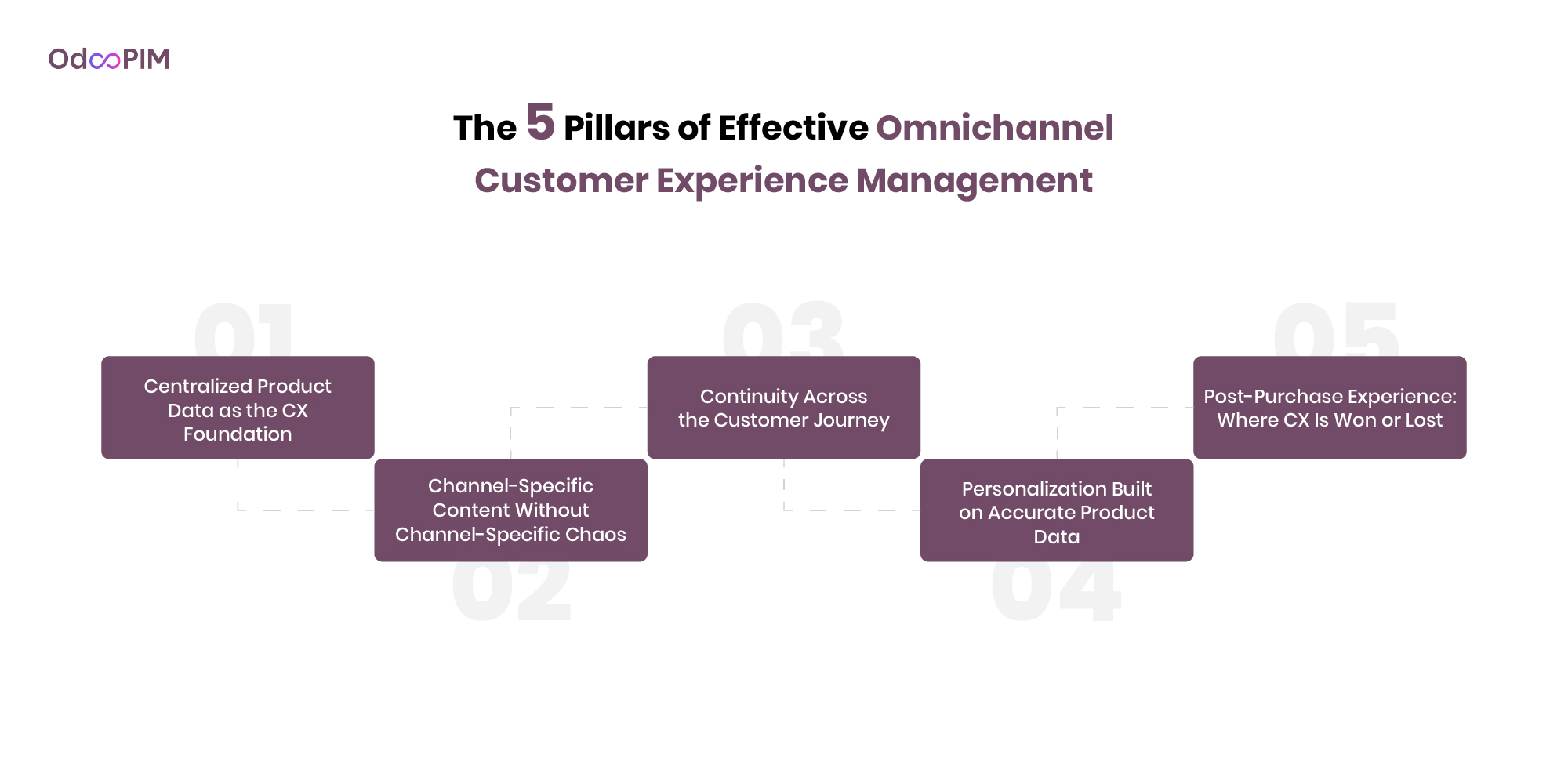
1. Centralized Product Data as the CX Foundation
Omnichannel product experience depends on centralized product data. Without a single source of truth, your website, Amazon, and stores display conflicting specifications. Consistent brand experience across channels is impossible when product data varies by channel. Omnichannel customer experience management starts with a PIM. Centralize your product data before you invest in any other CX initiative.
Customer experience across channels fails upstream when product data is inconsistent. A customer who sees different specifications on your website versus Amazon will not trust either version. Omnichannel CX strategy without product data governance guarantees failure. Build your foundation first. Your PIM is not optional. It is the prerequisite for every other pillar.
2. Channel-Specific Content Without Channel-Specific Chaos
Unified customer experience ecommerce requires content that adapts to each channel without manual duplication. Amazon needs flat, SEO-optimized descriptions. Your website requires rich formatting. Wholesale portals need spec sheets. Omnichannel experience management automates these adaptations from one master record. Your team writes once. The system formats for each channel.
Customer journey management ecommerce depends on channel-appropriate content. A product page on Amazon should not look like your website. But the specifications must match. Omnichannel customer experience succeeds when content adapts without creating inconsistency. Build channel-specific formatting rules into your PIM. Eliminate manual exports. Your team stops reformatting and starts improving content.
3. Continuity Across the Customer Journey
Customer journey management ecommerce requires continuity. A customer who adds items to cart on mobile expects that cart to appear on desktop. A support chat started on your website should be visible when the customer calls your service line. Omnichannel customer experience fails when customers must repeat themselves across channels. Consistent brand experience across channels depends on shared customer data.
Unified customer experience ecommerce integrates your website, support platform, POS, and CRM. Customer history, cart contents, and preferences follow the customer across every touchpoint. Omnichannel CX strategy without continuity feels disconnected. Customers notice. They become frustrated. They leave. Integrate your customer data systems before you claim to offer an omnichannel experience.
4. Personalization Built on Accurate Product Data
Omnichannel product experience enables personalization that actually works. Recommendation engines need accurate product attributes, color, size, category, compatibility. Customer experience across channels improves when recommendations reflect what customers want. Inaccurate product data produces irrelevant suggestions. Customers ignore them. Personalization fails.
Omnichannel customer experience management with inaccurate product data is worse than no personalization. A customer who receives recommendations for incompatible products assumes your brand doesn’t understand them. Consistent brand experience across channels depends on accurate attributes. Clean your product data before you personalize. Otherwise, you’re just automating irrelevance.
5. Post-Purchase Experience: Where CX Is Won or Lost
Omnichannel customer experience is won or lost after the purchase. Returns, exchanges, and support interactions determine whether customers return. Customer journey management ecommerce must include post-purchase workflows. A customer who buys online should return in-store without friction. Unified customer experience ecommerce integrates returns across every channel.
Omnichannel CX strategy without post-purchase integration fails. A customer who cannot return an online purchase to your store will not buy from you again. Customer experience across channels includes returns as a first-class citizen. Configure return workflows before your first return arrives. Your post-purchase experience determines customer loyalty. Get it right. Your competitors won’t. Omnichannel experience management succeeds when every pillar works together. Build all five pillars. Your customers will notice. They’ll come back. Omnichannel customer experience management is essential infrastructure. Invest accordingly.
Learn about catalog management software.

Product Data Is the Invisible Infrastructure of Omnichannel CX
CX leaders invest heavily in journey mapping, personalization engines, and channel integrations. Yet most consistently underinvest in the product data layer that every customer-facing system depends on. Omnichannel product experience cannot succeed when product data is incomplete or inconsistent. Companies with strong omnichannel strategies see 9.5% annual revenue growth versus 3.4% for weaker ones. This gap is driven by customer experience quality at every touchpoint and that quality depends on clean product data feeding every channel simultaneously.
Customer experience across channels requires a PIM at its core. Your personalization engine cannot recommend products it doesn’t understand. Your search cannot return results for missing attributes. Consistent brand experience across channels starts with centralized product data, not better journey maps. Omnichannel customer experience management is built on product data infrastructure. Invest in the invisible layer. Your customers will notice, not the infrastructure, but the consistency, accuracy, and trust it enables. Omnichannel CX strategy without product data governance guarantees failure.
How OdooPIM Supports Omnichannel Customer Experience Management
OdooPIM provides the product data infrastructure that omnichannel customer experience management requires. A centralized product data repository feeds every CX touchpoint from one validated record. Channel-specific content rules apply automatically, Amazon receives flat descriptions, your website gets rich formatting, wholesale portals receive spec sheets. Native Odoo ERP integration means product data, inventory, pricing, and orders share one ecosystem. Real-time syndication pushes updates to Shopify, WooCommerce, Magento, and Amazon instantly. Consistent brand experience across channels depends on this architecture.
Customer proof point: A global consumer goods brand managing 25,000 SKUs across Shopify, Amazon, and seven regional storefronts implemented OdooPIM. Before implementation, inconsistent specifications caused 18% return rates. Manual translation for each market consumed 40 hours weekly. After OdooPIM, returns dropped to 6%. Localization became automated. Omnichannel customer experience improved across every market. Customer journey management ecommerce succeeded because product data finally worked.
Multilingual and localization support ensures consistent CX across international markets, US customers see pounds and dollars, European customers see kilograms and euros. Workflow automation for enrichment, approval, and publication reduces lag between product update and live channel. Omnichannel CX strategy without this infrastructure cannot scale. Unified customer experience ecommerce is achievable. OdooPIM delivers the foundation. Your customers deserve consistency.
Learn about Omnichannel Order Management: The Complete Guide for Ecommerce Businesses (2026)
Omnichannel Customer Experience Management Best Practices
Map the Customer Journey From Product Discovery to Post-Purchase: Not Just to Checkout
Customer journey management ecommerce fails when you stop mapping at checkout. Returns, exchanges, and support interactions determine whether customers return. Map every touchpoint from discovery through post-purchase. Omnichannel customer experience depends on understanding what happens after the sale. Your CX metrics should include return reasons, support tickets, and repurchase rates. The post-purchase journey is where loyalty is won or lost.
Audit Your Product Data Consistency Across Channels Before Fixing CX Workflows
Consistent brand experience across channels is impossible when product data varies by channel. Audit your website, Amazon, and wholesale portal for conflicting specifications before investing in CX workflows. Omnichannel product experience depends on this foundation. A product description that differs between channels will cause returns regardless of how well you map the journey. Fix the data first. Then optimize the workflows.
Define Brand Voice and Terminology Standards Globally: Then Adapt Locally
Unified customer experience ecommerce requires global standards. Define your brand voice, terminology, and attribute naming conventions centrally. A shirt size is “Medium” everywhere, not “M” on Amazon and “Med” on your website. Omnichannel CX strategy without standards guarantees inconsistency. Then adapt locally for cultural relevance, units, and currency. Standards first. Localization second. Reverse the order, and you create chaos.
Treat Product Returns Data as a CX Signal, Not Just an Ops Problem
Customer experience across channels is revealed in your return data. A product returned because “didn’t match description” signals product data inconsistency, not customer remorse. Omnichannel customer experience management requires analyzing return reasons for upstream failures. Categorize returns by root cause. Track whether returns correlate with specific channels. Your returned data tells you where CX breaks. Listen to it.
Build Channel-Specific Content Rules Into Your PIM: Not Into Your Team’s Muscle Memory
Omnichannel experience management automates what manual processes cannot scale. Your team should not remember that Amazon requires flat descriptions under 2000 characters. Build channel-specific content rules into your PIM. Omnichannel product experience succeeds when the system handles formatting variations automatically. Your team writes once. The PIM adapts for each channel. Manual reformatting does not scale. Automation does.
Measure CX Per Channel Separately Before Reporting on It Aggregate
Omnichannel CX strategy cannot rely on aggregate metrics alone. Your website conversion rate may look healthy while Amazon conversion lags. Customer journey management ecommerce requires channel-specific measurement. Track CX metrics per channel, return rates, abandoned cart rates, support ticket volume. Aggregate reporting hides problems. Channel-specific reporting reveals them. Measure separately before you report together. What gets measured per channel gets improved per channel. What hides in aggregates stays broken.

Frequently Asked Questions
1. How do you measure the success of an omnichannel customer experience strategy?
Omnichannel CX strategy success is measured by channel-specific return rates, cart abandonment, and repurchase rates. Customer journey management ecommerce requires tracking continuity, do customers who start on mobile complete on desktop? Unified customer experience ecommerce succeeds when customers move between channels without friction. Aggregate metrics hide problems. Measure per channel before reporting overall. Omnichannel customer experience management success is revealed in retention, not just conversion.
2. What is the difference between omnichannel customer experience management and product experience management (PXM)?
Omnichannel customer experience management covers the customer journey, discovery, purchase, support, returns, across channels. Omnichannel product experience is a subset focused on how customers interact with product information across channels. PXM ensures consistent specifications, images, and descriptions everywhere. Customer experience across channels depends on strong PXM as its foundation. Build PXM first. Then expand to full CX. Without accurate product data, every other CX investment fails.
3. At what scale does omnichannel CX management require dedicated tooling rather than manual processes?
Omnichannel customer experience management requires dedicated tooling when you sell on three or more channels and manage over 500 SKUs. Below these thresholds, spreadsheets may still function. Above them, manual processes break. Consistent brand experience across channels becomes impossible when your team manually updates product data across five platforms. Manual reconciliation does not scale. Invest in tooling before your manual processes fail. The cost of broken CX far exceeds software subscription fees.
4. How does localization fit into omnichannel customer experience management for global ecommerce brands?
Localization is central to omnichannel customer experience management for global brands. Customer experience across channels must adapt units, currency, language, and cultural references without changing core product data. A US customer sees pounds and dollars. A European customer sees kilograms and euros. Build localization workflows into your PIM, translation, regional compliance, market-specific attributes. Omnichannel CX strategy without localization fails in international markets. Localization is a required CX dimension for global brands.
5. How should an ecommerce brand prioritize omnichannel CX improvements when resources are limited?
Prioritize omnichannel product experience first. Consistent brand experience across channels depends on accurate product data. Without it, every other CX investment fails. Second, fix inventory visibility, customers who see “in stock” online but find empty shelves will not return. Third, unify customer history across support channels. Customer experience across channels improves most when you fix the data foundation. Journey maps and personalization engines are worthless if product data is wrong. Build from the ground up.