Omnichannel content management centralizes product content, titles, descriptions, images, specifications, and syndicates it across sales channels. Product content management without omnichannel guarantees inconsistency between your website, Amazon, and stores. Multichannel content strategy adapts content for each platform while maintaining brand consistency. Omnichannel product data ensures customers see accurate information wherever they shop. Content consistency across channels builds trust and reduces returns. Ecommerce content management done right eliminates manual exports and version conflicts. Channel-specific product content formats automatically from one master record. Omnichannel content delivery is essential infrastructure for scaling brands.
What Is Omnichannel Content Management?
Omnichannel content management is the practice of centralizing product content, titles, descriptions, images, videos, specifications, and syndicating it across sales channels from a single source. Unlike multichannel content strategy where each channel manages content independently, omnichannel creates one master record that adapts to each platform’s requirements. Your website receives rich descriptions with formatting. Amazon gets flat, SEO-optimized text. Wholesale portals receive spec sheets and case quantities. Product content management without omnichannel guarantees inconsistency.
Omnichannel product data ensures customers see accurate, consistent information whether they shop on your website, Amazon, or in a physical store. Content consistency across channels builds trust and reduces returns. Channel-specific product content adapts without changing meaning, your brand voice remains consistent while each platform receives optimally formatted content. Ecommerce content management without this approach forces your team to maintain separate versions per channel. Omnichannel content delivery automates what manual processes cannot scale. Write once. Publish everywhere.
Learn about Best PIM for Shopify

Why Omnichannel Content Management Is Harder Than It Looks
The Hidden Cost of Inconsistent Product Content
Inconsistent product content has measurable financial impact. Two-fifths of shoppers return items because product details didn’t match reality. Two-thirds have abandoned a purchase because information was missing or inaccurate. Omnichannel management failures erode revenue. When your website describes a shirt as “cotton” and Amazon says “polyester,” customers receive the shirt expecting cotton. They return it. You eat shipping costs. Your margin disappears.
Product content management without consistency also damages search ranking. Missing attributes mean algorithms cannot properly index your products. Customers cannot filter for what you sell. Content consistency across channels is not just about customer trust, it’s about discoverability. Ecommerce content management done poorly costs you in returns, abandoned carts, and lost organic traffic. The hidden costs add up faster than most brands realize. Multichannel content strategy without centralization guarantees these outcomes.
Why a CMS Alone Cannot Manage Omnichannel Product Content
A CMS manages web pages and blog posts. Omnichannel content management requires syndicating product data to Amazon, social commerce, marketplaces, and wholesale portals, not just your website. Product content management for ecommerce requires structured attributes, not just free-text fields. A CMS cannot enforce that every product has a size, color, and material attribute. It cannot validate completeness before publication. It cannot syndicate channel-specific formatting.
Ecommerce content management requires a PIM at its core. A CMS manages content presentation. A PIM manages product data governance, enrichment, and syndication. Omnichannel product data needs structured attributes, completeness scoring, and workflow approvals. Your CMS can display the final product page. It cannot govern the upstream data that makes that page accurate. Multichannel content strategy without a PIM means your CMS becomes a data silo, not a solution.
Learn about Omnichannel management software.

Where Ecommerce Teams Lose Control of Their Content
Ecommerce teams lose control of omnichannel content management at four critical points. First, supplier data onboarding. New products arrive in inconsistent formats, spreadsheets, PDFs, email attachments. Your team manually reformats. Errors multiply. Second, channel-specific formatting. Your website needs rich descriptions. Amazon requires flat text. Your team manually adapts each product for each channel. Hours vanish.
Third, version control, marketing updates descriptions in one file. Operations updates specifications in another. No single source of truth. Content consistency across channels fails because no one knows which version is current. Fourth, approval workflows. Products go live without compliance sign-off or pricing approval. Product content management without governance guarantees errors. Omnichannel content delivery breaks when control points are missing. Fix these four points with a PIM. Your team regains control. Your content becomes consistent. Your customers notice the difference.
Learn about Omnichannel Order Management.
The 5 Pillars of Effective Omnichannel Content Management
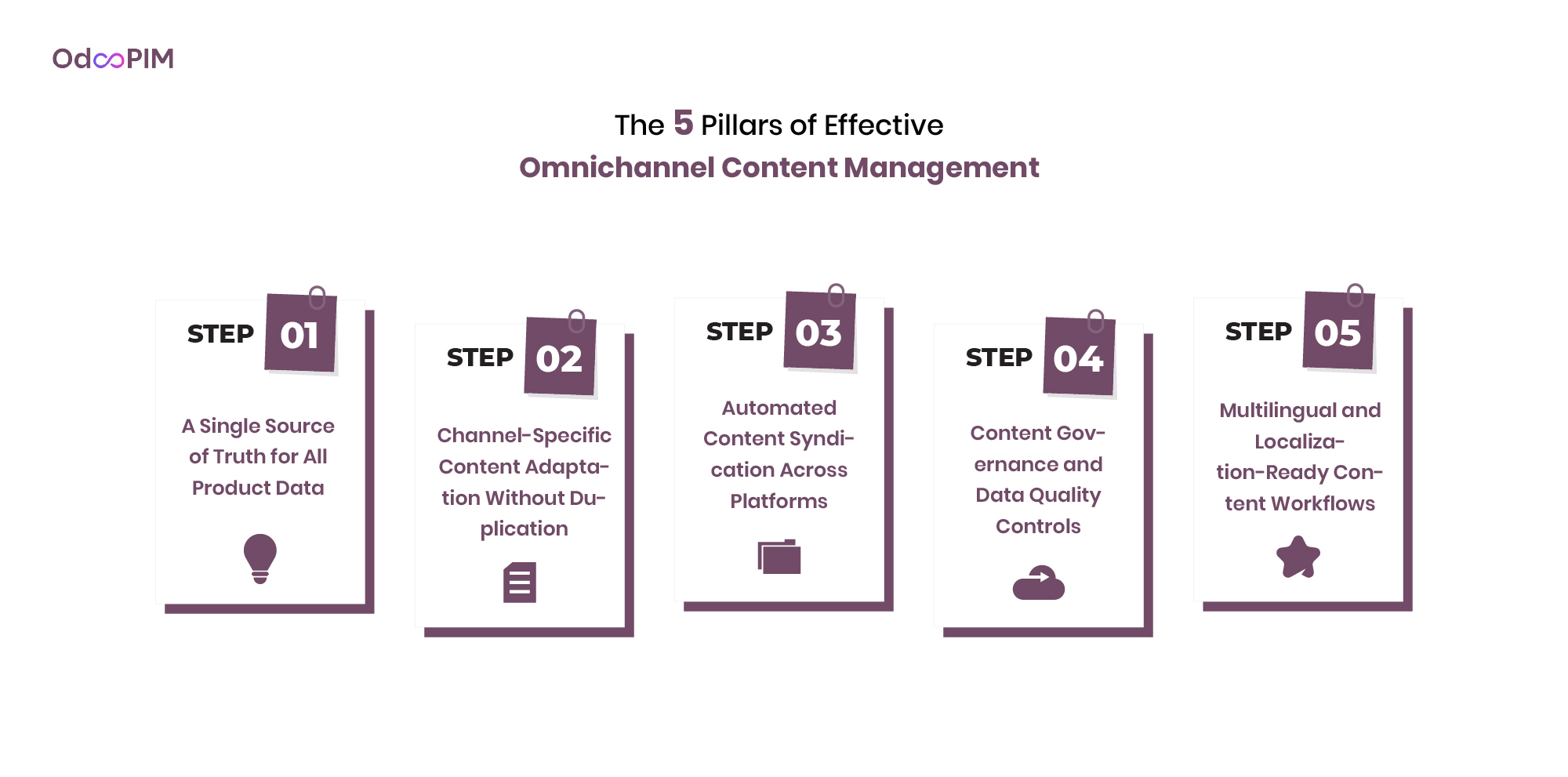
1. A Single Source of Truth for All Product Data
Omnichannel content management starts with one master record for every product. Your website, Amazon, and wholesale portals must all pull from the same source. Product content management without centralization guarantees inconsistency, your team maintains separate versions per channel, and they inevitably drift. Omnichannel product data requires a PIM as the foundation, not spreadsheets or per-channel systems.
Content consistency across channels is impossible without a single source of truth. When your website team updates a description, every channel should receive that change automatically. Ecommerce content management at scale depends on centralization. Build one source of truth before you add channels. Otherwise, you’re just multiplying manual work.
2. Channel-Specific Content Adaptation Without Duplication
Multichannel content strategy fails when teams manually reformat content for each platform. Omnichannel content management automates adaptation from one master record. Your website receives rich descriptions with formatting. Amazon gets flat, SEO-optimized text. Wholesale portals receive spec sheets and case quantities. Channel-specific product content applies rules automatically, no manual rework.
Product content management with adaptation rules eliminates duplication. Your team writes once. The system formats for each destination. Omnichannel content delivery handles the variation while you manage consistency. Without automation, a product update requires separate edits across channels. For five channels, that’s five updates per product. Adaptation rules compress that to one update.
3. Automated Content Syndication Across Platforms
Omnichannel content delivery must be automated, not manual. Your team cannot export CSV files to five channels every time a product changes. Ecommerce content management without automation guarantees errors and delays. A price update that takes one minute in your PIM should take one minute everywhere, not five separate updates across five platforms.
Content consistency across channels depends on syndication speed. When you discontinue a product, every channel should stop showing it immediately. Product content management with automated syndication pushes updates in real time. Configure your omnichannel content management system to publish changes instantly, not on a batch schedule. Automation scales. Manual exports break.
4. Content Governance and Data Quality Controls
Omnichannel product data requires governance before publication. Missing attributes, incomplete descriptions, and non-compliant content should never reach customers. Product content management with quality controls validates completeness, enforces required fields, and flags inconsistencies before syndication. Ecommerce content management without governance guarantees errors.
Content consistency across channels depends on pre-publish validation. A product missing size specifications should not go live anywhere. Set mandatory field rules, completeness scoring, and approval workflows. Omnichannel content management with governance catches errors upstream, not after customers find them. Prevention is faster than correction. Build quality controls before you scale.
5. Multilingual and Localization-Ready Content Workflows
Global brands need omnichannel content management that handles multiple languages and regional requirements. Product content management without localization forces your team to maintain separate versions per market. Channel-specific product content rules should adapt units, currency, and cultural references automatically. A product sold in the US shows pounds and dollars. The same product in Europe shows kilograms and euros.
Omnichannel content delivery for global markets requires workflow support for translation, regional compliance, and market-specific attributes. Multichannel content strategy at international scale cannot rely on manual translation per channel. Configure language rules in your PIM. Syndicate localized content automatically. Ecommerce content management for global brands succeeds when localization is systematic, not reactive. Build localization workflows before you enter new markets. Otherwise, your content consistency fails at the border.
Learn about Omnichannel Inventory Management.
PIM vs CMS: Which One Actually Manages Omnichannel Content?
| Capability | CMS (Content Management System) | PIM (Product Information Management) |
| Content type handled | Web pages, blog posts, basic product pages | Structured product data, attributes, specifications, digital assets |
| Channel syndication | Website only (or requires plugins/extensions) | Native syndication to Shopify, Amazon, marketplaces, wholesale portals |
| Structured data management | Limited. Free text fields primarily | Full attribute modeling, required fields, validation rules |
| Attribute validation | Minimal. No completeness scoring | Mandatory field enforcement, completeness scoring, quality rules |
| Scalability | Handles page volume well, not product data complexity | Designed for thousands of SKUs with complex attributes |
| Omnichannel suitability | Website-focused only | Built for multichannel syndication from day one |
For most ecommerce businesses managing 500+ SKUs across 3+ channels, a PIM is not optional, it’s the infrastructure that makes omnichannel content management possible. Multichannel content strategy without a PIM guarantees inconsistency, manual rework, and errors. Omnichannel content delivery succeeds when your PIM manages product data and your CMS manages page presentation. Separate the concerns. Choose the right tool for each job. Your content consistency depends on it.
Learn about Best Omnichannel Software.
How OdooPIM Powers Omnichannel Content Management
OdooPIM provides the omnichannel content management foundation that ecommerce brands need. A centralized product data hub built on Odoo means every SKU, attribute, and digital asset lives in one source of truth. Channel-specific content rules adapt your master content for each platform automatically, Amazon gets flat descriptions, your website receives rich formatting. Content consistency across channels is built in. Update once. Every channel reflects the change instantly.
Omnichannel product data syndicates natively to Shopify, WooCommerce, Magento, and Amazon through pre-built connectors. Built-in Odoo ERP integration means product data, inventory, and pricing share the same ecosystem. Workflow automation routes products through approval steps, no incomplete content goes live. Channel-specific product content never drifts because one master record feeds every destination.
Customer proof point: A mid-market electronics retailer with 10,000 SKUs across Shopify, Amazon, and a B2B portal implemented OdooPIM. Before implementation, inconsistent specifications caused 15% returns. Manual reformatting consumed 30 hours weekly. After OdooPIM, returns dropped to 5%. Syndication became automatic. Omnichannel content delivery compressed launch cycles from two weeks to two days. Multichannel content strategy finally worked, because product data finally worked too.

Omnichannel Content Management Best Practices for Ecommerce Teams
1. Audit Your Current Content Across Every Channel First
Before implementing any omnichannel content management system, audit your product content across every channel. Your website may show complete descriptions while Amazon listings miss key specifications. Content consistency across channels starts with knowing where gaps exist. Run completeness reports. Document discrepancies. You cannot fix what you haven’t measured.
2. Define Content Standards Before Building Your Channel Stack
Omnichannel product data requires consistent standards before you scale. Define required attributes per product family, a shirt needs size, color, material. A laptop needs a processor, RAM, and storage. Product content management without standards guarantees inconsistency. Document naming conventions, measurement units, and attribute formats before connecting any channel.
3. Separate Your Content Creation Workflow From Your Distribution Workflow
Ecommerce content management fails when teams try to create and distribute in the same step. Create once in your PIM. Then syndicate to all channels. Omnichannel content delivery works when creation and distribution are separate workflows. Your team writes descriptions. The system handles channel-specific formatting. Never manually reformat the same content for different platforms.
4. Build Completeness Scoring Into Your Product Data Process
Multichannel content strategy requires knowing what’s complete and what’s missing. Build completeness scoring into your PIM. A product missing dimensions should score 60% and block publication. Channel-specific product content cannot go live incomplete. Measure completeness per product family. What gets measured gets improved. What goes unmeasured guarantees gaps.
5. Treat Localization as a Content Requirement, Not an Afterthought
Global brands need omnichannel content management that handles localization systematically. Treat translation, unit conversion, and regional compliance as required fields, not post-launch fixes. Product content management with localization workflows adapts content for each market automatically. Build localization rules before you enter new markets. Retrofitting costs more than planning.
6. Measure Content Performance Per Channel: Not Just Overall
Content consistency across channels matters, but each channel also has unique performance drivers. Measure conversion rates, return rates, and engagement per channel. Your Amazon listing may need different optimization than your website. Omnichannel product data performance metrics should be channel-specific. A product that converts well on your website may need different content on Amazon. Measure separately. Optimize accordingly.

Frequently Asked Questions
1. What is omnichannel content?
Omnichannel product data is content that adapts to each channel while maintaining core consistency. A product description appears as rich text on your website, flat SEO-optimized copy on Amazon, and spec sheets on wholesale portals, all from one source. Product content management without omnichannel forces separate versions per channel. Content consistency across channels builds trust and reduces returns. Channel-specific product content formats automatically from a master record. Omnichannel content delivery ensures customers see accurate information everywhere they shop.
2. What are the four C’s of omnichannel?
The four C’s of omnichannel are: Consistent (same brand voice everywhere), Connected (channels share data smoothly), Contextual (content adapts to each platform’s requirements), and Customer-centric (designed around how customers actually shop). Omnichannel content management succeeds when all four work together. Product content management without consistency fails. Multichannel content strategy without connection creates silos. Ecommerce content management without context frustrates customers. Omnichannel product data delivers the four C’s automatically from one source.
3. What is omnichannel management?
Omnichannel content management is the practice of centralizing product content and syndicating it across every sales channel from one source. It covers content creation, enrichment, governance, channel-specific formatting, and automated distribution. Product content management without omnichannel guarantees inconsistency. Content consistency across channels requires a PIM at its core. Omnichannel content delivery automates what manual processes cannot scale. Ecommerce content management done right means write once, publish everywhere. Multichannel content strategy succeeds when your PIM handles variation while you manage consistency.