The best PIM for Shopify centralizes product data, automates enrichment, and syndicates accurate listings across your store and marketplaces. For US ecommerce brands, best Shopify PIM software must handle complex catalogs, multichannel selling, and ERP integration. Top PIM tools for Shopify vary by catalog size and tech stack. A shopify PIM comparison should evaluate total cost of ownership, not just subscription fees. PIM software for Shopify stores with native ERP integration eliminates middleware costs. Shopify product information management system done right drives discoverability and conversion.
Introduction for US Ecommerce Brands
The US ecommerce market is the most competitive Shopify environment globally. More SKUs, more channels, Amazon, Walmart Marketplace, TikTok Shop, wholesale portals, and higher buyer expectations for product data accuracy. US shoppers expect complete specifications, consistent information across channels, and zero listing errors. Meeting these demands with spreadsheets or Shopify’s native tools is impossible at scale.
This guide delivers a straightforward, no-fluff comparison of the best PIM for Shopify tools available in 2026. We cover who each solution is built for, what it costs, and where it fits your operational stack. Whether you’re managing 500 SKUs or 50,000, selling on Shopify alone or across Amazon and Walmart, this shopify PIM comparison helps you choose.
OdooPIM is built natively on Odoo, designed for mid-market to enterprise US ecommerce businesses that want PIM for US ecommerce and ERP in one unified system. For Odoo users, it eliminates the integration tax that standalone tools require. For others, this guide covers every leading option, so you can choose based on your actual tech stack, not marketing claims.

What Makes a PIM the Right Fit for Shopify?
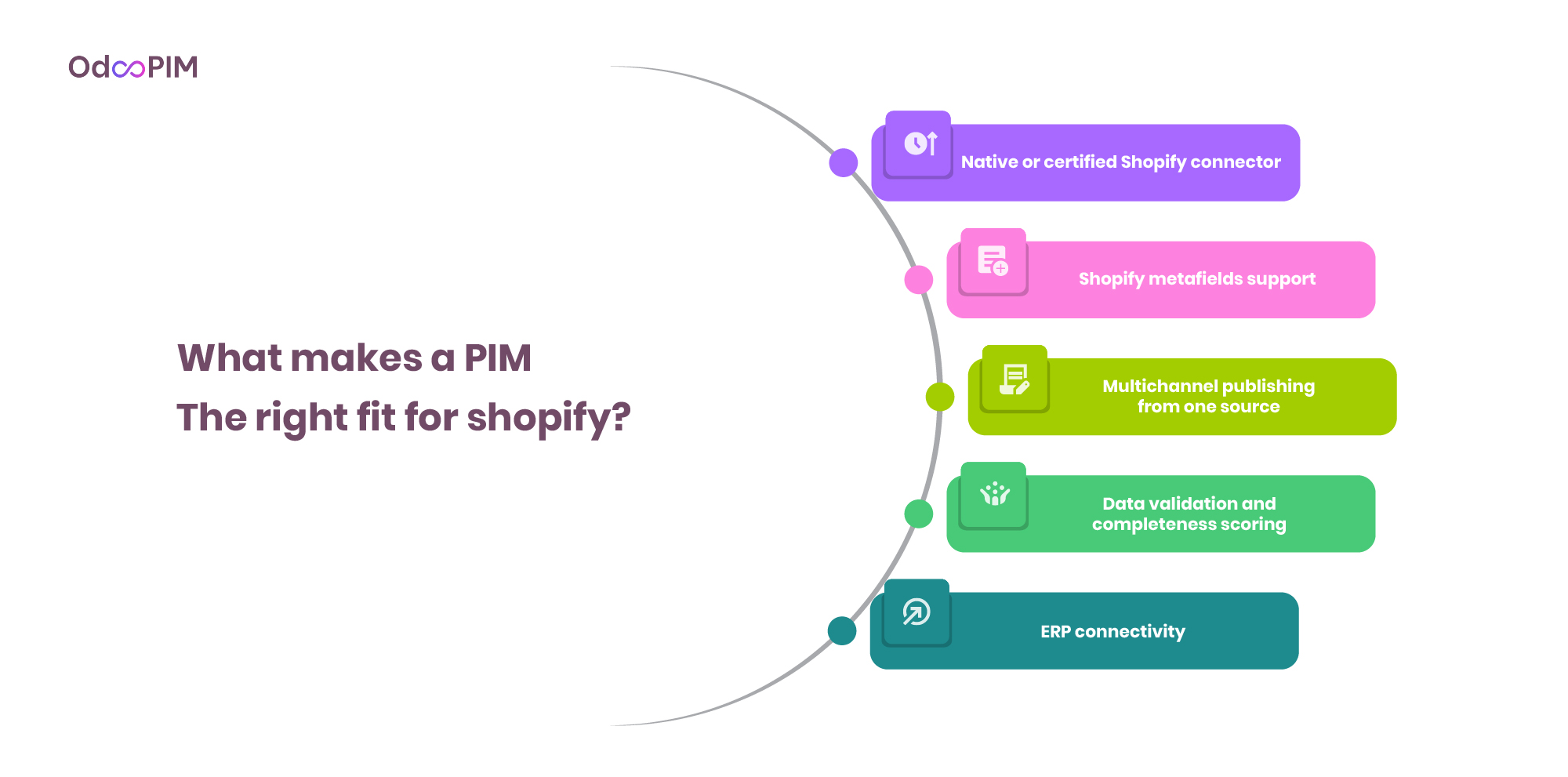
Not all PIMs are equal and not every “best PIM for Shopify” list explains what “good fit” means. Here are the five capabilities that separate a Shopify-ready PIM from a generic one.
1. Native or certified Shopify connector
A real best shopify PIM software connects via a maintained API integration, not CSV workarounds or third-party middleware apps. The connector must handle products, variants, metafields, and images smoothly. Top PIM tools for shopify with native connectors eliminate manual exports and flat file errors.
2. Shopify metafields support
US Shopify merchants, especially in apparel, electronics, and health & beauty, rely heavily on metafields for technical specs, compliance data, and personalization. A PIM software for shopify stores that cannot map metafields at scale is not Shopify-ready. Shopify product information management systems must handle custom attributes as easily as standard fields.
3. Multichannel publishing from one source
Most US Shopify merchants also sell on Amazon, Walmart Marketplace, or TikTok Shop. The best PIM for Shopify must publish to the channels simultaneously, not just Shopify. Shopify multichannel PIM ensures consistent product data across every sales destination without manual exports.
4. Data validation and completeness scoring
Publishing incomplete product data to Shopify costs money in returns, support contacts, and lost conversions. PIM for US ecommerce with pre-publish validation rules prevents this. Shopify catalog management software should block incomplete products before they reach your storefront.
5. ERP connectivity
US mid-market brands running an ERP alongside Shopify need their PIM for Shopify and Amazon to connect to inventory, purchasing, and supplier data. For Odoo users, odoo shopify PIM eliminates this integration requirement. PIM and ERP share the same database. For others, evaluate ERP integration depth carefully. Shopify PIM comparison should prioritize native connectivity over bolt-on middleware.
PIM makes a single, trusted source of product information available for multichannel commerce and data exchange.
–Gartner
At What Point Does a US Shopify Store Actually Need a PIM?
Most articles assume you know you need a PIM. Let’s answer the honest question first: at what point does your Shopify store require one? Below are the specific triggers that signal you’ve outgrown native product management.
500+ active SKUs
Below this threshold, Shopify’s native tools are usually sufficient. Above it, bulk updates and data consistency become full-time manual problems. Best PIM for Shopify automates what spreadsheets cannot scale.
Selling on 2 or more channels
Shopify plus Amazon, Walmart, or a B2B wholesale portal. Each channel has different format requirements. Managing them manually creates data drift. Shopify multichannel PIM ensures consistency everywhere.
Multiple Shopify stores
US brands running regional storefronts, B2C and B2B stores, or separate brand sites need one governing source of product data upstream of Shopify. PIM software for shopify stores centralizes control.
Product data managed in spreadsheets
When your team’s “system of record” is a shared Google Sheet or Excel file, every update is a risk. Shopify product information management system replaces spreadsheets with governed data.
Supplier data onboarding is manual
If new products require someone to reformat a spreadsheet before uploading to Shopify, a PIM’s structured onboarding workflow replaces that entire process. Top PIM tools for shopify automate supplier ingestion.
Shopify Plus with B2B complexity
Customer-specific pricing, tiered assortments, and multi-market data requirements exceed what Shopify Plus manages natively. PIM for US ecommerce with B2B capabilities handles this complexity.
If three or more of these apply to your Shopify operation, a PIM will pay back its cost in time savings within the first quarter. Use this shopify PIM comparison to find the right fit for your specific triggers. Odoo shopify PIM offers native ERP integration for Odoo users. PIM for shopify and amazon ensures consistency across your sales footprint. Shopify catalog management software turns catalog maintenance from bottleneck to growth engine.
Learn about best PIM software in India
Best PIM for Shopify in 2026: Top Tools Compared
The tools below represent the widely evaluated PIM for Shopify options for US ecommerce stores. Each profile covers core focus, best-fit use case, Shopify integration approach, pricing transparency, and honest limitations every buyer should know before signing a contract.
1. OdooPIM: Best for Odoo Users and ERP-Integrated Retailers
Core focus: Odoo-native PIM built on the same platform as Odoo ERP. Odoo shopify PIM shares your operational database, no middleware, no sync delays.
Best-fit use case: US mid-market to enterprise ecommerce businesses on Odoo or evaluating Odoo as their ERP. Ideal for merchants wanting PIM for US ecommerce and operations unified.
Shopify integration approach: Native Odoo-Shopify connector handles products, variants, metafields, and images. Real-time sync with inventory and pricing. Shopify catalog management software at its most integrated.
Pricing transparency: Transparent tiered pricing within Odoo ecosystem. No per-SKU fees. Total cost of ownership is lower for Odoo users than standalone alternatives.
Honest limitations: Best suited for Odoo users. Businesses not on Odoo face a steeper onboarding curve. Not the right choice for non-Odoo merchants.

2. Plytix: Best for SMB Shopify Merchants Needing Simple, Affordable PIM
Core focus: User-friendly PIM built for small to mid-sized businesses. Emphasizes ease of use, fast setup, and affordable pricing over enterprise complexity.
Best-fit use case: SMB Shopify merchants managing 500–5,000 SKUs who want centralized product data without paying for enterprise features they won’t use. Ideal for D2C brands selling on Shopify plus one or two additional channels.
Shopify integration approach: Pre-built Shopify connector with straightforward setup. Syncs products, variants, and images without developer involvement. No middleware required for basic sync needs.
Pricing transparency: Transparent SMB-friendly subscription tiers. Free plan available for up to 50 SKUs. Paid plans start around $100–200 monthly. No surprise enterprise fees.
Honest limitations: Lighter enrichment automation compared to enterprise PIMs. Limited ERP integration depth. Not suitable for catalogs above 10,000 SKUs or complex B2B pricing requirements. Best for teams that need simple, affordable PIM, not operational integration with ERP.
3. Akeneo: Best for Enrichment-Heavy Product Catalogs
Core focus: Product enrichment and catalog management with strong data modeling and completeness scoring.
Best-fit use case: Brands needing enrichment workflows, multi-language support, and complex attribute structures.
Shopify integration approach: API-ready connector. Strong multi-language support for international US brands selling across markets.
Pricing transparency: Enterprise quote-based. Community edition available for self-hosted technical teams.
Honest limitations: Implementation requires technical resources. Community edition lacks enterprise support. Best shopify PIM software for technical teams, not plug-and-play.
4. Pimcore: Best for Open-Source Flexibility
Core focus: Modular platform combining PIM, MDM, and DAM. Extreme customization capabilities.
Best-fit use case: Teams needing PIM plus master data management and digital asset management in one platform.
Shopify integration approach: Flexible data modeling with omnichannel publishing. Custom API development required.
Pricing transparency: Open-source core free. Paid enterprise options for support and advanced features.
Honest limitations: Requires significant developer resources. Not plug-and-play. Top PIM tools for shopify for technically resourced teams only.
5. Sales Layer: Best for SMB to Mid-Market Shopify Merchants
Core focus: Centralised product catalog hub with user-friendly interface and strong channel connectors.
Best-fit use case: SMB to mid-market Shopify merchants wanting fast setup without complex implementation.
Shopify integration approach: Straightforward channel connectors. Fast setup, good for teams without dedicated IT.
Pricing transparency: SaaS subscription. Quote-based for mid-market tiers.
Honest limitations: Lighter enrichment automation than enterprise options. Less ERP integration depth.
6. Salsify: Best for Large Brands with Retailer Networks
Core focus: Product Experience Management (PXM) combining PIM, DAM, and syndication for retailer compliance.
Best-fit use case: Large US brands selling through Walmart, Target, Home Depot, and other retailer networks.
Shopify integration approach: Strong content readiness and syndication tools. Certified connectors.
Pricing transparency: Enterprise quote-based. Significant implementation investment required.
Honest limitations: Expensive. Over-engineered for brands without complex retailer syndication needs.
Shopify PIM Comparison Summary
| Tool | Best For | Shopify Integration | ERP Native | Starting Price (USD) |
| OdooPIM | Odoo users, integrated operations | Native Odoo-Shopify | None.Same system | Part of Odoo subscription |
| Plytix | SMB Shopify merchants, simple needs | Pre-built connector | Requires integration | ~$100-200/month |
| Akeneo | Enrichment-heavy catalogs | API-ready | Requires integration | Free (CE) / Enterprise quote |
| Pimcore | Open-source flexibility | Custom API | Requires integration | Free (core) / Paid enterprise |
| Sales Layer | SMB to mid-market | Fast connectors | Requires integration | Quote-based |
| Salsify | Large retailer networks | Certified connector | Requires integration | Enterprise quote only |
The right best PIM for Shopify depends on your existing tech stack, team size, catalog complexity, and growth trajectory, not just feature lists. A tool that works for a 500-SKU D2C brand will fail for a 50,000-SKU wholesaler, and vice versa. For Odoo users, odoo shopify PIM eliminates integration overhead. Match the tool to your operational context, not marketing claims, and you’ll succeed.
OdooPIM for US Shopify Merchants: The Unified ERP + PIM Advantage
Every standalone PIM for Shopify on this list connects to your ERP and Shopify via integrations. Each integration is a separate license cost, a maintenance dependency, and a potential failure point when either system updates. That middleware layer adds complexity that US ecommerce teams shouldn’t have to manage.
OdooPIM is built inside Odoo, not bolted on. For US Shopify merchants, this architectural difference eliminates the integration tax. Odoo shopify PIM shares the same database as your operations. No separate sync tools. No API mapping. No data drift between your catalog and your ERP.
Here’s what this means for a US Shopify merchant using best PIM for shopify with native ERP integration:
- Product data created in OdooPIM draws directly from Odoo purchasing and supplier records, no import step, no reformatting, no manual data entry.
- Inventory updates in Odoo reflect in Shopify through one native sync, not a three-way handshake between ERP, PIM, and Shopify. Real-time accuracy, zero middleware.
- Pricing changes made in Odoo flow to Shopify through OdooPIM without a separate integration layer. Update once. Your store reflects it instantly.
- For US B2B Shopify operations: customer-specific pricing, tiered assortments, and wholesale portal data are managed in the same Odoo system. Shopify multichannel PIM with B2B depth built in.
Shopify PIM comparison ignores total cost of ownership. Standalone PIM software for shopify stores requires separate subscriptions for the PIM, the integration middleware, and ongoing maintenance. OdooPIM eliminates all three.
For US businesses on Odoo, OdooPIM is not an additional tool, it is the shopify product information management system that was always available inside the platform they already own. No new vendor. No new integration. No new monthly bill. Just native shopify catalog management software that works the way your operations work.
For non-Odoo merchants, other top PIM tools for shopify may fit better. But for Odoo users evaluating PIM for shopify and amazon or any multichannel strategy, OdooPIM delivers what standalone tools cannot: unity. PIM for US ecommerce shouldn’t mean another system to manage. With OdooPIM, it doesn’t.

How to Choose the Best PIM for Your Shopify Store: A US Buyer’s Framework
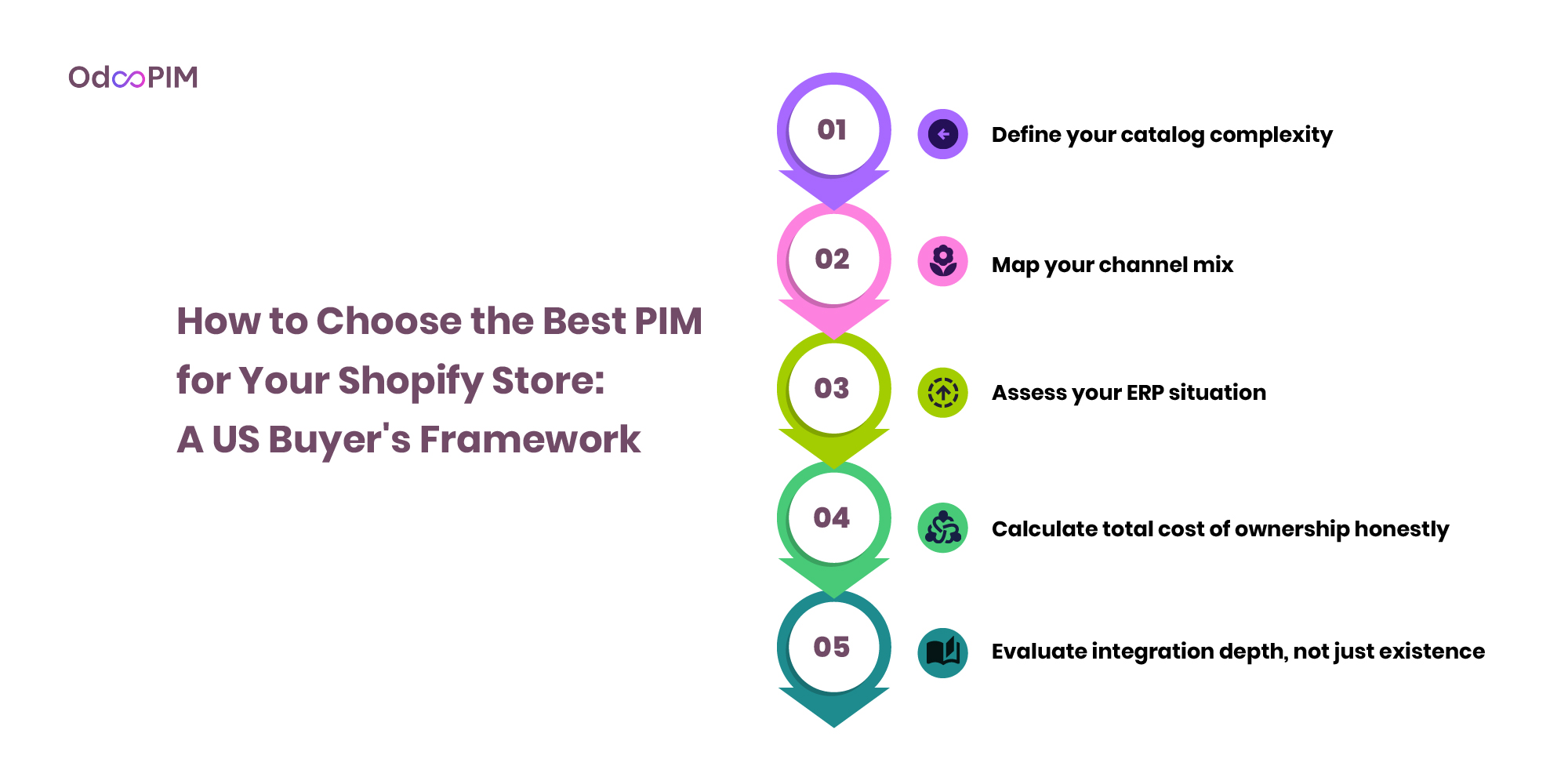
A practical decision framework for US Shopify merchants who aren’t ready to commit yet. Use this structured process to evaluate top PIM tools for shopify against your needs, not marketing claims
Step 1: Define your catalog complexity
Count your active SKUs today and project 24 months out. Under 500 SKUs? Simple attributes? Basic variations? You may not need enterprise PIM software for shopify stores yet. 500–5,000 SKUs with complex attributes and deep variations? A dedicated shopify product information management system pays for itself quickly. Over 5,000 SKUs with technical specifications, compliance data, and multi-language needs? Enterprise best PIM for shopify is non-negotiable.
Step 2: Map your channel mix
List every sales channel. Shopify only? A basic shopify catalog management software may suffice. Shopify plus Amazon? You need PIM for shopify and amazon with multichannel syndication. Add Walmart Marketplace, TikTok Shop, wholesale portals, or B2B channels? You require shopify multichannel PIM with channel-specific formatting and syndication rules. Each channel multiplies complexity. Your PIM must handle that multiplication automatically.
Step 3: Assess your ERP situation
This is the most underweighted factor in most shopify PIM comparison articles. Are you on an ERP? Which one? For Odoo users, odoo shopify PIM eliminates integration overhead. For non-Odoo merchants, evaluate ERP integration depth carefully. Standalone best shopify PIM software requires middleware to sync with your ERP, adding license costs, maintenance, and failure points. Native integration matters more than feature lists.
Step 4: Calculate total cost of ownership honestly
Subscription fees tell only part of the story. PIM for US ecommerce total cost includes: monthly or annual license, implementation and data migration, integration middleware (if any), training and onboarding, ongoing sync maintenance. A cheaper monthly license with expensive middleware often costs more than a higher subscription with zero integration overhead. For Odoo users, odoo shopify PIM has no middleware costs, no sync maintenance, no separate integration license.
Step 5: Evaluate integration depth, not just existence
“Integrates with Shopify” appears on every vendor’s website. What matters is how deeply. Ask specific questions: Does the connector handle metafields at scale? Variant hierarchies? Real-time inventory sync? Bidirectional updates? What happens when Shopify updates its API? Who maintains the connector? Top PIM tools for shopify with certified connectors invest in ongoing maintenance. Others leave you with broken syncs and support tickets.
Learn about 15 Best AI Tools for Ecommerce Business in 2026
The Bottom Line
The best PIM for Shopify fits your operational context, not just your feature wishlist. Define your catalog complexity. Map your channels. Assess your ERP. Calculate honest TCO. Evaluate integration depth. For Odoo users, odoo shopify PIM delivers native unity that standalone tools cannot match. For non-Odoo merchants, other PIM software for shopify stores may fit better. Use this framework to self-select, then validate with vendor demos using your data. Shopify product information management done right transforms catalog maintenance from bottleneck to growth engine.
PIM for Shopify Pricing: What US Merchants Should Expect
Pricing transparency is a gap across almost every shopify PIM comparison article. Let’s fix that. Below is what US merchants should expect to pay for PIM for US ecommerce across different tiers, plus the hidden costs most vendors don’t mention.
SMB-Tier PIMs (Plytix, Sales Layer SMB)
Typical cost: $300–$800 per month for basic catalogs. Entry-level plans may start lower, but features needed for multichannel selling push you into higher tiers.
What you get: Basic product data centralization, pre-built connectors for Shopify and Amazon. PIM software for shopify stores at this tier handles core needs for smaller catalogs.
Hidden costs: Connector depth is usually limited, metafield support may be partial, variant handling basic. Expect to outgrow within 12–24 months as catalog complexity increases.
Mid-Market PIMs (Akeneo Growth, Sales Layer Mid-Market)
Typical cost: $25,000–$60,000 per year. Implementation adds $15,000–$50,000 depending on ERP complexity and data migration requirements.
What you get: Deeper enrichment workflows, completeness scoring, API access, and certified Shopify connectors. Top PIM tools for shopify at this tier handle 5,000–50,000 SKUs effectively.
Hidden costs: ERP integration requires separate middleware or custom development. Sync maintenance becomes an ongoing operational expense. The license is only the beginning.
Enterprise PIMs (Salsify, Inriver, Akeneo Enterprise)
Typical cost: $60,000–$200,000+ per year. Implementation and integration costs often exceed license fees, sometimes doubling the first-year investment.
What you get: Full enterprise feature sets, advanced syndication, retailer compliance tools, governance workflows, dedicated support. Best PIM for shopify at this tier serves 50,000+ SKU catalogs.
Hidden costs: Implementation timelines stretch 6–12 months. Internal resources get consumed. Annual renewals escalate. These tools deliver value but require enterprise budgets and patience.
OdooPIM: A Different Model
OdooPIM is built on Odoo’s open-source foundation. For businesses on Odoo, total cost of ownership is significantly lower because there is no separate PIM for shopify license and no ERP integration to build.
What you pay: Your existing Odoo subscription. No separate PIM license. No middleware. No sync maintenance.
What you get: Native odoo shopify PIM with real-time sync across catalog, inventory, and pricing. Shopify catalog management software that shares your operational database. Shopify product information management system with no integration tax.
The comparison: A standalone best shopify PIM software at $50,000/year plus $30,000 implementation plus $15,000/year middleware may cost more than an Odoo subscription that already includes PIM capabilities. For Odoo users, the math is simple. For non-Odoo merchants, evaluating both paths, sometimes migrating to Odoo plus OdooPIM costs less than maintaining a standalone PIM plus separate ERP.
How to Evaluate Pricing Honestly
When comparing PIM for shopify and amazon options, calculate total cost of ownership over 3–5 years.
Include:
- Annual license fees (including escalations)
- Implementation and data migration
- Integration middleware or custom development
- Ongoing sync maintenance
- Internal team hours spent on vendor management
Shopify PIM comparison should prioritize TCO over monthly fees. A cheaper license with expensive middleware costs more than a higher subscription with zero integration overhead. For Odoo users, shopify multichannel PIM with native ERP integration delivers the lowest TCO. For others, match the tier to your complexity, but budget honestly. Hidden costs sink implementations faster than feature gaps.

Frequently Asked Questions
1. What is the best PIM for Shopify in 2026?
The best PIM for Shopify depends on your tech stack and catalog size. For Odoo users, odoo shopify PIM offers native ERP integration with no middleware costs. For SMB merchants with simple catalogs, Plytix delivers affordable PIM software for shopify stores. Enterprise brands needing retailer compliance often choose Salsify or Inriver. Shopify PIM comparison should prioritize operational context over feature lists. The right best shopify PIM software fits your existing systems, not just your wishlist.
2. Does Shopify have a built-in PIM?
Shopify does not have a built-in PIM. It offers native product management for storefront-ready data, but lacks upstream governance, no data validation, completeness scoring, supplier onboarding workflows, or audit trails. Shopify product information management system requires external tools once catalogs grow past 500 SKUs or sell across multiple channels. Top PIM tools for shopify fill this gap by adding enrichment, validation, and syndication capabilities. Shopify handles checkout and storefront. PIM for US ecommerce handles data governance upstream.
3. How much does a PIM for Shopify cost?
PIM for Shopify pricing varies widely. SMB-tier tools like Plytix cost $300–800 monthly. Mid-market solutions like Akeneo run $25,000–60,000 annually plus $15,000–50,000 implementation. Enterprise platforms like Salsify exceed $60,000–200,000+ yearly. For Odoo users, odoo shopify PIM has no separate license, PIM capabilities are included in Odoo subscriptions. Shopify catalog management software TCO includes integration middleware, sync maintenance, and internal team hours. Shopify PIM comparison should evaluate total cost over 3–5 years, not monthly fees alone.
4. What is the difference between a PIM and Shopify’s native product management?
Shopify’s native product management is designed for storefront-ready data, editing listings, managing variants, and uploading images. A PIM software for shopify stores handles upstream governance: supplier data onboarding, attribute enrichment, completeness scoring, approval workflows, and multichannel syndication. Shopify product information management system with PIM centralizes data before it reaches Shopify. Best PIM for Shopify adds validation rules, audit trails, and ERP integration that native tools lack. Shopify manages what customers see. PIM manages what your team creates upstream.
5. Can a PIM for Shopify also manage Amazon and Walmart Marketplace listings?
PIM for shopify and amazon is a core requirement for US merchants selling across multiple channels. Shopify multichannel PIM syndicates one governed product record to Shopify, Amazon, Walmart Marketplace, and other channels simultaneously. Each channel receives format-specific content, Amazon gets flat descriptions and your store gets rich formatting. Top PIM tools for shopify with multichannel syndication eliminate manual exports and inconsistent data. Without this, merchants maintain separate listings per channel, creating errors and consuming hours. PIM for US ecommerce turns multichannel complexity into background automation.
6. What is the best PIM for Shopify Plus?
For Shopify Plus merchants with B2B complexity, the best PIM for Shopify depends on ERP integration needs. Odoo shopify PIM delivers native unity for Odoo users, customer-specific pricing, tiered assortments, and wholesale portals managed in the same system. Shopify catalog management software for Shopify Plus must handle contract pricing and approval workflows. Enterprise options like Salsify or Inriver serve brands with heavy retailer compliance needs. Shopify PIM comparison for Plus merchants should prioritize B2B features, ERP connectivity, and total cost of ownership, not just channel syndication.