What Is a PIM Software Company?
A PIM software company builds platforms dedicated to one job: centralizing, enriching, and distributing product information across sales channels. Unlike generic databases, these product information management software providers focus on attributes, relationships, and channel-specific formatting. The best PIM software 2026 comes from vendors that understand how messy real-world catalogs get, thousands of SKUs, dozens of fields per product, and constant updates. They exist to kill spreadsheet chaos and manual data re-entry.
How PIM Companies Differ From ERP or CMS Vendors
ERP systems handle finances, inventory, and orders, product data is just one small table among hundreds. CMS platforms like WordPress or Shopify focus on front-end presentation, not back-end data structure. A PIM vs ERP comparison shows that ERPs store product data for transactions, while PIM tools for ecommerce enrich that same data for multiple channels simultaneously. Product data management tools within ERPs lack the flexibility to handle different image sizes, SEO descriptions, or marketplace-specific attributes.
Modern PIM software for small business fills this gap by sitting between your ERP and your sales channels, transforming raw data into channel-ready assets. Think of ERP as the source of truth for cost and stock; think of PIM as the engine for telling each customer the right story. ERPs answer „how many do we have?“ PIM answers „why should someone buy it?“ Two different questions, two different tools.
What to Expect From a Modern PIM Platform
Expect automated data mapping, bulk enrichment, and real-time syndication to dozens of channels. Multichannel product data management means one change propagates everywhere, Amazon, your site, Google Shopping, wholesale PDFs. The best platforms include role-based workflows, version history, and approval chains. Akeneo alternatives like Plytix or OdooPIM integration offer different trade-offs: Plytix prioritizes simplicity, while OdooPIM integration appeals to businesses already inside Odoo’s ecosystem.
Modern platforms provide AI that fills missing attributes and suggests category mappings. You should never manually reformat a spreadsheet again. The platform handles image resizing, field transformations, and channel-specific rules automatically. If a vendor still talks about CSV exports as a feature, walk away. That is not a modern PIM, that is a fancy spreadsheet with a subscription fee.

Why Businesses Are Switching to Dedicated PIM Solutions
Spreadsheets and siloed databases cannot keep pace with modern commerce. A single product update requires touching five different files, three team members, and two sleepless nights before every channel sees the change. That is why product information management software adoption is accelerating, businesses finally realize that stitching together disjointed tools costs more than buying a proper PIM solution. The best PIM software 2026 winners are those that eliminate manual reconciliation entirely.
The Problem With Spreadsheets and Siloed Product Data
A merged cell here, a formula overwritten there, and suddenly your Amazon listing shows the wrong price while your website shows the correct one. No audit trail exists. No one knows who changed what or when. Product data management tools built on shared drives create a single source of truth for no one, marketing maintains one file, operations another, sales a third. PIM software for small business solves this by forcing everyone into the same system with version control and change logs.
You cannot delete a column or email the wrong attachment. The data lives in one place, period. Spreadsheets work for fifty SKUs. Hit five hundred, and the cracks become chasms. Teams waste hours hunting down the „correct“ file version instead of actually selling products. Every minute spent reconciling spreadsheets is a minute not spent optimizing listings or launching new items. That hidden labor cost alone often justifies switching to dedicated PIM tools for ecommerce.
How PIM Software Reduces Errors Across Sales Channels
A wrong dimension on your website goes unnoticed; that same wrong dimension on a retailer portal triggers chargebacks and delistings. PIM tools for ecommerce apply validation rules at entry, not after damage spreads. The system flags missing images, mismatched prices, and incomplete attributes before publishing. Multichannel product data management means one correction fixes every destination simultaneously, no more fixing Amazon, then fixing eBay, then fixing your wholesale PDF.
ERPs catch transaction errors like negative inventory or mismatched invoices. PIM catches content errors like missing specifications or inconsistent sizing charts. You need systems working together. The best setups use Odoo PIM integration or similar bridges to keep product data flowing both ways. When a spec changes in the PIM, the ERP updates its records. When inventory drops in the ERP, the PIM adjusts channel availability. That two-way sync stops errors at the source rather than cleaning up messes after customers find them.
Learn about PIM Software Comparison 2026
Gartner analysts predict that by 2026, over 50% of businesses will use AI-driven tools to monitor sustainability compliance, and PIM solutions are shifting away from monolithic on-premises applications toward cloud-native, API-driven platforms.
– Gartner Market Guide for PIM Solutions
The Role of PIM in Multichannel and Omnichannel Commerce
Multichannel means being everywhere. Omnichannel means being consistent everywhere. A PIM solution delivers both by storing one master record and transforming it for each destination automatically. Social commerce needs short descriptions and square images. Marketplaces need GTINs and category-specific attributes. Your website needs long-form SEO copy and lifestyle photography. Akeneo alternatives and PIM software companies compete on how gracefully they handle these transformations without manual duplication.
The weak platforms require channel-specific overrides that drift out of sync over time. The strong ones let you set transformation rules once and trust the system to apply them every time. Modern best PIM software 2026 also tracks channel-specific performance, which descriptions drive conversions on Amazon versus your own site. That intelligence feeds back into your master data, creating a continuous improvement loop that spreadsheets cannot replicate. Without PIM, omnichannel remains a buzzword. With PIM, it becomes operational reality. Your customers see the same price, same specs, same imagery whether they shop on Instagram, Google, or your front door. That consistency builds trust. Trust builds revenue.
Top PIM Software Companies in 2026
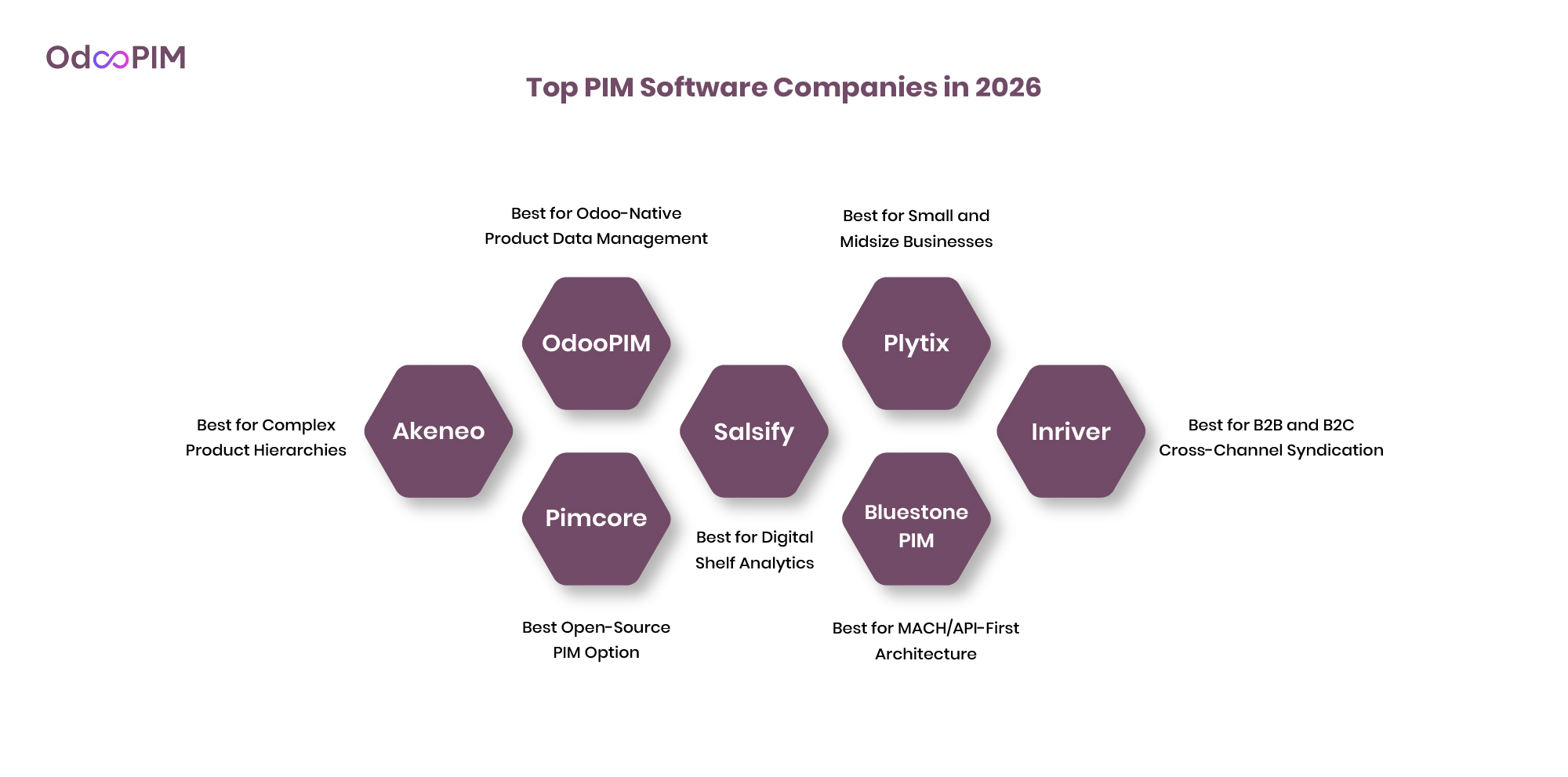
OdooPIM: Best for Odoo-Native Product Data Management
Odoo PIM integration sits inside the Odoo ecosystem, not as a separate bolt-on. Your product data flows between inventory, accounting, sales, and the PIM module without middleware or API fees. For businesses already running Odoo ERP, this is the cleanest product information management software available, no duplicate data entry, no sync delays, no connector maintenance.
The trade-off? OdooPIM lacks advanced enrichment features found in dedicated platforms. PIM vs ERP thinking matters here: Odoo gives you convenience, not best-in-class modeling. Still, for manufacturers and distributors already living in Odoo daily, the integration wins over raw power. Odoo PIM integration eliminates the need for separate billing from another PIM software company.

Akeneo: Best for Complex Product Hierarchies
Akeneo handles thousands of attributes, nested families, and variant relationships without slowing down. PIM tools for ecommerce mostly choke on B2B catalogs with twenty levels of hierarchy; Akeneo thrives on that complexity. The platform’s attribute grouping and reference entity features let you model relationships that other product information management software cannot represent at all.
For businesses with configurable products, bundled kits, or deep specification sheets, Akeneo remains the industry benchmark. Akeneo alternatives exist, but most compromise on data modeling depth. The downside? Akeneo’s interface feels dense to newcomers, and enterprise pricing climbs fast. Still, no other best PIM software 2026 contender matches its flexibility for genuinely complex catalogs.
Pimcore: Best Open-Source PIM Option
Pimcore bundles PIM, DAM, CDP, and MDM into a single open-source platform. Unlike PIM software companies that sell you separate modules, Pimcore gives you everything under one roof with no per-feature upcharges. Technical teams appreciate the full code access and unlimited customization possibilities. You own the stack completely.
The catch: self-hosting Pimcore requires serious engineering resources. This is not a plug-and-play PIM software for small business. Setup, maintenance, and security all fall on your team. For enterprises with dedicated developers, Pimcore delivers unmatched control at a fraction of commercial license costs. For everyone else, stick with managed PIM tools for ecommerce from vendors who handle the hosting headaches.
Salsify: Best for Digital Shelf Analytics
Salsify tracks how your product content performs across retailer sites, something most product information management software ignores. The platform shows you which images drive clicks on Amazon, which descriptions convert on Walmart, and where competitors outrank you. That intelligence turns PIM tools for ecommerce from a cost center into a revenue driver.
Salsify sits at the high end of any best PIM software 2026 discussion, often requiring six-figure annual commitments. Small brands should look elsewhere. But for enterprise retailers fighting for digital shelf visibility, Salsify’s analytics justify the premium. Multichannel product data management is table stakes. Knowing which content actually wins on each channel is the real advantage.
Plytix: Best for Small and Midsize Businesses
Plytix charges one flat monthly fee regardless of user count. No per-seat surprises. No volume overage shocks. For PIM software for small business buyers, that pricing model alone beats every competitor. The platform itself focuses on getting products live quickly, clean interface, straightforward channel connections, minimal friction.
The trade-offs become visible above 10,000 SKUs. Workflow automation and advanced syndication lag behind enterprise options. Still, Plytix is the smart starting point for most growing brands. You can always migrate to Akeneo alternatives later. Many businesses never need to. For catalogs under ten thousand products with standard attributes, Plytix delivers everything required at a fraction of enterprise costs.
Inriver: Best for B2B and B2C Cross-Channel Syndication
Inriver builds its entire architecture around one concept: feed once, publish everywhere. The platform’s syndication engine handles B2B portals, direct-to-consumer sites, marketplaces, and print catalogs from the same master record. Multichannel product data management is not a feature, it is the core product. Inriver also excels at role-based workflows, letting your B2B team see technical specs while your B2C team sees marketing copy.
Where Inriver stumbles is self-service onboarding. Implementation almost always requires certified partners, adding 30-50% to first-year costs. PIM vs ERP integration is solid but not exceptional. For large distributors juggling dozens of channel requirements simultaneously, Inriver’s syndication depth justifies the heavy setup. Just budget for professional services from day one.
Bluestone PIM: Best for MACH/API-First Architecture
Bluestone built its platform for developers, not merchandisers. Every action exposes an API endpoint. Every data model is fully customizable. For PIM software companies still relying on rigid schemas, Bluestone represents the MACH alliance vision, microservices, API-first, cloud-native, headless. Your front end and your PIM communicate how you design them.
The flexibility demands technical comfort. Merchandisers will find Bluestone’s interface sparse compared to Salsify or Plytix. But for engineering-led organizations building custom commerce experiences, no best PIM software 2026 contender offers this level of architectural freedom. Think of Bluestone as a PIM engine rather than a PIM application. If you want opinionated workflows out of the box, look elsewhere. If you want to build your own workflows your way, Bluestone delivers.
Key Features to Compare Across PIM Companies
Data Modeling and Catalog Flexibility
Data modeling determines how your product information is structured. Some PIM software companies lock you into rigid schemas where every product must have identical fields. Flexible platforms let you define unique attribute sets for each product family, shoes need sizes, electronics need voltage, furniture needs dimensions. Product information management software with strong modeling handles simple SKUs and complex variants equally well, without forcing square pegs into round holes.
The best PIM software 2026 offerings let you nest attributes, create reference fields that link products to other products, and support many-to-many relationships.
Test this early: import your messiest spreadsheet and see if the platform preserves every relationship. Akeneo alternatives often compromise here, flattening hierarchies to simplify the interface. If you sell configurable products or bundled kits, prioritize modeling depth over dashboard prettiness.
OdooPIM trade some enrichment depth for operational simplicity. That trade-off benefits the 80% of businesses that do not need Hollywood-level product storytelling.
AI-Powered Content Enrichment
AI features vary wildly across PIM tools for ecommerce. Basic systems auto-generate SEO titles from existing attributes. Advanced platforms categorize products, write descriptions, translate copy, and flag missing specifications without human input. The technology cuts enrichment time from weeks to days, especially for large catalogs where manual data entry becomes impossible. Product data management tools without AI force your team into tedious, repetitive work.
The catch: AI quality depends entirely on training data. Some PIM software companies ship half-baked models that generate nonsense. Always trial the AI feature with your actual products. Ask to see before-and-after examples from customers in your industry. The best PIM software 2026 contenders let you train models on your own catalog, improving accuracy over time. Avoid vendors that treat AI as a checkbox feature rather than a core investment.
ERP, CMS, and Ecommerce Integrations
Integration depth separates functional product information management software from frustrating paperweights. Check not just whether a connector exists, but what direction data flows. Two-way sync with ERPs ensures inventory changes in your ERP update channel availability instantly. PIM vs ERP integration quality varies, some vendors treat ERP as a one-time import source rather than a live partner. Odoo PIM integration stands out here because the PIM shares the same database as the ERP.
For ecommerce, demand real-time publishing, not scheduled CSV drops. The best PIM software for small business offers pre-built connectors for Shopify, Magento, WooCommerce, and BigCommerce. Enterprise buyers need API access for custom middleware. Ask each vendor for their integration failure rate and average sync latency. A connector that breaks weekly is worse than no connector at all. Your PIM tools for ecommerce should disappear into your stack, not demand constant babysitting.
Workflow Automation and Team Collaboration
Workflow automation turns product information management software from a storage bin into an operational engine. Look for role-based permissions, approval chains, task assignments, and change notifications. A strong system knows that marketing cannot publish a product before operations completes the spec sheet. Multichannel product data management requires coordinating dozens of people, automation removes the „who forgot to approve this?“ conversations.
Collaboration features should include commenting, version comparison, and rollback capabilities. When someone changes a description, you need to see what changed, who changed it, and when. The best PIM software 2026 options also offer audit logs that export for compliance reviews. Avoid platforms where the only collaboration tool is exporting a CSV and emailing it around. That defeats the entire purpose. Your team should work inside the PIM, not around it.
Multilingual and Multi-Region Support
Selling across borders demands language, currency, and regulatory adaptability. PIM software companies handle this differently. Some duplicate entire product records per language, messy and error-prone. Smart platforms store one master record with localized overlays for descriptions, measurements, and legal text. The system automatically serves the correct version based on customer location. Product data management tools without native multilingual support force your team to maintain separate spreadsheets per market.
Check each vendor’s translation workflow. Does the platform integrate with professional translation services? Can you approve translations before they go live? For regulated industries like food or medical devices, verify that region-specific compliance fields exist. The best PIM software 2026 for global commerce also handles unit conversions automatically, metric for Europe, imperial for the US. Akeneo alternatives vary widely here. Some treat translation as an afterthought. Others, like Bluestone and inRiver, build their architecture around regional adaptability from day one.
PIM Software for Different Business Types
PIM for Manufacturers and Distributors
Every product starts as a bill of materials, a spec sheet, or a CAD file. The right product information management software pulls from these sources rather than asking teams to re-enter data. PIM vs ERP thinking matters here, you need a bridge, not a replacement. Odoo PIM integration works well for manufacturers already on that stack. For others, look for platforms with native connectors to SAP, Microsoft Dynamics, or NetSuite.
Distributors face a different challenge: they carry thousands of products from hundreds of suppliers, each with its own data format. Multichannel product data management for distributors means normalizing messy supplier feeds into clean, consistent records. The best PIM software 2026 for this group includes automated data mapping and exception handling. When a supplier changes a spec, the system flags the discrepancy rather than silently breaking. Akeneo alternatives like inRiver or Pimcore offer stronger B2B workflows than pure ecommerce tools.
PIM for Retailers and Ecommerce Brands
Retailers need speed. A new collection launches next week, and product data must reach your site, marketplaces, and social channels simultaneously. PIM tools for ecommerce excel here by providing bulk editing, template-based enrichment, and one-click publishing. Product data management tools built for retailers prioritize visual workflows, drag-and-drop image assignment, inline editing, and channel previews that show how a listing will appear on Amazon versus your own store.
The key differentiator for retailers is syndication depth. Basic PIM software companies push data to channels but offer no feedback loop. Strong platforms pull back performance metrics, which images drive clicks, which descriptions convert. That intelligence improves future listings. For pure-play ecommerce brands without physical stores or B2B divisions, multichannel product data management focuses on direct-to-consumer channels plus marketplaces. Avoid enterprise platforms loaded with B2B features you will never use. Plytix or Akeneo’s Growth tier typically fits better than Salsify or Syndigo.
PIM for Small Businesses on a Budget
Small businesses face a brutal trade-off: spreadsheets are free but broken, enterprise PIM is powerful but unaffordable. PIM software for small business solves this by removing per-user fees and offering flat monthly pricing. Plytix leads this category because a ten-person team pays the same as a one-person team. No hidden overages. No „enterprise sales call“ just to see a price. Product information management software for bootstrapped brands should also offer self-service onboarding, no paid implementation required.
The limitations become visible above 10,000 SKUs or when you need advanced workflows. Akeneo alternatives like Plytix or OdooPIM (if you already use Odoo) work well within that range. Do not let enterprise sales teams convince you that you need six-figure software. Many small businesses run perfectly on PIM tools for ecommerce that cost less than $500 monthly. The best PIM software 2026 for your small business is the one you can afford to use, not the one with the most features you will never touch. Start simple. Outgrow it later. Most companies never need to upgrade.
PIM Software Pricing: What to Expect
Free and Open-Source PIM Options
Open-source product information management software exists, but free does not mean zero cost. Akeneo Community Edition and Pimcore give you full access to the codebase with no licensing fees. You can download, install, and modify the software however you want. PIM software companies that offer open-source versions make money on enterprise features, hosting, and support, not the core engine. For technical teams with server management skills, this route slashes software budgets dramatically.
You need hosting infrastructure, database administration, security monitoring, backups, and updates. A developer must handle every upgrade manually. If something breaks at 2 AM before a product launch, your team owns the fix. PIM software for small businesses rarely fits the open-source model unless you have an engineering headcount. Calculate your hourly labor before committing. Many teams find that a $500 monthly SaaS subscription costs less than paying a developer to babysit a „free“ platform.
Mid-Market PIM Pricing Tiers
Mid-market PIM tools for ecommerce usually run $2,000 to $3,000 monthly. Plytix charges flat fees regardless of user count, landing around $400 to $1,000 monthly for most catalogs. Akeneo’s Growth tier starts near $2,000 monthly but adds per-user fees above a certain threshold. PIM software companies in this range target businesses with 1,000 to 20,000 SKUs and teams of five to fifty people. You get managed hosting, regular updates, and customer support without enterprise overhead.
Some vendors charge by SKU count, punishing you for adding long-tail products. Others charge by API calls, which spike unpredictably during seasonal peaks. The best PIM software 2026 for mid-market buyers publishes transparent tiers and offers clear upgrade paths. Ask every vendor: „What happens when I double my SKUs next year?“ If the answer involves a surprise price hike, keep looking. Akeneo alternatives like Plytix or OdooPIM offer more predictable scaling than per-SKU models.
Enterprise PIM Costs and Hidden Fees
Enterprise product information management software starts around $50,000 annually and climbs past $200,000. Salsify, Syndigo, and inRiver occupy this tier. The software license itself is rarely the biggest line item. Implementation fees from certified partners add 30% to 100% of first-year costs. PIM vs ERP integration work often requires custom middleware, billed hourly. Data migration from legacy spreadsheets or old systems can run another $20,000 to $50,000 depending on data messiness.
The most dangerous hidden fee: mandatory user minimums. Some PIM software companies force you to buy fifty seats even if only fifteen people need access. Others charge for „premium support“ that should be standard. Always request a full-year cost projection including onboarding, training, integrations, and overage policies. Multichannel product data management at enterprise scale delivers real ROI, but only if you budget accurately. Get every fee in writing before signing. The best PIM software 2026 for enterprises publishes implementation estimates upfront. If a vendor refuses, assume they are hiding something.
Why OdooPIM Stands Out Among PIM Software Companies
Native Integration With the Odoo Ecosystem
Most PIM software companies build standalone platforms that require middleware to talk to your ERP. Odoo PIM integration works differently, the PIM module shares the same database as your Odoo inventory, sales, and accounting apps. No API calls. No sync delays. No connector fees. When a warehouse worker updates stock levels, that change appears in your product listings instantly because there is only one source of truth. PIM vs ERP becomes a false choice when both live inside the same system.
This native architecture eliminates a category of headaches. You never debug why product data mismatches between systems. You never pay for third-party integration tools. For businesses already running Odoo, switching to a standalone product information management software means paying more for less reliability. Odoo PIM integration turns your ERP into the hub for both transactions and content. The cost savings on integration labor alone often justify the switch from other PIM tools for ecommerce.
How OdooPIM Simplifies Product Data for Odoo Users
Odoo PIM integration adds product enrichment features without forcing your team to learn a second platform. The same product form that shows cost and quantity now also manages SEO descriptions, category-specific attributes, and channel publishing rules. Your team stays in familiar territory. No retraining on foreign workflows. Product data management tools that require context switching between ERP and PIM waste hours daily.
The simplification extends to data modeling. OdooPIM inherits your existing product structures, attributes, and categories automatically. You do not rebuild your catalog from scratch. For PIM software for small business teams wearing multiple hats, this matters enormously. A standalone PIM might offer deeper features, but those features mean nothing if your team struggles to use them. Akeneo alternatives like OdooPIM trade some enrichment depth for operational simplicity. That trade-off benefits the 80% of businesses that do not need Hollywood-level product storytelling.
Getting Started With OdooPIM
Activation takes minutes if you already run Odoo. Navigate to the Apps menu, search for „PIM,“ and install the module. Odoo PIM integration is not a separate product, it is a checkbox. Your existing products appear immediately with fields ready for enrichment. Add images, write channel-specific descriptions, set publishing rules. The best PIM software 2026 for Odoo users requires zero data migration because your products never left the system. Spreadsheet imports become optional, not mandatory.
For new Odoo users, the path requires an Odoo subscription first. The product information management software module adds cost but typically less than competing standalone PIMs. Implementation follows Odoo’s standard playbook: configure your company settings, import your product base, and start enriching. Most small businesses go live within two weeks. Compare that to enterprise PIM tools for ecommerce requiring months of professional services. Odoo PIM integration will not win feature battles against Salsify or Syndigo. But for straightforward catalogs inside the Odoo ecosystem, no other product data management tools deliver faster time-to-value.

Frequently Asked Questions
1. What Is the Best PIM Software for Small Businesses?
Plytix takes the crown for PIM software for small business because of its flat monthly pricing and zero per-user fees. A five-person team pays the same as a solo operator. The platform offers clean interfaces, direct channel publishing, and self-service onboarding without mandatory implementation partners. PIM tools for ecommerce often punish growing teams with seat-based pricing, but Plytix removes that friction. The trade-off appears above 10,000 SKUs or when you need advanced workflows. Still, most small businesses never hit those limits. For straightforward catalogs under ten thousand products, Plytix delivers enterprise-grade multichannel product data management at a fraction of the cost. Avoid overbuying features you will not touch next year.
2. Is There a Free PIM Software Option?
Akeneo Community Edition and Pimcore offer open-source product information management software with no licensing fees. You download the code, install it on your own servers, and maintain everything yourself. PIM software companies provide the software but not the hosting, security updates, or support. For technical teams with dedicated engineering hours, this route saves money. For everyone else, the hidden costs add up fast. Server maintenance, database backups, security patches, and upgrade labor consume time better spent on selling products. Best PIM software 2026 for non-technical users remains paid SaaS. Calculate your hourly labor before committing to „free.“
3. How Is PIM Different From a Product Catalog Tool?
A product catalog tool generates static outputs, PDFs, web pages, printed brochures. Product information management software does that plus continuous syndication across live channels. Catalog tools export once. PIM tools for ecommerce push updates continuously. When you change a price in a PIM, Amazon, your website, and your wholesale portal all reflect that change within minutes. A catalog tool requires manual re-export and re-upload. PIM vs ERP also matters here. ERPs store transactional data; catalog tools present that data. PIM sits between both, enriching and transforming before distribution. Think of catalog tools as cameras taking one picture. Think of PIM as a video feed updating in real time.
4. Can PIM Software Integrate With Odoo?
OdooPIM integration comes in two flavors. Native OdooPIM lives inside the same database as your Odoo ERP, sharing inventory, sales, and product records without middleware. This is the cleanest option for existing Odoo users. Alternatively, standalone PIM software companies like Akeneo or Plytix offer connectors to Odoo via API or third-party middleware like Zapier or Celigo. These external integrations work but introduce sync delays and potential failure points. Akeneo alternatives with Odoo connectors vary in reliability. Test the connector with your actual data volume before committing. For businesses already running Odoo daily, native Odoo PIM integration eliminates integration headaches. For others, external connectors still beat spreadsheets.