What Is AI Ecommerce Personalization?
AI ecommerce personalization delivers individualized shopping experiences by analyzing customer behavior, preferences, and purchase history in real-time. AI-driven product recommendations appear based on browsing patterns rather than that “customers also bought” logic. The technology creates a personalized shopping experience ecommerce stores cannot achieve manually.
Why AI ecommerce personalization matters in 2026 stems from customer expectations. Shoppers now abandon stores treating them like anonymous traffic. AI product data management feeds personalization engines with accurate information across channels. Ecommerce personalization software orchestrates email, on-site, and social interactions cohesively. Customer personalization using AI delivers 10-30% revenue lifts consistently. AI personalization ecommerce examples include homepage blocks changing per visitor and cart abandonment emails featuring products matching demonstrated interest.
How AI Personalization Actually Works Behind the Scenes
AI ecommerce personalization operates through data processing rather than manual rule-setting. AI-driven product recommendations analyze behavioral signals, dwell time, scroll depth, and click patterns, alongside explicit actions. Similar products surface based on multidimensional similarity matrices, not just category matching. This creates a personalized shopping experience ecommerce shoppers expect but rarely receive from basic tools.
Behind the interface, AI product data management ensures accurate attributes feed these calculations. Ecommerce personalization software tracks which items appear together in carts, generating frequently bought together suggestions. Personalized bundles form based on real-time inventory and purchase history. Customer personalization using AI extends to attribute-based matching, where products align with demonstrated style preferences. AI personalization ecommerce examples include search results prioritizing purchased brands.

AI Personalization Ecommerce Examples You’ve Seen in Real Life
Amazon’s “Customers also bought” remains the recognizable AI ecommerce personalization example in existence. These recommendations analyze millions of purchase patterns to predict complementary products with startling accuracy. The algorithm considers not just transaction data but viewing sequences, cart additions, and returns behavior. AI personalization ecommerce examples like this drive 35% of Amazon’s revenue through sheer computational power rather than human curation. Every “frequently bought together” suggestion reflects real behavioral mathematics.
Netflix-style product discovery has migrated into ecommerce. Modern stores present personalized homepages where product rows rearrange themselves per visitor. AI personalization ecommerce examples include browser pages reordering based on demonstrated preferences. AI-powered site search interprets vague queries intelligently, typing “birthday gift for dad under $50” returns relevant products rather than zero results. These implementations represent AI personalization ecommerce examples that feel magical but operate on attribute matching and behavioral prediction algorithms.
Learn about AI product enrichment software.
Organizations implementing comprehensive personalization platforms see nearly 3x returns, reporting $5 million in increased incremental revenue across channels.
– Forrester
Why Personalization Fails — The Product Data Problem
Incomplete attributes are equal to wrong recommendations. AI ecommerce personalization engines require rich, accurate product data to function properly. When product descriptions lack color, material, size, or style attributes, the algorithm cannot identify meaningful connections between items. AI product data management failures result in recommendations based on limited signals, suggesting expensive accessories for budget items or mismatched styles that confuse customers. The technology performs as designed, but garbage data produces garbage personalization every time.
Inconsistent data across channels confuses AI. When product specifications differ between your website and mobile app, AI ecommerce personalization receives conflicting signals about the same inventory. AI product data management inconsistency creates fragmented customer profiles that cannot deliver cohesive experiences. Data quality as the silent killer of personalization ROI manifests in abandoned carts and decreased engagement metrics. Merchants blame the technology when inadequate AI product data management undermines performance.
Learn about AI Tool for ecommerce.

What to Look for in Ecommerce Personalization Software
Real-time data processing separates ecommerce personalization software from outdated alternatives. AI ecommerce personalization requires immediate response to customer actions, recommendations based on yesterday’s behavior ignore today’s intent. The best systems process clicks, cart additions, and page views, adjusting the shopping experience within milliseconds. Ecommerce personalization software without real-time capability delivers irrelevant suggestions that frustrate rather than convert. Speed correlates with personalization effectiveness.
Multichannel compatibility ensures consistent experiences across the touchpoints. Ecommerce personalization software must unify websites, mobile apps, emails, and social interactions into single customer profiles. Integration with existing tech stack prevents data silos, the tool should connect with your platform, CMS, and analytics tools. Scalability for growing catalogs matters as inventory expands. AI ecommerce personalization platforms must maintain performance whether managing 1,000 or 100,000 SKUs without degradation. Choose ecommerce personalization software that grows alongside your business.
Benefits of AI-Powered Personalization Backed by PIM
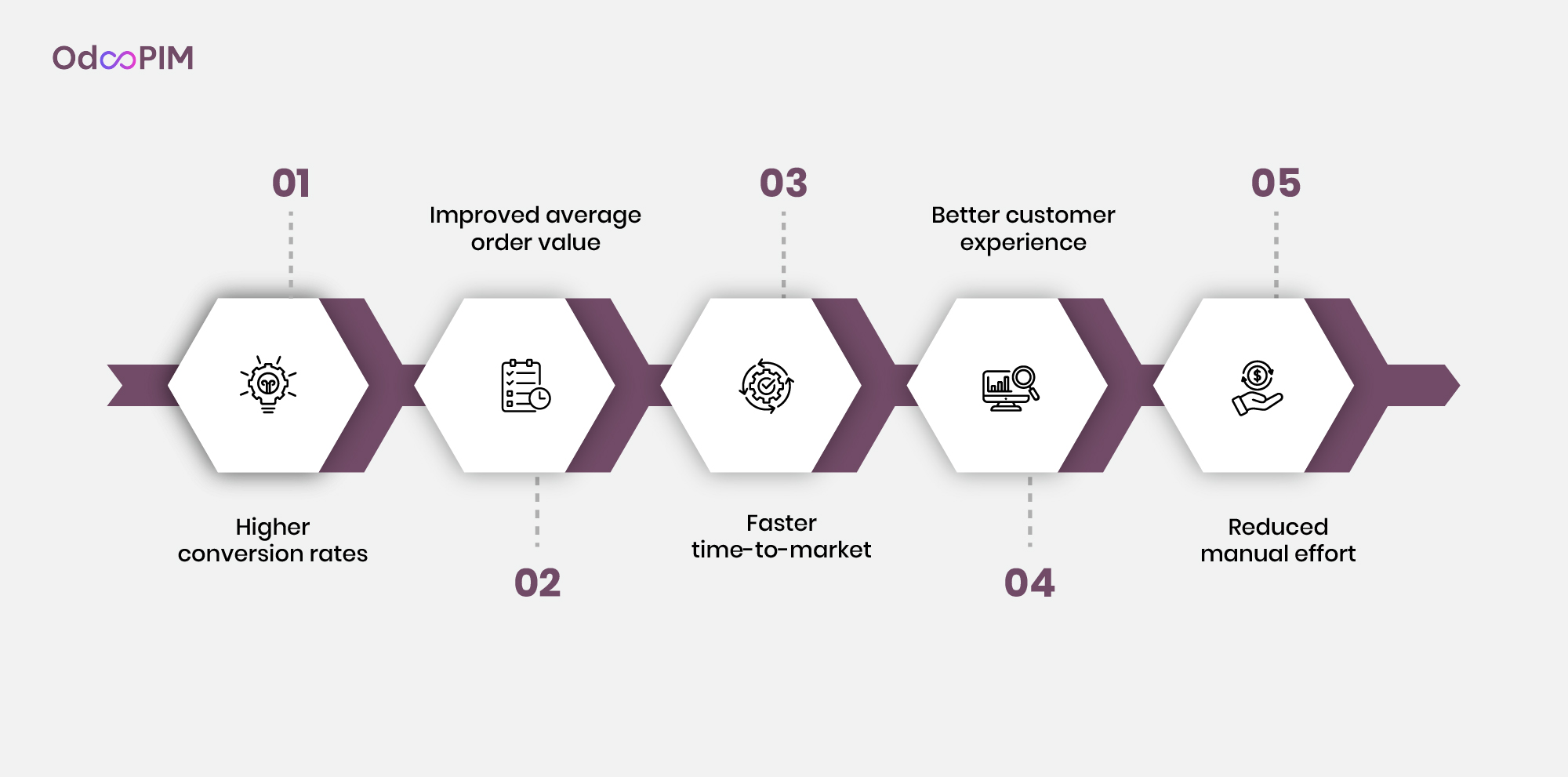
Higher conversion rates: AI ecommerce personalization powered by clean AI product data management converts browsers into buyers consistently. AI-driven product recommendations based on accurate attributes resonate with shopper intent, reducing bounce rates and increasing purchase completion. Stores report 10-30% conversion lifts after implementing proper personalization infrastructure.
Improved average order value
Customer personalization using AI suggests complementary products at optimal moments. Personalized shopping experience ecommerce platforms analyze cart contents to recommend appropriate add-ons, upgrades, and accessories. AI personalization ecommerce examples include “complete the look” suggestions that increase basket size naturally without cross-selling.
Faster time-to-market
AI product data management accelerates catalog preparation, enabling personalization engines to work immediately. Ecommerce personalization software deploys faster when product information requires no manual cleanup. New inventory starts generating personalized recommendations within hours rather than weeks.
Better customer experience
AI ecommerce personalization makes shoppers feel understood rather than marketed at. Personalized shopping experience ecommerce eliminates irrelevant recommendations and generic email blasts. AI-driven product recommendations demonstrate understanding of individual preferences, building loyalty through relevance.
Reduced manual effort
Ecommerce personalization software automates segmentation, testing, and optimization completely. AI product data management eliminates manual categorization and attribute assignment. Customer personalization using AI runs without human intervention, freeing teams for strategic work rather than repetitive adjustments.

How to Get Started with AI Personalization in Your Ecommerce Store
Audit your product data before evaluating any ecommerce personalization software. AI product data management requires complete, accurate attributes to function properly. Review product descriptions, images, and specifications for consistency. Fill missing attributes and standardize formats across your catalog. AI ecommerce personalization fails without this foundation, the algorithm cannot recommend what it cannot understand. Data cleanup determines success more than platform selection.
Choose the right personalization engine that integrates with your existing stack. Test AI-driven product recommendations on one channel initially, website homepage or email, not both simultaneously. Start small with a single use case like product recommendations or site search. Customer personalization using AI requires learning time; expand only after measuring results. Measure, iterate, expand systematically. Review conversion lifts and average order value changes before adding channels. Personalized shopping experience ecommerce builds through incremental implementation, not overnight transformation.
Learn about ecommerce inventory management software

Conclusion
AI ecommerce personalization has shifted from competitive advantage to customer expectation in 2026. Shoppers now demand personalized shopping experiences that ecommerce stores deliver, relevant recommendations, intuitive search, and consistent interactions across every channel. The technology delivering these experiences relies on AI product data management. Without clean, complete product attributes, even the sophisticated ecommerce personalization software produces irrelevant suggestions that drive customers away.
Start with AI-driven product recommendations on a single channel after auditing your product data thoroughly. Study AI personalization ecommerce examples from industry leaders but adapt strategies to your specific catalog and audience. Customer personalization using AI succeeds through measurement and iteration, not one-time setup. The stores winning in 2026 treat personalization as infrastructure, not decoration. Begin with data foundation, choose the right ecommerce personalization software, and expand systematically. Your customers will reward relevance with loyalty.
If you are looking for a tool that will help you leverage AI to pesonalize your ecommerce, you might want to consider OdooPIM. Natively built on Odoo but can still be deployed as a standalone product or integrated with several website platform, OdooPIM enables AI ecommerce personalization by maintaining a centralized, structured product data repository enriched with attributes, variants, and multimedia assets that AI engines can instantly query for hyper-relevant recommendations.
Its real-time synchronization across Odoo sales, inventory, and multichannel platforms powers dynamic features like behavior-based product suggestions, personalized search refinements, and targeted promotions—delivering tailored shopping experiences that boost conversions without data silos.
FAQ
1. How does AI personalize ecommerce experiences?
AI ecommerce personalization analyzes individual browsing behavior, purchase history, and real-time interactions to tailor the touchpoints uniquely. AI-driven product recommendations display items matching demonstrated preferences rather than generic popular products. Personalized shopping experience ecommerce extends to search results, email content, and homepage layouts that rearrange themselves per visitor. AI personalization ecommerce examples include pricing adjustments based on willingness-to-pay signals and browse pages reordering around proven interests. Every interaction trains the algorithm to deliver sharper relevance with subsequent visits.
2. Can AI personalization work for B2B ecommerce?
AI ecommerce personalization proves powerful in B2B contexts where relationships and account-specific pricing dominate. AI-driven product recommendations suggest quantities and frequently reordered items that individual buyers might miss. Personalized shopping experience ecommerce for B2B includes account-specific catalogs showing only authorized products. AI personalization ecommerce examples include automated reorder reminders timed to consumption cycles and volume discount suggestions at quantity thresholds. The technology adapts smoothly to negotiated pricing and multi-user buying groups.
3. What data is required for AI-driven product recommendations?
AI-driven product recommendations require product attributes, customer behavior, and transactional history. AI product data management must provide attributes, color, size, material, category, for meaningful connections. Customer behavior data includes browsing history, search queries, and click patterns across sessions. AI personalization ecommerce examples demonstrate richer data produces sharper recommendations identifying style preferences. Transactional purchase history reveals which recommendations converted versus engaged.
4. Is PIM necessary for ecommerce personalization software?
AI product data management through a PIM system is important for ecommerce personalization software. AI ecommerce personalization requires product attributes to identify connections between items. Without AI product data management, recommendations rely on limited category signals rather than feature preferences. AI personalization ecommerce examples from leading retailers share product data governance as their foundation. PIM provides a single source of truth enabling personalization across channels.