What Is Agentic AI in Ecommerce?
Agentic AI in ecommerce represents the next evolution beyond generative and predictive AI. In agentic AI, systems not only analyze but act independently. Unlike traditional tools requiring human prompts, autonomous AI agents ecommerce platforms execute complex workflows from start to finish without intervention. These agents negotiate with suppliers when inventory drops, adjust pricing strategies based on competitor movements, and resolve customer disputes by accessing order history and policies simultaneously. They learn from outcomes, refining future actions autonomously. Agentic AI ecommerce transforms online stores from human-operated businesses into human-directed ones, merchants set objectives while AI agents determine and execute the optimal paths to achieve them, operating 24/7 across every operational domain.
Why Product Data Is the Core of Agentic AI
Agentic AI ecommerce agents require product attributes to make autonomous decisions. When an autonomous AI agents ecommerce system analyzes inventory, it relies on complete specifications, dimensions, materials, variants to determine reorder quantities and supplier selection. AI product data automation feeds these agents with the information they need. Without clean data, agentic AI ecommerce makes flawed decisions, suggesting inappropriate substitutes, mispricing variants, or failing to identify stock relationships. The agent performs as designed, but poor inputs guarantee poor outputs. Machine learning product catalog systems cannot optimize what they cannot understand.
Channel inconsistency breaks autonomy because agentic AI ecommerce automation receives conflicting signals. An AI-powered PIM system provides the single source of truth for AI agents, ensuring consistent data across the touchpoints. Agentic AI for product information management depends on this foundation, autonomous agents cannot reconcile discrepancies between website and marketplace data independently. Autonomous AI for product data management requires centralized governance to operate effectively. AI ecommerce product catalog management through a PIM platform transforms information into inputs, enabling agentic AI ecommerce autonomy.
Learn about AI tools for ecommerce.

Agentic AI for Product Catalog Management
Agentic AI ecommerce transforms catalog management through autonomous AI for product data management that operates without human intervention. These agents classify and categorize products by analyzing images, descriptions, and specifications simultaneously. Machine learning product catalog systems identify product types, styles, and intended use cases, assigning accurate taxonomy positions. AI product data automation eliminates manual categorization. The agents learn from corrections, improving accuracy across thousands of SKUs. Catalog setup that once required weeks now completes in hours through agentic AI ecommerce automation.
Beyond classification, autonomous AI agents ecommerce handle variant relationships, attribute extraction, and family groupings smoothly. Agentic AI for product information management identifies that a blue medium shirt relates to the same item in red large, maintaining variant connections automatically. These agents maintain consistency across marketplaces and channels through AI-powered PIM system integration. AI ecommerce product catalog management ensures Amazon, Shopify, and social storefronts display identical product information simultaneously. Autonomous AI for product data management scales from hundreds to hundreds of thousands of products without quality degradation.
AI-Powered PIM Systems Explained
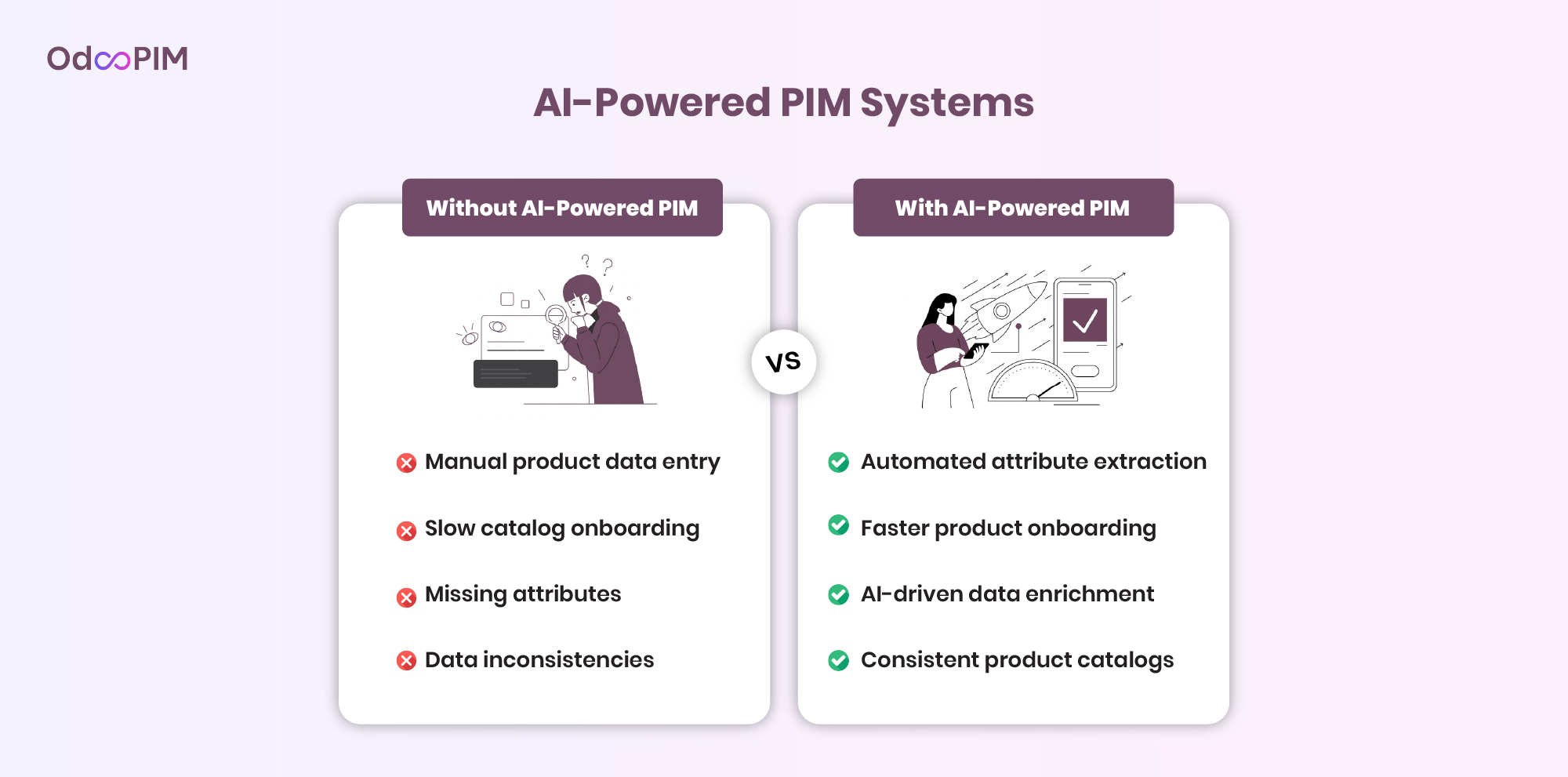
AI-powered PIM system platforms leverage agentic AI ecommerce to transform how merchants manage product information. Autonomous product onboarding begins when new items enter the system, machine learning product catalog agents extract specifications from supplier sheets, manufacturer images, and existing descriptions simultaneously. AI product data automation populates attributes, assigns categories, and validates information without human intervention. Products that once required days of manual setup now process within hours through autonomous AI agents ecommerce. Catalog expansion accelerates while error rates decline.
Attribute inference using ML enables AI ecommerce product catalog management systems to predict missing specifications from visual and textual patterns. Agentic AI for product information management identifies product characteristics, color, material, dimensions, that humans might overlook. Catalog improvement operates autonomously as autonomous AI for product data management agents monitor data quality, suggesting enrichments and flagging inconsistencies. Human-in-the-loop governance maintains oversight without slowing operations, merchants review critical decisions while routine tasks execute automatically through agentic AI ecommerce automation.
Agentic AI Ecommerce Automation Through PIM
Agentic AI ecommerce platforms deliver agentic AI ecommerce automation through continuous, autonomous catalog management. Auto-formatting product data per channel occurs without manual intervention, AI-powered PIM system agents adapt descriptions, images, and specifications to Amazon, Shopify, and eBay requirements simultaneously. Machine learning product catalog systems recognize that each channel demands unique formatting while maintaining core product integrity. Autonomous AI agents ecommerce handle these transformations instantly, eliminating channel-by-channel setup that previously consumed countless hours.
Detecting missing or incorrect attributes triggers automatic correction through agentic AI for product information management. When autonomous AI for product data management identifies incomplete specifications, it initiates AI product data automation workflows, pulling missing information from supplier databases, manufacturer sites, or historical patterns. AI ecommerce product catalog management improves as autonomous AI agents ecommerce learn from each enrichment cycle. Reducing manual catalog operations by 70-90% becomes achievable. Merchants shift from data entry to strategic oversight while agentic AI ecommerce automation maintains catalog quality 24/7.
According to Gartner, 90% of all B2B purchases will be handled by AI agents within three years, channeling more than $15 trillion in spending through automated exchanges.
– digital commerce
Autonomous AI for Product Data Quality & Governance
Autonomous AI for product data management maintains catalog integrity through data completeness monitoring. Agentic AI ecommerce agents scan every product record, calculating quality scores based on attribute presence, accuracy, and consistency. Machine learning product catalog systems identify gaps, missing dimensions, incomplete specifications, or vague descriptions, and prioritize fixes based on revenue impact. AI product data automation ensures merchants see which items require attention rather than auditing randomly. Quality becomes systematic rather than sporadic through autonomous AI agents ecommerce.
Error detection and self-correction operates within AI-powered PIM system environments. When agentic AI for product information management identifies pricing mistakes, attribute conflicts, or broken variant relationships, it initiates corrections automatically. Version control and approvals maintain trust and control in AI-driven systems, critical changes require human review while routine fixes execute autonomously. AI ecommerce product catalog management through agentic AI ecommerce automation provides complete audit trails showing every modification. Merchants retain governance without sacrificing speed, achieving reliability and autonomy simultaneously.

Machine Learning in Product Data Intelligence.
Machine learning product catalog systems excel at pattern recognition in product attributes that humans cannot perceive at scale. AI-powered PIM system platforms analyze thousands of product records simultaneously, identifying relationships between specifications, descriptions, and successful performance metrics. Agentic AI ecommerce agents detect that certain attribute combinations correlate with higher conversion rates or better search visibility. These patterns inform predictive enrichment, AI product data automation suggests missing attributes based on recognized patterns from similar products. Autonomous AI agents ecommerce refine these predictions as catalogs grow.
Learning from historical catalog updates enables agentic AI for product information management to improve autonomously over time. When merchants manually correct AI suggestions, autonomous AI for product data management incorporates those corrections into future decisions. AI ecommerce product catalog management systems become more accurate with every interaction. Preparing data for search, personalization, and ads happens automatically as agentic AI ecommerce automation optimizes attributes for each downstream system. Product information transforms from static records to dynamic intelligence assets that power every customer touchpoint.
Learn about ai ecommerce personalization
AI Product Data Automation at Scale
AI product data automation delivers faster time-to-market through agentic AI ecommerce agents that process new inventory. Machine learning product catalog systems extract attributes, assign categories, and validate information within hours rather than weeks. Autonomous AI agents ecommerce eliminate manual data entry bottlenecks that traditionally delayed product launches. Lower operational cost follows naturally as agentic AI for product information management replaces manual effort. Merchants scale catalogs without proportional headcount increases through AI-powered PIM system automation.
Consistent omnichannel product experiences emerge when autonomous AI for product data management syndicates identical information across the touchpoints. AI ecommerce product catalog management ensures Amazon, website, and social storefronts display matching descriptions, images, and specifications. Better downstream AI performance in search, recommendations, and ads results from agentic AI ecommerce automation providing inputs. Machine learning product catalog systems trained on complete data generate sharper predictions. AI product data automation creates compounding advantages, each downstream system performs better because upstream data quality improves.
Learn about pim for furniture retailers
How OdooPIM Enables Agentic AI Workflows
OdooPIM provides the centralized, structured product data that agentic AI ecommerce requires for autonomous operation. OdooPIM unifies every product record into a single source of truth. AI-powered PIM system architecture ensures machine learning product catalog agents receive complete, standardized attributes about colors, materials, dimensions, and relationships. Autonomous AI agents ecommerce depend on this foundation, without it, they cannot identify meaningful connections between items. OdooPIM delivers data that enables agentic AI for product information management.
Attribute-driven automation within OdooPIM allows autonomous AI for product data management to execute complex workflows independently. AI ecommerce product catalog management agents enrich attributes, normalize formats, and validate information automatically as products enter the system. Workflow approvals for AI actions maintain governance without slowing operations, critical changes route for human review while routine fixes execute through agentic AI ecommerce automation. OdooPIM provides the scalable foundation for autonomous agents, transforming catalogs into AI-ready assets that power every downstream system.

Key Takeaways on Agentic AI in Ecommerce
Agentic AI ecommerce represents the shift in how online retail operates. Autonomous AI agents ecommerce handle product classification, attribute enrichment, and channel syndication without human intervention. Yet these systems deliver results when built on structured foundations. AI-powered PIM system platforms provide the centralized data infrastructure that agentic AI for product information management requires. Machine learning product catalog agents cannot optimize what they cannot understand. AI product data automation succeeds when inputs remain complete and consistent.
The path forward demands autonomous AI for product data management paired with governance. AI ecommerce product catalog management through agentic AI ecommerce automation transforms operations from labor-intensive to capital-efficient. Merchants adopting this approach gain compounding advantages as catalogs grow and autonomous AI agents ecommerce learn from every interaction. Agentic AI ecommerce is not future speculation, it is current infrastructure separating market leaders from followers. The question is not whether to adopt agentic AI for product information management. The question is whether your product data is ready to support it.

FAQ
1. Can agentic AI manage product data without human intervention?
Agentic AI ecommerce platforms now manage product data autonomously across thousands of SKUs. Autonomous AI agents ecommerce classify products, extract attributes, and syndicate information without requiring human prompts. AI product data automation handles routine operations like variant grouping and category assignment. Machine learning product catalog systems learn from corrections, improving accuracy over time. Agentic AI for product information management monitors data quality, flagging only exceptions for human review. The system operates 24/7, processing new inventory instantly rather than waiting for manual attention. AI ecommerce product catalog management through autonomous agents reduces manual effort by 70-90% while maintaining quality standards.
2. How does PIM prevent agentic AI from making incorrect decisions?
AI-powered PIM system platforms provide the structured governance that prevents agentic AI ecommerce errors. Centralized product data ensures autonomous AI agents ecommerce receive complete, consistent attributes rather than fragmented information. Agentic AI for product information management operates within defined business rules encoded in the PIM. Validation workflows catch anomalies before they propagate across channels. Autonomous AI for product data management includes approval checkpoints for high-impact changes, pricing updates, category shifts, or critical attribute modifications. AI product data automation maintains audit trails showing every decision, enabling quick reversal if errors occur. PIM transforms machine learning product catalog systems from black boxes into governed, trustworthy automation.
3. Is agentic AI practical for mid-sized ecommerce businesses?
Agentic AI ecommerce has become infrastructure for mid-sized operations. AI-powered PIM system platforms offer tiered pricing accessible to businesses with 1,000-50,000 SKUs. Agentic AI ecommerce automation eliminates the need for proportional headcount growth as catalogs expand. Autonomous AI for product data management handles the data complexity that mid-sized merchants manage through spreadsheets. AI ecommerce product catalog management through autonomous AI agents ecommerce costs less than a single full-time employee while delivering greater consistency. Machine learning product catalog systems scale with business growth, preventing the operational breakdowns that traditionally occurred at expansion points. Mid-sized merchants gain enterprise capabilities without enterprise costs.
4. What product data attributes matter most for autonomous AI?
Structured attribute data forms the foundation for autonomous AI for product data management. Agentic AI ecommerce requires complete specifications, color, size, material, dimensions, technical specifications, to make decisions. Relationship attributes proving critical, which products complement others, which substitute for others, which belong in families. Machine learning product catalog systems need taxonomy data showing hierarchical relationships between categories. AI product data automation depends on consistent attribute formatting across the catalog. Agentic AI for product information management leverages historical performance data linking attributes to conversion rates. AI ecommerce product catalog management performs best when every product includes 20+ structured attributes rather than basic descriptions alone.
5. How does agentic AI improve long-term catalog scalability?
Agentic AI ecommerce transforms scalability by eliminating linear relationships between catalog size and operational effort. Autonomous AI agents ecommerce process 100,000 products with the same efficiency as 1,000. AI-powered PIM system platforms maintain data quality regardless of volume through AI product data automation. Machine learning product catalog systems improve with scale, more products mean more training data for better predictions. Agentic AI for product information management handles variant explosions automatically, maintaining relationships across thousands of SKU combinations. Autonomous AI for product data management prevents quality degradation during expansion. AI ecommerce product catalog management through agentic AI ecommerce automation ensures merchants scale from niche catalogs to extensive inventories without operational breakdowns or quality deterioration.