


Product Data Governance Done Right, with OdooPIM
No more inconsistent descriptions, duplicate SKUs, or delayed time-to-market. Trusted by 100+ businesses for product data quality management.
Trusted by reputed companies






Is your product data out of control?
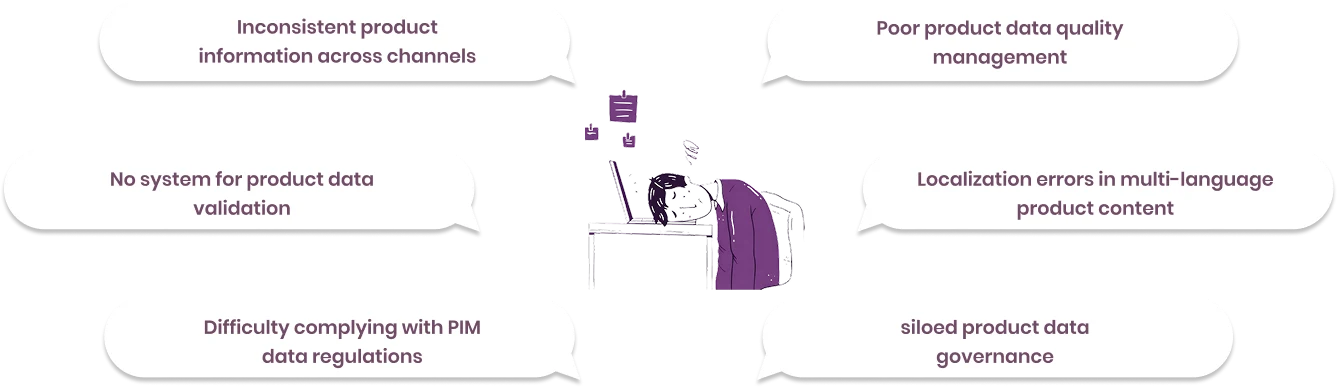
Key benefits of product data governance in OdooPIM

Product Data Validation
Validate product attributes against predefined rules and templates to ensure 100% data completeness.

Product Data Quality Management
Centralize and standardize product data from multiple sources to eliminate duplicates and correct inconsistencies.

PIM Data Regulations
Enforce compliance, such as RoHS, REACH, or FDA labeling, by embedding regulatory rules into product data workflows.

Product Localization Management
Adapt product specifications, measurements, and regional certifications for faster entry into new geographies.

Multi-Language Product Content
Manage product descriptions, tech specs, and marketing content in several languages for global sales channels.
Content Localization Costs
Cross-sell and upsell revenue
Product Returns
Who are the users of AI-powered PIM

Alice, CPO at a manufacturing company, uses OdooPIM to
- Maintain product integrity across markets
- Eliminate conflicting specifications between engineering, marketing, & sales.
- Automate management of thousands of SKUs, attributes, and variations.

Tom, head of marketing at a retail brand, uses OdooPIM to
- Synchronize product content and imagery on web, print, and marketplaces.
- Reduce errors, such as mispriced items or incorrect descriptions.
- Access localization tools for multi-language & multi-currency content.

Anitha, head of quality & compliance at an ecommerce company, uses OdooPIM to
- Embed compliance rules (RoHS, REACH, FDA, etc.) for traceability.
- Prevent non-compliant product data from being published.
- Maintaining version-controlled product specs in engineering, procurement, and sales teams.
Testimonial

Mister Art
Mister Art is a large online art and craft supply store. With thousands of SKUs, product variants, and vendor partners. They struggled to manage their data in online and offline stores, and wanted a cost-effective PIM they could deploy in weeks. OdooPIM helped them solve theis problem and more.
KEY HIGHLIGHTS
50000Number of SKUs uploaded
10000data points enriched
15sales channel integrations
Take the next step
See product data governance @ Work
Request a walkthrough to see how OdooPIM easily manages your product data.
Request a Call. Let’s Talk
Request an assessment call to discuss how OdooPIM enables product data validation, 32% faster.
Smart ROI Calculator
Calculate your OdooPIM investment and potential ROI in minutes with our estimator.
Frequently asked questions
Without product data governance, organizations face fragmented systems, duplicate SKUs, conflicting specifications, and costly delays. A single error, such as an incorrect weight, a mismatched BOM, or a missing compliance certificate, can trigger chargebacks, product returns, regulatory fines, or even recalls. Strong product data governance transforms product information from a source of operational friction into a strategic asset, enabling faster time-to-market, consistent customer experiences, and audit-ready compliance.
For example, validation rules can ensure that a product SKU includes mandatory attributes like weight, dimensions, material composition, and regulatory status. If a data entry fails any rule, the system flags it immediately, preventing incomplete or inaccurate data from propagating. This automated product data validation reduces manual correction efforts by up to 70%, eliminates inconsistencies between engineering and marketing teams, and ensures that product data quality management shifts from reactive cleanup to proactive prevention.
With a robust product data governance framework, organizations can define exactly which regulatory attributes, such as REACH, RoHS, FDA, or CE markings, are required for each product category. They can assign ownership to ensure compliance data is maintained by the right teams (e.g., quality, engineering, or regulatory affairs). Automated product data validation then enforces these rules, preventing non-compliant products from being published to e-commerce, print catalogs, or customer portals.
Furthermore, product data governance ensures full traceability. Every update to compliance data is logged with timestamps, user identities, and approval histories, creating an audit trail that satisfies regulatory bodies and customer quality audits.
Strong product data governance establishes clear rules for how localized attributes are created, approved, and syndicated. For example, a product sold in North America, Europe, and Asia may require different units of measurement, regulatory markings (UL, CE, CCC), and language-specific descriptions. Product localization management, when governed properly, ensures that these variations are managed from a single source of truth rather than duplicated spreadsheets or disconnected systems. This approach prevents inconsistencies, such as a product displaying metric measurements on a US site or missing region-specific compliance data, while enabling faster entry into new markets.
First, product data governance defines ownership for each language variant. For instance, the corporate marketing team may own English master content, while regional distributors own translations and cultural adaptations. This prevents conflicts and ensures accountability. Second, product data validation rules can enforce that before any product is published to a region, all mandatory language fields—such as product name, description, safety warnings, and regulatory disclaimers—are complete and approved. This prevents the common issue of products going live with incomplete or machine-translated content that could mislead customers or violate local laws.
PIM data regulations often require that multi-language content meet specific legal standards, such as ingredient labeling in the EU or hazard communication in North America. Governance ensures that these regulatory requirements are embedded into translation workflows, with automated checks to verify compliance before publication.