AI and ecommerce have become inseparable in 2026. What began as experimental chatbots and basic recommendation engines now powers core retail operations across the industry. Artificial intelligence for online retail analyzes customer behavior, automates product data management, and delivers personalized experiences at scale. Adoption rates tell the story: 73% of ecommerce businesses using AI report increased conversion rates. The technology has moved from competitive advantage to operational necessity.
This blog post examines how AI and ecommerce integration works behind the scenes. You will learn the mechanics of AI-driven personalization, see real implementation examples, and understand the data infrastructure required for success. Artificial intelligence for online retail delivers results only when built on clean, complete product information. We will show you what powers effective AI ecommerce and how to prepare your store for the personalization era.
What AI Means for Ecommerce Today
AI and ecommerce define how customers discover products online. Search functions powered by artificial intelligence for online retail interpret vague queries, typos, and natural language instantly. Rather than matching keywords, modern search understands intent, “birthday gift for mom who gardens” returns relevant products immediately. Discovery extends beyond search to browse pages that rearrange themselves around individual preferences. Customers find what they want faster, and stores capture sales that previously disappeared through zero-result searches.
Beyond discovery, AI and ecommerce transform operations through predictive analytics that forecast demand at SKU level. Personalization at scale delivers individualized experiences to millions simultaneously. Automation across ecommerce operations handles product data enrichment, inventory management, and customer service autonomously. Artificial intelligence for online retail has evolved from isolated features to the infrastructure powering every interaction. The technology no longer supplements ecommerce, it drives it.

AI in Ecommerce Personalization Depends on Clean Product Data
AI in ecommerce personalization fails when product data lacks completeness. Recommendation engines require rich attributes, color, material, size, style to identify meaningful connections between items. Without this information, algorithms suggest irrelevant products based on limited signals like category alone. AI and ecommerce systems trained on inconsistent data produce frustrating experiences that drive customers away.
AI in ecommerce personalization demands centralized product information as its foundation. Attributes, variants, and specifications must remain consistent across the channels. AI and ecommerce platforms pulling from fragmented data sources generate conflicting recommendations between websites and mobile apps. Centralized product information management ensures personalization algorithms receive complete, accurate inputs. The prerequisite for effective AI in ecommerce personalization is not better algorithms, it is better data governance. Clean product data transforms personalization from frustrating to magical.
By 2026, traditional search engine volume will drop 25%, with search marketing losing market share to AI chatbots and other virtual agents.
— Gartner
AI-Powered Product Management in Ecommerce
AI-powered product management transforms how merchants handle catalog operations. Automated product classification analyzes images and descriptions to assign accurate categories without manual intervention. The technology identifies product types, styles, and intended use cases from visual and textual data simultaneously. Attribute mapping and normalization extracts specifications from unstructured descriptions, pulling dimensions, materials, and colors into standardized fields automatically. AI and ecommerce integration eliminates the manual entry that consumed countless hours.
Variant and category intelligence enables systems to understand relationships between products intelligently. AI-powered product management recognizes that a blue medium shirt relates to the same item in red large, maintaining variant connections automatically. Bulk product updates using AI logic apply changes intelligently, updating attributes across catalogs based on pattern recognition rather than rigid rules. AI and ecommerce platforms executing these functions reduce time-to-market from weeks to hours. Product operations that required teams now run autonomously with greater accuracy.
Learn about PIM best practices to win in 2026

AI-Driven Ecommerce Automation
AI-driven ecommerce automation begins with automated product onboarding that eliminates manual data entry. When new products arrive, AI and ecommerce systems extract specifications from supplier sheets, manufacturer images, and existing descriptions simultaneously. The technology populates attributes, assigns categories, and prepares listings for publication without human intervention. Products that once required days of setup now go live within hours. Catalog expansion accelerates while error rates plummet.
Channel-specific content formatting represents another domain where AI-driven ecommerce automation delivers measurable value. The same product description reformats automatically for Amazon, eBay, Shopify, and social commerce requirements. AI and ecommerce platforms handle price and inventory data synchronization across every channel in real-time, preventing overselling and pricing discrepancies. Reduced manual operations free teams from repetitive updates to focus on strategy and growth. AI-driven ecommerce automation transforms ecommerce from labor-intensive to capital-efficient operations.
AI Product Data Optimization for Better Performance
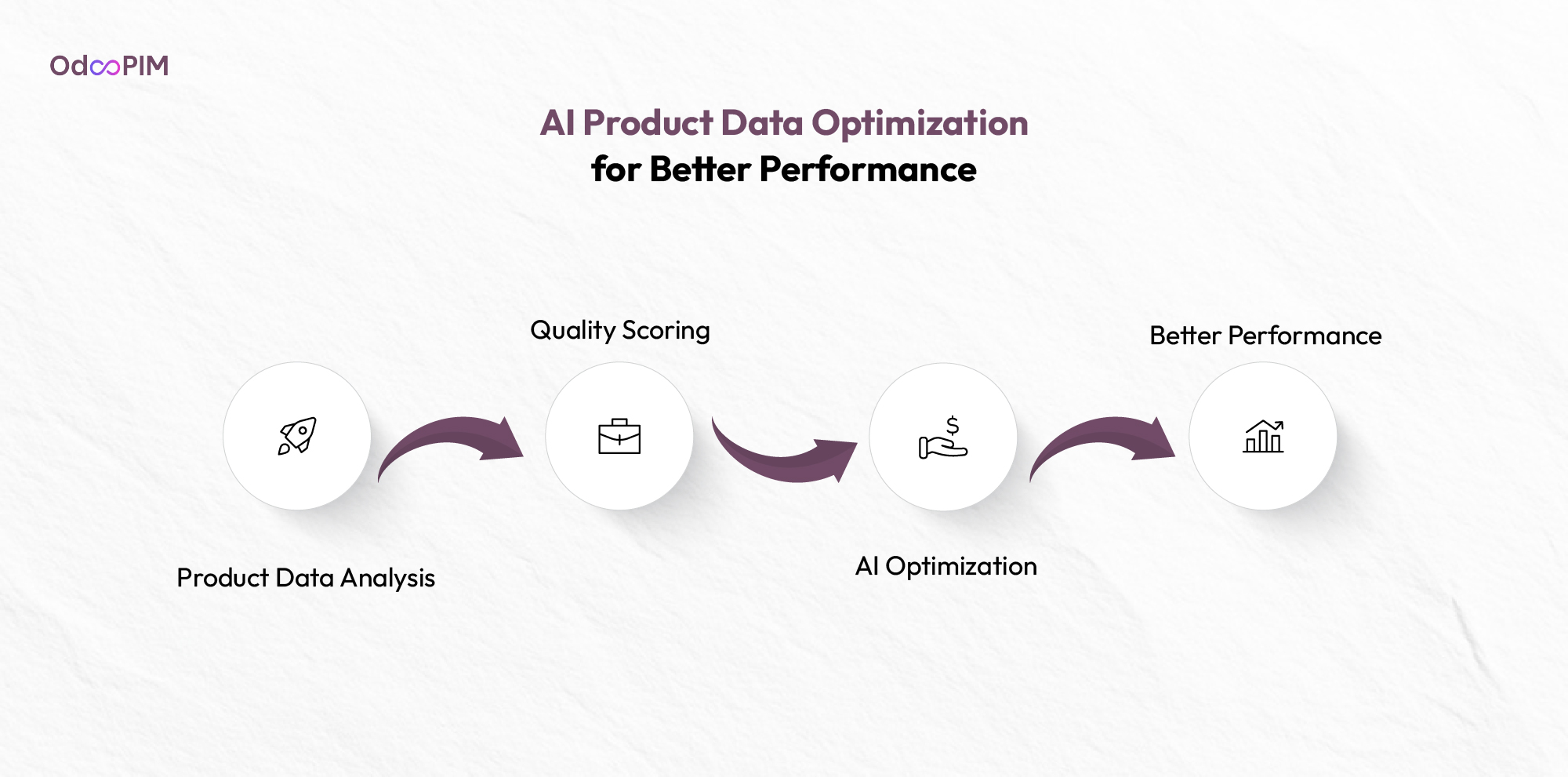
AI product data optimization begins with data completeness and quality scoring that evaluates product records automatically. AI and ecommerce systems scan descriptions, images, and attributes to identify gaps and inconsistencies. Each product receives a quality score highlighting missing information, weak descriptions, or problematic specifications. Merchants see which items require attention and prioritize fixes based on revenue impact. Optimization becomes systematic rather than random.
SEO-optimized product attributes emerge as AI product data optimization analyzes search patterns and competitor content. The technology suggests improved titles, enriched descriptions, and relevant keywords that increase discoverability. Error detection and correction operates continuously, catching pricing mistakes, attribute conflicts, and broken relationships before customers encounter them. Preparing product data for AI engines ensures recommendation systems and personalization algorithms receive the rich inputs they require. AI and ecommerce platforms performing these functions outperform competitors relying on manual optimization alone.

How OdooPIM Supports AI-Ready Ecommerce
OdooPIM lays the foundation for AI-ready ecommerce by centralizing product data, such as descriptions, variants, images, and attributes into a unified, structured repository that AI algorithms can easily ingest for automated enrichment and personalization.
With real-time synchronization to Odoo’s ecommerce, inventory, and sales modules, OdooPIM enables AI-driven features such as dynamic pricing, predictive recommendations, and multichannel content optimization, ensuring consistent, enriched product experiences across Shopify, Amazon, and custom storefronts without manual rework.
Upload millions of data points, enables partners to upload their data and structure and enrich all these data points, several times a day if necessary with OdooPIM. The product onboarder tool quickly uploads data, and can be scheduled to upload and sync data at a set frequency.
Learn about The 10 Best Product Information Management (PIM) Software for 2026
To wind up this blog post
AI and ecommerce have evolved from emerging technology to operational infrastructure in 2026. Artificial intelligence for online retail now powers discovery, personalization, and automation across successful stores. Yet the technology’s effectiveness depends on what feeds it. AI in ecommerce personalization fails without clean product data. AI-powered product management cannot optimize what it cannot understand. AI-driven ecommerce automation requires structured inputs to deliver results.
The path forward requires AI product data optimization as the prerequisite for everything that follows. Smart product data enrichment transforms information into AI-ready assets that recommendation engines and personalization algorithms use. Stores investing in smart product data enrichment gain compounding advantages as their catalogs grow. Those skipping this foundation watch AI investments underperform. The question is no longer whether to adopt AI and ecommerce capabilities. The question is whether your product data is ready to support them.

FAQ
1. How does AI handle inconsistent product data across multiple ecommerce channels?
AI and ecommerce platforms detect inconsistencies across channels by comparing product records against a centralized source of truth. Smart product data enrichment algorithms identify discrepancies in pricing, descriptions, and availability between your website, Amazon listing, and social storefront. The technology automatically reconciles differences by flagging anomalies and suggesting corrections based on predefined rules. AI product data optimization ensures the accurate version propagates everywhere. This prevents customers from encountering outdated inventory or mismatched pricing across touchpoints. AI-driven ecommerce automation maintains consistency without manual channel-by-channel auditing.
2. Can AI improve ecommerce performance without increasing ad spend?
Artificial intelligence for online retail optimizes existing traffic rather than acquiring more visitors. AI in ecommerce personalization increases conversion rates by showing each shopper products matching demonstrated preferences. AI-powered product management ensures search functions return relevant results, capturing sales that would otherwise disappear through poor discovery. Smart product data enrichment improves organic visibility through SEO-optimized attributes. These mechanisms lift revenue without additional acquisition costs. AI and ecommerce integration delivers 10-30% revenue increases from existing traffic by converting more of what you already have.
3. What type of product data is most important for AI-driven decision making in ecommerce?
Structured attribute data ranks highest for AI-driven ecommerce automation. Color, size, material, dimensions, and technical specifications enable recommendation engines to identify meaningful connections between items. Smart product data enrichment transforms unstructured descriptions into standardized attributes that algorithms process. Relationship data, which products complement others, which substitute for others, proves critical. AI product data optimization requires consistent taxonomy across the catalog. Without these fundamentals, AI and ecommerce systems make decisions based on incomplete signals. The attribute data transforms AI from basic pattern matching to genuine intelligence.
4. How does AI support scalability when an ecommerce catalog grows rapidly?
AI-powered product management handles exponential catalog growth without proportional headcount increases. When thousands of new SKUs arrive, smart product data enrichment extracts attributes, assigns categories, and validates information. AI product data optimization scales horizontally, processing 100,000 products with the same efficiency as 1,000. AI-driven ecommerce automation syndicates new inventory across channels simultaneously, eliminating channel-by-channel setup. Artificial intelligence for online retail maintains data quality standards regardless of volume. Merchants scale from niche catalogs to extensive inventories without operational breakdowns or quality degradation.
5. Is AI-powered ecommerce more effective for B2B or B2C businesses?
AI and ecommerce deliver transformative results for both models, though applications differ. B2C benefits from AI in ecommerce personalization, recommendation engines and individualized experiences driving impulse purchases. B2B gains leverage AI-powered product management for complex catalogs, contract-specific pricing, and account-based personalization. Smart product data enrichment proves crucial for B2B technical specifications and compliance documentation. AI-driven ecommerce automation handles B2B complexities like ordering, approval workflows, and recurring shipments. Artificial intelligence for online retail shows higher ROI in B2B because manual processes consume more resources. Both segments win, just differently.