
By 2026, Product Information Management Best Practices will transition from operational nicety to strategic necessity. The sheer complexity of commerce, driven by AI-powered channels, dynamic pricing, and digital experiences, makes a PIM system crucial. Adopting PIM best practices is the only way to master product data management at scale.
It transforms spreadsheets into a source of truth for product catalog management, ensuring consistent and compliant product content management across touchpoint. The Product Information Management process is now the engine for omnichannel product management. Mastering these product data management best practices is how brands will compete on experience, agility, and trust.
What Is the Product Information Management Process?
The Product Information Management process is a lifecycle that transforms data into a high-value commercial asset. It begins with the collection of inputs into a PIM system. This data is then enriched with marketing content, media, and specifications as part of product content management.
A validation phase ensures accuracy and compliance, adhering to key product data management best practices. The information is distributed to the sales channels, enabling omnichannel product management. Effective execution relies on roles, data owners provide inputs, stewards govern quality, and approvers authorize publication, making these PIM best practices fundamental to product catalog management.

Why PIM Best Practices Matter in 2026
Adhering to Product Information Management Best Practices is no longer optional; it is the cornerstone of competitive advantage. AI-powered commerce requires structured data to function, so your PIM system must provide this fuel. Rising omnichannel product management demands consistency everywhere, an output of disciplined product content management.
Data accuracy dictates conversion rates and customer trust. Investing in these product data management best practices delivers a clear ROI: it accelerates time-to-market, reduces costs from errors, and unlocks superior customer experiences. Mastering the Product Information Management process is the strategy for profitably scaling product catalog management in the landscape.
Product Information Management Best Practices 2026
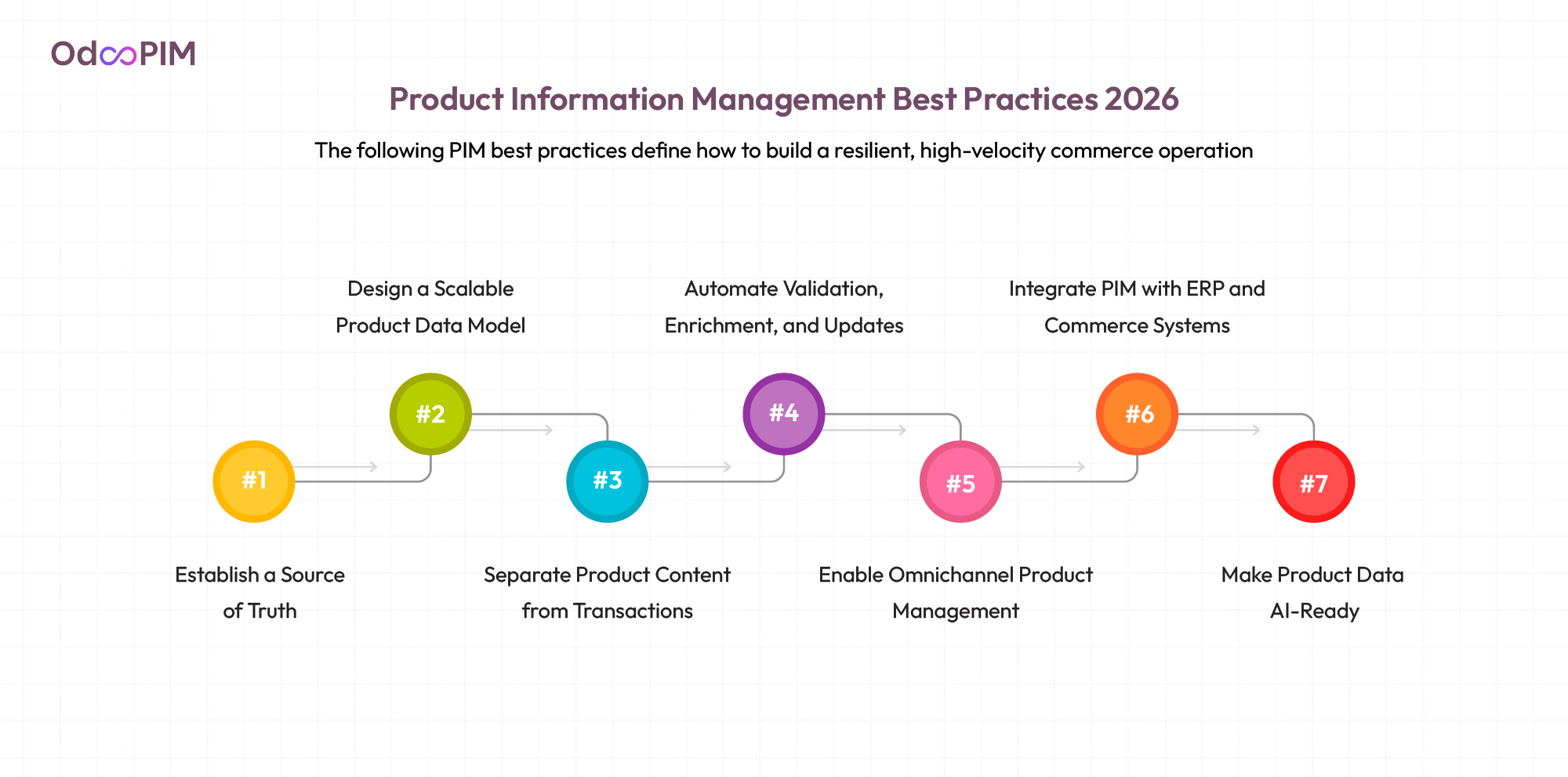
The following PIM best practices define how to build a resilient, high-velocity commerce operation.
1. Establish a Source of Truth
Centralize the information within a master PIM system. This is the step in the Product Information Management process, eliminating data silos and conflicts.
2. Design a Scalable Product Data Model
Architect a model in your PIM system to accommodate future categories and attributes, ensuring long-term product catalog management viability.
3. Separate Product Content from Transactions
Decouple product content management from transactional ERP data. This allows for independent marketing agility and streamlined operational updates.
4. Automate Validation, Enrichment, and Updates
Implement rules to enforce data quality (product data management best practices) and automate repetitive tasks, ensuring efficiency and accuracy at scale.
5. Enable Omnichannel Product Management
Use your PIM system to tailor and syndicate consistent product stories to a channel from a hub, delivering a unified customer experience.
6. Integrate PIM with ERP and Commerce Systems
Create a smooth data flow. This integration synchronizes operational facts with commercial narratives, powering a business engine.
7. Make Product Data AI-Ready
Structure and enrich your data to fuel AI tools for personalized search, dynamic content, and predictive analytics, turning your catalog into a strategic asset.

How OdooPIM Supports Modern PIM Best Practices
OdooPIM operationalizes leading Product Information Management Best Practices. Its PIM system architecture provides a hub for product content management, separated from transactional data to enable enrichment and agility. This design is fundamental to executing a Product Information Management process.
Native integration with Odoo ERP closes the loop between commercial storytelling and operational reality, a tenet of advanced product data management best practices. The platform enforces these PIM best practices through operations and configurable governance workflows, ensuring accurate product catalog management for omnichannel product management.
Common Mistakes to Avoid in 2026
Adopting Product Information Management Best Practices means avoiding important strategic errors. A pitfall is treating your PIM system as merely a product catalog management tool. This view ignores its main role in enabling omnichannel product management and product content management.
Another error is over-customizing the platform before standardizing main workflows, which creates fragility and hinders scalability. Ignoring formal data ownership and governance undermines the Product Information Management process. Without stewardship, even the PIM system will fail, as product data management best practices require accountability to maintain a source of truth.
In 2026, Product Information Management Best Practices are the competitive differentiator. They transform a basic PIM system from a repository into an active growth engine. By mastering the Product Information Management process, from disciplined data governance to AI-ready enrichment, you unlock product catalog management and omnichannel product management.
These product data management best practices ensure your product content management is not just consistent, but compelling and conversion-optimized across the touchpoint. The result is an agile operation that reduces costs, accelerates launches, and fuels revenue. Adopting these PIM best practices is how you turn product information into your valuable asset.
Learn about product data for ecommerce.
To win, serve, and retain customers, sellers must provide content that’s unique to a buyer’s locale, need, occasion, persona, and channel at every step of the customer journey.
– Forrester
OdooPIM Aligns with 2026 PIM Best Practices
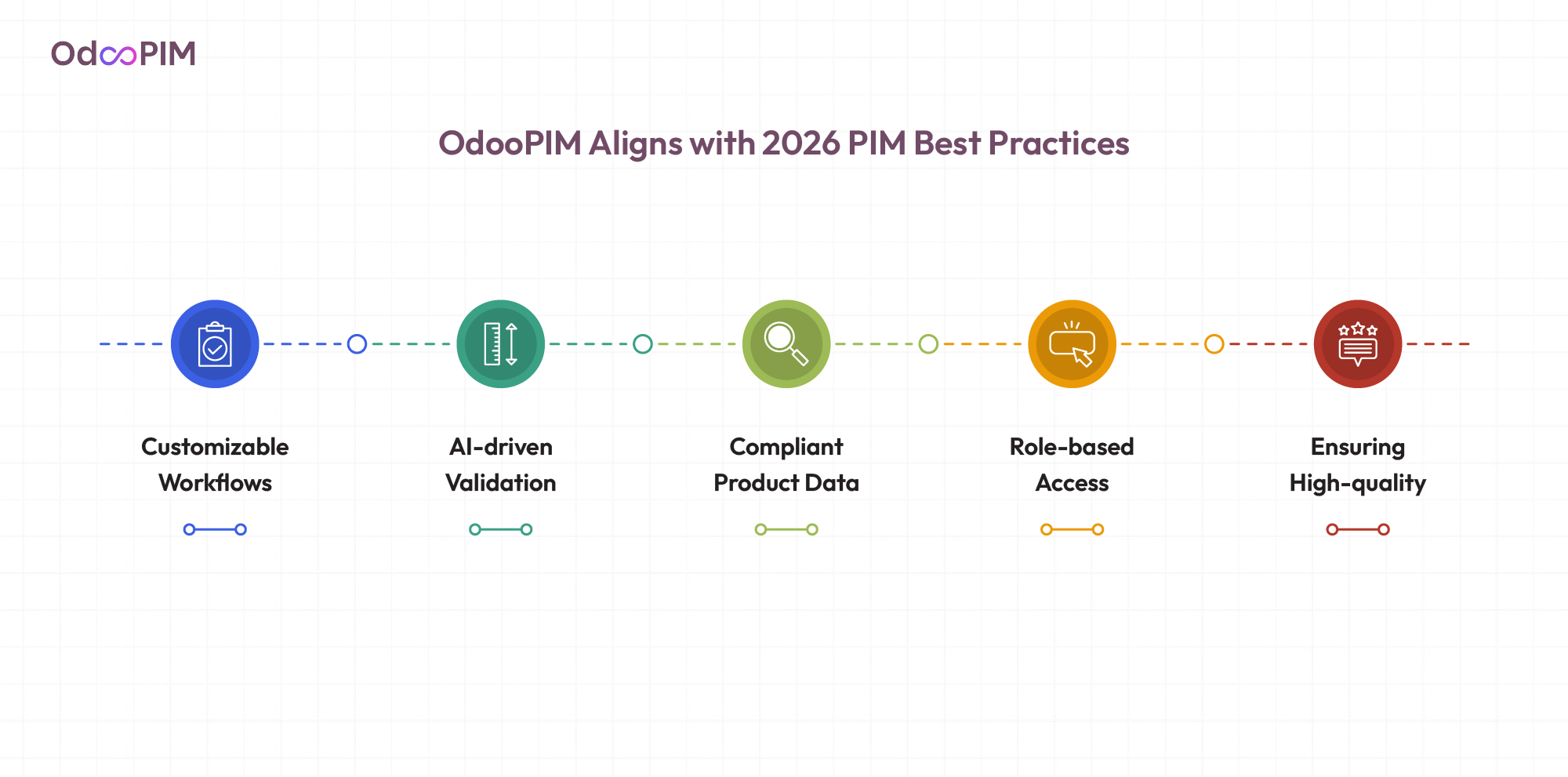
OdooPIM is a comprehensive solution that includes an onboarder, AI-data enrichment option, structuring of data and automation of sales channels. OdooPIM excels in 2026 for PIM best practices by establishing robust data governance through customizable workflows, role-based access, and AI-driven validation, ensuring high-quality, compliant product data across teams. Its native Odoo ERP integration delivers real-time synchronization, multichannel publishing, and automated enrichment with ML for attributes, translations, and SEO optimization. This reduces manual effort by up to 40% while supporting scalable variant management.
AI and Analytics for Competitive Edge
Leveraging AI assistants for predictive categorization, cross-sell suggestions, and inconsistency detection, OdooPIM fosters collaborative, analytics-driven insights via integrated dashboards for faster time-to-market and personalization. Flexible architecture with scheduler-based updates and omnichannel support (e.g., marketplaces, e-commerce) enables continuous improvement, making it ideal for manufacturing PIM needs like health equipment catalogs.

FAQ
1. Why is Product Information Management important for businesses in 2026?
In 2026, Product Information Management Best Practices are crucial for competitive commerce. As AI and personalization dominate, businesses require data to fuel these systems. A PIM system provides this foundation, transforming information into an asset. It is the engine for smooth omnichannel product management and efficient product catalog management. Without mastering the Product Information Management process, companies face operational bottlenecks, inconsistent customer experiences, and an inability to leverage new technologies, ceding market share to data-driven competitors.
2. What problems occur when product data is managed without a PIM system?
Operating without a PIM system leads to inefficiencies and errors that cripple growth. Teams drown in manual product data management, using error-prone spreadsheets that cause data silos, listing inaccuracies, and brand inconsistency across channels. This fractured approach makes omnichannel product management impossible and renders product data management best practices unattainable. The result is slowed time-to-market, poor customer experiences due to conflicting information, corrupted analytics, and escalating operational costs from constant error correction and compliance failures.
3. How does a PIM system support omnichannel product consistency?
A PIM system centralizes the data and assets for product content management in one master hub. From this repository, the platform syndicates validated information to the sales touchpoint, websites, marketplaces, social media, and POS systems. This architecture is the core of Product Information Management Best Practices for omnichannel product management. It guarantees that titles, descriptions, images, and attributes are consistent, building customer trust and delivering a brand experience without manual, channel-by-channel updates.
4. When should a growing business consider implementing PIM?
A business should implement a PIM system at the inflection point where manual product data management becomes a growth barrier. Key signals include expanding into new sales channels, managing a growing product catalog, experiencing frequent listing errors or compliance issues, and when marketing teams struggle with inefficient product content management. Implementing Product Information Management Best Practices before complexity spirals out of control provides the foundation needed for omnichannel product management and prevents operational debt that hinders future expansion.
5. How does structured product data improve AI-driven search and discovery?
By following product data management best practices within a PIM system, you create a normalized, and attribute product catalog. This structure allows AI algorithms to understand product relationships, features, and contexts. It enables semantic search, accurate personalized recommendations, and attribute-based filtering. Product Information Management Best Practices transform your catalog from a list into a queryable knowledge graph, enhancing on-site search relevance, discovery, and conversion rates.