What is AI for Ecommerce?
AI for ecommerce refers to machine learning technologies that automate, optimize, and personalize online retail operations. Unlike static rules-based software, AI solutions for ecommerce learn from customer behavior, inventory patterns, and market trends to make real-time decisions without human intervention.
AI powered ecommerce platforms analyze datasets instantly, predicting which products individual shoppers want, adjusting prices based on demand fluctuations, and forecasting inventory needs before stock runs low. These ecommerce AI solutions range from chatbots handling customer inquiries to recommendation engines that increase average order values by 10-30%.
An AI ecommerce platform integrates these capabilities into unified systems that manage everything from product data enrichment to supply chain optimization. The technology gives stores a 24/7 digital workforce that scales while delivering personalized experiences previously impossible at scale.
Core Areas Where AI Transforms Ecommerce
1. Product Information & Catalog Management:
AI for ecommerce automates product data enrichment by extracting attributes from images and descriptions. AI solutions for ecommerce like Odoo PIM eliminate manual entry errors through categorization and validation rules. These systems syndicate consistent product information across the sales channels simultaneously. Duplicate detection algorithms identify and merge redundant listings automatically. The result is a clean, accurate catalog that improves search visibility and customer trust.
2. Personalization & Customer Experience:
AI powered ecommerce engines analyze individual browsing behavior to serve hyper-relevant product recommendations in real-time. Search functions become intuitive, understanding shopper intent rather than just matching keywords. Dynamic pricing adjusts based on demand, inventory levels, and customer segments. Cart abandonment drops as AI triggers personalized exit offers and follow-up sequences.
3. Marketing Automation:
Ecommerce AI solutions determine optimal send times for each subscriber individually, boosting open rates significantly. Audience segmentation happens based on behavioral patterns and purchase history. Content generation tools create product descriptions, email copy, and ad variations without manual input. Campaign performance data feeds back into the system, refining targeting algorithms.
4. Inventory & Demand Forecasting:
AI for ecommerce analyzes historical sales data alongside seasonal trends and external market factors. Predictive algorithms forecast demand at the SKU level with remarkable accuracy, preventing costly stockouts. Reorder points trigger when inventory reaches predetermined thresholds. Overstock situations decrease as AI identifies slow-moving items before they become cash flow problems. The supply chain becomes proactive, responding to predicted demand.

Learn about product data management software.
Benefits of Implementing AI in Ecommerce
Faster time-to-market: AI for ecommerce automates product data preparation, cutting catalog setup from weeks to hours. AI solutions for ecommerce generate descriptions, extract attributes, and publish across channels simultaneously. New product launches that once required manual effort now happen in minutes rather than days.
Reduced operational cost: AI powered ecommerce eliminates manual data entry, chatbot-handled inquiries, and automated inventory tracking, reducing labor expenses by 30-50% while maintaining output. These savings compound as your catalog grows without proportional headcount increases.
Higher conversion rates: Personalized recommendations and dynamic pricing driven by an AI ecommerce platform increase average order values and reduce abandonment. Stores report 10-30% revenue lifts after implementing these capabilities.
Better cross-channel consistency: Ecommerce AI solutions syndicate accurate product information simultaneously, eliminating customer confusion from channel discrepancies. Shoppers encounter the same descriptions, images, and pricing whether on marketplaces, social media, or your storefront.
Improved customer trust: Real-time inventory accuracy and instant support responses build reliability. AI for ecommerce ensures customers see accurate stock levels and receive immediate answers, strengthening brand credibility. Repeat purchase rates increase when shoppers learn they can depend on your store.
Learn about AI for product data management.
Gartner projects AI agents will command $15 trillion in B2B purchases by 2028 Digital Commerce 360, with autonomous buying systems and machine-to-machine negotiation moving into the mainstream.
— Daryl Plummer, VP Distinguished Analyst & Chief of AI Research, Gartner
How to Choose the Right AI Ecommerce Platform
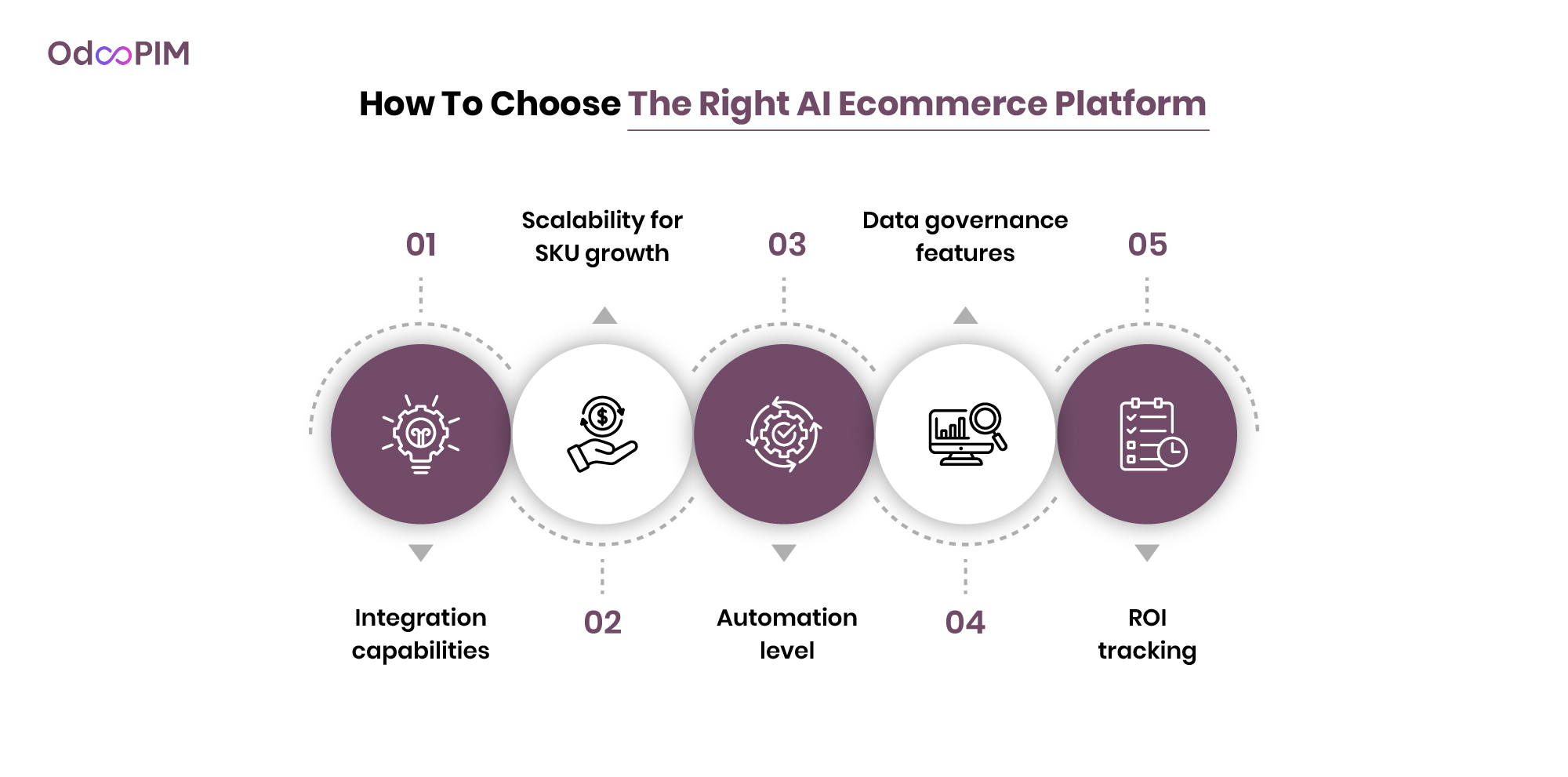
1. Integration capabilities
Your AI for ecommerce must connect with existing ERP, marketplaces, and CMS. AI solutions for ecommerce with pre-built connectors deploy faster and require zero custom development work. Verify bidirectional sync capabilities so updates flow both ways without manual intervention.
2. Scalability for SKU growth
The AI powered ecommerce platform should handle 100 or 100,000 products without performance degradation. Test how systems process updates before committing. Confirm that pricing tiers accommodate your three-year growth projection without forcing migration later.
3. Automation level
Ecommerce AI solutions eliminate work rather than creating dashboards you must still monitor constantly. Look for systems that take autonomous action based on rules, not just ones that send alerts requiring your response.
4. Data governance features
AI for ecommerce requires strict access controls, version history, and approval workflows. Ensure you control who edits what before publishing across channels. Audit logs should track every change for compliance and troubleshooting purposes.
5. ROI tracking
The AI ecommerce platform must provide clear analytics showing time saved, revenue increased, and errors eliminated. If you cannot measure impact, you cannot justify investment. Dashboard visibility into these metrics should be real-time, not quarterly reports.

The Future of AI in Ecommerce
Generative AI Revolution
AI for ecommerce will soon design product lines from trend data, generating images and descriptions before manufacturing begins. AI solutions for ecommerce become creative partners, not just operational tools. Product variations generate based on winning attributes. A/B testing happens in simulation before physical inventory exists, eliminating guesswork.
Conversational Commerce
Voice and chat interfaces powered by AI powered ecommerce will handle complex transactions end-to-end. Customers describe needs; the AI ecommerce platform locates, compares, and purchases without clicking. Upsells occur within conversation flow rather than pop-ups. Returns and exchanges process through simple dialogue, reducing friction completely.
Predictive Everything
Ecommerce AI solutions forecast customer lifetime value at first site visit, enabling acquisition spending. Inventory, pricing, and marketing optimize themselves continuously. Churn prediction triggers retention offers before customers abandon.
Autonomous Operations
AI for ecommerce manages stores, adjusting bids, responding to reviews, handling disputes, without human intervention. Owners focus on strategy while AI executes tactics smoothly. Competitor price changes trigger positioning adjustments. Customer service resolutions complete without tickets ever reaching humans.
Ethical AI & Privacy
Transparent algorithms and consent-based personalization become competitive advantages. AI powered ecommerce respects boundaries while delivering value, building trust through demonstrated data responsibility.
Extended Reality (XR)
Virtual try-on and product visualization merge with AI recommendations, letting shoppers experience products before purchase with photorealistic accuracy. Return rates drop as customers verify fit digitally first. Social sharing of XR experiences drives traffic as users showcase potential purchases with friends.
Why OdooPIM Is a Smart AI Solution for Ecommerce
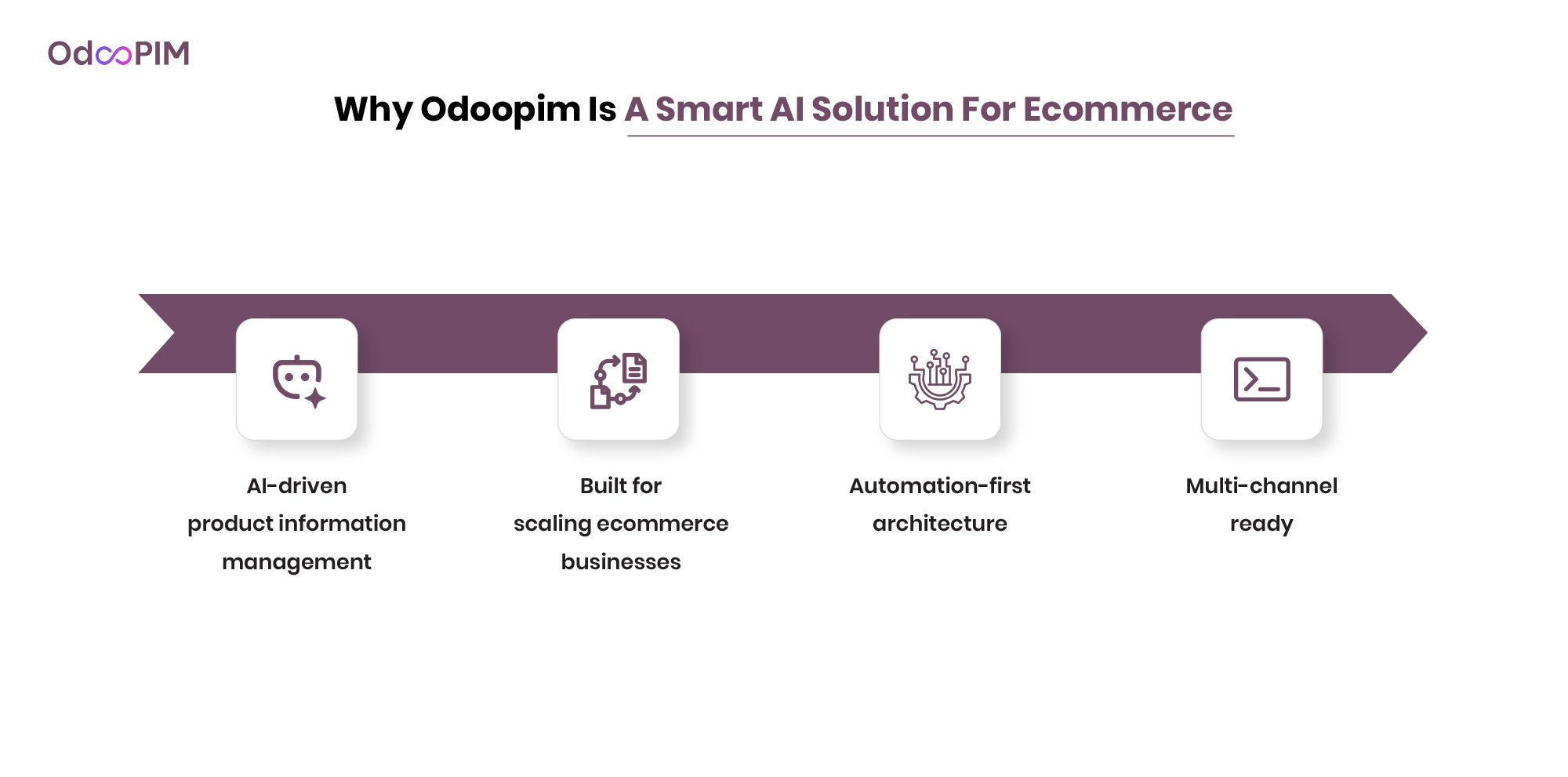
AI-driven product information management: OdooPIM embeds AI for ecommerce into product data workflows. AI solutions for ecommerce within the platform extract attributes from images, enrich descriptions, and categorize items without manual effort. Data quality improves as the system learns from corrections. Duplicate detection merges redundant listings automatically, ensuring catalog cleanliness at all times.
Built for scaling ecommerce businesses: Whether launching 100 or 100,000 SKUs, OdooPIM maintains performance. Natively built on Odoo, the solution grows with your catalog without requiring migration or reimplementation at any stage. Processing speed remains consistent regardless of data volume, even during peak season updates.
Automation-first architecture: As an ecommerce AI solution, OdooPIM handles enrichment, validation, and syndication autonomously while you focus on growth initiatives rather than spreadsheet management. Approval workflows trigger based on your defined rules, not random human availability.
Multi-channel ready: An AI ecommerce solution that syndicates consistent product information across marketplaces, social channels, and your storefront, OdooPIM eliminates channel discrepancies. Real-time updates push changes everywhere, ensuring customers never encounter outdated pricing or unavailable inventory.
Learn about Catalog management software

Best AI Tools for Ecommerce: Leveling the Retail Playing Field
AI for ecommerce determines which stores thrive and which stagnate. From product information management to personalized customer experiences, AI solutions for ecommerce deliver measurable advantages that manual operations cannot match. The best AI tools for ecommerce discussed throughout this post represent the minimum standard for competitive retail operations in 2026.
For small operations, the best AI tools for small ecommerce stores 2026 prove that enterprise capabilities are accessible. These AI tools for ecommerce business solutions eliminate the resource gap that once favored large retailers exclusively. AI powered ecommerce levels the playing field.
Implementing ecommerce AI solutions requires methodical selection based on integration needs, scalability requirements, and budget realities. But the selection process signals readiness to evolve. An AI ecommerce platform like OdooPIM demonstrates how automation-first architecture transforms product data management.

FAQ
1. How does AI help optimize product pricing strategies in ecommerce?
AI for ecommerce analyzes competitor pricing, demand fluctuations, and inventory levels to adjust prices in real-time. AI solutions for ecommerce identify optimal price points that maximize conversion rates and profit margins simultaneously. Dynamic pricing algorithms respond to market changes, preventing revenue loss during demand spikes. AI powered ecommerce platforms test thousands of price variations automatically, learning which strategies work for products. The result is automated pricing that outperforms manual adjustments while requiring zero human intervention.
2. Can AI detect fraudulent transactions in online stores?
AI for ecommerce identifies fraudulent patterns humans cannot spot across millions of transactions. Ecommerce AI solutions analyze purchase velocity, shipping mismatches, and device fingerprints to score risk levels. Suspicious activities trigger automatic holds or additional verification steps before processing completes. AI powered ecommerce platforms learn from false positives, reducing legitimate customer friction over time. Fraud detection accuracy improves with every transaction, protecting revenue while maintaining checkout conversion rates.
3. How does AI improve search accuracy on ecommerce websites?
AI for ecommerce understands shopper intent beyond keyword matching, interpreting typos, synonyms, and natural language queries effortlessly. AI solutions for ecommerce analyze click-through patterns to learn which results satisfy search terms. Product discovery improves as algorithms consider color, style, size, and context rather than text matches. AI powered ecommerce platforms personalize search results based on individual browsing history and purchase behavior. Zero-result searches decline as AI finds products even when customers lack vocabulary.
4. What role does AI play in automating product categorization?
AI for ecommerce examines product images, descriptions, and attributes to assign accurate category placements automatically. Ecommerce AI solutions extract visual features from photos, color, shape, pattern, to determine taxonomy positions. The technology learns from corrections, improving categorization accuracy across your catalog. AI powered ecommerce platforms maintain consistency by applying identical logic to every product, eliminating human variance. Large catalogs categorize in minutes rather than weeks, accelerating time-to-market significantly.
5. Can AI support multi-channel ecommerce selling across marketplaces and websites?
AI for ecommerce syndicates product information simultaneously to Amazon, eBay, Shopify, and social channels from one centralized platform. AI solutions for ecommerce adapt content format and specifications to each channel’s requirements automatically. Inventory syncs in real-time across selling venues, preventing overselling and stockout issues. AI powered ecommerce platforms monitor performance per channel, suggesting optimization opportunities based on comparative analytics. An AI ecommerce platform turns multi-channel complexity into a single, manageable operation.