The best omnichannel software centralizes product data, automates enrichment, and syndicates accurate listings across sales channels. Omnichannel software for ecommerce must handle channel-specific formatting, real-time inventory sync, and workflow approvals. Omnichannel product data software like OdooPIM integrates natively with your ERP, no middleware, no data drift. A best omnichannel ecommerce platform unifies catalog, inventory, and operations. Omnichannel commerce software replaces spreadsheets with automation. Multichannel ecommerce software without centralization guarantees inconsistency. PIM software for omnichannel is the foundation. Omnichannel product management software turns channel complexity into competitive advantage.
What Is Omnichannel Ecommerce Software?
Omnichannel software for ecommerce goes beyond basic multichannel. Multichannel means you sell on many channels, websites, Amazon, retail stores, but each operates independently. Omnichannel commerce software unifies product data, inventory, orders, and customer information behind the scenes. A customer checking stock on your mobile app sees the same availability as a store associate.
The software category covers product data sync (keeping specifications consistent everywhere), inventory management (real-time stock visibility across locations), order routing (fulfilling from the optimal warehouse), and customer data unification (purchase history follows the shopper across channels). Omnichannel product data software like OdooPIM centralizes everything. Multichannel ecommerce software adds channels. PIM software for omnichannel connects them. The best omnichannel product management software eliminates the manual work of managing separate systems. Your channels multiply. Your complexity shouldn’t.

Multichannel vs Omnichannel: What’s the Real Difference?
The distinction isn’t academic, it impacts your revenue. Multichannel ecommerce software lets you sell on multiple platforms, but each channel operates in isolation. Product data lives separately. Inventory sync is manual or batched. The result? Inconsistent specifications, pricing mismatches, and overselling. Customers notice. They return items. They leave bad reviews.
Omnichannel commerce software unifies everything behind the scenes. A single source of information for product data, inventory, and customer information. Update once. Every channel reflects the change instantly.
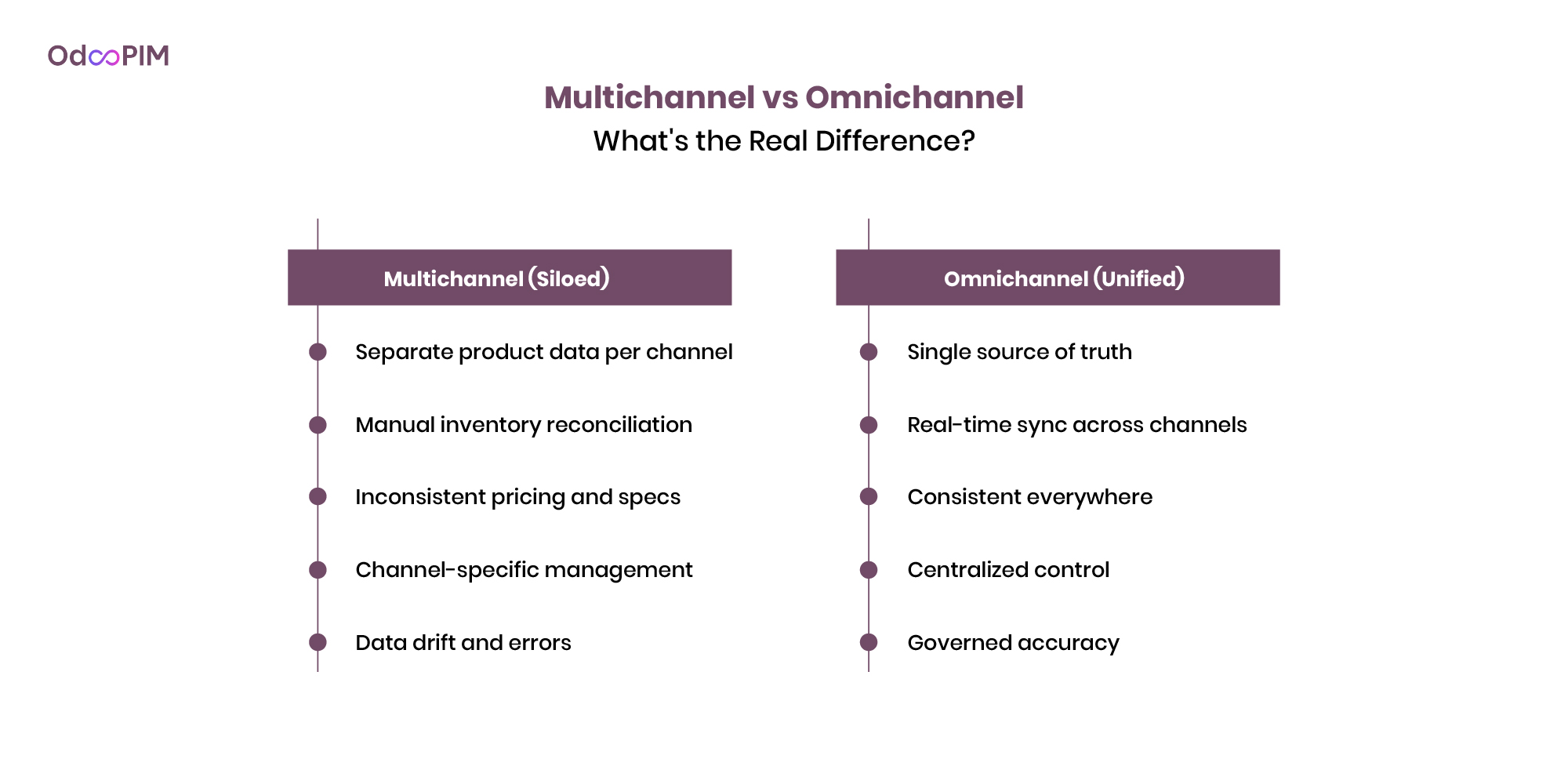
Best omnichannel software like OdooPIM deliver a unified approach. Omnichannel product data software eliminates inconsistent product data that causes returns and erodes trust. PIM software for omnichannel is the foundation. Omnichannel product management software turns channel complexity into competitive advantage. The business case is simple, omnichannel drives consistency, consistency drives trust and trust drives sales. Omnichannel software for ecommerce isn’t optional for growing brands, it’s essential infrastructure.
Why Most Ecommerce Brands Struggle with Omnichannel Execution
Your product descriptions on Amazon differ from your website. Inventory shows “in stock” online but the warehouse sold the last unit hours ago. Your team copy-pastes product data between spreadsheets and platforms, hoping nothing gets missed. Something always gets missed.
The root cause of omnichannel failure is always broken product data, not bad channel strategy. According to Forrester research, 18% of US shoppers returned an item because the product description was inaccurate . MIT Sloan research shows companies lose between 15% and 25% of annual revenue due to poor data quality. Gartner estimates the average annual organizational cost at $12.9 million. Omnichannel product data software solves the underlying data fragmentation that makes omnichannel execution so difficult.
Without PIM software for omnichannel, inconsistent product information creates customer confusion, and returns. Omnichannel product management software centralizes your data so every channel displays accurate, consistent information. Best omnichannel software like OdooPIM unifies catalog, inventory, and operations in one system. Omnichannel ecommerce software that doesn’t start with data centralization is just adding channels to a broken foundation.

Despite strong e-commerce growth, 76% of global retail sales will still occur offline in 2028 — which is why Forrester emphasizes that retailers must invest in omnichannel strategies delivering a seamless experience across both online and offline channels.
The Hidden Cost of Inconsistent Product Data
The costs of inconsistent product data are measurable. Two-fifths of shoppers return items because product details didn’t match their expectation. Two-thirds have abandoned a significant purchase because information was missing or inaccurate. Each return eats margin. Each abandoned cart is lost revenue. Multichannel ecommerce software without data centralization guarantees these outcomes.
Manual data entry adds another hidden cost. Adding a single product manually consumes 20–46 minutes. For 1,000 new SKUs, that’s 500 hours of team time. Hours your team could spend on strategy. Omnichannel product data software automates enrichment and syndication, eliminating manual work.
Inconsistent product data also damages your search ranking. Missing attributes mean algorithms cannot properly index your products. Customers cannot filter for what you sell. PIM software for omnichannel ensures complete, accurate data feeds every channel. Best omnichannel software like OdooPIM centralizes product data so inconsistencies never reach customers. Omnichannel product management software turns hidden costs into recovered revenue.
What to Look for in Omnichannel Ecommerce Software
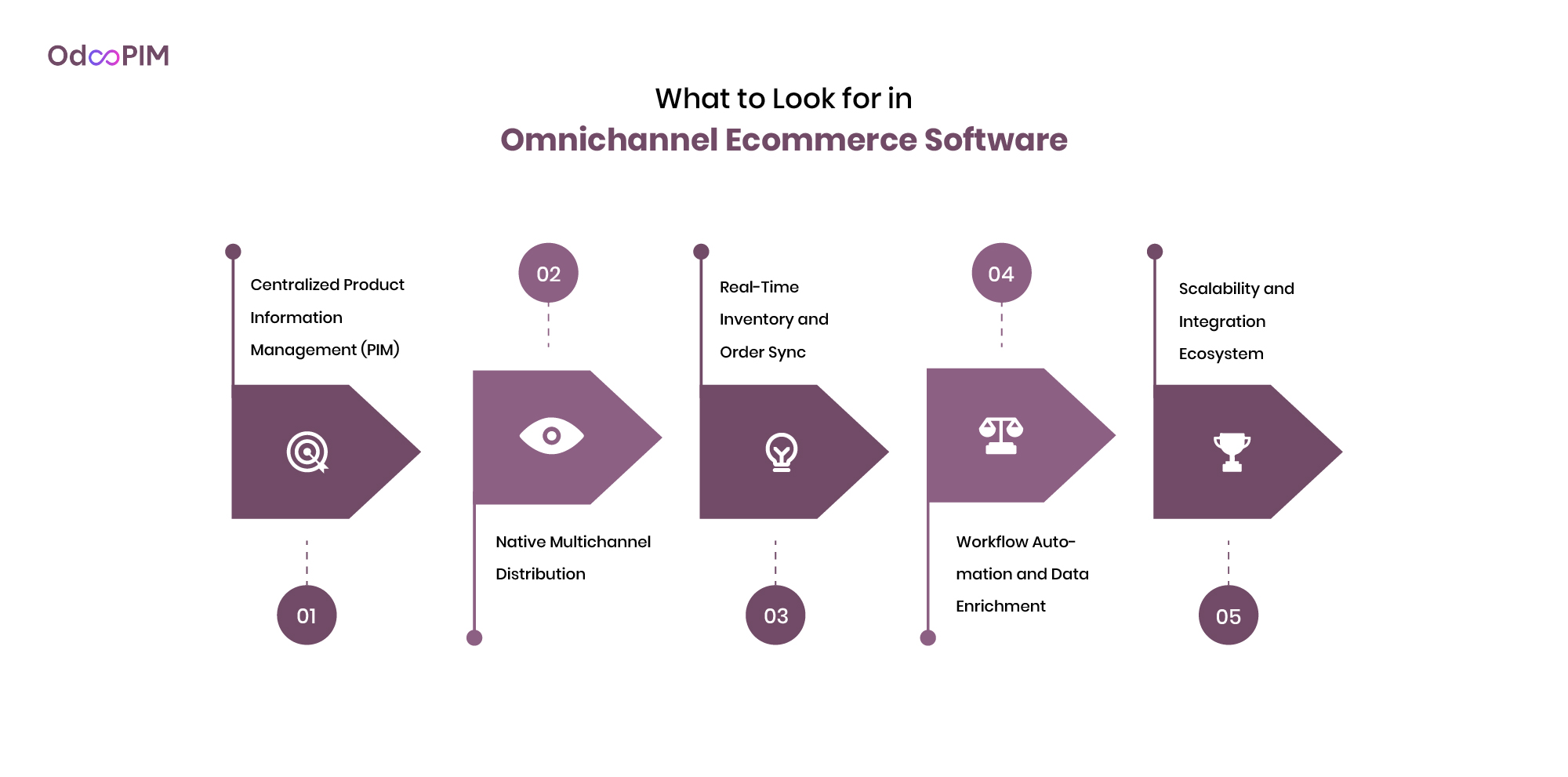
1. Centralized Product Information Management (PIM)
Your omnichannel software for ecommerce must start with a PIM at its core. Omnichannel product data software without centralization is just multichannel with more manual work. A PIM creates a repository where every product record lives, attributes, images, specifications, pricing. PIM software for omnichannel ensures your website, Amazon, and wholesale portals display the same governed information.
Centralized product data eliminates version conflicts and manual reconciliation. Your team updates once. Every channel reflects the change instantly. Best omnichannel ecommerce platform capabilities like OdooPIM embed PIM directly into your operational database. Omnichannel product management software without a PIM foundation will fail as your catalog scales.

2. Native Multichannel Distribution
Omnichannel commerce software must publish to every channel natively, not through CSV exports or third-party connectors. Multichannel ecommerce software with native distribution handles channel-specific formatting. Amazon receives flat descriptions optimized for search. Your website gets rich content with images and comparison charts. Wholesale portals see case quantities and B2B pricing. All from one master record.
Native distribution eliminates manual reformatting. Your team writes once. The system adapts for each channel. Omnichannel ecommerce software like OdooPIM offers pre-built connectors for Shopify, WooCommerce, Magento, Amazon, and Walmart Marketplace. Best omnichannel software handles the variations so you don’t have to. Without native distribution, your team becomes the integration layer. That doesn’t scale.
3. Real-Time Inventory and Order Sync
Real-time sync separates omnichannel product data software from basic multichannel tools. When inventory updates in your ERP, your catalog must reflect it instantly, not on a scheduled batch. Omnichannel commerce software with real-time sync prevents overselling and customer frustration. A shopper adds to cart, but if another channel sold the last unit seconds ago, the system knows immediately.
Real-time sync applies to pricing, orders, and product data. Best omnichannel ecommerce platform capabilities push changes to every channel. Multichannel ecommerce software with batch updates creates data drift. Your website shows “in stock” while Amazon is already sold out. Omnichannel software for ecommerce must prioritize real-time accuracy.
4. Workflow Automation and Data Enrichment
Omnichannel product management software must automate enrichment and workflow approvals. PIM software for omnichannel with AI-assisted attribute filling completes missing specifications automatically. Completeness scoring shows what gaps remain before publication. Workflow rules route new products through approval steps, marketing signs off, compliance verifies, pricing approves.
Workflow automation eliminates email chains and spreadsheet attachments. Omnichannel ecommerce software with task assignments, due dates, and notifications keeps everyone aligned. Best omnichannel software like OdooPIM compresses launch cycles from weeks to days. Your catalog grows faster because processes move work forward, not sideways. Without automation, your team becomes the bottleneck. Automation turns catalog maintenance from reactive firefighting into proactive growth.
5. Scalability and Integration Ecosystem
Omnichannel commerce software must scale with your business. Today’s 500 SKUs should not require a platform migration at 5,000. Best omnichannel ecommerce platform capabilities handle hundreds of thousands of products without performance degradation. Multichannel ecommerce software that works for small catalogs often breaks under growth.
Your omnichannel software for ecommerce must connect to your ERP, ecommerce platform, marketplaces, and logistics systems. PIM software for omnichannel with API-first architecture integrates smoothly. For Odoo users, OdooPIM offers native integration, no middleware, no sync delays. Omnichannel product data software that requires custom API development for every connection adds complexity, not efficiency.
Learn about multi channel ecommerce platform
The Best Omnichannel Software for Ecommerce Brands: Compared
| Software | Best For | PIM Included | Multichannel Sync | Odoo Integration | Pricing Model |
| OdooPIM | Odoo users, integrated operations | ✅ Native | ✅ Native connectors | ✅ Same system | Transparent tiered |
| Akeneo | Enrichment-heavy enterprise catalogs | ✅ Yes | 🔶 Via connectors | 🔶 Via connector | Enterprise quote |
| Salsify | Retailer syndication & compliance | ✅ Yes | ✅ Strong syndication | 🔶 Via connector | Enterprise quote |
| Pimcore | Open-source flexibility | ✅ Yes | 🔶 Custom API | 🔶 Via connector | Open source + paid |
| Contentserv | Product experience management | ✅ Yes | 🔶 Via connectors | 🔶 Via connector | Enterprise quote |
Omnichannel software for ecommerce varies widely in architecture. The best omnichannel ecommerce platform for Odoo users is OdooPIM, native ERP integration eliminates middleware. For non-Odoo merchants, Akeneo or Salsify may fit enterprise needs. Multichannel ecommerce software without PIM cannot deliver omnichannel.
Why OdooPIM Is Built Differently for Ecommerce Brands
OdooPIM is not a standalone PIM bolted onto your stack. It is built natively on Odoo, meaning omnichannel product data software shares the same database as your ERP, inventory, and operations. No middleware, no sync delays, no data drift between your catalog and your business systems.
Key differentiators: Native ERP + PIM in one platform. Designed for mid-market ecommerce brands managing complex catalogs across multiple channels. Omnichannel commerce software with multichannel-ready connectors for Shopify, Amazon, WooCommerce, and wholesale portals. Product data enrichment workflows and completeness scoring built in.
Real-world use case: A fashion retailer managing 8,000 SKUs across Shopify and Amazon reduced catalog update time by 75% using OdooPIM. Manual enrichment dropped from 30 minutes per SKU to automated attribute completion. Launch cycles compressed from two weeks to two days.
For Odoo users, omnichannel product management software doesn’t require a separate platform. It’s the PIM capability already inside the system you own. For non-Odoo merchants, evaluate based on integration depth. But for Odoo users, OdooPIM is the clear choice.
How to Choose the Right Omnichannel Software for Your Business
Ask every vendor these questions before signing. The answers reveal whether their omnichannel software for ecommerce fits your operations.
1. Does it include native PIM, or do we need separate software? PIM software for omnichannel is the foundation. Without it, you’re just adding channels to broken data. Best omnichannel ecommerce platform capabilities start with centralized product data.
2. How does it handle channel-specific data formatting? Amazon needs different content than your website. Omnichannel product data software should apply formatting rules automatically, not require manual exports. Ask for a demo of syndication to multiple channels from one master record.
3. What does onboarding actually look like? Timeline matters. Some multichannel ecommerce software takes months to implement. Others deliver value in weeks. Ask about data migration support, training, and go-live process.
4. What’s the integration path with our existing ERP? This is the most underweighted factor. Omnichannel commerce software that requires custom API development or middleware adds complexity and cost. For Odoo users, OdooPIM offers native integration. For others, verify connector depth before committing.
5. How does pricing scale with our catalog growth? Per-SKU fees punish growth. Best omnichannel software offers transparent pricing that scales predictably. Ask about annual increases, implementation costs, and hidden fees.
6. What does support and maintenance include? When something breaks, who fixes it? Omnichannel ecommerce software vendors with dedicated support teams and SLAs protect your operations. Avoid vendors where support means community forums and delayed responses.
Omnichannel product management software should make your team more efficient, not add vendor management overhead. Use these questions to evaluate honestly. The right fit transforms operations. The wrong fit creates another system to manage. Choose accordingly.

Frequently Asked Questions
1. What is omnichannel ecommerce software?
Omnichannel ecommerce software unifies product data, inventory, orders, and customer information across sales channels from a single platform. Unlike basic multichannel ecommerce software where channels operate independently, omnichannel creates a smooth experience behind the scenes. A customer checking stock on your mobile app sees the same availability as a store associate. Omnichannel product data software ensures consistent specifications everywhere. PIM software for omnichannel is the foundation. The best omnichannel commerce software like OdooPIM centralizes catalog, inventory, and operations, eliminating the manual work of managing separate systems. Your channels multiply. Your complexity shouldn’t.
2. How is omnichannel software different from multichannel software?
Multichannel ecommerce software lets you sell on multiple platforms, website, Amazon, retail stores, but each channel operates independently. Product data lives separately. Inventory sync is manual or batched. Omnichannel software for ecommerce unifies everything behind the scenes. A single source of truth for product data, inventory, and customer information. Update once. Every channel reflects the change instantly. Best omnichannel software like OdooPIM eliminates inconsistent product data, pricing mismatches, and overselling. Omnichannel commerce software connects channels. Multichannel just adds them.
3. Why is product data management critical for omnichannel success?
Omnichannel product data software is the foundation of every successful omnichannel strategy. Without accurate, consistent product information across every channel, customers encounter conflicting specifications, missing attributes, and pricing mismatches. Two-fifths of shoppers return items because product details didn’t match reality. Two-thirds have abandoned a purchase because information was missing. PIM software for omnichannel ensures your website, Amazon, and physical stores all display the same governed content. Best omnichannel ecommerce platform capabilities start with centralized product data. Omnichannel product management software without data consistency guarantees returns, lost trust, and abandoned carts.
4. Can OdooPIM integrate with Shopify, WooCommerce, and Amazon?
OdooPIM offers native connectors for Shopify, WooCommerce, Magento, Amazon, and wholesale portals. Omnichannel commerce software with native distribution handles channel-specific formatting automatically. Amazon receives flat descriptions optimized for search. Your Shopify store gets rich content with images. WooCommerce receives structured attributes. All from one master record. Omnichannel product data software like OdooPIM eliminates manual exports and CSV uploads. Update once. Every channel reflects the change instantly. For Odoo users, best omnichannel software means native ERP integration, no middleware, no sync delays. Omnichannel ecommerce software without native connectors forces your team to become the integration layer. OdooPIM handles the variations so you don’t have to.
5. What size ecommerce business needs omnichannel software?
Omnichannel software for ecommerce becomes essential once you sell on two or more channels and manage over 500 SKUs. Below these thresholds, manual processes may still work. Above them, spreadsheets break. Version conflicts multiply. Inconsistent product data causes returns and abandoned carts. Multichannel ecommerce software without centralization guarantees these outcomes. Best omnichannel ecommerce platform capabilities like OdooPIM serve mid-market brands managing 500–50,000 SKUs across multiple channels. PIM software for omnichannel scales with your catalog, handling hundreds of products today and thousands tomorrow without platform migration. The right time to adopt omnichannel software is before your manual processes break. Waiting costs revenue.