What Is an Ecommerce Order Management System (OMS)?
Definition and scope
An ecommerce order management system is software that captures, processes, and tracks orders from the moment a customer clicks “buy” until the package arrives at their doorstep. The OMS platform handles order routing to warehouses, inventory allocation, fulfillment coordination, and returns management across multiple sales channels. Order management system ecommerce solutions integrate with your website, marketplaces, and physical stores to provide a unified view of all ecommerce orders regardless of where they originated. Online order management system capabilities are essential for any seller handling more than 100 orders daily, because manual order processing simply does not scale. The OMS order management system is the engine that keeps your fulfillment operations running smoothly.
Core OMS functions: order capture, routing, fulfillment, returns
Order management in ecommerce starts with order capture, where the ecommerce order management solution ingests orders from your website, Amazon, eBay, and other channels into a single queue. The commerce order management system then routes each order to the optimal fulfillment location based on inventory availability, shipping cost, and customer proximity. Fulfillment coordination pushes orders to warehouses or dropshipping partners, generates shipping labels, and tracks delivery status. E-commerce order management system returns management handles refunds, exchanges, and return shipping logistics. Order management systems also manage inventory allocation across channels, preventing overselling by syncing stock levels in real time. Without these core functions, ecommerce orders would be processed manually, leading to errors, delays, and customer frustration.
What an OMS cannot do on its own
An OMS platform can route orders to warehouses, but it cannot validate that the product data it receives is accurate or complete. The order management system ecommerce relies entirely on the product information fed into it, if a SKU is missing dimensions, the OMS cannot calculate correct shipping weights, leading to wrong courier rates and delayed dispatch. Ecommerce order management system solutions cannot enrich product descriptions, add missing variant attributes, or ensure that product data is consistent across the sales channels before orders are captured. Online order management system tools also lack the ability to validate product listings against channel requirements, so missing GTINs or incorrect category attributes can trigger listing rejections at the channel level before the OMS ever sees the order. The order management in ecommerce workflow breaks when the product data feeding the OMS is incomplete or inconsistent, because garbage in equals garbage out in fulfillment.
Learn about PIM Software for eCommerce

Where OMS Fulfillment Failures Actually Begin
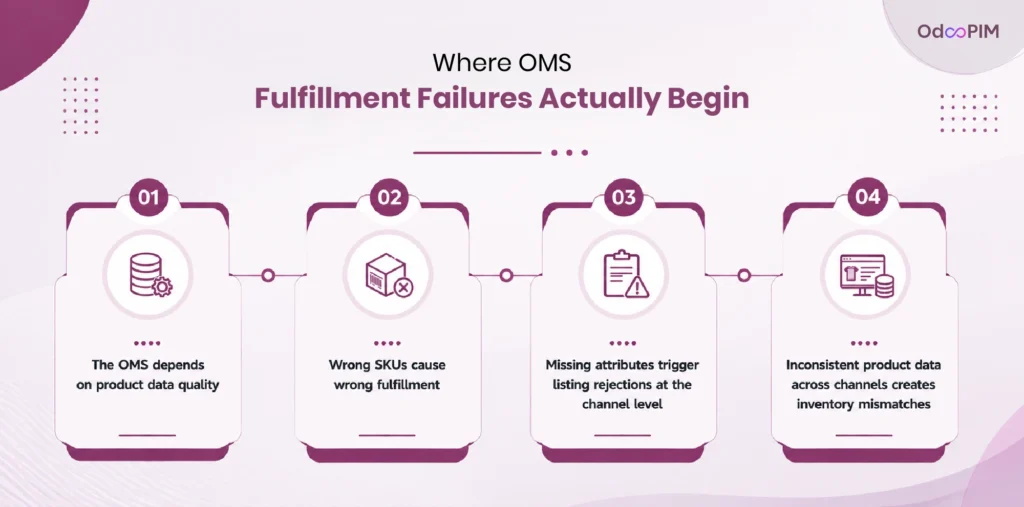
The OMS depends on product data quality
Ecommerce order management systems are only as reliable as the product data they process, because every fulfillment decision, shipping weight, carrier selection, warehouse assignment, depends on accurate product attributes. The OMS platform cannot compensate for missing dimensions, incorrect weights, or inconsistent SKUs across channels, so poor product data upstream inevitably causes fulfillment failures downstream. Order management system ecommerce performance hinges on data quality because the OMS makes decisions based on what you tell it about your products. If your product data is incomplete, your ecommerce orders will be fulfilled incorrectly, leading to customer complaints, returns, and lost revenue. Order management systems cannot fix data problems they cannot see.
Wrong SKUs cause wrong fulfillment
When product data is inconsistent across channels, the OMS order management system receives mismatched SKU information that leads to duplicate orders, inventory mismatches, and overselling. An online order management system that cannot reconcile SKU discrepancies will route orders to the wrong warehouse or pick the wrong product variant, causing fulfillment errors that anger customers. The order management system for ecommerce relies on clean SKU data to match orders to inventory, but if the same product has different SKUs on Amazon versus your website, the commerce order management system sees two different products, not one. Ecommerce order management solution failures often trace back to SKU inconsistency that originated in product data preparation, not in the OMS itself. Fix the SKU data upstream, and the OMS handles fulfillment correctly.
Missing attributes trigger listing rejections at the channel level
Order management in ecommerce requires complete product attributes at the point of listing creation, because Amazon, Walmart, and other channels reject incomplete product feeds before they ever generate orders. The ecommerce order management system cannot capture orders for products that were never listed due to missing GTINs, brand names, or category attributes. E-commerce order management system integration with channels depends on clean data submission, and when attributes are missing, listings are suppressed or rejected entirely. Order management systems cannot create orders for products that do not exist in the channel catalog, so missing attributes upstream directly impact order volume downstream. Complete product data in the PIM ensures listings go live and orders flow to the OMS.
Inconsistent product data across channels creates inventory mismatches
When product data varies across sales channels, different sizes, different SKUs, different availability flags, the ecommerce order management system struggles to maintain accurate inventory synchronization. An OMS platform that receives conflicting inventory signals will either oversell products that are out of stock or fail to sell products that are available. Order management system ecommerce inventory accuracy depends on consistent product identification across all channels, because the OMS uses SKUs to track stock levels. Online order management system users often discover that the root cause of inventory mismatches is inconsistent product data across channels, not OMS failures. Align product data upstream, and the OMS can maintain accurate inventory across the sales channels.
Learn about Best PIM Software for Ecommerce
| Root Cause | What the OMS Sees | Fulfillment Outcome |
| Incorrect product dimensions | Inaccurate shipping weight | Wrong courier rate, delayed dispatch |
| Missing variant attributes | Incomplete order line | Fulfillment error, customer complaint |
| Mismatched SKUs across channels | Duplicate or unmatched orders | Inventory mismatch, oversell |
| Outdated product availability | Stale stock signal | Order accepted on out-of-stock item |
| Incomplete product data feed | Partial product sync to OMS | Listing rejected or unpublished |

What Is a PIM System and Why It Sits Upstream of Your OMS
PIM definition and scope
A Product Information Management (PIM) system centralizes, enriches, and validates product data before it reaches your ecommerce order management system, ensuring that every SKU has complete attributes, accurate dimensions, and consistent channel-ready content. PIM for ecommerce manages product descriptions, images, variant relationships, and channel-specific formatting that the OMS relies on for accurate fulfillment. Unlike spreadsheets, a PIM enforces data quality rules at the source, preventing bad data from ever reaching your OMS platform. Ecommerce order management success begins with product data quality, and PIM ensures that quality from the start.
How PIM feeds the OMS with clean, validated product data
The PIM syndicates enriched, validated product data directly to your order management system ecommerce, ensuring that every SKU has complete dimensions, correct weights, and consistent attributes before orders are captured. Online order management system integration with PIM means that product data flows from the master catalog to the OMS automatically, eliminating manual data entry and the errors that come with it. Order management system for ecommerce performance improves when the OMS receives clean data because fulfillment decisions are based on accurate product information. Commerce order management with PIM-upstream means that listing rejections and fulfillment errors caused by bad data are eliminated before they start.
PIM vs. spreadsheets: why manual data prep breaks OMS workflows
Spreadsheets have no validation rules, no data types, and no relationships, so manual product data preparation inevitably introduces errors that break ecommerce order management workflows. Ecommerce order management solution teams spend hours reconciling spreadsheet versions, fixing missing attributes, and correcting inconsistent SKUs that cause fulfillment failures. Order management in ecommerce with spreadsheet-driven product data means garbage data reaches the OMS, causing wrong shipping weights, mismatched SKUs, and listing rejections. E-commerce order management system performance suffers because spreadsheets cannot enforce completeness or consistency at scale, and the OMS inherits every spreadsheet error. PIM eliminates the spreadsheet chaos that breaks OMS workflows.
What ecommerce product data enrichment looks like in practice
Ecommerce orders depend on enriched product data that includes complete dimensions, accurate weights, standardized SKUs, and channel-specific descriptions that the OMS uses for fulfillment. Product data enrichment in a PIM means adding missing attributes like material composition, care instructions, or technical specifications that the OMS platform needs for accurate order routing. Order management systems benefit from enriched data because complete product information enables better warehouse assignment, shipping calculation, and returns handling. Ecommerce order management system performance improves with enriched data because the OMS can make better fulfillment decisions. Enrichment happens in the PIM, not in the OMS.
Learn about Ecommerce Catalog Management
Data Quality Crisis 83% of businesses struggle with product data that is incomplete, inconsistent, or outdated.
– Forrester
How PIM and OMS Integration Works in an Ecommerce Tech Stack
The data flow — PIM → OMS → fulfillment → channel
Product data flows from the PIM to the ecommerce order management system, then to fulfillment, and finally back to channels as inventory updates. The OMS platform receives complete product data from the PIM, including dimensions, weights, and SKUs that drive accurate order routing. Order management system ecommerce integration with PIM ensures that any product data change in the PIM automatically updates the OMS and all connected channels. Online order management system users see improved accuracy because the PIM upstream provides clean data that the OMS processes reliably.
What a PIM ecommerce integration covers (product attributes, SKUs, pricing, media, availability)
Ecommerce order management solution integration with PIM covers every product data element the OMS needs: attributes like dimensions and weight, SKUs for order matching, pricing for fulfillment cost calculation, media for returns verification, and availability signals for inventory allocation. Order management in ecommerce requires all these data elements to function correctly, and PIM ensures they are complete and consistent before reaching the OMS. E-commerce order management system integration with PIM means that product data updates flow automatically, eliminating manual data synchronization.
Real-time product data feed sync: keeping OMS inventory signals accurate
Ecommerce order management with real-time PIM-OMS sync ensures that inventory signals are always accurate because product availability updates in the PIM flow immediately to the OMS and channels. Order management systems that lack real-time sync rely on batch updates that create gaps between inventory and channel availability. Ecommerce order management system real-time sync with PIM prevents overselling because stock changes update instantly across the systems. Commerce order management with real-time PIM integration keeps inventory signals accurate and fulfillment reliable.
How PIM enforces completeness rules before product data reaches the OMS
Order management system for ecommerce receives only complete product data because the PIM enforces validation rules that block incomplete SKUs from syndication. Ecommerce order management with PIM validation means that products missing dimensions, weights, or required attributes cannot reach the OMS, preventing fulfillment errors before they start. OMS platform performance improves because incomplete product data never enters the order management workflow. Online order management system with upstream validation ensures that every order processed has complete product information for accurate fulfillment.
Learn about eCommerce AI Agents
OdooPIM: PIM and OMS on a Single Odoo Platform
Native integration: no middleware between product data and order workflows
OdooPIM shares the same database as the Odoo OMS, eliminating the middleware that mostly connects separate PIM and OMS systems and introducing sync delays and failure points. Ecommerce order management system with Odoo means product data created or enriched in OdooPIM flows to the OMS platform without custom connectors or third-party integration tools. Order management system ecommerce native integration with OdooPIM reduces technical complexity and maintenance overhead. Online order management system with Odoo gives you one unified system for product data and order management.
Product data completeness enforced before orders are processed
OdooPIM validation rules ensure that every product reaching the ecommerce order management system has complete dimensions, correct SKUs, and all required attributes before orders are captured. Order management in ecommerce with OdooPIM upstream means that missing GTINs, incorrect weights, or inconsistent variants are caught and fixed in the PIM before they ever reach the OMS. E-commerce order management system with native validation eliminates the “garbage in, garbage out” problem that plagues disconnected systems.
Real-time sync between catalog, inventory, and fulfillment in Odoo
Ecommerce order management solution with OdooPIM provides real-time sync between your product catalog, inventory levels, and fulfillment operations, all within the same database. Order management systems with Odoo update inventory across the channels instantly when orders are placed, preventing overselling and stockouts. Ecommerce order management system real-time sync ensures that customers see accurate availability and receive correct products.
Ecommerce product data feeds pushed to channels directly from OdooPIM
Commerce order management with OdooPIM syndicates product data from the PIM to your website, marketplaces, and OMS platform without separate integration layers. Order management in ecommerce with Odoo means product feeds are generated from enriched master data and pushed to every channel automatically. Ecommerce orders flow back to the OMS for fulfillment, creating a complete product-to-order lifecycle within one platform.
Built for mid-market ecommerce brands scaling across multiple channels
Order management system for ecommerce with OdooPIM is designed for mid-market brands selling across multiple channels, providing the product data quality foundation needed to scale order volume without scaling data teams. Ecommerce order management with Odoo reduces manual data prep and fulfillment errors as you grow. OMS platform with OdooPIM scales from hundreds to thousands of orders daily without adding headcount. Online order management system with Odoo gives you enterprise-grade capabilities without enterprise-grade complexity.
Learn about AI in B2B Ecommerce

Case Studies
Case Study 1: Asian Online Retailer Cuts Order Errors and Scales with PIM-OMS Integration
Challenge
A leading Hong Kong online retailer curated over 600 brands with more than 1 million product references across heritage fashion labels and contemporary streetwear. The company’s disjointed backend systems, separate ERP, PIM, and OMS platforms, created significant data inconsistencies that impacted order accuracy. Product attributes, pricing, and stock levels were not synchronized across systems, causing fulfillment errors and operational inefficiencies. The outdated ecommerce platform lacked flexibility for omnichannel capabilities, making it difficult to maintain accurate online order management system workflows as order volumes grew.
Solution
VISEO Asia led a full-scale replatforming to Salesforce Commerce Cloud, integrating Akeneo PIM to streamline product data management and ensuring seamless omnichannel synchronization across all key systems. The integration connected Akeneo PIM, SAP ERP, and Baozun OMS, enabling real-time data synchronization for accurate pricing, inventory, and order processing. Middleware was developed between Akeneo PIM and SAP ERP to eliminate inconsistencies in product attributes, pricing, and stock levels before data reached the OMS order management system.
Results
- Real-time synchronization between ecommerce, PIM, ERP, and OMS platform achieved
- Product management workflow significantly improved, with Akeneo PIM automating complex product data updates and reducing manual errors
- Customized checkout and localized return management system enhanced customer retention
- Scalable, high-performance platform capable of supporting regional growth across Asia
- The retailer now operates on a future-ready ecommerce order management ecosystem with smooth data flow from PIM to OMS
Case Study 2: Health and Beauty Brand Improves OMS Fulfillment SLA by 50% with Centralized Data
Challenge
SkinX, a fast-growing teledermatology and skincare ecommerce platform, faced severe operational bottlenecks as order volumes surged across multiple channels. Orders came from its proprietary app, major regional marketplaces, offline channels, and B2B partners, all siloed and managed manually. Without a centralized online order management system, the company struggled with inventory batch tracking, expiry date management, and real-time visibility across growing SKU counts. Manual inefficiencies in inventory handling led to errors, and SLA compliance was deteriorating as customer expectations for speed and reliability increased .
Solution
SkinX implemented Anchanto Order Management (OMS) and Warehouse Management (WMS) systems to create a unified backend. The OMS platform integrated with SkinX’s proprietary app, major regional marketplaces, and offline channels to consolidate orders in one place, enabling consistent processing and SLA tracking. The system provided real-time visibility into inventory levels, order status, and fulfillment KPIs through centralized dashboards, supporting faster data-driven decisions.
Results
- Fulfillment speed SLA improved by 50% even as order volumes increased
- Greater inventory accuracy with precise tracking of batches and expiry dates
- Expanded SKU management supporting a broader product range without sacrificing control
- Real-time multi-channel order processing enabling faster fulfillment and delivery
- The company scaled operations across multiple sales channels and warehouse locations without investing in physical infrastructure.
Learn about Product Data for Ecommerce
Benefits of Aligning PIM and OMS in Your Ecommerce Operations
Fewer order errors and returns caused by bad product data
Ecommerce order management with PIM-OMS alignment reduces errors because accurate product data drives accurate fulfillment. OMS platform users experience fewer returns and customer complaints when product data is complete. Order management system ecommerce with upstream PIM ensures that wrong SKUs or missing attributes never cause fulfillment failures.
Faster product launches: enriched data ready before listings go live
Order management system for ecommerce with PIM means product data is enriched and validated before it ever reaches the OMS, accelerating new product launches. Ecommerce order management solution with PIM upstream eliminates the data preparation bottleneck that delays listings. Order management systems with PIM integration reduce time-to-market.
Consistent product information across every channel your OMS manages
Online order management system with PIM upstream ensures consistent product data across your website, marketplaces, and fulfillment systems. Ecommerce order management with PIM eliminates the discrepancies that cause inventory mismatches and order errors. Commerce order management with consistent product data improves accuracy across the channels.
Reduced manual intervention in product data prep and order routing
Ecommerce order management system with PIM automates product data preparation, reducing manual work and eliminating errors. Order management in ecommerce with automated data flows means your team focuses on strategy, not data entry. OMS platform with PIM upstream cuts manual intervention in order routing.
Scalability: manage a growing catalog without growing your data team
Ecommerce order management solution with PIM and OMS on one platform scales your catalog without scaling your data team. Order management systems with upstream PIM handle growth automatically as product data stays clean and consistent. Ecommerce order management system with OdooPIM gives you the foundation to scale from hundreds to thousands of orders daily without adding headcount.
Learn about Ecommerce PIM software.

Frequently Asked Questions
1. What is the difference between a PIM and an OMS?
A PIM (Product Information Management) system centralizes, enriches, and validates product data before it reaches your sales channels and fulfillment systems. An OMS platform captures, routes, and tracks ecommerce orders from purchase to delivery. The order management system ecommerce handles order routing, inventory allocation, and returns, while the PIM ensures that every SKU has complete dimensions, correct weights, and consistent attributes that the ecommerce order management system needs for accurate fulfillment. Commerce order management works correctly only when the PIM upstream provides clean product data. You need both: PIM prepares the product data, and an online order management system executes the order workflow.
2. How does PIM improve ecommerce order accuracy?
Ecommerce order management accuracy depends on complete product data. A PIM ensures that every SKU has correct dimensions, weights, and attributes before reaching the OMS order management system, so shipping weights are accurate and warehouse routing decisions are correct. Order management in ecommerce with upstream PIM eliminates wrong SKUs, missing variant attributes, and inconsistent product information across channels that cause fulfillment errors. Ecommerce order management solution with PIM integration reduces returns and customer complaints because products match what customers ordered. E-commerce order management system performance improves when product data is validated at the source, not fixed at fulfillment.
3. What is ecommerce product data enrichment?
Ecommerce product data enrichment is the process of adding missing product information, correcting inconsistent attributes, and optimizing product content for sales channels and fulfillment systems. Enrichment includes adding dimensions, weights, materials, variant attributes, SEO descriptions, and images that the OMS platform needs for accurate order routing and shipping calculation. Order management system for ecommerce relies on enriched data because complete product information enables correct warehouse assignment, shipping cost calculation, and returns handling. Ecommerce order management with enriched data means fewer fulfillment errors and faster order processing. Enrichment happens upstream in the PIM, not in the order management systems.
4. How does PIM and OMS integration work?
PIM and OMS integration works by syndicating enriched, validated product data from the PIM to the ecommerce order management system via API or native connector. The PIM feeds product attributes, SKUs, dimensions, weights, and availability signals to the OMS platform, which uses that data for order routing and fulfillment. When product data changes in the PIM, the order management system ecommerce receives updates automatically, keeping inventory signals accurate across the channels. Commerce order management with integration ensures that the OMS always has complete product data. Order management in ecommerce with PIM integration eliminates manual data entry and the errors that come with it.
5. Do I need both a PIM and an OMS for my ecommerce store?
If you process more than 100 ecommerce orders daily or sell across multiple channels, you need both. A PIM ensures your product data is complete, accurate, and consistent across every channel before it reaches your online order management system. Your ecommerce order management system handles order capture, routing, fulfillment, and returns, but it cannot fix missing dimensions or wrong SKUs. Order management systems require clean product data to function correctly, and PIM provides that foundation. E-commerce order management system plus PIM upstream means fewer fulfillment errors, faster launches, and scalable growth. Spreadsheets cannot sustain growth, and an OMS alone cannot fix bad data.