How Much Does a PIM Cost?
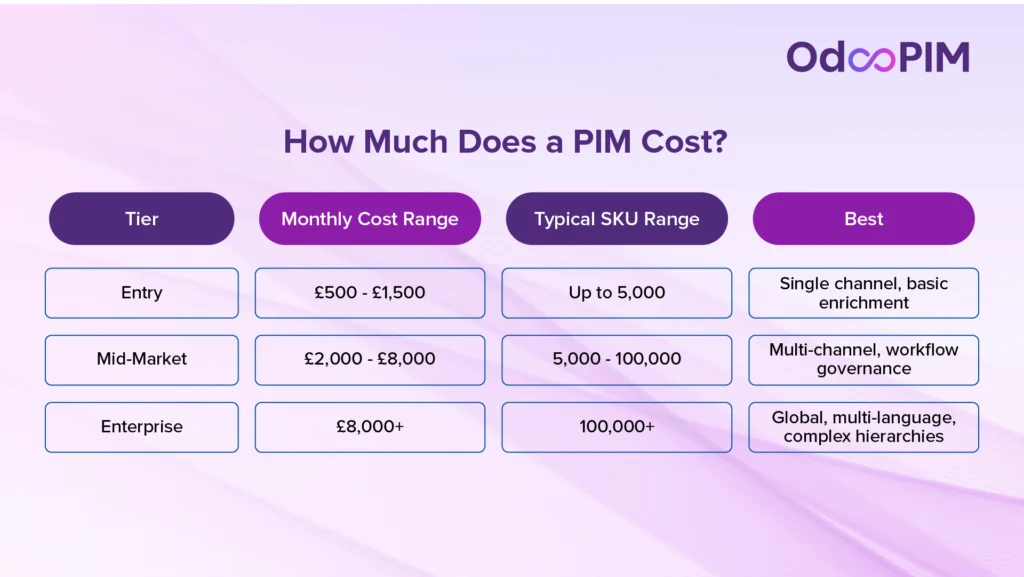
PIM pricing spans a wide spectrum, with entry-level solutions starting around £500-£1,500 monthly for small catalogs, mid-market platforms ranging from £2,000-£8,000 monthly, and enterprise deployments exceeding £100,000 annually. The PIM software cost you pay depends less on feature lists and more on SKU volume, channel count, integration complexity, and the deployment model. OdooPIM disrupts these traditional PIM pricing tiers by providing mid-market capabilities within the Odoo ecosystem, where native ERP integration eliminates the cost premiums that standalone platforms command.
Why PIM Vendors Don’t Publish Pricing
Most PIM vendors hide behind “contact sales” because PIM software cost depends on too many variables to fit a simple pricing page. The quote-based model allows vendors to assess your requirements and price accordingly, but it also obscures the cost drivers. PIM pricing opacity makes comparison shopping difficult, forcing organizations to endure multiple sales processes before understanding the investment required. OdooPIM eliminates this pricing opacity by operating within the Odoo ecosystem with transparent module-based pricing.

PIM Pricing Models Explained
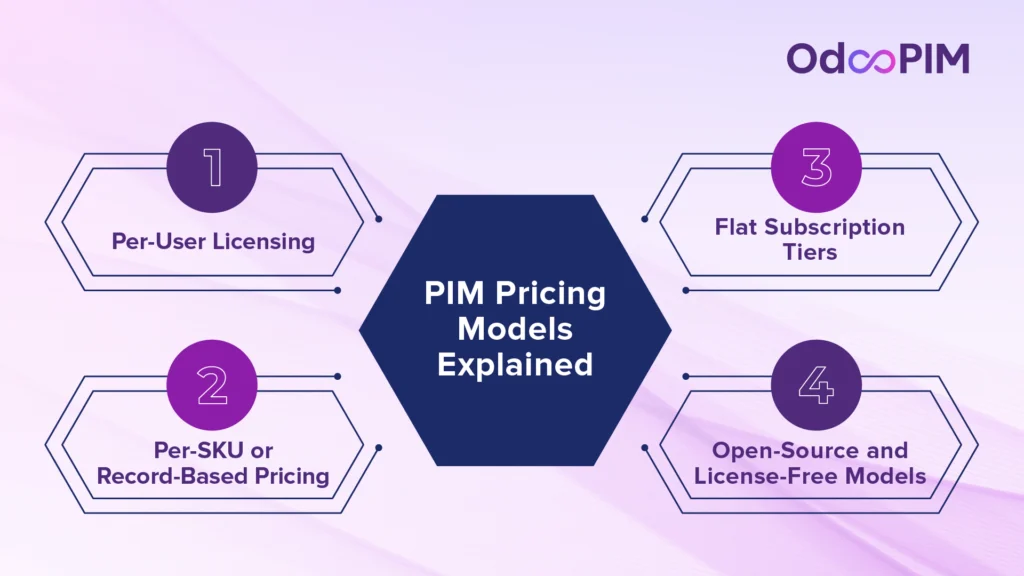
Per-User Licensing
Per-user PIM pricing models charge based on the number of team members accessing the platform, with different rate tiers for viewers, contributors, and administrators. PIM software cost escalates quickly under per-user pricing when multiple departments need platform access for workflow participation. The model penalizes collaboration because adding occasional users for approval workflows triggers additional license fees. OdooPIM offers flexible user access within the Odoo framework where pricing scales with business growth rather than penalizing cross-functional collaboration.
Per-SKU or Record-Based Pricing
Record-based PIM pricing ties cost to catalog size, charging by the number of SKUs managed within the platform. Organizations with seasonal catalogs or fluctuating SKU counts face unpredictable PIM software cost as record volumes change. The model particularly penalizes distributors who aggregate products from hundreds of suppliers and carry high SKU counts. OdooPIM provides predictable pricing that accommodates catalog growth without the per-SKU penalties that make record-based PIM pricing challenging for large catalogs.
Flat Subscription Tiers
Flat subscription PIM pricing models offer predictable monthly or annual fees based on capability tiers rather than consumption metrics like users or SKUs. This approach simplifies budgeting because PIM software cost remains constant regardless of catalog growth within tier limits. Tiers mostly gate advanced features, completeness scoring, channel syndication, workflow automation, behind higher subscription levels. OdooPIM delivers flat subscription pricing through Odoo’s module-based model, providing predictable PIM pricing that scales with business needs.
Open-Source and License-Free Models
Open-source PIM pricing starts at zero for the software license but accumulates substantial costs for hosting, implementation, integration development, and ongoing maintenance. The “free” license masks the investment required, with PIM software cost shifting from predictable fees to variable operational expenses. Organizations without technical teams face hidden costs exceeding commercial subscriptions. OdooPIM takes a different approach, as a native Odoo module with transparent pricing, it eliminates the hidden infrastructure and development costs of open-source platforms while delivering governed product data management fully integrated with your ERP.
Learn about best pim software.
Poor data quality costs organizations an average of $12.9 million every year.
– Gartner
What Drives PIM Costs Up?
SKU and Catalog Volume
SKU count remains the primary PIM pricing driver because catalog volume determines storage requirements, processing demands, and enrichment effort. Each additional thousand SKUs adds attribute population requirements, digital asset management overhead, and syndication complexity. Catalog complexity, variant structures, product hierarchies, attribute depth, multiplies the cost impact of raw SKU counts. OdooPIM handles large catalogs without the per-SKU pricing penalties that make high-volume PIM pricing prohibitive in record-based models.
Number of Channels and Integrations
Every connected sales channel increases PIM software cost through connector licensing, channel-specific formatting requirements, and ongoing syndication maintenance. Integration costs compound with each ERP, ecommerce platform, marketplace, and third-party system connected to the PIM. Channel expansion strategies must account for the additional PIM pricing that each new endpoint introduces. OdooPIM eliminates connector-based pricing by providing native Odoo ecosystem connectivity where adding channels does not multiply integration costs.
Users and Workflows
The number of users and the complexity of approval workflows impact PIM pricing through license fees and governance configuration effort. User-based PIM pricing models penalize the cross-functional collaboration that effective product data governance requires. Complex workflow automation adds implementation and configuration expenses. OdooPIM supports collaborative enrichment without per-user penalties, making governance accessible across departments.
Localization and Data Complexity
Multi-language product content and regional variations multiply PIM pricing because each locale requires additional attributes, translated content, and market-specific formatting. Complex product relationships, bill of materials structures, compatibility matrices, supersession chains, demand data modeling that increases implementation costs. The PIM software cost impact of localization grows with each additional language and market. OdooPIM manages localization within the Odoo framework where multi-language capabilities operate on the same data model.
Learn about headless commerce

PIM Implementation Costs
Setup and Configuration
PIM implementation cost begins with platform setup, data model configuration, and workflow design that transforms the software into an operational system. Data model design, defining product families, attribute groups, and category taxonomies, consumes significant implementation resources. The PIM software cost of setup varies between native ERP-integrated platforms like OdooPIM and standalone deployments requiring extensive configuration.
Data Migration and Cleansing
Data migration represents the largest component of PIM implementation cost because extracting product data from legacy systems reveals quality problems accumulated over years. Cleansing duplicate records, standardizing inconsistent attributes, and populating missing specifications consumes more resources than the technical transfer itself. OdooPIM reduces migration costs by operating on the same data model as Odoo ERP, eliminating data transformation complexity.
Training and Adoption
Team training and organizational adoption represent significant PIM software cost components that vendors rarely include in initial pricing discussions. Users accustomed to spreadsheet-based workflows need structured onboarding to embrace governed enrichment processes. OdooPIM reduces adoption friction by operating within the familiar Odoo environment where teams manage daily operations.

The Hidden Costs Buyers Miss
Middleware and Connector Fees
Standalone PIM platforms require middleware and connectors to reach ERP systems, adding recurring PIM pricing for integration licensing and maintenance. These PIM software cost items remain invisible in license comparisons because vendors quote platform fees without the integration tax. OdooPIM eliminates middleware costs by operating natively within the Odoo ERP framework.
Ongoing Sync Maintenance
Synchronization monitoring, troubleshooting, and re-mapping after platform upgrades create ongoing PIM pricing that license fees never capture. The PIM software cost of maintaining integrations through version upgrades accumulates annually. OdooPIM removes sync maintenance because product data and ERP operations share one database.
Upgrade and Customization Costs
Platform version upgrades trigger PIM implementation cost for re-testing integrations, updating customizations, and re-mapping field connections. The PIM pricing cycle repeats annually as connected systems evolve. OdooPIM upgrades with the Odoo platform automatically, eliminating separate integration re-testing.
How to Calculate PIM Total Cost of Ownership
Calculate PIM pricing over three years by adding license fees, implementation services, data migration, integration development, training, middleware, ongoing maintenance, and upgrade re-testing. The PIM software cost comparison must normalize different PIM pricing models against your specific SKU volume, channel count, and user requirements. Most organizations discover that native solutions like OdooPIM deliver lower total cost because eliminating integration maintenance compounds annually.
How Native ERP Architecture Changes the Cost Equation
Standalone PIM platforms like Akeneo, Salsify, and inRiver add a permanent middleware cost layer to PIM pricing through connector licensing, synchronization maintenance, and recurring integration rework. OdooPIM eliminates these costs by operating natively within the Odoo ERP framework, where product data, inventory, and pricing share one database without integration layers. There are no connector fees, no sync maintenance, and no duplicate data infrastructure inflating PIM software cost over time. For organizations evaluating PIM pricing models and seeking affordable PIM software for small business that scales, OdooPIM delivers governed product data management without the integration tax that defines standalone platform economics.
FAQs
1. How much does PIM software cost per month?
PIM pricing ranges from approximately £500-£1,500 monthly for entry-level solutions, £2,000-£8,000 for mid-market platforms, and £8,000+ for enterprise deployments, though these figures represent license fees alone. The PIM software cost includes implementation services, data migration, and integration development that often double the monthly license expense. OdooPIM provides predictable module-based pricing within the Odoo ecosystem, eliminating the middleware fees and integration costs that inflate standalone platform expenses.
2. Why don’t most PIM vendors show pricing?
PIM vendors hide behind “contact sales” because PIM software cost depends on numerous variables, SKU volumes, user counts, and integration requirements, that make one-size-fits-all pricing pages misleading. This opacity prevents buyers from comparing PIM pricing models across vendors without enduring multiple sales processes. OdooPIM operates with transparent Odoo module pricing, allowing businesses to understand PIM implementation cost before engaging sales conversations.
3. What’s the biggest hidden cost in PIM?
Integration represents the largest hidden cost in PIM pricing, with standalone platforms requiring middleware, connectors, and ongoing synchronization maintenance that license fees never include. Organizations discover that the PIM implementation cost of connecting to ERP, ecommerce, and marketplace systems often exceeds the platform subscription itself. OdooPIM eliminates this hidden cost entirely by operating natively within the Odoo ERP framework, where product data and business systems share one database without connectors or middleware.
4. Is open-source PIM really free?
Open-source PIM pricing starts at zero for the software license but accumulates substantial costs for hosting infrastructure, implementation services, integration development, and ongoing platform maintenance. Organizations without dedicated development teams discover that open-source PIM implementation cost exceeds commercial subscriptions when they hire external consultants for deployment and maintenance. OdooPIM takes a different approach, as a native Odoo module with transparent pricing, it eliminates the hidden infrastructure and development costs of open-source platforms while delivering governed product data management fully integrated with your ERP.
5. How do I calculate PIM total cost of ownership?
Calculate PIM pricing over three years by adding license fees, implementation services, data migration, integration development, training, middleware, ongoing maintenance, and upgrade re-testing costs. Most organizations discover that PIM implementation cost for standalone platforms grows annually as middleware maintenance and connector updates compound. Native platforms like OdooPIM deliver lower total cost because eliminating integration infrastructure removes the most expensive ongoing line items from the calculation.