The Unique Challenges of Furniture Retail
The furniture industry faces complex variability, where a sofa model can generate SKUs across fabric, finish, and configuration options. Purchases are visual, with customers relying on imagery and specifications during the sales cycle. Fragmented data sabotages sales. Inconsistent product information across websites, marketplaces, and physical stores erodes customer confidence and creates operational chaos, and this is where a solution like OdooPIM can help.
The Centralizing Power of PIM
A PIM acts as the source of truth, unifying complex specs, high-resolution visuals, and configuration rules. For a furniture business, this means consistency for combinable components. Enterprise PIM and cloud-based PIM solutions provide the scalability and accessibility needed to manage this complexity across teams and locations.
Strategic Capabilities for Furniture and Home Decor
Advanced PIM software delivers capabilities that transform furniture operations:
- Material and finish variation management with PIM handles option trees, ensuring accurate pricing and availability.
- 3D model and visualization integration with PIM supports your catalog, feeding real experiences and configurators.
- Product configuration in furniture PIM empowers customers while automating backend specification for manufacturing.
- Product lifecycle tracking for furniture brands provides control from prototype through end-of-life, crucial for managing collections and inventory.
- AI-powered furniture catalog organizations can auto-tag assets, suggest cross-sells, and optimize content for search.
Selecting the Right Furniture PIM Solution
When evaluating the best PIM solution, furniture retailers prioritize variant handling and visual asset management. The best PIM for furniture e-commerce excels at catalog management, supports SKU counts, and integrates with online furniture marketplaces. A PIM for large-scale furniture manufacturing bridges the gap between sales configuration and production data. Solutions like odooPIM offer integrated business management and industry functionality.
Furniture Product Data Challenges
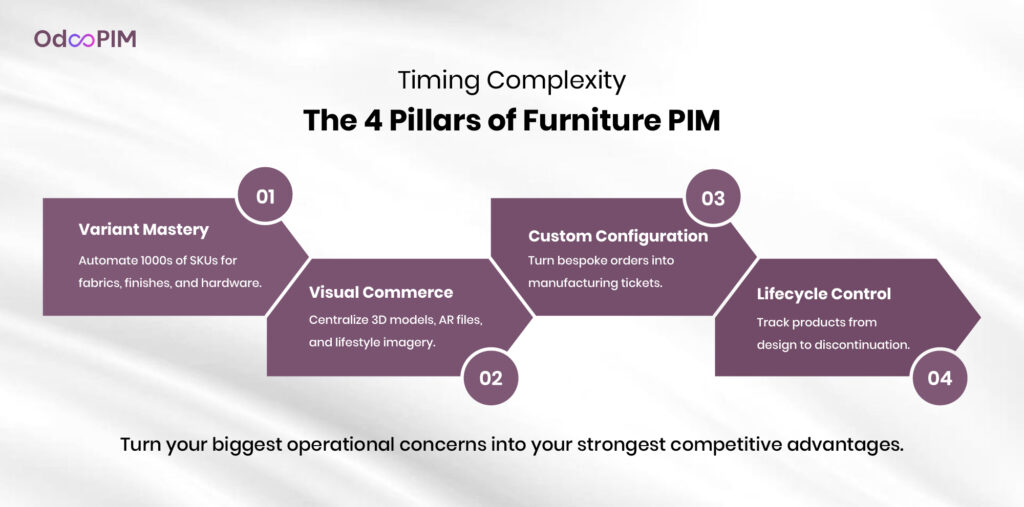
Handling thousands of SKUs across material and finish combinations, wood types, fabrics, colors becomes untenable with spreadsheets. Managing material and finish variations with PIM is the first problem a PIM system solves, structuring options into a marketable hierarchy.
3D model and visualization integration with PIM transforms technical assets into sales tools, enabling real-time previews and photorealistic room scenes. For the PIM for furniture businesses, this capability is non-negotiable, allowing customers to visualize configurations accurately.
Product configuration in furniture PIM requires a system that captures customer selections and translates them into accurate specifications, pricing, and manufacturing tickets. This link between front-end choice and back-end production is what defines the best PIM, such as OdooPIM for furniture eCommerce.
Managing collections, warranties, and regional compliance documentation across sales channels is a nightmare. Effective catalog management within an Enterprise PIM, such as OdooPIM ensures this information is consistent across multiple distribution channels.
The PIM for large-scale furniture manufacturing includes product lifecycle tracking for furniture brands, managing phases from launch to discontinuation. Implementing an AI-powered furniture catalog organization can automate the tagging and relation of these datasets, ensuring collections are merchandised, and inventory is aligned with demand.
Learn about best PIM software

What a PIM System Does for Furniture Retailers
A PIM system transforms product data from a liability into an asset. It centralizes details, dimensions, material specs, assembly instructions, and care guides into a source of truth. This eliminates errors and ensures the team works from accurate information.
This foundation enables catalog management, which is essential for managing offerings. Managing endless configurations for a furniture business or tracking lighting variants, the system structures complexity into marketable, sellable products.
A PIM software automatically syncs consistent data in real time to your e-commerce website, physical POS systems, and online furniture marketplaces. This capability is the engine for channel product distribution for furniture stores, ensuring the channel delivers a trustworthy product story.
This extends beyond sales into production, linking customer configurations to factory specifications. Enterprise PIM and cloud-based PIM solutions scale this power, providing the accessibility required for global operations.
A PIM for home decor retailers does more than organize data; it operationalizes it. It turns intricate material and finish variation management into an advantage, feeds 3D model and visualization integrations, powers product configuration tools, and provides the backbone for product lifecycle tracking.
Core PIM Features Tailored for Furniture
Superior PIM software automates variant generation, turning combinations of fabrics, stains, and hardware into marketable SKUs. This is the bedrock of catalog management for any PIM for home decor retailers.
Visual commerce requires a 3D model and visualization integration with PIM. This feature links photorealistic renders, 360-degree spins, and AR/VR assets to product records, transforming technical files into immersive sales tools across channels.
Advanced systems integrate with front-end configurators. Customer selection feeds the PIM system in real-time, generating quotes, manufacturing tickets, and fulfillment instructions, a capability for PIM for furniture businesses.
From design sketches and prototype phases through active sales, discontinuation, and post-purchase warranty claims, this tracking provides visibility and control. A cloud-based PIM ensures that a product story, with its variants and visuals, is published to your website and online furniture marketplace.
Best PIM for Furniture eCommerce and Multi-Channel
For home decor retailers, the focus is on visual narrative and inspiration. A PIM system, such as OdooPIM manages imagery, lifestyle photography, and room planner integrations, ensuring these assets are linked and deployed across consumer touchpoints.
A PIM for modular furniture businesses prioritizes logical architecture. It requires hierarchical structures to define relationships among components, arms, bases, and finishes. This technical foundation enables customer configuration and manufacturing instructions, essential for the furniture manufacturing.
The OdooPIM software acts as the command hub, pushing channel content not only to your branded site but also to major online furniture marketplaces, such as Amazon and eBay, B2B wholesale portals, and in-store digital kiosks.
It enables updates and provides mobile access for showroom staff, ensuring data accuracy from warehouse to sales floor. This scalability makes a cloud-based PIM a choice over legacy systems.
OdooPIM: Built for Furniture Operations
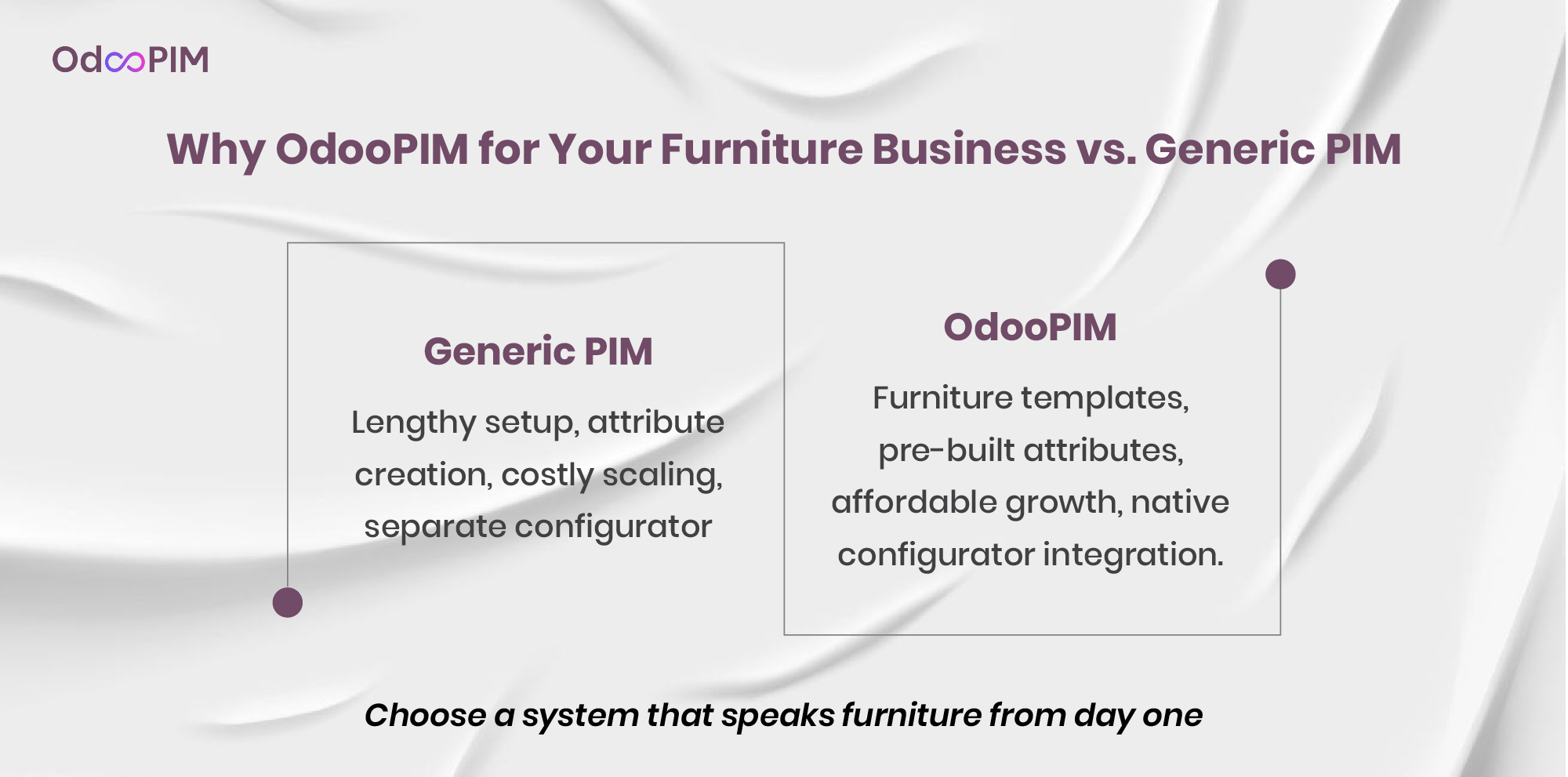
PIM software requires adaptation, and OdooPIM is engineered for the Furniture industry. It provides native handling of furniture attributes, seat depth, weight capacity, and assembly time, treating them as data. This specialization addresses the fundamental needs for managing material and finish variations through PIM and catalog management.
Its integrated AI-powered furniture catalog organization automates the heavy lifting: applying smart tags, generating product descriptions, and powering dynamic upsell recommendations. This intelligence transforms static catalogs into responsive sales tools.
This creates a system where a custom product configuration from the sales floor updates inventory, generates manufacturing orders, and initiates delivery tracking. This end-to-end visibility enables product lifecycle tracking for furniture brands, connecting phases from procurement through post-sale service.
This approach makes Enterprise-grade OdooPIM scalable from a PIM for home decor retailers to one for furniture manufacturers. It powers channel product distribution for furniture stores, ensuring data flows to your e-commerce site and major online furniture marketplaces.
An Enterprise PIM handles multi-language descriptions, regional pricing, and local market regulations across sales territories. This control is what enables multi-channel product distribution for furniture stores, ensuring brand and product consistency from a flagship website to online furniture marketplaces.
Advanced product lifecycle tracking for furniture brands provides oversight from concept through discontinuation across factories and retail locations. This visibility prevents errors, manages phase-outs, and aligns inventory with planning.
The best PIM solution, such as OdooPIM, leverages a cloud-based architecture. It combines the depth for material and finish variation management with the breadth for global catalog management.
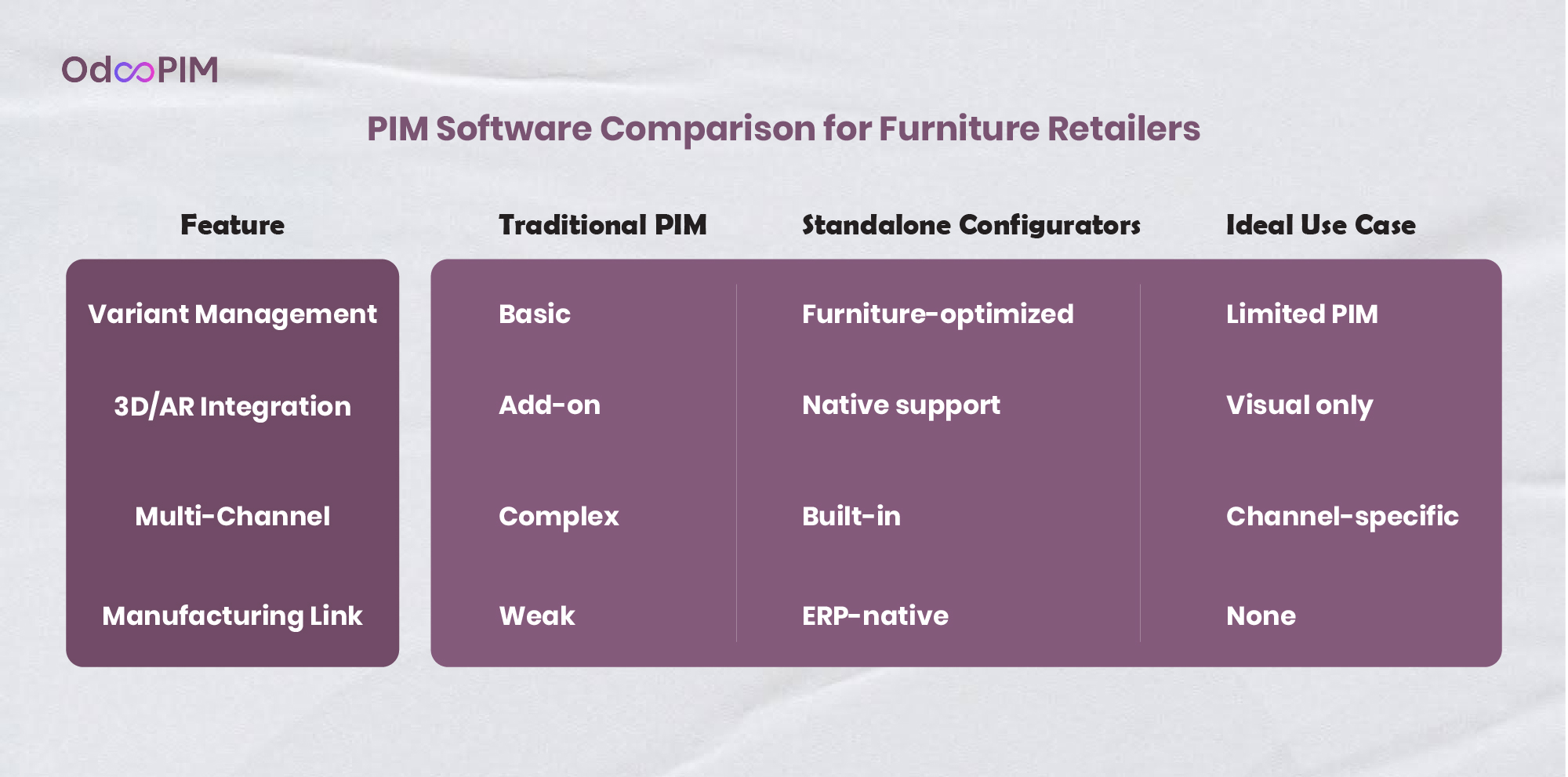
PIM Software Comparison for Furniture Retailers
Implementation Roadmap for Furniture PIM
A PIM software deployment follows a phased approach that prioritizes data integrity and operational integration. This roadmap ensures your investment delivers clarity and long-term scale.
Phase 1: Foundational Data Audit
Begin by cleaning and standardizing existing product information. This step involves auditing specifications, verifying image assets, and validating 3D model libraries. It establishes a data baseline for the PIM system, preventing the migration of legacy errors into the environment.
Phase 2: Strategic Attribute Modeling
Define the data architecture for your business. This means building furniture fields for dimensions, materials, and performance ratings, and establishing logical rules for managing material and finish variations in PIM. This model becomes the blueprint for your digital catalog management strategy.
Phase 3: Core System Integration
Connect the PIM software to your business platforms. This includes integration with your e-commerce site, ERP, or inventory system, and front-end custom product configuration tools. For a PIM for furniture manufacturing, this phase is vital for linking sales data to production planning.
Phase 4: Controlled Channel Syndication
Activate multi-channel product distribution for furniture stores, begin by syndicating a controlled product set to your sales channels. Test feeds to key online furniture marketplaces to ensure data formatting and asset delivery meet the platform’s requirements before rollout.
Phase 5: Team Enablement & Governance
Transition the system from a technical project to an operational asset. Train sales, design, and operations teams on workflows. Establish governance for ongoing product lifecycle tracking and content updates. For Enterprise PIM deployments, leverage AI-powered furniture catalog organization features to automate ongoing data enrichment.
Learn more about PIM vs PCM.
ROI: What Furniture Retailers Gain from PIM
The value of Product Information Management is measured in revenue, reduced costs, and operational dominance. It delivers a substantial return on investment by transforming data from a burden into a profit driver.
Accelerate Time-to-Market and Agility
Implementing a PIM system slashes the time required for catalog management and product introduction by 40-60%. This speed is a competitive edge, allowing PIM for home decor retailers to launch seasonal collections and PIM for modular furniture businesses to introduce components across channels. A cloud-based PIM ensures this agility is globally synchronized.
Drive Revenue and Customer Confidence
Comprehensive 3D model and visualization integration with PIM boosts conversion rates by closing the imagination gap for online shoppers. For PIM for online furniture marketplaces, consistent data improves search ranking and buyer trust.
Unlock Operational Efficiency and Scale
It automates the complexity of multi-channel product distribution for furniture stores, eliminating manual data entry and errors. For PIM for furniture manufacturing, the integration of product configuration with production systems streamlines order fulfillment and reduces manufacturing errors. Complete product lifecycle tracking for furniture brands provides strategic oversight, optimizing inventory and minimizing waste.
Achieve Strategic Data Intelligence
Leading Best PIM solutions, including platforms like odooPIM, offer AI-powered furniture catalog organization. This capability automates tagging, optimizes cross-selling, and provides insights, turning your catalog into a commercial asset.
Learn more about PIM for ecommerce.

Why Choose OdooPIM Among the Best PIM Solutions
In a market of PIM software, OdooPIM delivers actionable value for furniture brands. It is built to address this industry’s challenges, making it a contender among the best PIM solutions.
OdooPIM provides furniture templates and pre-configured attributes, allowing businesses to bypass months of setup. This turnkey approach establishes it as the best PIM for furniture e-commerce, enabling deployment of functionalities like material and finish variation management and catalog management.
OdooPIM operates as a cloud-based PIM that avoids vendor lock-in. Its design ensure integration with existing e-commerce platforms, ERP systems, and product configuration tools. This flexibility is essential for managing complex multi-channel product distribution for furniture stores and syndicating data to major online furniture marketplaces.
By combining industry readiness, scalability from boutique to enterprise, and open-system value, OdooPIM delivers a practical PIM solution.
Furniture’s Future Is PIM-Powered
Product Information Management is the catalyst, transforming chaos into an engine for visual commerce and fulfillment. It is the foundational system that turns product complexity into a competitive advantage.
Success now depends on mastering material and finish variation management, delivering 3D models and visualization integration, and enabling product configuration. These capabilities are not optional enhancements; they are the requirements for customer engagement. A PIM system provides the command to orchestrate this complexity across channels, from e-commerce to online furniture marketplaces.
OdooPIM is an Enterprise PIM that delivers the tools home decor retailers, modular furniture businesses, and manufacturers need. As a cloud-based PIM, it enables multi-channel product distribution, enriches catalog management with an AI-powered organization, and provides product lifecycle tracking.

Frequently Asked Questions
1. What is the Best PIM for Furniture e-commerce?
It moves beyond data storage to enable operational management of variants, visuals, and configurations. This PIM software provides a framework for material and finish variation management and catalog management, turning thousands of SKUs into a marketable digital catalog.
Key differentiators include native support for furniture attributes, such as dimensions, weight capacity, and assembly details, as well as deep integrations for 3D model and visualization integration. The system also empowers product configuration, allowing customer selections to flow into quotes and manufacturing tickets. For businesses aiming at multi-channel product distribution for furniture stores, the Best PIM solutions will feature automated syndication tools to push content to your website and online furniture marketplaces.
Platforms like OdooPIM exemplify this category by offering ready data models within a cloud-based PIM architecture. The solution functions as a source of truth that accelerates time-to-market, enriches the customer experience with reliable and visual information, and reduces operational friction and costly errors.
2. How does a PIM system manage material and finish variations for furniture?
A PIM system automates the complexity of material and finishes variation management with PIM by replacing processes with a structural engine. Instead of managing thousands of SKUs as entries, the PIM software allows you to define a product model, like a sofa, and then create rules for attributes like fabric, cushion fill, leg finish, and color. The system generates valid combinations as sellable product variants, with its own unique identifier, pricing, and asset associations.
This rule management ensures consistency and accuracy across sales channels. When a finish option is added or a material is discontinued, the change is made once in the PIM system. The update then propagates from the main e-commerce site to wholesale portals, eliminating the risk of selling an unavailable configuration. This capability is for PIM for modular furniture businesses, where components mix and match, and for PIM for home decor retailers with expansive, seasonal collections.
Marketing teams can launch collections, sales teams have confidence in real-time availability, and customers encounter trustworthy, detailed information.
3. Can a PIM system integrate 3D models and visual configurators?
A solution like OdoodPIM acts as the source of truth not only for textual data but also for high-value digital assets. Within the PIM software, 3D models, 360-degree spins, augmented reality (AR) files, and lifestyle imagery are linked to product records and their variants. This ensures the correct visual asset is associated with the SKU across customer touchpoint.
The PIM system can feed configurator tools, allowing customers to select materials and finishes, and see a photorealistic render update. The selections made in these configurators are captured as data within the product configuration in the furniture PIM workflow, generating specifications for pricing and manufacturing.
The PIM system can distribute the 3D assets and configured visuals to different online furniture marketplaces that support such content, enhancing listings and reducing return rates.
4. How does a Cloud-based PIM help with multi-channel distribution for furniture stores?
The advantages of a cloud-based PIM is that it provides an updated source of truth that is accessible to teams and systems. When product information is updated in the PIM system, a price change, a new finish, an updated assembly guide, that change is live and can be syndicated to connected sales channels. This eliminates dangerous data lag and the effort of updating the channel separately.
The PIM software can tailor product data feeds to meet the technical requirements and formatting rules of online furniture marketplaces, your own e-commerce website, B2B portals, and in-store digital kiosks. This ensures a consistent brand and product story, while optimizing content for the performance on the platform. For a PIM for modular furniture businesses, this means configurable options are presented accurately.
It accelerates the launch of collections across channels, capturing market demand faster. It reduces errors and mismatched information that lead to customer distrust, negative reviews, and costly returns. By automating the distribution of content, including assets for 3D model and visualization integration, a cloud-based PIM turns the challenge of omnichannel retail into a manageable competitive advantage.
5. Is there an affordable Enterprise PIM that can scale with a growing furniture business?
These Best PIM solutions avoid the traditional high-cost, high-complexity entry barrier of legacy enterprise software. They operate on a cloud-based PIM subscription model, allowing businesses to start with catalog management and product information management functions and add advanced capabilities, such as AI-powered organization or manufacturing modules as needed.
A solution like OdooPIM can begin as an effective PIM for home decor retailers, managing hundreds of SKUs with visuals. As the business grows into a PIM for modular furniture businesses or a PIM for large-scale furniture manufacturing, the system can expand its data model, integrate with ERP and PLM systems, and manage global multi-channel distribution without requiring a disruptive and expensive platform migration.
OdooPIM eliminates significant upfront capital expenditure and reduces the total cost of ownership by maintaining a system over the long term. Businesses gain access to enterprise PIM features, including product lifecycle tracking, product configuration workflows, and user governance, at a fraction of the traditional cost.