Navigating the PIM Landscape – OdooPIM vs Pimcore
For retailers, distributors, and eCommerce teams, product information has transformed from a catalog into a high-volume, multi-channel asset. Managing specifications, images, compliance data, and inventory across dozens of sales points is a core business operation. Spreadsheets and disconnected tools create errors, delay launches, and erode customer trust.
Selecting the right Product Information Management (PIM) system for your business is a strategic decision with revenue implications. A capable platform turns product data into a competitive advantage, ensuring accuracy, accelerating time-to-market, and enabling omnichannel selling.
In the search for the best PIM solutions, businesses evaluate two distinct models: specialized, standalone platforms versus fully integrated systems. This comparison examines Pimcore against OdooPIM, the AI-powered PIM natively built into Odoo ERP.
OdooPIM is a cloud-based PIM built into an operational platform. This means catalog management connects to inventory, automated order processing, and procurement workflows without third-party integrations.
For companies conducting a PIM software comparison or booking a PIM software demo, the central question is this: do you need a powerful but isolated data repository, or a dynamic enterprise PIM that fuels your organization? Odoo’s integrated approach eliminates data silos and middleware, making it not only a powerful PIM system but also the best PIM software for small businesses and growth-focused companies seeking efficiency and control from a suite.
What Is Product Information Management (PIM)?
A Product Information Management (PIM) system serves as the single source of truth for structured product data, it consolidates and governs the product detail, from technical specifications and marketing descriptions to pricing, digital assets, and market-specific variants. This centralized control replaces the chaos of spreadsheets and disparate databases with organized, actionable intelligence.
PIM software provides catalog management to structure products for different regions, brands, or customer segments. The system handles complex product attributes, variants, and relationships with precision. It acts as a central hub for digital assets, ensuring the right images and videos are always linked and available. Finally, a PIM enables automated channel syndication, pushing enriched, accurate data to eCommerce sites, marketplaces, and distribution partners.
Your PIM software comparison should distinguish between three architectural models:
- Standalone PIM Software: A specialized tool focused on data enrichment and distribution. While feature-rich, it creates a new data silo, demanding time and budget to integrate with your an ERP, CRM, and other business systems.
- PIM + MDM Platforms: Solutions like Pimcore expand their scope into Master Data Management, governing not just products but also customer, supplier, and location data. This approach suits large enterprises with complex governance needs but introduces substantial implementation and maintenance complexity.
- The Integrated PIM+ERP Stack: Exemplified by OdooPIM, this model eliminates the flaws of standalone tools. As a native module within Odoo’s unified business suite, it operates as a cloud-based PIM. Product data enriched in the PIM through AI is available for sales quotes, warehouse operations, manufacturing schedules, and financial reporting.
This integration establishes AI-powered OdooPIM as a leading choice among the best PIM solutions as it delivers the power of an enterprise PIM without the typical overhead of middleware and sync projects. By turning the PIM system into the main data engine, OdooPIM provides unparalleled operational agility. This efficient, all-in-one approach makes it the practical best PIM software for small businesses and growth-stage companies aiming to scale without accumulating technical debt. A focused PIM software demo should highlight this connectivity as the decisive advantage.

OdooPIM: Integrated PIM for the Odoo Ecosystem
OdooPIM is the native Product Information Management (PIM) solution built into the Odoo business platform. Its architecture, built-in AI, onboarder tool, and extensive feature set are its advantages. Product data is not managed in a separate silo but lives as a component of a comprehensive operational system, making it a SaaS PIM designed for connectivity.
Unlike a standalone PIM software, OdooPIM can share its database with Odoo ERP, CRM, eCommerce, and inventory modules. Changes made within the PIM system, like updating a product description or an image, can be reflected across the platform, from the website storefront to warehouse pick lists. This eliminates reconciliation errors. The interface prioritizes an intuitive UX, allowing teams to master catalog management and product enrichment with AI, and without extensive training.
There are no complex integration projects or multi-vendor compatibility issues to resolve. You implement a platform, not a patchwork of software. This efficiency makes OdooPIM a standout choice for the best PIM software for small businesses that need immediate capability without prohibitive setup costs.
The system is designed to grow with your business, transitioning smoothly into a full-scale enterprise PIM solution. As operations expand into multiple sales channels, complex manufacturing, or global distribution, OdooPIM’s integrated data foundation ensures that product information scales as a controlled, centralized asset.
In any PIM software comparison, this combination of immediate usability and long-term architectural cohesion is decisive. While platforms like Pimcore offer breadth, OdooPIM delivers operational coherence, leverages AI in several features, and turns product data into a driver of business execution rather than just a marketing resource.
Pimcore: Open-Source PIM Powerhouse
Pimcore is a larger offering that lets users combine Product Information Management (PIM), digital asset management (DAM), content management (CMS), and master data management (MDM) into a unified suite. Pimcore provides a framework where the aspect, from data models to user interfaces, can be built to specifications.
This makes it a robust tool for technical enterprise PIM scenarios. Its customization and headless architecture allow developers to tailor the PIM system for unique business logic, legacy system integrations, and digital experience requirements. It excels at governing massive, intricate catalogs and managing multi-domain data across global brands or regulated industries. For organizations with substantial in-house technical resources and a need to model highly specialized data relationships, Pimcore represents a contender among the best PIM solutions.
The platform’s flexibility translates into longer implementation timelines, higher development costs, and continuous maintenance overhead. It is a toolkit, not an out-of-the-box solution. Success with Pimcore requires a dedicated technical team to build, customize, and manage the platform, as it is not a turnkey solution.
When conducting a software comparison between OdooPIM vs Pimcore, Pimcore’s profile is clear: it is engineered for enterprises where technical complexity outweighs the need for speed and operational cohesion.
It suits organizations willing to trade rapid deployment and cross-departmental workflow for total control over their data architecture. This stands in contrast to solutions like OdooPIM, which prioritize business processes and integrated catalog management over developer-centric customization.
Forrester evaluated PIM providers across 23 criteria, confirming PIM is now a core capability for any enterprise that sells products.
– Forrester
PIM Software Comparison: OdooPIM vs Pimcore Head-to-Head
| Feature | OdooPIM | Pimcore | Winner For |
| Ease of Use | Business-user friendly | Developer-focused | SMBs |
| Deployment | Cloud-based PIM SaaS | Self-hosted or cloud | Speed |
| Integrations | Native Odoo ERP | Custom APIs | ERP users |
| Customization | Configurable | Unlimited code | Enterprises |
| Cost Model | Subscription | Open-source + services | Budgets |
| Scalability | SMB to mid-market | Enterprise PIM | Volume |
OdooPIM vs Pimcore: Core Capabilities Breakdown
A superior Product Information Management (PIM) system is defined by how it handles the essential tasks of mastering product data. The leading best PIM solutions all address these core areas, but with different approaches that affect speed, cost, and business agility.
Catalog Management: Structure vs. Freedom
Effective catalog management organizes products into logical hierarchies, manages complex variants, and creates bundled offerings.
- OdooPIM uses a template-driven approach, ensuring data consistency and accelerating population, as attributes defined in a template apply to related products. This structured data is ERP-synced by default; changes to a product template update inventory records, manufacturing specs, and sales quotes across the unified Odoo environment.
- Pimcore employs object-oriented data modeling, which provides immense flexibility for defining complete product classes and relationships, making it well-suited to highly non-standard catalog structures. This freedom requires upfront technical design and lacks native, pre-built business process integration.
Digital Asset & Media Handling
These platforms centralize images, videos, and documents. The difference lies in workflow integration.
- As a cloud-based PIM within a suite, OdooPIM links assets to operational workflows. An approved product image is available to the eCommerce website, the sales team’s quotation tool, and the marketing module.
- Pimcore’s DAM is granular but operates as a separate module within its own suite, requiring additional configuration to push assets into external business applications like an ERP or CRM.
Multi-Language & Multi-Region Support
Managing regional compliance data, translations, and localized marketing is a baseline requirement for any PIM system, and we can see this in a OdooPIM vs Pimcore comparison.
- OdooPIM handles this as an integrated function that assigns a product to multiple regions, manages language variants, local pricing rules, and compatible warehouses within the platform.
- Pimcore provides the technical framework to model this complexity, but delegates the business logic, such as connecting a regional variant to inventory or tax rules, to development.
Channel Publishing
The goal of PIM software is to automate the syndication of enriched product data to eCommerce sites, marketplaces, and print catalogs.
- The integrated nature of OdooPIM makes publishing to the Odoo eCommerce connector a one-click action, as the channel is a native module. For external channels, the unified data structure simplifies feed generation.
- Pimcore’s headless architecture is designed for this task, capable of outputting data to any endpoint via APIs. Realizing this requires building and maintaining each channel connector.
This OdooPIM vs Pimcore software comparison reveals a key divide: OdooPIM provides a connected, business-ready system that powers operations, making it the best PIM software for small businesses scaling efficiently.
Cloud-based PIM vs Self-Hosted: Deployment Realities
The decision between a cloud-based PIM and a self-hosted solution defines your operational overhead, financial model, and long-term agility. This is not a minor technical choice; it determines how your business consumes and benefits from a PIM system.
OdooPIM: The Operational Advantage
OdooPIM eliminates infrastructure management, which translates to immediate deployment, where your team focuses on catalog management and product enrichment from day one. You gain automatic updates that deliver new features and security enhancements without downtime or extra cost.
Financially, this model offers predictable, scalable subscription pricing, converting large capital expenditures into a manageable operating expense. This operational efficiency is why OdooPIM is considered the best PIM software for small businesses and growth-focused companies, as it redirects resources from IT overhead to business activities.
Pimcore: The Control Equation
Pimcore’s open-source model provides full ownership and control. You choose the hosting environment, dictate the upgrade schedule, and possess the freedom to customize the source code without restriction. This is valuable for organizations with data sovereignty requirements, unique compliance mandates, or the need to embed the PIM system into a legacy technical landscape. The trade-off is the responsibility for related costs and labor: cloud or data center hosting, dedicated DevOps personnel, security hardening, and the manual execution of updates and patches.
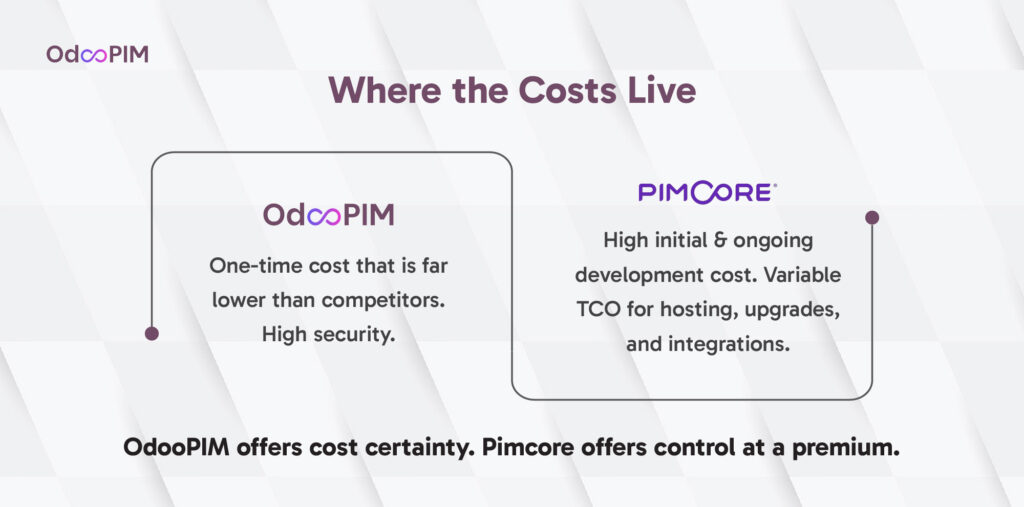
Evaluating Total Cost of Ownership, OdooPIM vs Pimcore
For a self-hosted platform like Pimcore, the total cost includes ongoing infrastructure expenses, dedicated developer and administrator salaries, and the significant operational risk of downtime or security breaches stemming from internal management. The integrated nature of OdooPIM bundles these costs into a one-time expense, providing a predictable enterprise PIM capability without hidden technical debt.

Best PIM Solutions for Different Business Sizes
Selecting the right PIM system is not a one-size-fits-all decision. The optimal platform aligns with your company’s size, technical resources, and growth trajectory. A OdooPIM vs Pimcore software comparison should address where the solution delivers maximum value.
For Small Businesses: Velocity Over Complexity
The best PIM software for small businesses prioritizes utility and cost efficiency. AI-enabled OdooPIM is the definitive choice for its integrated, cloud-based model which delivers a fully functional offering from day one. Teams can launch catalog management without a dedicated IT department. The affordable, predictable costs and connection to Odoo’s built-in sales, inventory, and eCommerce tools accelerate time-to-value, allowing small businesses to compete with enterprise-grade processes without the overhead.
For the Mid-Market: The Strategic Crossroads
Mid-market companies face a pivotal choice dictated by their ERP strategy.
If you prioritize unified operations, OdooPIM remains the superior path. Expanding the Odoo ecosystem consolidates business data, product, financial, and operational into a source of truth. This eliminates integration sprawl and creates a scalable platform for growth.
If you are committed to a non-Odoo ERP and require a standalone PIM system, Pimcore becomes a viable technical option, provided you have the budget and team to manage the significant integration and customization workload.
For the Enterprise: Governance at Scale
Large organizations with established, complex IT landscapes and specialized data governance needs represent Pimcore’s ideal domain. Its strength lies in managing intricate, object-oriented data models across multiple brands, regions, and legacy systems. As an enterprise PIM, Pimcore offers the depth for organizations where customization and total control are mandatory, funded priorities.
Migration and Expansion Considerations
OdooPIM offers a low-risk expansion path within its unified suite, adding manufacturing, advanced CRM, or global eCommerce is a module activation, not a new integration project. Starting with Odoo as the best PIM software for small businesses sets a foundation for organic growth into a comprehensive enterprise PIM solution.
Beginning with a standalone system like Pimcore leads to a future of complex, costly middleware and data synchronization challenges as you attempt to connect it to other business applications.
When evaluating best PIM solutions, especially in a OdooPIM vs Pimcore evaluation, your decision should account for total business evolution, not just initial features. A PIM software demo for OdooPIM will show a cohesive business platform. A demo for Pimcore will showcase a powerful development project.
Integration and Ecosystem Comparison
The value of a PIM is unlocked by how it connects to and energizes the rest of your business technology stack.
OdooPIM: The Business Engine
OdooPIM is not a standalone PIM software. It is the product data of a fully integrated business suite. Its connections are not integrations, they are native, pre-built functions. Enriching a product attribute in the PIM and updates its listing in the Odoo eCommerce store, its availability in the inventory module, and its cost in the manufacturing application. This synchronization across ERP, CRM, and sales creates a cohesive operational reality. For companies seeking a cloud-based PIM that acts as a central nervous system, this eliminates the risk, cost, and latency of third-party connectors. This inherent cohesion is a reason OdooPIM is considered the best PIM software for small businesses and growing companies, as it delivers an out-of-the-box enterprise PIM experience without development.
Pimcore: The API-First Framework
Pimcore is an API-first, headless platform that provides maximum connectivity: it can be engineered to send and receive data from virtually other systems. Realizing it demands significant development resources to build, test, and maintain the integration point. While this offers ultimate flexibility for complex, legacy-heavy environments, it transforms the connection into a project with ongoing technical debt.
Ecosystem and Innovation
Third-Party Ecosystem: Odoo’s validated app store offers thousands of specialized modules and pre-built connectors to major platforms such as Amazon, Shopify, and shipping carriers, extending the system’s functionality with certified, maintained solutions. Pimcore’s community provides extensions, but their compatibility varies, placing the evaluation and integration burden on your team.
OdooPIM provides a complete, connected business operating system where catalog management is a natural component of a larger workflow. Pimcore provides a toolkit for constructing those connections yourself. A PIM software demo reveals this: one shows a working business process; the other shows a powerful development environment.
Hands-On Evaluation: Request a PIM Software Demo
A PIM software demo moves beyond feature lists to reveal operational truth. Your evaluation between OdooPIM vs Pimcore should test real-world workflows, not just admire a polished presentation. The focus for the platforms should differ to uncover their value and potential burden.
Testing OdooPIM: The Business Process Test
In an OdooPIM demonstration, your goal is to validate operations. Go beyond basic catalog management and insist on a cross-module workflow.
- Attribute Setup & Sync: Create a product template with attributes and variants. Then, navigate to the Inventory and Sales apps to confirm that those variants exist with accurate stock levels and pricing.
- Channel Publishing: Enrich a product with images and descriptions, then publish it to the Odoo eCommerce module. Validate that the live product page reflects your changes, demonstrating channel management.
- Data Flow: Update a product’s weight or cost in the PIM and observe the change propagate to a draft sales order or a manufacturing bill of materials. This proves the system operates as a source of truth.
Validating Pimcore: The Technical Framework Review
A Pimcore demo should assess customization depth and development workload.
- Data Modeling: Request a demonstration of creating a new, non-standard product class with unique attributes and relationships. Evaluate the complexity of the interface and the technical understanding required.
- Custom Workflow Build: Ask to see an approval workflow or a user-specific data view being configured. This reveals the level of effort needed to tailor the system to your processes.
- Performance & Scalability: Inquire about handling a catalog of 50,000+ SKUs with complex relationships. Discuss the infrastructure requirements and potential performance tuning needed, highlighting the ongoing technical investment.
Key Questions for Any Vendor
Regardless of OdooPIM vs Pimcore platforms, get answers:
- Walk me through the exact steps to add a new sales channel, from data mapping to live publishing. How long does it take?
- What does the upgrade process entail?
How much downtime or internal effort is required quarterly or annually? - Show me your roadmap for the PIM module?
How do you balance new features with system stability?
Define Your Success Metrics
For a cloud-based PIM like OdooPIM, track time-to-value: days to launch a basic catalog, minutes to update data across channels. For an enterprise PIM project, measure development velocity: weeks to model product data, months to a minimum viable launch.
The insightful PIM software comparison happens when you test the system against your objective: business efficiency or technical customization. For companies seeking the best PIM software for small businesses, the OdooPIM demo showcases a route to operational coherence.
Build Intelligence Into Your Product Data Strategy
Superior PIM is not a software purchase; it’s a strategic commitment to operational intelligence. The final choice in your PIM software comparison should turn product data from a managed asset into a competitive accelerator. The platforms discussed are legitimate contenders, but they serve fundamentally different masters.
OdooPIM is the definitive choice for businesses that prioritize workflows over isolated functionality. As a cloud-based PIM, it embeds catalog management into your operation, making product information actionable across sales, finance, and supply chain. This creates velocity, reducing time-to-market and eliminating cross-departmental friction. For this reason, it stands as the best PIM software for small businesses and growth-focused companies seeking to scale with efficiency, not complexity.
Pimcore is a framework for enterprises where a dedicated team exists to build and maintain that vision.
Your decision hinges on an assessment of your own organization:
- Choose OdooPIM if your goal is to streamline and connect your business within an evolving enterprise PIM platform.
- Consider Pimcore if you have a validated need for customization that justifies the substantial and ongoing investment in development and infrastructure.
Run a disciplined OdooPIM vs Pimcore software comparison grounded in your workflows, not generic features. Insist on a hands-on PIM software demo that proves the system’s claims in a scenario you define. Align your selection with your long-term growth roadmap, choose the PIM system that becomes a force multiplier for your operation.

Frequently Asked Questions
1. What is the main difference between OdooPIM and Pimcore in a head-to-head PIM software comparison?
OdooPIM is a module of a unified business suite built for operational cohesion. It is designed from the ground up to be the Product Information Management heart of a system that also handles ERP, CRM, eCommerce, and manufacturing. This means your product data is not just stored; it is live across business functions without integration. A price change in the PIM updates the sales quote. A new variant is allocated in the warehouse. This integrated nature is its advantage, making it an efficient PIM system.
Pimcore is a best-of-breed platform focused on data mastery and digital experience. It combines PIM, DAM, MDM, and CMS into a developer-centric toolkit. Its strength is extreme flexibility through object-oriented data modeling, allowing you to structure highly complex, non-standard product information to your specifications. This makes it a standalone PIM software powerhouse that requires significant development to connect to your ERP, eCommerce platform, and other operational systems. It provides the components to build a perfect model, but you should construct the connections to your business processes.
The choice revealed in a thorough OdooPIM vs Pimcore software comparison is between a ready-to-drive business solution and a custom-engineered framework. OdooPIM offers out-of-the-box business velocity, where the PIM software is a pre-wired component of a larger machine. Pimcore offers customization depth for organizations that need to build a data architecture and have the technical resources to maintain it.
2. Is OdooPIM the best PIM software for small businesses, and can it scale as an enterprise PIM?
OdooPIM is the best PIM software for small businesses due to its combination of immediate usability, low barrier to entry, and integrated value. As a cloud-based PIM, it requires no upfront hardware investment or dedicated IT staff. Small teams can launch sophisticated catalog management in days, not months, and start seeing a return because the product data they enrich powers their integrated eCommerce store, sales pipeline, and inventory counts. The predictable one-time cost makes the expense manageable, allowing SMBs to leverage an enterprise-grade PIM system without the traditional enterprise overhead.
OdooPIM is designed to scale into a full enterprise PIM solution, its scalability is not about handling more SKUs; it’s about extending product data governance across a growing, complex organization. The whole data model that serves a small business can expand to support multiple companies, brands, and warehouses within a database. As operations grow, you can activate advanced Odoo modules for manufacturing, global accounting, or multi-website eCommerce, connected to the central Product Information Management hub without needing a complex integration project.
A business can start with OdooPIM for catalog management and sales, then scale into a comprehensive operational platform. This contrasts with starting on a limited standalone tool that hits a ceiling, forcing a migration. OdooPIM’s strength is its continuum: it is the launchpad for SMBs and the cohesive data foundation for a scaled enterprise, eliminating the disruptive transition between the two stages.
3. Should I choose a standalone PIM system like Pimcore or an integrated PIM like OdooPIM?
A standalone PIM system like Pimcore is a specialist tool, its purpose is to achieve mastery and flexibility over your product information model. You choose this path when your product data is complex and non-standard, and the need to model it outweighs the need to have it flow into other business applications. It is ideal when you have a dedicated technical team to build and maintain the integrations (APIs) to your ERP, eCommerce, and other systems.
An integrated PIM like OdooPIM is designed to make product data actionable across the company. The PIM software is wired into the sales, finance, inventory, and manufacturing modules which means there are no bridges to build; the data already lives in a landscape. You choose this path for velocity, accuracy, and operational cohesion. Updates made by marketing in the PIM are visible to sales and warehouse teams without delay or sync errors.
An integrated PIM delivers a lower total cost of ownership and faster time-to-value by consolidating resources on a platform. Unless you have an undeniable requirement for Pimcore’s customization and the budget to support its technical ecosystem, the integrated efficiency of a solution like OdooPIM is the more strategic and profitable choice.
4. How does catalog management differ between a cloud-based PIM (Odoo) and an open-source platform (Pimcore)?
Catalog management in a cloud-based PIM like Odoo is a streamlined, business-user-oriented process focused on speed and consistency. It utilizes template-driven approaches, where you define attribute sets (e.g., for a “laptop”) once and apply them to hundreds of products, ensuring data uniformity. The interface is designed for rapid bulk operations, easy variant creation, and intuitive categorization because it’s part of an integrated offering, the catalog you manage is the same catalog used for warehouse bin locations, manufacturing Bills of Materials, and sales quotations.
It provides extreme flexibility, allowing you to design product classes, attributes, and relationships that can match any conceivable business model. This is ideal for managing highly intricate catalogs with non-standard relationships (e.g., managing parts for a configurable industrial machine). Structuring your catalog requires upfront technical design and a deeper understanding of data architecture. The system offers the tools to build a perfect catalog structure, but the business logic for how that catalog connects to inventory levels or sales channels should be built.
OdooPIM provides a pre-configured, opinionated framework for catalog management that links to business outcomes. Pimcore provides a blank canvas and a toolkit, granting total freedom but demanding that you build the process from data entry screens to business rules. For companies, the configured approach delivers immediate productivity.
5. What are the total costs of ownership when comparing these best PIM solutions, including implementation and maintenance?
In a OdooPIM vs Pimcore comparison, the total cost of ownership (TCO) is dominated by implementation, integration, and ongoing maintenance. For an open-source platform like Pimcore, initial costs include significant development hours for installation, customization, data modeling, and building and testing integrations to your ERP, eCommerce, CRM, and other systems. You should budget for annual costs of server hosting, dedicated DevOps or administrator salaries, security patching, and the labor-intensive process of upgrading the platform while preserving your code.
For AI-powered OdooPIM, the TCO model is different and lower which makes the implementation focus on configuration, data migration, and user training. The predictable subscription fee for this cloud-based PIM includes hosting, security, and routine updates and upgrades, which are applied without project-based costs. There is no need for server admins or developer support for maintenance.
Pimcore’s TCO is variable and escalates with unforeseen integration challenges, performance tuning needs, and feature requests. OdooPIM’s TCO is more predictable and contained which means OdooPIM converts a large, unpredictable capital and labor expense into a known operational cost, freeing capital and IT staff for strategic work. While Pimcore requires a committed, ongoing investment in technical infrastructure.
6. Can I see a live workflow in a PIM software demo for OdooPIM and Pimcore before deciding?
A PIM software demo should be a hands-on workflow test, not a passive slideshow. When demoing OdooPIM, you should direct the presenter to show a complete, cross-functional workflow. For example, ask them to create a new product variant in the PIM, adjust its inventory count, and then immediately generate a sales order and invoice within the demo environment. This will prove the native integration and immediate data sync that is the platform’s hallmark. This demo shows how the PIM system functions as part of a business operations engine.
For a Pimcore demo, your focus should shift to validating customization and data modeling power. Request a demonstration of how they would model a complex product relationship unique to your industry. Ask to see the process of building a custom workflow or user interface for a team. The goal here is to assess the development environment and understand the level of effort required to tailor the platform to your needs. This demo will showcase its flexibility but also highlight the technical expertise required to leverage it.
The OdooPIM demo will showcase business agility and out-of-the-box cohesion, solidifying its case as a top contender for best PIM software for small businesses and integrated operations. The Pimcore demo will illustrate technical capability and customization depth. By testing a real workflow, you move beyond feature lists and experience the fundamental difference: one demo shows you a working business process, while the other shows you the tools to build one. Your reaction to these demos will indicate which model aligns with your company’s resources and strategic priorities.