What Is Free PIM Software?
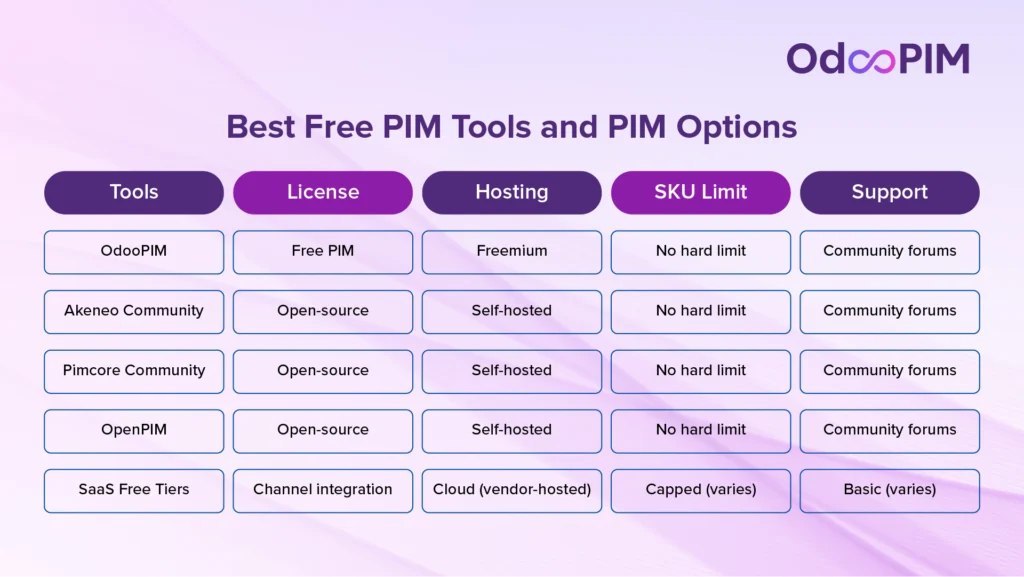
Free PIM software is product information management technology available at no licensing cost, typically offered as open-source platforms or limited freemium tiers of commercial solutions. These PIM software free options provide core capabilities like centralized product data storage, basic attribute management, and manual channel exports without the subscription fees of enterprise platforms. PIM free solutions appeal to startups and small businesses testing whether structured product data management delivers enough value to justify eventual investment in paid tools. The free PIM tools landscape spans self-hosted open-source platforms requiring technical expertise and cloud-based free tiers with restricted features. Understanding the limitations of free product information management software matters more than evaluating feature lists because what these tools exclude often determines their operational cost.
Best Free PIM Tools and PIM Options
What Free PIM Software Doesn’t Include
Hosting and Infrastructure
Free PIM software open-source options require organizations to provision, configure, and maintain their own servers, databases, and security infrastructure. Self-hosted PIM software free deployment demands ongoing server maintenance, performance monitoring, backup management, and security patching. Cloud infrastructure costs for hosting PIM free platforms often exceed what businesses anticipate when evaluating only the zero license price. Organizations without existing server infrastructure discover that hosting expenses transform their free software into a significant operational cost. The infrastructure burden of self-hosted free product information management software consumes IT resources that could otherwise support revenue-generating activities.
Implementation and Configuration
Free PIM tools require substantial technical expertise for installation, data model configuration, and workflow setup that paid platforms include as part of implementation services. Organizations underestimating the complexity of configuring PIM software free solutions discover that initial deployment consumes weeks or months of developer time. Data migration from spreadsheets and legacy systems into PIM free platforms demands technical skills for data mapping, transformation, and validation. The implementation effort for free product information management software often costs more in internal resources than a year of paid platform subscription. Small businesses lacking dedicated technical teams find PIM software for small business free options require hiring external consultants, erasing the cost advantage of zero license fees.
ERP and Ecommerce Connectors
Free PIM software typically lacks pre-built connectors to ERP systems and ecommerce platforms, requiring custom API development for every integration point. Building and maintaining these PIM software free integrations consumes developer hours that multiply with each connected system and channel. The absence of native PIM free connectors means product data synchronization depends on manual exports or custom-coded integrations vulnerable to failure. Organizations discovering this gap after deployment face the choice of funding custom development or operating the PIM as a disconnected data island. Integration costs transform best free PIM software options from no-cost solutions into expensive custom development projects.
Support and Upgrades
Free product information management software relies on community forums and documentation for troubleshooting, lacking the guaranteed response times of commercial support agreements. Open-source PIM free platforms require organizations to manage their own upgrades, security patches, and version migrations. When production issues arise with free PIM tools, teams troubleshoot independently without vendor escalation paths or dedicated support engineers. The upgrade burden of self-hosted PIM software free platforms creates version locks where organizations delay critical updates because migration requires unavailable technical resources. The absence of vendor support transforms PIM software for small business free options into operational risks during critical selling periods.
Advanced Workflows and Governance
Free PIM software excludes the enrichment workflows, approval chains, and role-based governance that growing organizations require. PIM software free options lack completeness scoring, automated quality rules, and the validation engines that enforce data standards before channel publication. The PIM free governance gap means organizations rely on manual oversight and email-based approvals that break down as catalog complexity increases. Advanced features like bulk editing, attribute inheritance, and automated syndication remain exclusive to paid tiers or enterprise editions. Free product information management software works for basic data centralization but fails when organizations need the governance controls that prevent listing errors at scale.
Learn about PIM Pricing

The Hidden Costs of Free PIM Software
Developer Time to Self-Host and Maintain
Self-hosting free PIM software demands ongoing developer attention for server maintenance, database administration, performance tuning, and security patching. The hours spent maintaining PIM software free infrastructure accumulate month after month, creating a recurring operational cost invisible in license price comparisons. Organizations discover that the loaded cost of developer time spent on PIM free platform maintenance often exceeds commercial subscription fees. This hidden expense makes free PIM software economics deceptive when comparing only license costs against paid alternatives. Small teams diverted to platform maintenance lose capacity for the revenue-generating activities that drive business growth.
Middleware/Connector Costs to Reach Your ERP and Channels
Free PIM tools require custom-built integrations to connect with ERP systems, ecommerce platforms, and marketplace channels that paid platforms include as standard connectors. Developing these PIM software free integrations demands specialized API expertise, ongoing maintenance when connected systems update, and troubleshooting when synchronization fails. The connector development cost for PIM free platforms multiplies with each channel addition, creating an integration tax that grows with business expansion. Organizations evaluating free product information management software must budget for integration development that often exceeds annual paid PIM subscription costs. The PIM software for small business integration burden frequently forces platform abandonment before organizations realize value from their free software investment.
Migration Cost When You Outgrow It
Migration from free PIM software to a paid platform involves extracting data, mapping it to a new data model, and rebuilding workflows and integrations. This PIM software free exit cost includes the data cleansing effort as organizations discover quality issues accumulated during the free platform period. The migration expense of leaving PIM free tools often exceeds the cumulative savings from avoiding paid subscriptions during the free period. Organizations that delay migration risk compounding data problems that make eventual transition more expensive and disruptive. The best free PIM software serves as a temporary bridge, but organizations must budget for the inevitable migration when free tools can no longer support operational requirements.
Total Cost of Ownership vs. License Price
The true cost of free product information management software encompasses hosting infrastructure, implementation services, integration development, ongoing maintenance, and eventual migration expenses. Organizations fixated on the zero license price of PIM free solutions overlook the fully loaded operational costs that accumulate over months and years. PIM software for small business evaluations must compare total cost of ownership against paid alternatives rather than celebrating the absence of subscription fees. A modest monthly PIM subscription often costs less than the internal resources consumed maintaining and integrating free platforms. The best free PIM software decision requires honest accounting of every cost dimension beyond the deceptive simplicity of zero license fees.
Case Studies
Case Study 1: Small Electronics Brand Adopts Open-Source Free PIM Software and Discovers the Hidden Cost of Self-Hosting
Challenge
A small consumer electronics brand with eight hundred SKUs selling through their website and Amazon needed to move beyond spreadsheet-based product data management. The team of five evaluated free PIM software options and selected an open-source platform, attracted by the zero license cost and the promise of enterprise-grade product information management. They had one developer comfortable with basic server administration but no dedicated DevOps expertise. The business needed centralized product data to eliminate the listing inconsistencies that caused occasional Amazon policy warnings and customer complaints about specification mismatches.
Solution
The brand deployed the open-source PIM software free platform on a cloud server, with their developer handling installation, database configuration, and initial data model setup. The team spent three weeks importing product data from spreadsheets, configuring attributes, and manually formatting content for their website and Amazon channel. As the PIM free platform required ongoing maintenance, security patches, performance tuning, database backups, the developer’s time shifted from revenue-generating site improvements to infrastructure management. Integration with Amazon remained manual because the free product information management software lacked pre-built marketplace connectors, requiring CSV exports and manual uploads for every product update.
Results
- The brand achieved initial product data centralization with free PIM tools, reducing listing inconsistencies that had caused Amazon policy warnings.
- Developer time consumed by PIM software free maintenance averaged twelve hours weekly, security patches, database tuning, and troubleshooting, diverting resources from growth initiatives.
- Manual Amazon integration limited the team to weekly updates, creating dangerous multi-day lags between product changes and channel synchronization.
- After eight months, leadership calculated that internal maintenance costs exceeded what a modest paid PIM software for small business subscription would have cost.
- The brand migrated to a paid platform, recognizing that the best free PIM software evaluation must account for the fully loaded cost of self-hosting, not just the zero license price.
Case Study 2: B2B Industrial Supplier Tests Free PIM Software, Hits Scalability Ceiling, and Migrates to OdooPIM
Challenge
A B2B industrial components supplier with two thousand SKUs running Odoo ERP wanted to test whether structured product data management could improve their website and distributor portal performance. They selected a free PIM software SaaS freemium tier, attracted by cloud hosting and the ability to evaluate PIM capabilities without upfront investment. The free tier limited them to five hundred SKUs and lacked API access, meaning they could only manage a quarter of their catalog and could not connect to their Odoo ERP. The team needed to prove PIM value to leadership before securing a budget for a full deployment while managing catalog growth that would soon outstrip the free tier.
Solution
The supplier loaded their top five hundred revenue-generating SKUs into the PIM software free tier, manually enriching product descriptions and technical specifications. They tracked website conversion rates for enriched products versus unenriched products still managed through spreadsheets, building the business case for PIM investment. The PIM free limitation became apparent quickly, without ERP integration, inventory levels and pricing required manual synchronization that introduced errors. When leadership approved the PIM budget based on the positive enrichment results, the team evaluated the best free PIM software migration paths and selected OdooPIM for its native Odoo connectivity.
Results
- The free product information management software pilot proved PIM value, with enriched products showing measurable conversion improvement over spreadsheet-managed SKUs.
- The freemium PIM free tier’s SKU cap prevented catalog-wide enrichment, leaving three-quarters of products stuck in manual processes despite proven ROI.
- Manual ERP synchronization during the free PIM tools trial introduced inventory discrepancies that required hours of reconciliation each week.
- Migration to OdooPIM eliminated the SKU limitations and provided native Odoo integration, transforming the partial pilot into full catalog governance.
- The supplier concluded that PIM software for small business free tiers serve as effective proof-of-concept tools but cannot support operational deployment for growing B2B catalogs requiring ERP connectivity.

When Free PIM Software Makes Sense (and When It Doesn’t)
Good Fit: Small Catalogs, Technical Teams, Single Channel
Free PIM software suits startups and micro-businesses managing a few hundred SKUs with in-house developers comfortable deploying and maintaining open-source platforms. These PIM software free environments work when organizations sell through a single channel requiring minimal content formatting and have no immediate plans for channel expansion. PIM free tools make sense for technically proficient teams testing whether structured product data management improves operations before committing a budget. The best free PIM software for this scenario provides immediate data centralization benefits without the licensing commitment that uncertain ROI cannot justify. Small ecommerce operations with straightforward product data need to find free product information management software sufficient for their current stage.
Poor Fit: Growing SKU Counts, Multichannel B2B, No In-House Developers
Free PIM software fails for organizations managing thousands of SKUs across multiple channels where manual processes and limited platform capabilities create operational bottlenecks. B2B manufacturers and distributors discover that PIM software free options lack the complex attribute management, technical specification handling, and channel syndication their business models demand. Organizations without internal development resources cannot sustain the self-hosted PIM free infrastructure that open-source platforms require. Growing businesses encounter the hard ceiling of free product information management software when catalog complexity and channel expansion outstrip platform capabilities. The PIM software for small business free approach collapses when product data governance becomes essential for preventing the listing errors that damage customer trust and marketplace standing.
Simple Decision Checklist
Select free PIM software if your catalog contains fewer than a thousand SKUs, you sell through a single channel, and your team includes developers comfortable with open-source deployment. Choose PIM software free options when testing product data management concepts or operating with constrained budgets that genuinely cannot accommodate even modest paid subscriptions. Avoid PIM free tools if you lack technical resources, plan channel expansion, manage complex B2B product data, or require ERP integration for real-time synchronization. Reject free product information management software when governance and workflow automation matter for preventing costly listing errors. Upgrade from the best free PIM software when the hidden costs of self-hosting, integration development, and manual workarounds exceed the price of a paid platform.
A Cost-Effective Alternative: PIM Built Natively on Odoo
OdooPIM delivers a practical PIM software for small business alternative that eliminates the hidden costs of standalone free PIM software by operating natively within the Odoo ERP ecosystem. The platform requires no middleware or connector development because it shares the same data model as Odoo ERP, inventory, sales, and ecommerce modules. This native architecture provides lower total cost of ownership than self-hosting open-source PIM software free platforms while adding the integration costs that alternatives demand. OdooPIM serves B2B manufacturers, distributors, and wholesalers who need governed product data management connected to operational systems without the integration tax. The platform transforms product information management from a standalone software decision into an integrated capability within the business systems organizations already use.

FAQs
1. Is there any truly free PIM software?
Yes, free PIM software exists in the form of open-source platforms like Akeneo Community Edition, Pimcore Community Edition, and OdooPIM’s free application that provide core product information management capabilities without licensing costs. However, PIM software free does not mean costless, organizations must fund hosting infrastructure, implementation, integration development, and ongoing maintenance that the zero license price obscures. PIM free open-source options require technical expertise for deployment and continuous upkeep that consumes internal resources or contractor budgets. Freemium tiers of commercial free PIM tools provide truly free access with strict SKU limits, restricted features, and no advanced functionality. The honest answer about free product information management software is that the software license may be free, but operational deployment never is.
2. What is the best free PIM software for small businesses?
The best free PIM software for small businesses depends on existing technology infrastructure, with OdooPIM providing the strongest value for organizations already using Odoo ERP. Akeneo Community Edition offers robust PIM software for small business environments where product data centralization matters more than ERP integration. Pimcore Community Edition suits technically sophisticated small businesses needing combined PIM and digital asset management capabilities within a single PIM software free platform. SaaS free tiers deliver the most accessible free PIM tools entry point for small businesses lacking development resources, providing cloud hosting and basic support. The right free product information management software choice matches your technical capabilities, catalog complexity, and existing technology stack rather than chasing feature lists.
3. What is the difference between free and open source PIM?
Free PIM refers to PIM free software available at no monetary cost, which includes open-source platforms and freemium tiers of commercial products with restricted features. Open-source PIM specifically describes free PIM software where the source code is publicly accessible, modifiable, and self-hosted, requiring organizations to manage their own infrastructure. Freemium PIM software free tiers from commercial vendors provide cloud-hosted access without source code access, removing infrastructure burden while imposing strict usage limits. The distinction matters because open-source free PIM tools demand technical expertise for deployment while freemium free product information management software provides managed access with feature restrictions. PIM software for small business evaluation must consider whether your team can support self-hosted open-source platforms or requires the simplicity of cloud-hosted free tiers.
4. What are the hidden costs of free PIM software?
The hidden costs of free PIM software begin with infrastructure expenses for hosting, server maintenance, security patching, and database administration that self-hosted platforms demand. Integration development for PIM software free platforms consumes significant resources because free tools lack the pre-built ERP and ecommerce connectors that paid solutions include. Developer time spent maintaining PIM free platforms accumulates month after month, creating recurring operational costs that often exceed commercial subscription fees. Migration expenses surface when organizations outgrow free product information management software and must fund data extraction, model mapping, and workflow rebuilding in a paid platform. The best free PIM software total cost calculation must account for these hidden dimensions rather than celebrating the deceptive simplicity of zero license fees alone.
5. When should a business upgrade from free PIM software to a paid PIM?
A business should upgrade from free PIM software when monthly maintenance and integration costs begin exceeding the price of a commercial PIM subscription. The upgrade trigger arrives when channel expansion demands syndication capabilities and connector support that PIM software free tools cannot provide without expensive custom development. Growing SKU counts push PIM free platforms past their performance limits, creating enrichment backlogs that delay product launches and frustrate customers. The tipping point for free product information management software occurs when the absence of governance workflows and quality automation causes listing errors that damage marketplace standing. PIM software for small business environments graduates to paid platforms when product data management shifts from an operational convenience into a revenue-critical capability that justifies professional tooling investment.