What Is Composable Commerce?
How Composable Commerce Works
Composable commerce operates on the principle that every commerce function should exist as an independent, swappable module connected through standardized APIs. You select a cart solution from one vendor, a search engine from another, a PIM from a third, and weave them together into a unified system without being locked into any single provider’s ecosystem. Each component handles its specific domain, product data, checkout logic, content delivery, while communicating through a shared integration layer. This architecture transforms the traditional composable commerce platform from a static installation into a living ecosystem where capabilities can be added, upgraded, or replaced without downstream disruption. The model treats technology choices as ongoing decisions, not one-time commitments made at platform selection.
Composable Commerce vs. Headless Commerce
Headless commerce decouples the frontend presentation layer from the backend commerce engine, allowing brands to deliver custom experiences while keeping backend logic intact. Composable commerce extends this decoupling philosophy to every layer of the stack, not just the frontend-backend divide. While headless separates the customer-facing storefront from the commerce engine, a composable commerce approach breaks the commerce engine itself into independent modules, payments, inventory, pricing, promotions, each selectable individually. Understanding what is composable commerce means recognizing it as headless commerce taken to its logical extreme: not just separating frontend from backend, but decomposing the commerce infrastructure into component parts. The headless model provides frontend freedom; composable provides complete architectural freedom across every function.

Composable Commerce vs. Monolithic Platforms
Monolithic platforms bundle every commerce capability into a single, tightly coupled system where changing one function risks destabilizing others. Customizing checkout logic on a monolith might break product recommendations because the codebase treats them as interconnected rather than independent. A composable commerce platform eliminates this dependency by treating each capability as an isolated service with well-defined boundaries and API contracts. The benefits of composable commerce versus monolithic alternatives crystallize when businesses need to add a channel, integrate a new payment method, or adopt an emerging technology that the monolithic vendor doesn’t yet support. Monoliths force you to work within their roadmap and architectural constraints; composable commerce puts your roadmap back in your control.
Key Benefits of Composable Commerce
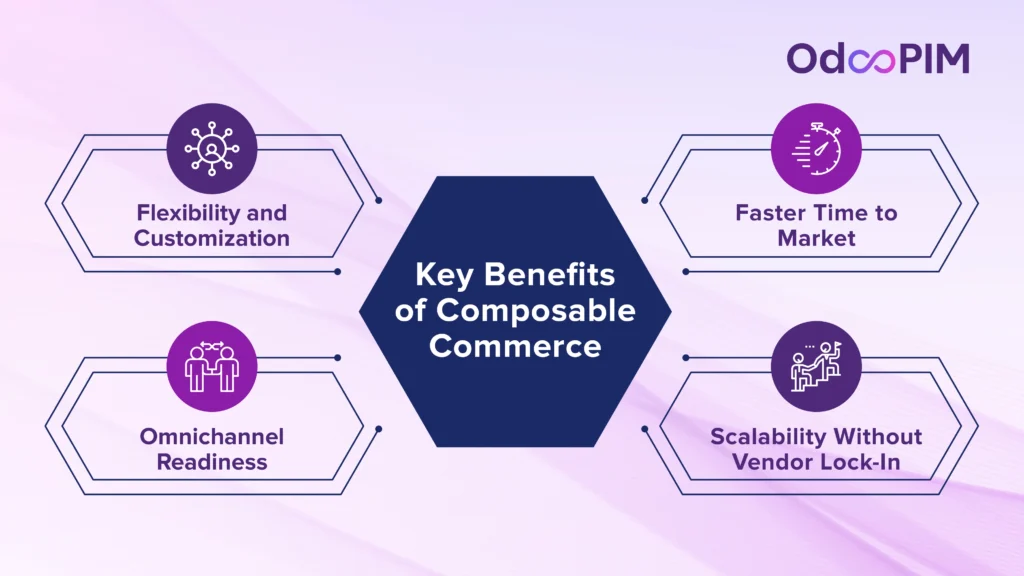
Flexibility and Customization
Composable commerce hands you the freedom to select every component of your technology stack based on specific business requirements rather than accepting a platform’s bundled capabilities. A manufacturer needing complex quote-to-cash workflows can choose a specialized pricing engine while using a different vendor for content management, neither constrained by the other’s limitations. This modular customization extends to B2B-specific requirements like contract pricing, bulk ordering, and customer-specific catalogs that monolithic platforms treat as afterthoughts. The benefits of composable commerce shine brightest when unique business processes demand technology that adapts to operations rather than forcing operations to conform to software defaults. Customization becomes a feature of the architecture rather than a costly customization project.
Faster Time to Market
Decoupled components allow parallel development and independent deployment cycles, eliminating the bottleneck of waiting for a monolithic platform upgrade to launch new capabilities. When your search provider releases an improved algorithm, you integrate it without touching the checkout code or risking cart functionality. A composable commerce platform accelerates experimentation by letting teams deploy new features to specific components without regression testing a monolithic codebase. This architecture slashes the time between identifying a market opportunity and delivering the capability to capture it. The benefits of composable commerce manifest in deployment velocity that monolithic competitors simply cannot match.
Omnichannel Readiness
A composable commerce omnichannel architecture inherently supports channel expansion because the backend services remain channel-agnostic while feeding any frontend experience. The same product data, pricing logic, and inventory service powers your B2B portal, mobile app, Amazon storefront, and distributor feeds without rebuilding for each channel. Adding a new touchpoint becomes a frontend exercise rather than a backend reconstruction because the commerce services expose their capabilities through standardized APIs. This channel flexibility makes composable architecture the natural foundation for any serious omnichannel strategy. The model grows with your channel footprint rather than constraining it.
Scalability Without Vendor Lock-In
Composable commerce protects against vendor dependency by ensuring no single technology provider controls your commerce operation. If your current cart solution underperforms or your search provider raises prices unsustainably, you replace that component without migrating your platform. This portability extends beyond switching costs to include the freedom to adopt emerging technologies from new vendors that monolithic platforms may never integrate. The benefits of composable commerce include negotiating leverage with every vendor, since each knows their component can be replaced without catastrophic disruption. Scalability comes from architectural independence, not from a single vendor’s capacity promises.
Learn about what is CPG
Composable Commerce Architecture and MACH
What MACH Means in Practice
MACH stands for Microservices, API-first, Cloud-native, and Headless, the four architectural principles that underpin composable commerce. Microservices break commerce functionality into small, independent services each handling a specific business capability with its own data store and deployment pipeline. API-first ensures every service exposes its functionality through well-documented APIs that become the contract between components, enabling the plug-and-play interoperability that defines a composable commerce platform. Cloud-native means services are designed for cloud deployment from inception, leveraging elastic infrastructure that scales automatically with demand. Headless completes the framework by decoupling the presentation layer from backend logic, allowing any frontend to consume commerce services. Together, these MACH principles form the technical foundation upon which every composable commerce architecture stands.
Packaged Business Capabilities (PBCs)
Packaged Business Capabilities represent the practical implementation unit of composable commerce: self-contained software components that deliver a specific business function with its own data, logic, and APIs. A checkout PBC handles all cart, payment, and order confirmation logic independently from a product search PBC or a content management PBC. These capabilities package complex commerce functionality into bounded contexts that teams can develop, deploy, and scale independently. Understanding what is composable commerce at the implementation level means thinking in PBCs rather than features, each capability operates as a mini-application with boundaries and contracts. The composable commerce platform emerges from orchestrating these capabilities into a cohesive commerce experience through API connections rather than monolithic code dependencies.
How Components Connect in a Composable Stack
Components in a composable stack communicate through a standardized integration layer where each service exposes its capabilities via REST or GraphQL APIs. An orchestration layer or commerce-specific mesh routes requests between services, handling authentication, data transformation, and error management across the component ecosystem. When a customer searches for a product, the frontend simultaneously calls the search PBC for results, the PIM for enriched product data, and the pricing engine for customer-specific rates, assembling the response from multiple independent services. This connection model treats every component as an equal participant in a distributed system rather than a subordinate module in a hierarchical platform. The architecture thrives on loose coupling, where each service understands only its domain and communicates through well-defined interfaces that insulate it from changes in other components.

Composable Commerce for B2B Manufacturers and Distributors
Why B2B Is Moving to Composable Commerce
B2B commerce demands specialized functionality, contract pricing, bulk ordering, customer-specific catalogs, quote workflows, that monolithic platforms designed for B2C consistently underserve. Manufacturers and distributors operate with complex pricing matrices, multi-tiered approval chains, and intricate product configurations that resist standardization into off-the-shelf software. A composable commerce platform lets B2B organizations select best-in-class components purpose-built for industrial commerce rather than accepting retail-focused features awkwardly adapted. The benefits of composable commerce for B2B include the ability to integrate deeply with existing ERP systems, configure quoting engines that reflect decades of pricing logic, and serve customer-specific catalogs drawn from governed product data. This architectural fit explains why industrial commerce is abandoning monolithic platforms for composable alternatives at an accelerating rate.
ERP Integration in a Composable Stack
ERP integration in a composable architecture becomes a first-class component rather than an afterthought connector bolted onto a monolithic platform. The ERP system exposes customer data, inventory levels, pricing agreements, and order history through its own APIs, which the composable orchestration layer consumes alongside other commerce services. A composable commerce omnichannel strategy depends on this ERP connectivity to deliver accurate, customer-specific information across every touchpoint without duplicating data. Real-time inventory synchronization, contract price enforcement, and accounts receivable validation flow directly from the ERP into the commerce experience because composable architecture treats ERP integration as a core capability. The composable commerce platform acknowledges that for B2B organizations, commerce technology must serve business systems that predate and outlast any single digital channel.
Product Catalog Complexity in B2B
B2B product catalogs dwarf their B2C counterparts in complexity, often containing tens of thousands of SKUs with technical specifications, compliance certifications, dimensional variants, and customer-specific pricing tiers. A composable commerce platform addresses this complexity by making the PIM an independent component optimized for industrial-scale product data rather than treating catalog management as a subset of the commerce engine. Complex product hierarchies, interrelated components, and configuration rules demand a specialized data layer that monolithic commerce platforms cannot provide natively. The benefits of composable commerce for catalog-heavy manufacturers include the ability to select a PIM purpose-built for industrial product data and connect it seamlessly to commerce, search, and syndication services. This architectural separation ensures product information receives the specialized governance it requires while remaining accessible to every customer-facing channel.
The Role of PIM in a Composable Commerce Platform
Why Product Data Is the Foundation
Product data constitutes the informational bedrock upon which every commerce interaction depends, from search and browse to comparison and purchase. Without accurate, enriched, and well-structured product information, even the most sophisticated composable commerce platform produces beautiful storefronts displaying content that erodes buyer confidence. Every component in a composable stack, search, recommendations, pricing, checkout, consumes product data in some form, making the PIM the silent foundation supporting the entire architecture. A composable commerce omnichannel strategy collapses when product information feeding those channels lacks consistency and completeness. The composable model recognizes product data as a standalone capability deserving its own specialized component rather than a feature buried inside a commerce engine.
What a PIM Does in a Composable Stack
A PIM in a composable architecture centralizes every product attribute, digital asset, technical specification, and marketing description into a single governed repository that exposes enriched content through APIs. The search component queries product data to return relevant results; the pricing engine references product attributes to apply correct rates; the syndication service pulls channel-specific subsets for marketplace distribution. This specialization means the PIM handles the unique demands of product data governance, version control, enrichment workflows, completeness validation, while other services consume the output without duplicating data management logic. Understanding what is composable commerce at the data layer means recognizing that product information requires its own component with its own lifecycle, governance rules, and enrichment processes independent of any commerce engine. The PIM becomes the authoritative voice of product truth in a distributed system where multiple services need consistent answers to the same product questions.
How OdooPIM Fits as the Product Data Layer
OdooPIM serves as the specialized product data component within a composable architecture, governing every attribute, specification, and digital asset while exposing enriched content through standardized APIs. It connects natively to Odoo ERP for real-time inventory, pricing, and customer data synchronization without requiring middleware between your commerce stack and business systems. Within a composable commerce platform, OdooPIM handles the unique demands of industrial product data, complex hierarchies, technical documentation, compliance certifications, while feeding consistent information to search, commerce, and syndication components. The system enforces data completeness standards before content reaches customer-facing channels, preventing the incomplete listings that undermine marketplace performance and buyer trust. OdooPIM transforms product data management from a constraint on composable commerce adoption into the strongest link in the component chain.

Is Composable Commerce Right for Your Business?
When Composable Commerce Makes Sense
Composable commerce fits organizations whose business requirements outstrip the capabilities of monolithic platforms, particularly B2B manufacturers managing complex products and unique selling processes. Your technology roadmap demands flexibility to adopt emerging vendors and replace underperforming components without platform-level migration projects. The benefits of composable commerce align with businesses planning aggressive channel expansion, since the architecture natively supports adding touchpoints without backend reconstruction. Choose composable when your competitive advantage depends on technology that adapts to your business processes rather than forcing your operations into a platform’s predetermined workflows. This approach rewards organizations with the technical maturity to manage multiple vendor relationships and the clarity to select best-in-class components for each commerce function.
When to Wait
Organizations with straightforward commerce requirements, limited SKU counts, and uncomplicated selling processes may find monolithic platforms sufficient for their current needs. The composable commerce platform model demands integration capabilities and architectural oversight that smaller teams lacking dedicated technical resources cannot sustain. Wait if your digital roadmap involves a single channel with standard B2C-style purchasing flows that off-the-shelf solutions handle adequately. The transition from monolith to composable requires organizational readiness beyond technology selection, including team structures aligned to component ownership and API-first thinking. A composable approach rewards preparation and punishes premature adoption without the operational maturity to manage distributed systems effectively.
Where to Start
Begin your composable commerce journey by identifying the single component causing the most business pain, typically product data management for B2B organizations, and replacing it with a specialized, API-first solution. Implement a PIM as your foundational data layer before adding commerce, search, or syndication components that consume enriched product information. Starting with product data governance ensures every subsequent component receives clean, complete, and consistent content from day one. This incremental approach delivers immediate operational value while building toward a fully composable architecture without the risk of a big-bang platform migration. The path to composable commerce begins not with replacing everything simultaneously but with making each component decision independently, connected through APIs, governed by a clear architectural vision.
FAQs
1. What is composable commerce?
What is composable commerce if not the freedom to build your commerce stack from independent, best-in-class components instead of accepting a monolithic platform’s bundled capabilities. A composable commerce platform treats every function, cart, search, pricing, content, product data, as a swappable module connected through standardized APIs. You select each component based on specific business requirements and connect them into a cohesive ecosystem without being locked into any single vendor’s roadmap. The benefits of composable commerce include the ability to replace underperforming components without ripping apart the entire system. This architectural philosophy transforms technology selection from a one-time platform commitment into an ongoing series of independent, strategic decisions.
2. What is the difference between composable commerce and headless commerce?
Headless commerce decouples the frontend presentation layer from the backend commerce engine, allowing custom storefronts while keeping the backend intact. Composable commerce extends this decoupling philosophy to every layer of the stack, breaking the commerce engine itself into independent modules like payments, inventory, and pricing. While headless separates the customer-facing experience from the commerce logic, composable decomposes the infrastructure into discrete, swappable services. A composable commerce platform treats headless as one architectural principle among many rather than the complete solution. The distinction matters because headless provides frontend freedom while composable delivers complete architectural freedom across every commerce function.
3. What is MACH architecture in composable commerce?
MACH stands for Microservices, API-first, Cloud-native, and Headless, the four architectural principles that form the technical foundation of composable commerce. Microservices break commerce functionality into small, independent services each handling a specific business capability with its own data and deployment pipeline. API-first ensures every service exposes functionality through well-documented interfaces that become the contract enabling plug-and-play interoperability across the composable commerce platform. Cloud-native design means services leverage elastic infrastructure that scales automatically with demand rather than depending on fixed server capacity. Headless completes the framework by decoupling presentation from logic, allowing any frontend to consume commerce services in a composable commerce omnichannel deployment.
4. What role does a PIM play in a composable commerce platform?
A PIM serves as the specialized product data component within a composable commerce platform, centralizing every attribute, specification, and digital asset into a single governed repository. It exposes enriched product content through APIs that search, commerce, pricing, and syndication components consume without duplicating data management logic. This architectural separation ensures product information receives dedicated governance, version control, enrichment workflows, completeness validation, rather than being treated as a feature buried inside a commerce engine. The benefits of composable commerce for product data include selecting a PIM purpose-built for complex catalogs and connecting it smoothly to the channels. A composable commerce omnichannel strategy depends on this specialized data layer to deliver consistent product truth across touchpoints.
5. Is composable commerce suitable for B2B manufacturers and distributors?
Composable commerce is architecturally ideal for B2B manufacturers and distributors whose complex requirements outstrip monolithic platforms designed primarily for retail. These organizations manage intricate pricing matrices, customer-specific catalogs, bulk ordering workflows, and ERP integrations that demand specialized components rather than one-size-fits-all features. A composable commerce platform lets industrial businesses select best-in-class quoting engines, configure complex product relationships, and serve governed technical data across channels. The benefits of composable commerce for B2B include the ability to integrate with existing ERP systems while delivering a composable commerce omnichannel experience across distributor portals, direct storefronts, and marketplaces. This architectural fit explains why manufacturers and distributors are abandoning rigid monoliths for composable alternatives.