What Are Consumer Packaged Goods (CPG)?
Definition
The consumer packaged goods definition describes products that sell quickly at relatively low cost, requiring frequent repurchase due to consumption or limited shelf life. These goods arrive in packaged form, boxes, bottles, cans, wrappers, designed for individual or household use rather than commercial or industrial application. What is CPG, fundamentally concerns items with high turnover velocity where brand switching costs remain low and purchase decisions happen in seconds. The packaging itself serves dual purposes: protecting contents while functioning as the primary marketing vehicle on crowded retail shelves. CPG consumer packaged goods differ from other product categories in their reliance on mass distribution, repeat purchase behavior, and the constant battle for consumer attention at the point of sale.
CPG Examples
Everyday consumer packaged goods examples include food staples like bread, milk, cereal, frozen meals, and snack foods that dominate grocery store aisles. Beverages represent another massive CPG consumer packaged goods category spanning bottled water, soft drinks, coffee, tea, juice, and alcoholic beverages sold through retail channels. Personal care items, shampoo, toothpaste, deodorant, skincare products, razors, constitute a what are CPG products segment where brand loyalty commands premium pricing despite functional similarity between competitors. Household products including laundry detergent, dish soap, cleaning sprays, paper towels, and trash bags round out the home care dimension of consumer packaged goods. Over-the-counter medications, vitamins, supplements, and first-aid supplies represent the healthcare adjacent category that blurs the line between CPG and pharmaceutical products.

CPG vs Durable Goods
Consumer packaged goods diverge sharply from durable goods in purchase frequency, price point, and the decision-making psychology driving consumer behavior. Durable goods like appliances, furniture, electronics, and vehicles involve extended consideration cycles, higher price tags, and multi-year replacement timelines that bear no resemblance to the rapid turnover defining what is CPG. A refrigerator purchase triggers weeks of research, price comparison, and feature evaluation; a toothpaste purchase happens in seconds based on habit or shelf placement. CPG consumer packaged goods manufacturers optimize for repeat purchase and brand loyalty within low-consideration categories, while durable goods producers focus on infrequent, high-stakes purchase moments. The consumer packaged goods definition inherently excludes items designed for long-term use, as the “packaged” and “fast-moving” qualifiers both point toward consumable rather than lasting goods.
Forrester’s Jitender Miglani, Principal Analyst, notes that online penetration for nondurable CPG categories such as grocery and beauty is only about half that of durable goods — leaving most CPG categories under 40% online and primed for high-single-digit to double-digit ecommerce growth through the end of the decade.
— Forrester US Online Retail Forecast, via Retail TouchPoints
Why CPG Matters
Market Size
The sheer scale of the consumer packaged goods industry makes it an economic force that touches every household and retail channel globally. Annual spending on what are CPG products reaches trillions of dollars across developed and emerging markets, employing millions in manufacturing, logistics, marketing, and retail. The CPG consumer packaged goods sector commands more shelf space and retail square footage than any other product category, dominating grocery stores, drugstores, mass merchandisers, and increasingly digital marketplaces. This market magnitude means even fractional shifts in consumer preference within CPG categories ripple through supply chains, advertising spending, and retail strategies. The CPG meaning for the broader economy lies in its role as a bellwether for consumer confidence, spending patterns, and inflationary pressures.
Purchase Frequency
Consumer packaged goods achieve their defining velocity through purchase cycles measured in days or weeks rather than months or years. The average household replenishes what is CPG staples dozens of times annually, creating recurring revenue streams and habitual buying patterns that durable goods manufacturers can only envy. This consumption-replenishment cycle means CPG consumer packaged goods brands must win at every shopping occasion because switching costs remain negligible. The frequency dynamic creates both opportunity and vulnerability: loyal customers deliver predictable revenue, but a single stockout or price increase can redirect that loyalty instantly. Consumer packaged goods examples like milk, bread, and eggs demonstrate purchase frequency at its extreme, with weekly or even daily replenishment driving the grocery trip itself.
Brand Loyalty
CPG brand loyalty operates as a peculiar paradox where consumers swear allegiance to specific toothpaste or detergent brands while remaining one discount or stockout away from switching permanently. Successful consumer packaged goods companies invest decades building trust through consistent quality, memorable advertising, and strategic shelf placement that makes their products the default choice. Brand equity in the CPG consumer packaged goods space translates into pricing power, retail leverage, and the ability to extend trusted names into adjacent product categories. Yet private label consumer packaged goods examples demonstrate how fragile that loyalty becomes when retailers offer comparable quality at meaningful discounts. The what is a CPG company question increasingly centers on which brands maintain pricing power as consumers trade down.
Economic Impact
The CPG consumer packaged goods sector functions as a massive employment engine spanning agriculture, manufacturing, packaging, transportation, marketing, and retail. Wage trends, commodity prices, and supply chain disruptions within consumer packaged goods cascade through the broader economy because the industry touches so many interconnected sectors. What is CPG manufacturing represents a significant portion of industrial output in most developed economies, with production facilities distributed geographically to minimize transportation costs. The industry’s advertising spending sustains media ecosystems, while its logistics requirements shape transportation infrastructure and warehouse development. CPG companies rank among the largest employers and taxpayers in many regions, making their operational health a matter of economic policy concern.
What Is a CPG Company?
Role
A what is a CPG company answer starts with the core function of developing, manufacturing, distributing, and marketing fast-moving packaged goods to consumers through retail intermediaries. These organizations orchestrate complex supply chains that source materials, operate production facilities, manage quality control, and deliver finished products to thousands of retail locations or to consumers. CPG consumer packaged goods companies maintain extensive research and development operations that continuously reformulate products, design new packaging, and identify emerging consumer needs before competitors. The marketing function within consumer packaged goods organizations rivals operations in sophistication, deploying brand advertising, trade promotion, digital engagement, and retail partnerships to capture consumer attention. Sales teams negotiate shelf placement, promotional calendars, and pricing strategies with retail partners who control the final consumer access point.
Scale
Consumer packaged goods companies operate at staggering scale, with multinational giants managing hundreds of brands across dozens of product categories in markets spanning every continent. These organizations run manufacturing facilities producing millions of units daily, supply chains sourcing ingredients globally, and distribution networks reaching hundreds of thousands of retail outlets. The largest CPG consumer packaged goods enterprises employ tens of thousands of people and generate annual revenues exceeding many national economies. Yet what is a CPG company also includes the emerging digital-native brands that achieve rapid growth through direct-to-consumer channels, contract manufacturing partnerships, and social media marketing without owning factories or negotiating for shelf space. The CPG meaning now encompasses both century-old conglomerates and venture-backed startups disrupting categories through agile operations and digital-first brand building.

Trends Reshaping the CPG Industry
D2C and eCommerce
Direct-to-consumer commerce alters the consumer packaged goods distribution model by letting brands sell straight to shoppers, capturing customer data and margin that retailers historically controlled. CPG consumer packaged goods companies that once depended on supermarket shelf placement now build sophisticated ecommerce operations, subscription programs, and digital engagement strategies that disintermediate traditional retail partners. The shift toward what is CPG sold online accelerated permanently during the pandemic and continues reshaping category dynamics as consumers discover the convenience of replenishment subscriptions and doorstep delivery. This consumer packaged goods channel transformation forces legacy brands to develop digital capabilities while defending retail relationships that still generate the majority of revenue. CPG brands winning the D2C battle combine digital shelf optimization, social commerce, and first-party data strategies that traditional retail partnerships never provided.
Sustainability
Sustainability pressures reshape consumer packaged goods packaging, sourcing, and manufacturing as consumers and regulators demand reduced environmental impact across the product lifecycle. CPG consumer packaged goods companies face intensifying scrutiny over plastic waste, carbon emissions, water usage, and ingredient sourcing practices that previous generations of shoppers never considered. The what are CPG products sustainability challenge extends beyond packaging to include agricultural supply chains, manufacturing energy consumption, and end-of-life product disposal. Leading consumer packaged goods organizations respond with recycled content commitments, refillable packaging formats, and regenerative agriculture programs that transform sustainability from compliance burden into brand differentiator. CPG brands that fail to address environmental concerns watch market share migrate toward competitors with credible sustainability stories and transparent supply chains.
Health and Wellness
Health-conscious consumers drive reformulation across consumer packaged goods categories, demanding cleaner ingredients, reduced sugar, higher protein, and functional benefits from everyday products. The CPG consumer packaged goods industry responds with product lines featuring plant-based ingredients, probiotic fortification, and recognizable ingredient lists that satisfy label-reading shoppers. What is CPG innovation increasingly centers on nutritional improvement and functional benefits rather than mere flavor variations or packaging refreshes. Traditional consumer packaged goods examples like soda, cereal, and frozen meals face category disruption from better-for-you alternatives that command premium pricing and attract younger demographics. CPG brands built on indulgence and convenience now acquire or launch health-oriented lines to capture shifting consumer preferences.
Private Labels
Retailer-owned brands capture growing market share across consumer packaged goods categories as quality improvements and price advantages overcome historical stigma. CPG consumer packaged goods companies that once dismissed private labels as an economy-tier alternative now compete against retailer brands offering premium positioning, innovative formulations, and margins that fund aggressive pricing strategies. The what is a CPG company competitive landscape intensifies as retailers leverage customer data, shelf placement authority, and supply chain control to accelerate private label expansion. Consumer packaged goods examples from Costco’s Kirkland, Target’s Good & Gather, and Amazon’s Solimo demonstrate how private labels now compete credibly at every price tier. National CPG brands respond with innovation acceleration, loyalty program investment, and value-tier offerings that defend market share without triggering unsustainable price wars.
Tech and AI
Technology and artificial intelligence transform consumer packaged goods operations from product development through supply chain management to marketing execution. CPG consumer packaged goods companies deploy machine learning to predict demand, optimize pricing, personalize promotions, and identify emerging consumer trends from social media signals. The what is CPG innovation pipeline accelerates as AI analyzes ingredient combinations, flavor profiles, and packaging concepts to reduce development cycles from years to months. Computer vision and sensor technology enable consumer packaged goods manufacturers to monitor production quality, reduce waste, and predict equipment maintenance needs before failures disrupt output. CPG marketing transforms through programmatic advertising, dynamic creative optimization, and predictive analytics that target consumers with unprecedented precision.

Challenges CPG Companies Face at Scale
SKU Sprawl
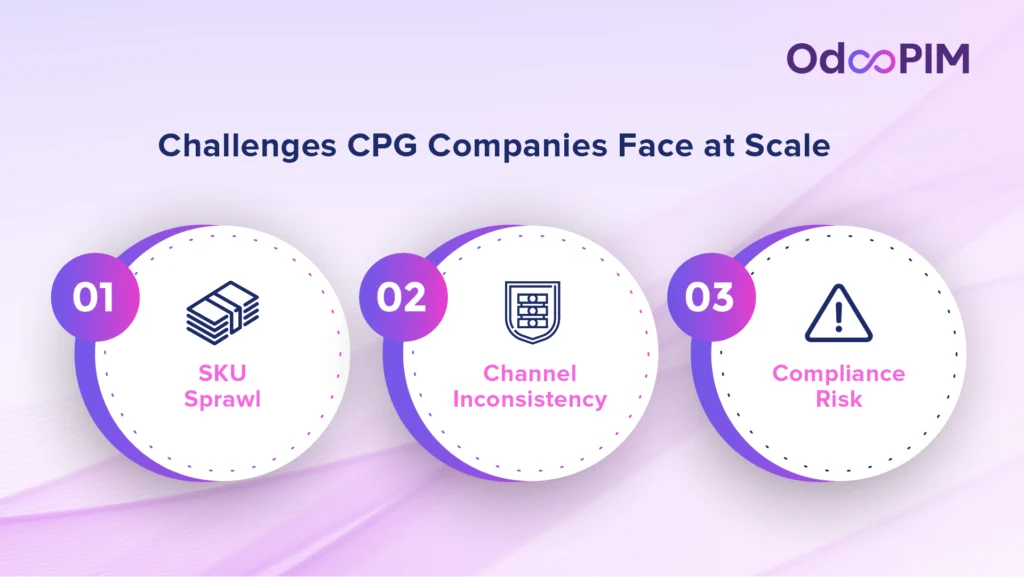
CPG consumer packaged goods companies multiply SKUs relentlessly as brand extensions, flavor variations, package sizes, and promotional formats proliferate across product lines. This SKU sprawl creates product data management nightmares where thousands of items require accurate specifications, ingredient lists, nutritional information, and digital assets synchronized across channels. What are CPG products without governed product data become listing errors, compliance violations, and supply chain inefficiencies that compound with each new variation. The consumer packaged goods industry’s addiction to line extensions drives top-line growth while silently increasing operational complexity beneath the surface. CPG organizations discover that SKU rationalization projects become inevitable when catalog complexity outstrips the systems designed to manage it.
Channel Inconsistency
Consumer packaged goods sold across supermarkets, drugstores, convenience stores, club retailers, ecommerce platforms, and direct-to-consumer sites require consistent product information that disconnected systems cannot deliver. A CPG consumer packaged goods brand listing the same cereal on Amazon, Walmart.com, Instacart, and their own D2C site often presents different images, descriptions, and nutritional information on each platform. This what is CPG channel fragmentation confuses consumers who encounter conflicting product details depending on where they shop. The consumer packaged goods definition of brand integrity increasingly includes data consistency across every digital and physical touchpoint. CPG companies that fail to synchronize product information across channels undermine the brand equity they spent decades building.
Compliance Risk
CPG consumer packaged goods operate under intensifying regulatory requirements governing ingredient disclosure, nutritional labeling, allergen warnings, and sustainability claims across multiple jurisdictions. A what is a CPG company compliance failure, incorrect allergen information, outdated nutritional panels, unsubstantiated marketing claims, triggers regulatory action, litigation, and brand damage that can erase years of equity building. Consumer packaged goods examples of compliance failures demonstrate how a single product data error can force costly recalls and erode consumer trust permanently. The CPG regulatory environment grows more complex as governments mandate front-of-pack labeling, restrict certain ingredients, and require detailed supply chain transparency. Consumer packaged goods organizations discover that manual compliance processes cannot scale alongside regulatory proliferation.
How a Product Data Foundation Supports CPG Brands
Single Source of Truth
A centralized product data repository transforms CPG consumer packaged goods operations by giving every team, R&D, marketing, sales, regulatory, supply chain, access to identical, governed product information. This single source of truth eliminates the version conflicts that occur when the ingredient list in R&D differs from the label in marketing and the digital shelf on Amazon. What is CPG product data governance becomes the operational backbone that prevents costly errors before they reach consumers or regulators. The consumer packaged goods brands winning at scale invest in product information management that treats data quality with the same discipline as product quality. CPG organizations with governed product data launch products faster, enter channels smoother, and recall items less frequently than competitors relying on spreadsheet-based data management.
Faster Launches
Governed product data accelerates consumer packaged goods innovation by eliminating the manual data assembly that bogs down new product introductions. When R&D specifications, marketing content, and regulatory documentation live in a centralized system, the transition from formulation to commercialization happens in weeks rather than months. CPG consumer packaged goods companies with mature product data foundations syndicate complete, accurate listings to every channel simultaneously, capturing first-mover advantage rather than playing catch-up. The what is a CPG company speed-to-market equation increasingly favors organizations that treat product data readiness as a launch prerequisite rather than an afterthought. Consumer packaged goods brands compress innovation cycles by building product data once and publishing everywhere without rework.
Native ERP Connection
CPG consumer packaged goods companies running on Odoo gain compounding advantage when product data management connects natively to ERP, inventory, sales, and ecommerce without middleware. This native connection ensures ingredient changes, packaging updates, and nutritional revisions flow instantly from the product record to every channel and business function. The what are CPG products, data synchronization between PIM and ERP eliminates the dangerous lag where manufacturing produces updated formulations while digital channels still display previous specifications. Consumer packaged goods operations benefit from real-time visibility where inventory levels, pricing updates, and compliance documentation stay synchronized across the technology stack. CPG brands on Odoo with native PIM capability build a data foundation that scales with catalog growth rather than crumbling beneath it.
Case Studies
Case Study 1: Organic Snack Brand Centralizes Product Data and Cuts Launch Time by Sixty Percent
Challenge
A growing organic snack brand with two hundred fifty SKUs managed product data through disconnected spreadsheets shared across R&D, marketing, and sales teams. Each department maintained its own version of ingredient lists, nutritional panels, and packaging specifications, creating constant conflicts when products reached retail and ecommerce channels. A major retailer flagged that the brand’s Amazon listing displayed different ingredient information than the physical package on store shelves, threatening their authorized supplier status. New product launches consumed six weeks of manual data coordination between R&D formulation records, marketing descriptions, and regulatory compliance documentation. The company needed to understand what is a CPG company data foundation required to scale without the operational chaos that fragmented product information creates.
Solution
The brand implemented a centralized PIM to serve as the single source of truth for all product data across their CPG consumer packaged goods portfolio. R&D teams uploaded ingredient specifications and nutritional data into governed product records where marketing could access verified technical information without duplicating it in separate files. Regulatory compliance documentation attached to each SKU ensured that allergen warnings, organic certifications, and nutritional panels remained current and consistent regardless of channel. Channel syndication pushed enriched product content to Amazon, Whole Foods online, Instacart, and the brand’s D2C storefront simultaneously from the same master records. The consumer packaged goods workflow transformed from six separate spreadsheet versions into one governed process where every team contributed to and pulled from identical product truth.
Results
- New product launch time reduced from six weeks to seventeen days as manual data assembly gave way to governed enrichment workflows
- Retailer compliance violations eliminated when ingredient and nutritional data synchronized across channels from a single source
- The what is CPG data foundation now supports planned expansion into three additional retail chains without adding product data management headcount
- Customer trust strengthened as shoppers encountered identical ingredient lists and nutritional information whether purchasing on Amazon, Instacart, or the brand’s D2C site
- The consumer packaged goods definition of brand consistency now includes data accuracy across every digital and physical touchpoint
Case Study 2: Personal Care Manufacturer Recovers from Channel Inconsistency with Governed Product Data
Challenge
A mid-sized personal care manufacturer producing soaps, lotions, and skincare products sold through six channels: their D2C website, Amazon, Walmart.com, Target.com, specialty beauty retailers, and grocery chains. Product data for their four hundred SKUs lived in marketing spreadsheets that rarely synchronized with the formulation records maintained by R&D. A customer complaint revealed that the ingredient list on Target.com differed from both the physical package and the D2C site, triggering an internal audit that uncovered similar discrepancies across channels. The what are CPG products data fragmentation problem intensified as marketing launched seasonal variants and limited-edition scents that multiplied SKU counts without corresponding data governance. The company faced mounting compliance risk as regulatory requirements for ingredient disclosure and allergen warnings grew more stringent.
Solution
The manufacturer deployed a PIM to centralize every product attribute, ingredient list, marketing description, and regulatory document into one governed repository. R&D established the master ingredient records and formulation specifications that marketing could enrich with brand content without altering the verified technical data. Compliance documentation including cruelty-free certifications, organic claims, and allergen declarations attached to each SKU with expiration tracking that flagged renewals before certifications lapsed. The CPG consumer packaged goods channel syndication engine pushed consistent product content to six sales channels, formatting attributes to meet each platform’s specific requirements while maintaining data integrity. Seasonal product launches now follow a governed workflow where R&D specifications flow into enrichment templates that marketing completes, eliminating the manual spreadsheet handoffs that caused previous inconsistencies.
Results
- Channel product data consistency achieved across D2C, Amazon, Walmart, Target, beauty retailers, and grocery chains from a single governed repository
- Customer complaints related to ingredient discrepancies dropped to zero within the first quarter of CPG PIM adoption
- Compliance risk eliminated as certification expiration tracking and automated updates ensured all channels displayed current regulatory information
- Seasonal product launch time reduced by half as governed workflows replaced manual spreadsheet coordination between teams
- The what is a CPG company operational foundation now supports international expansion into markets with additional regulatory requirements and labeling standards
- The brand discovered that consumer packaged goods examples of successful channel expansion share one common element: governed product data that predates the channel strategy itself

FAQs
1. What is the full form of CPG?
The full form of CPG is Consumer Packaged Goods, describing products that consumers use daily, replace frequently, and purchase at relatively low cost through retail channels. Understanding what is CPG means recognizing these items as the packaged foods, beverages, toiletries, and household essentials that fill shopping carts across every demographic. The CPG meaning encompasses both the physical products and the massive industry infrastructure that develops, manufactures, distributes, and markets them globally. What is consumer packaged goods if not the cereal boxes, shampoo bottles, and cleaning supplies that households replenish constantly without conscious deliberation. The consumer packaged goods definition hinges on rapid turnover, low purchase price, and habitual consumption patterns that distinguish these products from durable or luxury goods.
2. Is CPG the same as FMCG?
CPG and FMCG describe the same product category with regional naming preferences, Consumer Packaged Goods dominates North American usage while Fast-Moving Consumer Goods prevails in Europe, Asia, and Africa. Both terms define products characterized by high sales velocity, low individual price points, and frequent replenishment cycles driven by daily consumption. What is CPG to an American marketer mirrors what FMCG means to a British counterpart: packaged foods, beverages, personal care items, and household goods moving rapidly through retail channels. The CPG meaning and FMCG definition share identical product scope despite the semantic difference in terminology. Whether labeled CPG consumer packaged goods or FMCG, these products operate on the same business model fundamentals of volume, velocity, and brand-driven repeat purchase behavior.
3. What industries fall under CPG?
Food and beverage manufacturing represents the largest CPG consumer packaged goods segment, spanning everything from fresh bakery items and frozen meals to soft drinks and alcoholic beverages sold through retail. Personal care and beauty constitute another massive CPG products category, including skincare, haircare, oral care, cosmetics, and grooming products that consumers purchase repeatedly. Household care encompasses cleaning supplies, laundry detergents, paper products, and air fresheners that fit squarely within the consumer packaged goods definition. Over-the-counter medications, vitamins, supplements, and first-aid supplies form the healthcare-adjacent CPG sector where regulatory compliance adds complexity. Pet food and pet care products round out the consumer packaged goods examples, demonstrating how the industry spans virtually every consumable category found in retail environments.
4. What is an example of a CPG company?
Procter & Gamble stands as the “what is a CPG company” example, managing a portfolio spanning Tide detergent, Pampers diapers, Gillette razors, Crest toothpaste, and dozens of other household staples across global markets. Unilever similarly exemplifies CPG consumer packaged goods leadership with brands like Dove, Hellmann’s, Knorr, and Ben & Jerry’s reaching consumers in over one hundred ninety countries. Nestlé dominates food and beverage consumer packaged goods examples with products from coffee creamers to frozen pizzas to infant nutrition. PepsiCo and Coca-Cola represent beverage-focused CPG giants whose products achieve near-universal distribution through retail, foodservice, and vending channels. These what are CPG products powerhouses demonstrate the scale, brand portfolio depth, and distribution sophistication that define successful consumer packaged goods enterprises.
5. What is the difference between CPG and durable goods?
Consumer packaged goods differ fundamentally from durable goods in purchase frequency, price point, and the consumer psychology governing buying decisions. Durable goods like appliances, furniture, electronics, and automobiles involve extended consideration cycles, substantial financial commitment, and multi-year replacement timelines bearing no resemblance to the rapid turnover defining what is CPG. A washing machine purchase triggers weeks of research and comparison while a laundry detergent purchase happens habitually in seconds. The consumer packaged goods definition inherently excludes items designed for long-term use, as the packaged and fast-moving qualifiers both point toward consumable rather than lasting products. CPG consumer packaged goods manufacturers optimize for repeat purchase behavior within low-consideration categories, while durable goods producers focus on infrequent, high-stakes purchase moments requiring extensive consumer education and relationship building.