
What Is Product Data Management and Why Does It Matter?
Product data management is the discipline of collecting, organizing, and maintaining every piece of product information, descriptions, specs, images, pricing. Product data management best practices ensure customers see accurate, consistent data whether they shop on your website, Amazon, or a retail partner portal. Bad product data kills sales: wrong dimensions trigger returns, missing attributes break site search, inconsistent pricing erodes trust. Managing product data in ecommerce without a system means spreadsheets, chaos, and constant firefighting, product catalog management best practices start with one source of truth where every update flows automatically to every channel.
What Counts as Product Data?
Product data includes every piece of information that describes what you sell. Base attributes: product name, SKU, GTIN, brand, description, price, weight, dimensions. Enriched content: SEO metadata, bullet points, lifestyle images, videos, 3D models, customer reviews, ratings. Product catalog management best practices treat all these elements as interconnected parts of one master record, not scattered files. Product data standardization means every product follows the same attribute structure, size options come from a dropdown, not free text entry.
Channel-specific data also counts. Amazon requires different image ratios than your website. Google Shopping needs short descriptions under 150 characters. Managing product data in ecommerce includes these variations. Relationship data matters too, compatible accessories, replacement parts, upsell suggestions, cross-sell links. Product data enrichment strategy adds technical specs for B2B buyers, fabrication details for fashion shoppers, ingredient lists for food products. If information helps a customer decide to buy, it belongs in your product data. Odoo product data management treats this as one unified system.

The Real Cost of Poor Product Data Management
Calculate the waste. Your team spends ten hours weekly hunting for correct product information across spreadsheets, emails, and supplier portals. That is 520 hours annually, roughly $15,000 in labor for a mid-level employee. Product data management best practices would cut that time by 75%. Then add returns. A wrong dimension in your listing triggers returns at 20-30% of the item’s value after shipping and restocking. Product data quality best practices prevent these errors at the source, not after customers complain.
Lost sales add another hidden cost. Missing attributes means shoppers cannot filter to find your products. Inconsistent descriptions confuse comparison shoppers, who buy from competitors with cleaner data. How to improve product data quality directly impacts conversion rates. One study showed a 15% revenue lift after cleaning product data. Compliance penalties from retailers like Amazon or Walmart for incomplete listings add fines or delisting. Product information management best practices include validation that blocks incomplete data before syndication. Poor product data management is not a technical problem, it is a revenue leak. PIM implementation best practices plug that leak.
Who Is Responsible for Product Data in a Business?
No single department owns product data in most organizations. Marketing writes descriptions. Operations manages specifications. Sales sets pricing for different channels. Product data governance assigns clear ownership for each attribute regardless of who enters it. A governance framework says: Marketing owns SEO fields, Operations owns technical specs, Sales owns channel pricing, Compliance owns legal copy. Product information management best practices centralize the system while distributing responsibility by role.
Without governance, product data becomes everyone’s problem and no one’s problem. Updates stall because no one knows who approves changes. Errors persist because no one feels accountable. Managing product data in ecommerce requires a data owner at the executive level, often a Product Information Manager or Master Data Manager. This person defines product data standardization rules, enforces product data quality best practices, and mediates conflicts between departments. Odoo product data management includes role-based permissions that implement these rules automatically. The system knows marketing cannot edit technical specs; operations cannot change SEO copy. Clear ownership. Cleaner data. Fewer arguments. Product data enrichment strategy works when everyone knows their lane.
Learn about Product data management software.
Common Product Data Management Mistakes to Avoid
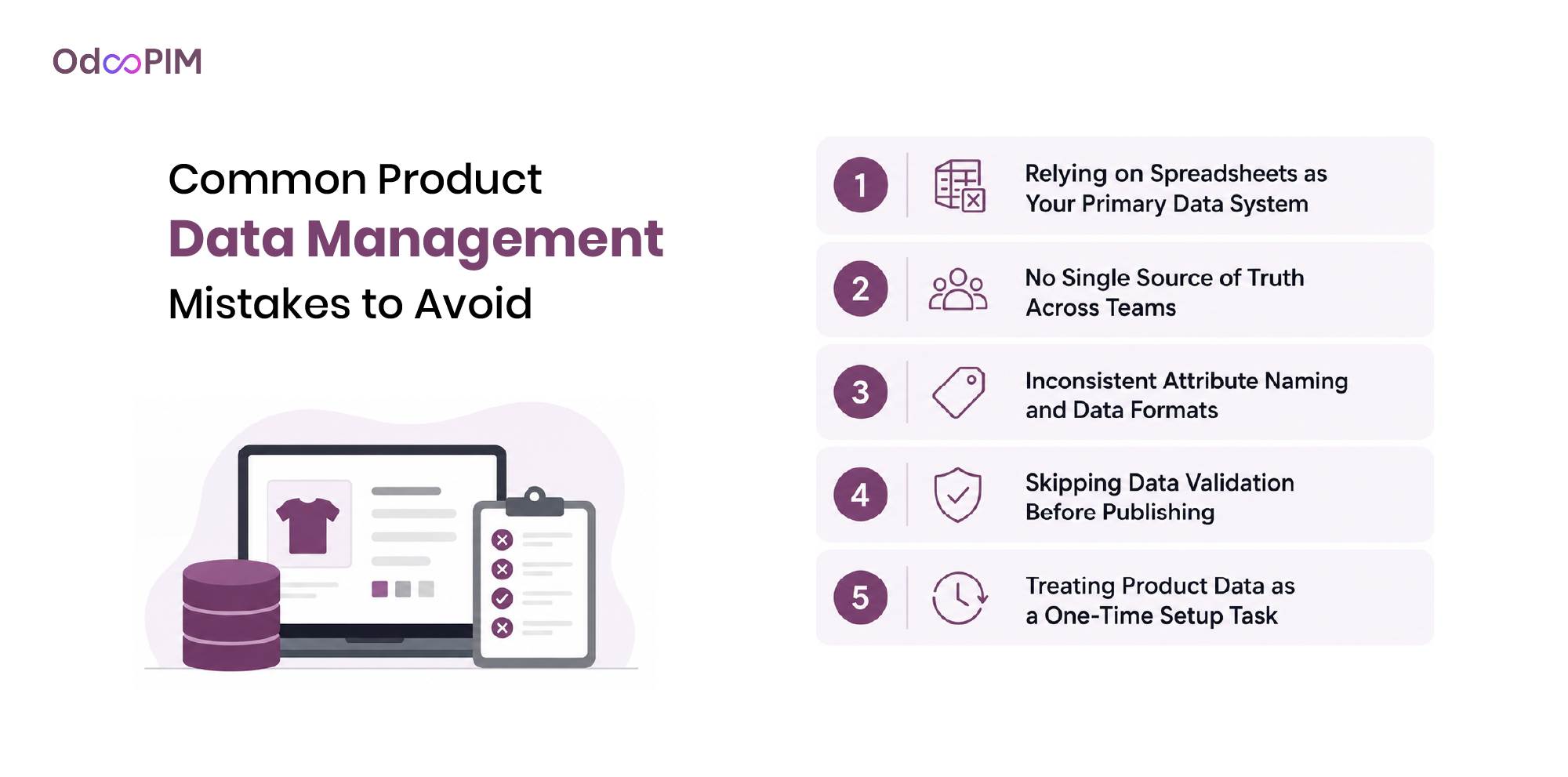
1. Relying on Spreadsheets as Your Primary Data System
Spreadsheets feel comfortable because everyone knows Excel. But they fail silently. A merged cell here, a broken formula there, and suddenly your product descriptions vanish or your pricing miscalculates. Managing product data in ecommerce with spreadsheets means no audit trail, no version control, and no way to know who changed what. Product data management best practices replace spreadsheets with a database that enforces data types and tracks every edit.
The real cost appears when multiple people edit the same file. One person updates dimensions while another changes pricing. Which version wins? You spend hours reconciling conflicts. Product catalog management best practices centralize data in a system designed for concurrent access, not a file built for single-user editing. Product information management best practices say: if your “master” product data lives in a spreadsheet, you do not have master data. You have organized chaos. How to improve product data quality starts with leaving Excel behind.
2. No Single Source of Truth Across Teams
Marketing maintains one spreadsheet. Operations keep another. Sales has a third. A product update requires touching all three, and they never match. Product data governance fails when no one knows which file is current. Your website shows old pricing because marketing forgot to update the operations file. Product data standardization cannot happen when each team defines “size” or “color” differently.
The solution is one system that every team uses. Odoo product data management exemplifies this, your ERP handles inventory, accounting, and product data under one login. Product data enrichment strategy works when marketing, operations, and sales enrich the same record rather than separate files. PIM implementation best practices prioritize consolidation over new features. Clean up your source before adding complexity. A single messy source is better than multiple conflicting versions. At least you know where the mess lives.
3. Inconsistent Attribute Naming and Data Formats
One product uses “Medium.” Another uses “M.” A third uses “Med.” Your site filters cannot handle this variation. Product data quality best practices demand standardized attribute values defined in dropdown menus, not free text entry. Managing product data in ecommerce without standardization guarantees broken filters, frustrated customers, and lost sales. Shoppers filter by “Large” and see only half your large products because the rest say “L.”
Data formats matter too. Dates appear as MM/DD/YYYY in some records and DD/MM/YYYY in others. Prices include dollar signs in one field and not another. Product catalog management best practices enforce format rules at entry. The system rejects non-compliant data before it pollutes your catalog. Product data standardization is not exciting work, but it separates professional operations from amateur chaos. How to improve product data quality begins with a simple rule: every attribute has one allowed format, defined once, enforced everywhere.
Product Data Management (PDM) serves as the backbone system for controlling product design data and managing changes throughout development.
— Gartner
4. Skipping Data Validation Before Publishing
Your team publishes a new product. Two weeks later, customers start returning it. The description said “100% cotton” but the spec sheet said “polyester blend.” No one validated the data before it went live. Product data management best practices include validation checkpoints that block incomplete or inconsistent data from reaching your store. Product information management best practices catch missing images, conflicting specs, and incomplete attributes before customers see them.
Validation saves money. A single return triggered by bad data costs your business shipping, restocking, and lost margin. Multiply by hundreds of products. PIM implementation best practices build validation rules into your workflow. The system flags missing GTINs, incorrect image ratios, and mismatched prices. Product data quality best practices mean bad data never reaches your channels because your tools stop it at the source. Manual review misses errors. Automated validation catches them every time.
5. Treating Product Data as a One-Time Setup Task
You migrate your product data to a clean system. Everyone celebrates. Six months later, the data is messy again because no one maintained it. Product data governance requires ongoing processes, not a one-time project. New products arrive with inconsistent attributes. Suppliers change specifications without telling you. Managing product data in ecommerce is a continuous discipline, not a weekend cleanup task.
Product data enrichment strategy includes regular audits, automated quality scoring, and clear ownership for updates. Product catalog management best practices schedule quarterly data health checks. How to improve product data quality long-term means building review cycles into your calendar. Treat product data like your physical inventory, you would not count it once and ignore it for years. Odoo product data management includes scheduled validation reports that flag deteriorating quality. Product data standardization requires maintenance. Set calendar reminders. Assign ownership. Run regular audits. Your product data is a living asset. Treat it accordingly.
Learn about product attributes marketing

Product Data Management Best Practices
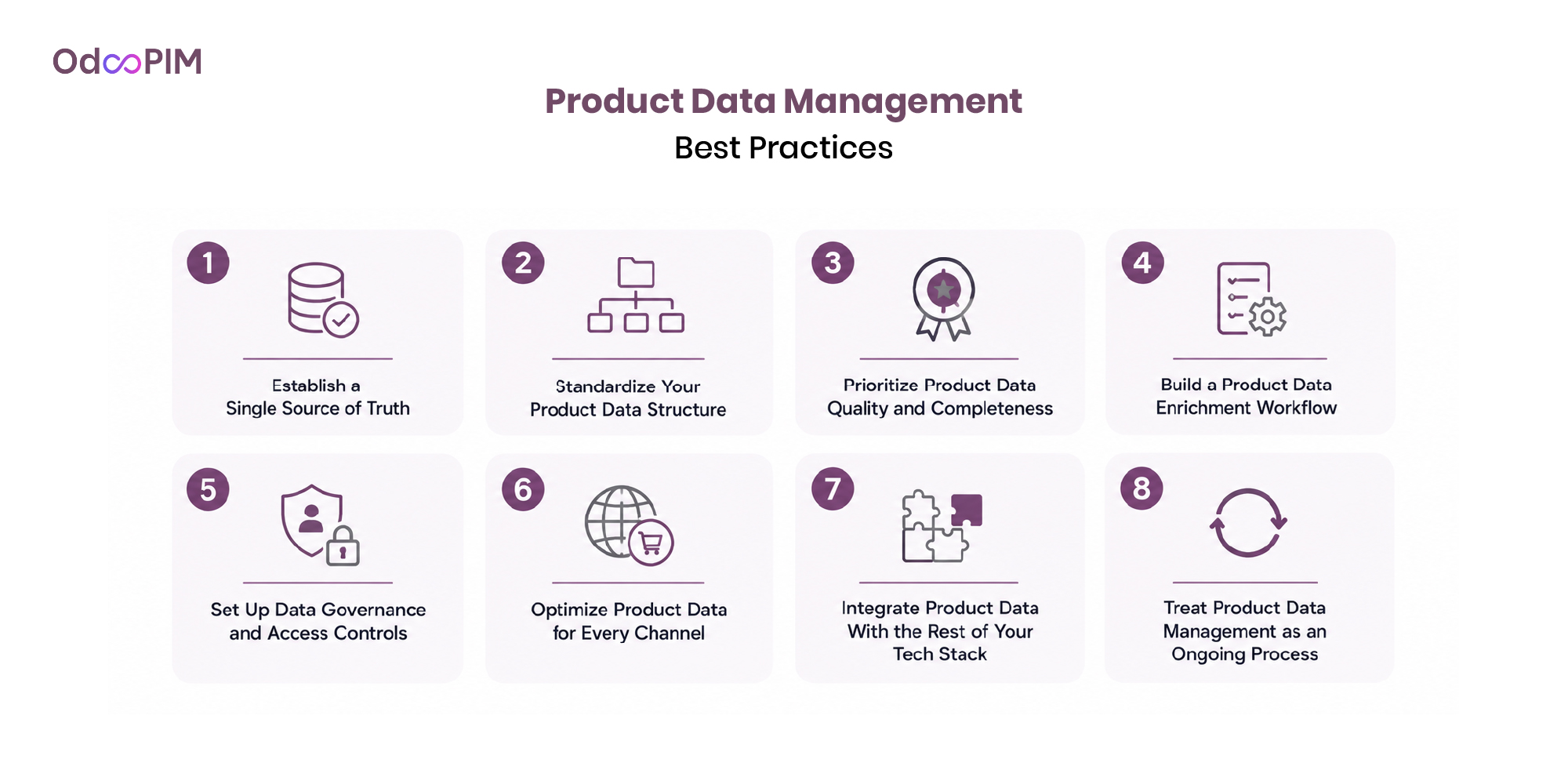
Best Practice #1: Establish a Single Source of Truth
Centralizing product data creates a single source of truth, one system holding every attribute, image, and specification, eliminating duplicates, conflicts, and debates over current versions. Without this foundation, all other product data management best practices fail because fragmented data from multiple sources guarantees inconsistencies like mismatched prices across your website and Amazon. Start by extracting core identifiers from your ERP, gather enrichment spreadsheets, and stage supplier feeds to map varied vendor attributes to your standard taxonomy. A PIM system like Odoo product data management, Akeneo, or Plytix handles relationships, version control, and multi-channel syndication that spreadsheets and ERPs cannot. Choose the right tool based on your catalog complexity, test with actual data, and achieve one source for infinite outputs, enabling product data quality best practices and freeing your team from fighting the system.
Best Practice #2: Standardize Your Product Data Structure
Product data standardization demands one name per attribute across your entire catalog, choose “Size” and eliminate variations like “SIZE” or “Size_Value”, and document every attribute name, definition, and allowed values in a data dictionary. Enforce these conventions through dropdown menus instead of free text fields, so a customer filtering by “Large” sees every large product because all use the same value. Every product must have mandatory fields filled before reaching customers: SKU, name, price, description, category, and at least one image, with formats enforced strictly (prices as numbers without currency symbols, dates as YYYY-MM-DD). Product catalog management best practices also define a consistent taxonomy, a laptop belongs under Electronics > Computers > Laptops, not Office Supplies, with annual reviews, quarterly audits, and clear ownership to ensure your navigation reflects business strategy, not historical accidents. Odoo product data management includes these validation features natively, enabling product data quality best practices that block incomplete or inconsistent data before it pollutes your catalog.
Best Practice #3: Prioritize Product Data Quality and Completeness
Good product data must be accurate, complete, consistent, and current. Product data quality best practices require measuring these dimensions because you cannot improve what you do not track. Run a full catalog export to count missing values per field and segment by category, apparel may struggle with size charts, electronics with voltage specs. Use completeness scores (fields present divided by required fields) with thresholds like 90% for published products, automatically blocking anything below that level. How to improve product data quality starts with sorting products by lowest score and assigning ownership per attribute. Automated validation rules check data at entry: price fields must contain numbers, conditional rules enforce that electronics require voltage, apparel requires size. Managing product data in ecommerce with an automated validation engine, like Odoo product data management, shifts quality from reactive cleanup to proactive prevention, stopping errors before they reach your catalog.
Best Practice #4: Build a Product Data Enrichment Workflow
Enrichment transforms raw supplier data into complete product stories, SEO descriptions, lifestyle images, technical manuals, and channel-specific variations like Amazon bullet points or website long-form copy. Product data governance assigns clear ownership: marketing owns descriptions, operations owns specifications, legal owns compliance, and workflow automation routes tasks automatically through your PIM. AI accelerates enrichment by generating draft content and filling missing attributes, cutting manual work by 70%, though human review catches tone issues and factual errors. Product data management best practices also treat digital assets as product attributes, enforcing naming conventions and automating image resizing for different channels. Odoo product data management includes task assignment, AI assistance, and asset management features, ensuring complete records without blank placeholders or broken links.
Best Practice #5: Set Up Data Governance and Access Controls
Product data governance answers who can do what, when, and how, preventing the chaos of multiple people editing the same fields while protecting sensitive data like pricing and costs. Role-based permissions assign the minimum access each role needs: view-only for some, edit with approval for others, and field-level controls ensuring marketing edits SEO while operations handles specs. Approval workflows require a second set of eyes before high-risk changes go live, with notification systems and service level agreements to prevent delays. Version control saves every change as a new version, letting you revert mistakes instantly, while audit trails log who changed what and when for full accountability. Odoo product data management includes granular permissions, approval routing, version history, and audit logging, turning product data management from trust-based guesswork into evidence-based control.
Best Practice #6: Optimize Product Data for Every Channel
Each channel has unique requirements, Amazon needs short bullet points and white-background images, your website demands long-form SEO copy, and Google Shopping requires structured price feeds. Product catalog management best practices store one master record and apply transformation rules per channel, mapping your PIM’s “product_name” to Amazon’s “title” while truncating descriptions intelligently. Before syndication, channel-specific validation checks that every product has required fields (GTIN for Amazon, voltage for electronics), blocking incomplete data and preventing rejected feeds or suppressed listings. A single price update in your PIM pushes to every channel simultaneously, no manual per-platform edits, no version drift between your website and Amazon. Odoo product data management includes mapping, transformation, validation, and real-time sync features, ensuring consistent, accurate product data across all channels with every update.
Best Practice #7: Integrate Product Data With the Rest of Your Tech Stack
Your ERP holds inventory and costs; your PIM holds enriched descriptions and images. Product data management best practices connect these systems for two-way sync, when ERP updates inventory, the PIM receives it and syndicates to channels automatically, eliminating manual double-entry. For ecommerce platforms and marketplaces, use pre-built connectors (Shopify, Amazon, eBay) that handle authentication and mapping, testing each with real data before committing. Connect your PIM to your DAM so product records automatically pull associated images based on naming conventions, with advanced two-way metadata sync for alt text and usage analytics. Choose real-time sync for pricing and inventory, scheduled sync for descriptions and images, and monitor sync logs to catch failures before customers notice. Odoo product data management includes native ERP integration, pre-built ecommerce connectors, DAM connectivity, and both sync modes, all in one unified system.
Best Practice #8: Treat Product Data Management as an Ongoing Process
Schedule monthly or quarterly audits to catch missing attributes, inconsistent values, and broken links, sampling large catalogs while tracking completion rates and assigning fixes. Use dashboards to monitor completeness scores per category and validation failure rates per channel, displaying trends over time so you know if data quality is improving or deteriorating. Review your data model quarterly, adding new attributes and categories before you need them; an outdated model forces workarounds like using description fields for specifications. Train every employee who touches product data, new hires complete standards training in week one, existing team members receive annual refreshers with quick-reference guides and comprehension tests. Odoo product data management includes built-in reporting dashboards, data model flexibility, and user training resources, because your product data quality depends more on team behavior than software features.
Learn about MDM vs PIM

How PIM Software Supports Product Data Management Best Practices
What a PIM Does That Spreadsheets and ERPs Cannot
Spreadsheets cannot enforce data types or prevent conflicting edits. Two people open the same file, and the last save wins. Product data management best practices require concurrent access controls that spreadsheets lack entirely. ERPs store transactional data, inventory, costs, orders, but treat product descriptions and images as afterthoughts. Product information management best practices need enrichment workflows, channel syndication, and attribute governance. ERPs provide none of these natively. Managing product data in ecommerce requires purpose-built PIM software.
A PIM fills the gap between spreadsheets and ERPs. It centralizes enrichment, enforces standards, and distributes to channels. Product catalog management best practices become possible because PIMs handle complex attribute hierarchies that break spreadsheets. Product data governance works because PIMs offer role-based permissions and approval workflows. Product data standardization becomes automatic with dropdown fields and validation rules. Spreadsheets scale negatively, more products create more chaos. ERPs scale for transactions, not content. PIMs scale for both.
Key PIM Features That Enforce Best Practices Automatically
Attribute validation blocks incomplete or incorrectly formatted data at entry. Required fields cannot stay empty. Product data quality best practices become system rules, not team reminders. Role-based permissions ensure that only authorized users edit sensitive fields like pricing or compliance copy. Product data governance happens through system configuration, not policies ignored after training. Workflow automation routes enrichment tasks to the right people with deadlines and approvals. Product information management best practices embed quality checks into every product’s journey from creation to publishing.
Channel syndication pushes your master data to every sales channel in the correct format. Product catalog management best practices use channel mapping rules defined once, applied automatically. Version control and audit trails record every change. Who edited what and when. Product data management best practices rely on these logs for troubleshooting and accountability. Odoo product data management includes all these features. Product data enrichment strategy works because the PIM handles distribution, letting your team focus on content. How to improve product data quality becomes a matter of configuring your PIM correctly, not convincing your team to try harder.
Signs It’s Time to Move From Manual Management to a PIM
Your team spends more than ten hours weekly on product data entry or cleanup. Spreadsheet tabs multiply. No one knows which file is current. Product data management best practices become impossible to follow because the tools do not support them. Managing product data in ecommerce with spreadsheets or basic ERPs works below 500 products. Above that threshold, manual processes crack. Attribute inconsistency appears across your catalog. Customers complain about broken filters. Returns increase from missing specifications.
You sell on multiple channels and maintain separate catalogs for each. A price change requires logging into three different systems. Product catalog management best practices collapse under manual multichannel maintenance. Your team creates workarounds, exporting CSV files, reformatting manually, uploading one by one. Product information management best practices demand a PIM when you hit three channels or 1,000 SKUs. PIM implementation best practices suggest moving before the pain becomes urgent. Transition during calm periods, not crisis moments. Product data quality best practices require the right tools. Spreadsheets and ERPs stop being adequate eventually. That point arrives earlier than most businesses expect.
How OdooPIM Helps You Follow Product Data Best Practices
Centralized Product Data Management Inside the Odoo Ecosystem
OdooPIM shares the same database as your Odoo ERP, eliminating the integration headaches of standalone PIMs. Your inventory, pricing, and product data live in one place, not two systems fighting for truth. Product data management best practices become easier because centralization happens automatically, no middleware, no sync delays, no connector fees. Managing product data in ecommerce within Odoo means your team works from one interface for transactions and enrichment.
This native architecture prevents the classic PIM-ERP data drift. A price change in your ERP updates the PIM instantly because they are the same system. Product information management best practices require this kind of tight integration to maintain consistency across operations and marketing. Odoo product data management turns centralization from a project into a default state. Product data quality best practices depend on a single source of truth. OdooPIM delivers that without custom development.

Built-In Workflow and Approval Tools in OdooPIM
OdooPIM includes native workflow automation that routes product data tasks between teams. A junior merchandiser enriches a product, and the system automatically sends it to a senior editor for approval. Product data governance happens through configuration, not manual coordination. Product information management best practices use these workflows to enforce quality checks before data reaches your channels. No approval, no publishing. The system enforces the rule.
Approval chains are fully customizable. A product might require marketing approval for descriptions, legal approval for compliance copy, and operations approval for specifications. Product data management best practices assign different approvers per attribute type. Product catalog management best practices benefit from clear handoffs between teams. Product data enrichment strategy works because workflows ensure nothing falls through the cracks. PIM implementation best practices configure approval rules based on your business structure. OdooPIM executes them automatically.
How OdooPIM Helps Teams Enrich, Validate, and Distribute Product Data
Enrichment starts with your existing Odoo data, product names, SKUs, pricing from your ERP. Your team adds descriptions, images, SEO fields, and channel-specific variations. Product data enrichment strategy within OdooPIM uses the same interface your team already knows. Validation rules block incomplete products from syndication. Missing GTIN? Required image absent? The system rejects publishing until fixes are made. Product data quality best practices become automated checkpoints.
Distribution pushes enriched products to your ecommerce store, marketplaces, and retail partners. Managing product data in ecommerce across channels becomes a single click. One master record. Dozens of outputs. Product catalog management best practices use OdooPIM’s channel mapping to transform data for each destination automatically. Product data standardization applies to your master data. Channel optimization applies to distribution. How to improve product data quality means catching errors at enrichment, not after syndication. OdooPIM’s validation catches them early.
Learn about product content enrichment
Getting Started With OdooPIM for Better Product Data Management
If you already use Odoo, activation takes minutes. Navigate to Apps, install the PIM module, and your existing products appear immediately. Odoo product data management requires no data migration because your products are already in the system. PIM implementation best practices suggest starting with one product category, configuring your attribute model, and testing enrichment workflows before scaling. Product data management best practices begin with clean data, audit your existing products before enriching them.
For new Odoo users, subscribe to Odoo first, then add the PIM module. Implementation follows Odoo’s standard playbook: configure your company settings, import your product base, set up user permissions. Product information management best practices recommend training your team on the PIM interface before going live. Product data governance starts day one with role-based permissions. Product data enrichment strategy benefits from OdooPIM’s native ERP integration. Managing product data in ecommerce within Odoo means your team learns one system, not two. Most businesses go from signup to first product syndication within two weeks.

Frequently Asked Questions
1. What Is the Most Important Product Data Management Best Practice?
Establish a single source of truth. Without centralization, every other product data management best practice fails because your team cannot agree on which version is current. A single database or PIM where every product attribute lives, descriptions, images, specs, pricing, eliminates the chaos of spreadsheets and siloed files. Product data governance becomes possible when data lives in one place. Product data standardization starts here. Managing product data in ecommerce without centralization guarantees errors, wasted time, and customer complaints. Pick one system. Make everyone use it. That is the foundation everything else builds on.
2. How Do I Improve Product Data Quality Without a PIM?
Start with a cleanup sprint. Export all product data into one spreadsheet. How to improve product data quality manually means standardizing attribute values, replace “M,” “Med,” and “Medium” with one consistent value. Fill missing required fields. Delete duplicate products. Create a data dictionary documenting every attribute name and allowed value. Product data quality best practices without a PIM require rigorous manual processes. Schedule weekly audits. Assign ownership per attribute type. Product catalog management best practices still apply even without automation. But know this: manual processes crack above 500 products. A PIM becomes necessary eventually.
3. What Is the Difference Between Product Data Management and PIM?
Product Data Management (PDM) is the discipline, the practices, governance, and standards for handling product information. Product data management best practices include standardization, validation, and enrichment workflows. A PIM (Product Information Management) is the software that automates these practices. Product information management best practices become easier to enforce with a PIM, but the practices exist independently of the tool. Think of PDM as the rulebook and PIM as the referee. You can attempt the rules manually. The referee just makes enforcement automatic. Odoo product data management exemplifies a PIM that enforces best practices natively.
4. How Does Odoo Handle Product Data Management?
Odoo product data management integrates PIM directly within the Odoo ERP ecosystem, sharing the same database as your inventory, accounting, and sales modules. No separate system. No sync delays. Product data enrichment strategy happens in the same interface where your team already manages transactions. Product data management best practices are enforced through role-based permissions, validation rules, and approval workflows built into OdooPIM. Managing product data in ecommerce within Odoo means product data flows from your ERP to your store to your marketplaces without middleware. For Odoo users, this native integration eliminates the connector headaches of standalone PIMs.