
Ecommerce catalog management is the process of organizing, enriching, and distributing product data across online sales channels. It covers everything from product titles and descriptions to images, pricing, and specifications. When done well, it ensures customers always find accurate, complete product information, wherever they shop.
Think of your ecommerce catalog as the digital face of every product you sell. Ecommerce product catalog management determines whether that face appears consistent across your website, Amazon, and social channels. Without proper management, product listings become inconsistent, incomplete, and confusing to customers. Catalog data standardization ensures every item follows the same format, making your inventory searchable and comparable.
Effective product catalog management system implementation transforms spreadsheets into structured assets. Ecommerce catalog management services help teams maintain quality at scale while product listing optimization ensures every product page performs. The result is a catalog that sells while you sleep.
What Is Ecommerce Catalog Management?
Ecommerce catalog management goes beyond simply uploading products to your website. It’s the ongoing, systematic process of creating, standardizing, enriching, and distributing product data across every channel where you sell. Your ecommerce catalog represents every item’s digital identity, titles, descriptions, images, specifications, pricing. Ecommerce product catalog management ensures these identities remain accurate, complete, and consistent regardless of where customers encounter them.
This discipline applies to every sales destination, your own store on platforms, such as Shopify, WooCommerce, or Magento, marketplaces including Amazon and eBay, and wholesale portals for B2B customers. Catalog data standardization ensures a product listed on your website appears with the same specifications on Amazon. Product listing optimization adapts content for each channel’s requirements while maintaining core accuracy. Without this systematic approach, ecommerce catalog management services become reactive firefighting rather than proactive control.
A product catalog management system transforms product information into structured, searchable assets. Ecommerce catalog management done right means customers always find complete, trustworthy information, and your team stops manually fixing the same errors across different platforms.

What Does an Ecommerce Product Catalog Contain?
Your ecommerce catalog holds more than simple product names and prices. Every item in your inventory carries dozens of data points that must work together smoothly. Understanding this anatomy reveals why ecommerce catalog management is complex and critical.
| Category | What It Includes | Why It Matters |
| Product Identifiers | SKU, GTIN, UPC, ASIN, MPN, manufacturer codes | These are your product’s DNA, unique IDs that prevent confusion between similar items and enable accurate tracking across channels |
| Product Attributes | Title, description, specifications, size, color, material, variants | The descriptive layer that helps customers understand what they’re buying and powers search and filtering |
| Pricing & Availability | Regular price, sale price, cost, margin, stock levels, backorder status | Dynamic data that changes frequently and impacts purchase decisions and profitability |
| Digital Assets | Images, videos, 3D models, PDF spec sheets, user manuals | Visual and documentation content that builds confidence and reduces returns |
| Marketing Content | SEO titles, meta descriptions, feature bullets, cross-sell suggestions, gift guides | Content designed to attract traffic and increase order values |
| Operational Data | Shipping dimensions, weight, country of origin, supplier info, compliance certifications | Behind-the-scenes data that logistics, procurement, and compliance teams depend on |
Ecommerce product catalog management means keeping all of it accurate, consistent, and updated across channels. Catalog data standardization ensures your weight field doesn’t appear as “lbs” in one place and “pounds” in another. Product listing optimization turns raw attributes into compelling content. This is why ecommerce catalog management services and a strong product catalog management system aren’t optional, they’re the only way to maintain sanity at scale.
Learn about How eCommerce AI Agents Are Transforming Product Data Management in 2026
Without PIM, governing and syndicating product information across omnichannel ecosystems becomes nearly impossible.
– Forrester
Why Ecommerce Catalog Management Gets Complicated Fast.
You know the moment ecommerce catalog management breaks down. A customer service ticket arrives, “The product page says blue, but I received red.” You check the website, it says blue, you check the warehouse system, it says red. Somewhere between product setup and customer delivery, data diverged. This is the reality when ecommerce catalog management lacks centralized control. Small inconsistencies become customer-facing failures that erode trust and generate returns.
The complexity creeps up silently. What worked for fifty products fails at five hundred. A single specification change that once took five minutes now requires updating spreadsheets for your website, Amazon, Google Shopping, and three wholesale portals. Ecommerce product catalog management becomes a game of whack-a-mole, fix one channel, discover another is outdated. Your team spends more time maintaining data than improving it.
Every new channel multiplies the problem. Each marketplace has unique requirements, different formatting rules, and separate update processes. Catalog data standardization feels impossible when every destination demands customized information. The ecommerce catalog that should be your greatest asset becomes your biggest operational headache.

The Spreadsheet Problem
Spreadsheets are where ecommerce catalog management goes to die. You start with one master file, but soon you have the working version, the backup, the one marketing uses, and the copy someone created “just for reference.” Nobody knows which is current. Product listing optimization suffers when teams edit different versions simultaneously. A price updates in one spreadsheet but not the ones feeding your channels.
The moment someone emails a spreadsheet attachment, you’ve lost control. Now there are two versions, yours and theirs. When they reply with “updates attached,” you have three. Ecommerce product catalog management becomes a forensic exercise in comparing files rather than improving content. You spend hours reconciling differences instead of building better product experiences.
Spreadsheets lack governance, anyone can delete a column, overwrite formulas, or introduce formatting that breaks integrations. Catalog data standardization requires consistency that collaborative spreadsheets cannot provide. The tool that felt like control initially becomes the reason you cannot trust your own data.
The Multichannel Complexity Problem
Every channel demands something different, Amazon wants descriptions under 2000 characters with specific keyword placement and Google Shopping requires optimized titles following strict formulas. Your website supports rich formatting and custom fields. A single product needs five variations of the same information. Ecommerce catalog management means creating and maintaining all of them.
When you update a specification, you manually edit each channel or risk inconsistency. The product that launched simultaneously across platforms drifts apart over time. Product listing optimization becomes channel-by-channel firefighting rather than strategic improvement. Your team constantly asks, “Which version is correct?” The answer shouldn’t depend on which file they check.
Ecommerce catalog management services exist because this complexity overwhelms internal teams. The product is identical everywhere, but the work to make it appear that way multiplies with every sales channel. Without a product catalog management system, multichannel selling means multichannel suffering.
The Scale Problem
Scale changes everything about ecommerce catalog management. Adding fifty products manually takes a day, adding five hundred takes weeks and adding five thousand becomes impossible. Yet this is what growth demands, more products, more variants, more specifications to track. Your ecommerce catalog either scales with you or becomes the bottleneck limiting growth.
Data entry errors that were annoying at small volumes become catastrophic at scale. A missing dimension on one product is a minor fix. Missing dimensions across thousands means customers cannot find anything via filters. Ecommerce product catalog management at scale reveals every weakness in your foundation. The shortcuts that worked temporarily become permanent liabilities.
Spreadsheet formulas break. File sizes become unmanageable. Collaboration becomes impossible when multiple people need simultaneous access. Catalog data standardization requires systems designed for volume, not tools designed for small business accounting. Scale doesn’t just multiply your products, it multiplies every problem exponentially.
The Team Coordination Problem
Catalog management touches everyone. Merchandisers create product briefs, copywriters craft descriptions, photographers deliver assets, operations provide shipping data and compliance ensures certifications exist. Without coordination, each team works in isolation, creating data silos that never reconcile. Ecommerce catalog management becomes a coordination nightmare.
The ecommerce catalog fragments, marketing’s version differs from operations’, which differs from what customers see. Meetings multiply as teams try to align information that should flow automatically. Product listing optimization suffers when copywriters don’t have final specifications. Customers notice when descriptions don’t match actual products.
Ecommerce product catalog management fails not because individuals don’t work hard, but because coordination across functions requires systems humans cannot maintain manually. The problem isn’t effort, it’s complexity. A product catalog management system designed for team collaboration eliminates the coordination tax that slows everyone down.
Learn about best PIM Software.

What Is Catalog Data Standardization — and Why Does It Matter?
Catalog data standardization means applying rules to how product information is structured, named, formatted, and validated before it’s published anywhere. Without standardization, your ecommerce catalog becomes chaotic, the same product appears differently across channels, confusing customers and eroding trust. Ecommerce catalog management depends on standardization to make product data reliable, searchable, and scalable.
Standardization covers naming conventions for product titles and categories, ensuring “men’s running shoe” doesn’t also appear as “running shoe for men” or “athletic footwear male.” Attribute completeness rules define required versus optional fields, preventing listings from going live missing important specifications. Image quality and format standards ensure every product photo meets resolution requirements and file specifications. Unit consistency means measurements, weights, and currencies follow uniform formats across your catalog.
Catalog data standardization also ensures taxonomy alignment across channels, your product categories map correctly whether customers browse on your website, Amazon, or Google Shopping. Product listing optimization becomes possible when standardized data provides consistent raw material. A strong product catalog management system enforces these standards automatically. Without standardization, ecommerce product catalog management means constantly fixing preventable errors. With it, your catalog becomes a reliable asset rather than a recurring headache.
What Is a Product Catalog Management System?
A product catalog management system is centralized software that stores, organizes, and distributes all your product information from a single source of truth. Unlike spreadsheets scattered across departments, this system provides one place where every ecommerce catalog element lives, identifiers, attributes, assets, pricing, and operational data. Ecommerce catalog management becomes manageable because teams stop chasing files and start working from the same foundation.
The system enforces catalog data standardization automatically. When someone enters a product, required fields cannot be skipped. Image formats must meet specifications and units should follow consistent rules. Ecommerce product catalog management shifts from manual policing to system-enforced governance. Your team focuses on improving content rather than fixing format errors. The platform handles the rules; people handle the creativity.
Beyond storage, a product catalog management system powers distribution. It connects to your website, marketplaces, and wholesale portals, pushing standardized data everywhere simultaneously. Product listing optimization happens once and applies across channels. Ecommerce catalog management services become optional rather than essential because the system does the heavy lifting. This is how professional teams maintain sanity at scale.
Learn about Best Online Catalog Management Tools.
Core Features to Look for in a Catalog Management System
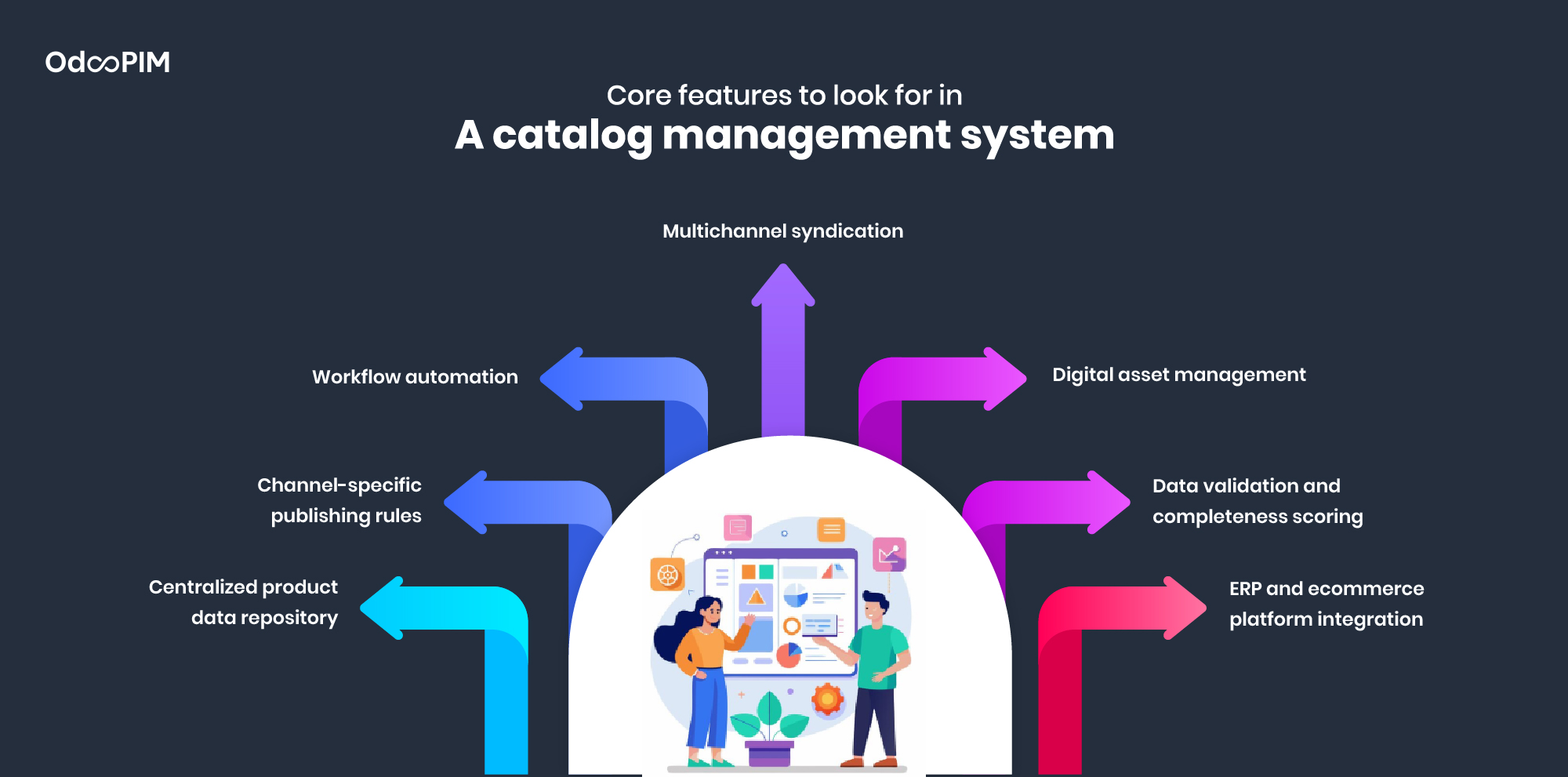
1. Centralized product data repository
This eliminates version conflicts by giving everyone access to the same master data. No more “which spreadsheet is current” debates. Your ecommerce catalog finally has a single source of truth that marketing, operations, and sales trust.
2. Workflow automation
Speeds up time-to-publish by routing products through approval steps automatically. Tasks stop sitting in inboxes waiting for someone to remember them. Ecommerce product catalog management becomes faster because the system moves work forward, not people.
3. Channel-specific publishing rules
Removes manual reformatting by adapting content for each destination. Amazon gets flat descriptions and your website gets rich formatting. Catalog data standardization means one product entry powers perfect presentation everywhere.
4. Data validation and completeness scoring
Catches errors before they go live by checking every product against your quality rules. Missing attributes trigger alerts. Incomplete listings don’t publish. Product listing optimization starts with complete, accurate data every time.
5. Digital asset management
Keeps images and data linked so products always have correct visuals. When you update a photo in the system, every channel receives the new version. Your ecommerce catalog stays visually consistent without manual image swapping.
6. Multichannel syndication
Enables one update to flow everywhere simultaneously. Change a price in the product catalog management system; your website, Amazon, and Google Shopping update instantly. No more channel-by-channel maintenance.
7. ERP and ecommerce platform integration
Eliminates data silos by connecting your catalog system with inventory, orders, and accounting. Ecommerce catalog management services become unnecessary when systems share data automatically. Your catalog reflects real inventory and accurate costs because integration keeps everything synchronized.
Learn about best PIM software for ecommerce site
Ecommerce Catalog Management Best Practices
1. Define Your Data Model Before You Scale
Most teams define their data model while building it and it shows. Taxonomy mismatches, inconsistent attributes, and missing fields emerge as the ecommerce catalog grows. Before you add the next hundred products, map what information every item needs. Define category structures, attribute sets, and required fields. A clear data model turns ecommerce product catalog management from reactive firefighting into systematic execution. The time spent planning pays back when you’re not rebuilding a structure mid-growth.
2. Establish a Single Source of Truth and Enforce It
Your team cannot maintain what they cannot find. When product data lives in multiple spreadsheets, emails, and old versions, ecommerce catalog management becomes impossible. Establish one system where every product record lives permanently. Then enforce that updates happen there. No exceptions. Catalog data standardization requires this discipline. Once your team trusts the single source, coordination improves and errors drop.
3. Standardize Before You Enrich
Trying to enrich inconsistent information multiplies problems rather than solving them. Catalog data standardization must come first, consistent formats, complete required fields, uniform units. Only then should you invest in product listing optimization and content enhancement. Enrichment amplifies whatever foundation exists. Build on solid ground or watch your efforts compound chaos. Standardize first and enrich second. This order separates professional operations from perpetual cleanup.
4. Build Channel-Specific Publishing Workflows
One-size-fits-all exports satisfy no channel completely. Amazon needs different formatting than your website and Google Shopping requires specific title structures. Ecommerce catalog management at scale means building workflows that adapt content for each destination automatically. Your product catalog management system should know that Amazon descriptions need flat text while your site uses rich formatting. Channel-specific rules eliminate manual reformatting and ensure every platform receives optimized content without duplicate work.
5. Score Catalog Completeness: What Gets Measured Gets Improved
Establish completeness scores for every product, percentage of required fields populated, image requirements met, specifications complete. Track these metrics weekly. Ecommerce product catalog management improves when teams see where gaps exist. A dashboard showing catalog health drives action more effectively than spreadsheets. Make completeness visible, and your team will naturally prioritize filling gaps. Measurement creates accountability and accountability drives quality.
How OdooPIM Simplifies Ecommerce Catalog Management
OdooPIM is a product information management solution built on the Odoo platform, purpose-designed for ecommerce catalog management. Unlike standalone tools that require complex integrations, OdooPIM centralizes product data from suppliers, internal teams, and existing systems into one unified repository. Your ecommerce catalog has a single source of truth that everyone can trust. Catalog data standardization becomes automatic rather than manual.
The platform connects to Shopify, WooCommerce, Magento, and major marketplaces, enabling smooth product listing optimization across every channel. Update a product once; it refreshes everywhere simultaneously. This integration eliminates the manual exports and channel-by-channel edits that consume ecommerce product catalog management teams. Ecommerce catalog management services become optional rather than essential.
OdooPIM’s advantage is its native fit within the broader Odoo ecosystem. Unlike isolated PIM tools, it shares real-time data with Odoo ERP, inventory, and sales modules. Your product catalog management system stays synchronized with stock levels, orders, and financials automatically. It’s best suited for mid-sized to enterprise ecommerce teams already using or evaluating Odoo, businesses ready to stop fighting data chaos and start scaling efficiently.

FAQ
1. What is ecommerce catalog management?
Ecommerce catalog management is organizing, enriching, and distributing product data across online sales channels. Your ecommerce catalog includes titles, descriptions, images, pricing, and specifications. Management ensures this information remains accurate and consistent wherever customers shop, your website, Amazon, social channels, and wholesale portals. Ecommerce product catalog management transforms raw supplier data into compelling, channel-ready content. Without it, product information becomes fragmented and unreliable. Done well, customers always find trustworthy information and your team stops manually fixing errors across platforms.
2. What is the difference between a product catalog and a PIM system?
A product catalog is the visible content customers see, titles, descriptions, images, and prices on your site. A PIM system, or product catalog management system, is the behind-the-scenes software storing and structuring that data before publication. Ecommerce catalog management relies on PIM to maintain consistency across channels. Without PIM, your ecommerce catalog depends on spreadsheets and manual updates. With PIM, you have a single source of truth feeding accurate, standardized product information to every sales destination automatically. The catalog is the storefront; PIM is the organized warehouse behind it.
3. Why do ecommerce businesses struggle with catalog management at scale?
Scale exposes every weakness in ecommerce catalog management. Spreadsheets that worked for fifty products fail at five hundred. Manual updates become full-time jobs. Catalog data standardization collapses when different team members maintain separate versions. Each new channel multiplies complexity, Amazon wants different formatting than your website. Ecommerce product catalog management breaks down because coordination exceeds human capacity. Without a product catalog management system, errors compound and teams spend more time fixing problems than improving content. Growth shouldn’t mean chaos, but without proper systems, that’s what happens.
4. What is catalog data standardization?
Catalog data standardization means applying consistent rules to how product information is structured, named, and formatted before publication. It ensures your ecommerce catalog follows uniform conventions, product titles use the same format, measurements stick to consistent units. Without standardization, the same product appears differently across channels. “Men’s running shoe” becomes “running shoe for men” elsewhere. Ecommerce catalog management depends on standardization to make product data reliable. It’s the foundation enabling product listing optimization and multichannel syndication. Standardize first, then everything else becomes possible.
5. How does a product catalog management system improve product listing optimization?
A product catalog management system improves product listing optimization by providing clean, standardized data that optimization tools can actually use. When your ecommerce catalog contains consistent attributes and complete information, you can optimize listings with confidence. The system enables channel-specific publishing rules, adapting content for Amazon, Google Shopping, and your website without manual rework. Catalog data standardization ensures every product has attributes needed for SEO and conversion. Instead of optimizing each listing individually, you optimize once and syndicate everywhere. Ecommerce catalog management becomes efficient, and listings consistently perform across channels.