
Catalog management solutions centralize product information, automate enrichment, and syndicate accurate listings across sales channels. The correct product catalog management solutions depend on catalog size, channel complexity, and tech stack. For ecommerce teams, ecommerce catalog management solutions must integrate with operational systems. Digital catalog management solutions handle everything from SKU management to product taxonomy management. Enterprise catalog management solutions add governance and workflow automation. Centralized product data enables product data enrichment, catalog automation, and product data syndication at scale.
This blog post compares leading catalog management solutions across criteria that matter for ecommerce businesses. We evaluate product catalog management solutions on integration depth, scalability, and team usability. Digital catalog management solutions vary, some excel at product taxonomy management for complex catalogs, others prioritize ease of use for smaller teams. Enterprise catalog management solutions like Akeneo serve large organizations with dedicated resources, while ecommerce catalog management solutions like OdooPIM offer native ERP integration. Whether you need centralized product data with catalog automation or advanced product data syndication, the right tool depends on your existing systems and growth trajectory.
What Is a Catalog Management Solution — and Why Does It Matter?
Catalog management solutions are systems that centralize, enrich, and distribute product information across sales channels. Basic catalog management built into platforms like Shopify works for small catalogs, until you hit the breaking point. Around 300–500 SKUs or three channels, native tools collapse. Spreadsheets multiply and product data fragments. What started as simple becomes chaos. Product catalog management solutions step in where native tools fail, providing centralized product data, product data enrichment, and product taxonomy management that scales.
Why does this matter? Because customers notice when product information fails. 83% of shoppers would abandon an ecommerce site if product information is insufficient. Incomplete specifications, inconsistent details across channels, and missing attributes kill conversions. Digital catalog management solutions prevent this by automating SKU management, enabling catalog automation, and handling product data syndication across every channel. Enterprise catalog management solutions add governance and workflow controls that ensure quality at scale. For growing ecommerce businesses, moving to ecommerce catalog management solutions isn’t optional, it’s the difference between scaling successfully or breaking under complexity.

What’s the Difference Between Catalog Management and PIM?
Catalog management solutions refer to the process and tools for organizing and publishing product information across channels. A Product Information Management solution is the engine that powers advanced catalog management. Think of catalog management solutions as the visible capability; PIM as the infrastructure behind it. Ecommerce catalog management solutions built into platforms handle basic needs, while digital catalog management solutions with PIM at their core deliver centralized product data, product data enrichment, and product taxonomy management that scales.
Understanding this distinction helps you identify your needs. If you’re managing under 300 SKUs across one or two channels, basic catalog management solutions may suffice. But if you need catalog automation, complex SKU management, or product data syndication across multiple channels, you need the depth of a PIM. Enterprise catalog management solutions are PIM-powered. OdooPIM provides this depth while integrating natively with your Odoo ERP, making it a product catalog management solutions platform that combines catalog visibility with PIM power. Choose based on complexity, not terminology.
Gartner’s Market Guide for Product Information Management Solutions notes that as digital commerce becomes increasingly complex, organizations must adopt PIM to provide consistent product information across touchpoints and enable effective multichannel product experiences.
– Helen Grimster & Jason Daigler — Gartner
Signs Your Ecommerce Business Has Outgrown Basic Catalog Management
1. Manual spreadsheet updates across channels
You export product data to Amazon, Shopify, and Google Shopping, each requiring separate reformatting and manual adjustments. Hours disappear weekly as your team manually reconciles what should be automated. This is why catalog management solutions with product data syndication exist, to eliminate channel-by-channel manual work.
2. Inconsistent product descriptions across platforms
The same item reads differently on your website versus marketplaces because data lives in disconnected spreadsheets. Customers notice these inconsistencies, eroding trust and driving them to competitors. Product catalog management solutions ensure centralized product data delivers consistent messaging everywhere, maintaining brand integrity across channels.
3. High return rates from missing or inaccurate specifications
Returns spike because dimensions, materials, or compatibility details were missing from listings. Manual product data enrichment fails at scale, leaving critical gaps that frustrate customers. Digital catalog management solutions with automated product taxonomy management ensure every product page contains complete specifications that reduce returns.
4. Slow time-to-market for new product launches
New products take weeks to launch because data lives in spreadsheets requiring manual enrichment before publication. Your competitors launch faster because they use ecommerce catalog management solutions with catalog automation. Catalog management solutions that automate SKU management and product data enrichment compress launch cycles from weeks to days.
5. No single source of truth across your organization
Different team members work from different spreadsheet versions, marketing has one file, operations another, sales a third. Chaos follows as decisions get made based on outdated information. Enterprise catalog management solutions provide centralized product data that every department trusts, eliminating version conflicts.
6. The breaking point threshold
Basic catalog management solutions break around 300–500 SKUs across three or more sales channels. Beyond this, spreadsheets and native platform tools cannot keep up with complexity. Dedicated product catalog management solutions with product data syndication, catalog automation, and product taxonomy management become important infrastructure for continued growth.
Learn about 15 Best AI Tools for Ecommerce Business in 2026.

What to Look for in a Catalog Management Solution
- Centralized product data repository: Your catalog management solutions must provide a single source of truth that every department trusts. Without centralized product data, teams work from conflicting spreadsheet versions, creating errors that propagate across channels.
- SKU management and bulk editing at scale: SKU management capabilities must handle thousands of variants without performance degradation. Bulk editing tools lets you update attributes across hundreds of products simultaneously.
- Product data enrichment tools: Look for AI-assisted attribute filling and completeness scoring. Product data enrichment automates the manual work of populating missing specifications and improving content quality.
- Product taxonomy management and attribute flexibility: Product taxonomy management lets you structure categories and attributes how your business needs them. The system adapts to your taxonomy, not forces you into structures.
- Product data syndication to multiple channels: Product data syndication must push accurate, channel-optimized content to every sales destination simultaneously. Manual exports defeat the purpose of digital catalog management solutions.
- Integration with existing ecommerce platforms: Your ecommerce catalog management solutions must connect natively to Shopify, WooCommerce, Magento, and Amazon. Pre-built connectors save months of development time.
- ERP connectivity: For businesses on Odoo, enterprise catalog management solutions with native ERP integration eliminate middleware costs and sync delays. Product catalog management solutions that share a database with your ERP deliver real-time visibility.
- Workflow automation and team collaboration: Catalog automation should route products through approval workflows, assign tasks, and track changes.
- Scalability for catalog growth: The platform must scale from hundreds to hundreds of thousands of SKUs without requiring migration.
- Transparent pricing and total cost of ownership: Evaluate total cost, subscription fees, implementation, training, ongoing maintenance. The cheapest license costs more in hidden expenses.
Should You Choose a Standalone PIM or an Integrated Platform?
Standalone catalog management solutions like Akeneo, Salsify, and Sales Layer deliver powerful product catalog management solutions with product data enrichment and product taxonomy management capabilities. They function as specialized digital catalog management solutions that excel at product data syndication across complex channels. But they require separate implementation, separate budgets, and separate integrations with your ERP, ecommerce platform, and order management system. That integration layer adds middleware costs, sync delays, and maintenance overhead.
Integrated platforms like OdooPIM embed ecommerce catalog management solutions within your operational ecosystem. Centralized product data, SKU management, and catalog automation share the same database as your ERP, inventory, and accounting. This eliminates integration costs and ensures real-time data sync across every function. For businesses already on Odoo or evaluating Odoo as their ERP, the enterprise catalog management solutions choice is clear. For organizations with entrenched legacy systems, standalone product catalog management solutions may fit better. The decision hinges on total cost of ownership and integration overhead, not just feature comparisons.
The Best Catalog Management Solutions for Ecommerce Businesses in 2026
1. OdooPIM: Best for Ecommerce Businesses Already on Odoo or Seeking an Integrated Solution
 OdooPIM functions as the only catalog management solution natively integrated with ERP, ecommerce, inventory, and order management, eliminating the integration layer. Built on the Odoo ecosystem, it delivers centralized product data, product data enrichment, SKU management, product taxonomy management, and product data syndication across channels without middleware costs. Native connectors support Shopify, WooCommerce, Magento, and Amazon.
Key features: Centralized product repository with ERP sync; multichannel syndication with channel-specific formatting; automated catalog automation workflows; role-based access and approval controls; bulk editing and variant management at scale.
Limitations: Best suited for Odoo users, businesses without Odoo ERP face a steeper onboarding curve.
Pricing: Transparent tiered pricing within Odoo ecosystem; no per-SKU fees.

2. Akeneo: Best for Large Enterprises with Complex Data Models
Akeneo ranks among leading enterprise catalog management solutions for brands managing 50,000+ SKUs with complex data modeling and localization requirements. Its strengths in product taxonomy management, completeness scoring, and enterprise workflow management make it a market leader for organizations with IT resources.
Key features: Advanced data modeling and attribute structure; completeness scoring and quality dashboards; localization and multi-language support; API-first architecture for custom integrations.
Limitations: High implementation cost; longer time-to-value; significant developer resource investment required.
Pricing: Enterprise quote-based; implementation costs exceed license fees.
3. Sales Layer: Best for Mid-Market Brands Focused on Data Quality Scoring
Sales Layer delivers digital catalog management solutions with a visual catalog interface and built-in content quality grading tools. It appeals to marketing-led teams managing mid-market catalogs who prioritize data quality visibility and ease of use over operational integration.
Key features: Visual catalog interface with completeness scoring; channel-specific publishing rules; user-friendly interface for non-technical teams; pre-built connectors for major platforms.
Limitations: Lighter product data enrichment automation compared to enterprise options; limited ERP integration depth.
Pricing: Quote-based SaaS subscription; positioned for mid-market businesses.
4. Plytix: Best for Small to Mid-Sized Ecommerce Brands
Plytix offers lean, user-friendly ecommerce catalog management solutions for teams managing 400–5,000 SKUs, particularly D2C brands on Shopify and Amazon. Its accessible entry point and straightforward interface make it a popular choice for businesses stepping into product catalog management solutions.
Key features: Intuitive interface with low learning curve; affordable SMB-friendly pricing; basic product data syndication to major channels; team collaboration tools.
Limitations: Limited scalability beyond 5,000 SKUs; lighter catalog automation and enterprise governance features.
Pricing: SMB-friendly subscription tiers; public pricing available.
5. Salsify: Best for Consumer Brands with Heavy Marketplace Presence
Salsify approaches catalog management solutions through a Product Experience Management lens, emphasizing retailer syndication networks and consumer brand requirements. Its strength lies in pre-built connections to retail partner portals like Walmart, Target, and Home Depot.
Key features: Extensive retailer syndication network; product experience management focus; content scoring and optimization tools; enterprise-grade governance.
Limitations: Expensive for mid-market businesses; over-engineered for brands without retail compliance needs; complex implementation.
Pricing: Enterprise quote-based; significant implementation investment required.
6. Pimcore: Best for Enterprises Needing Open-Source Flexibility
Pimcore provides open-source enterprise catalog management solutions combining PIM, DAM, and MDM in a single platform. Its extreme flexibility appeals to organizations with dedicated technical teams who need custom infrastructure for complex data environments.
Key features: Open-source with full code access; combined PIM, DAM, and MDM capabilities; highly customizable data modeling; scalable for large catalogs.
Limitations: Requires significant developer resources; not plug-and-play; implementation overhead is substantial.
Pricing: Open-source core with paid enterprise options; development costs exceed license fees.
Side-by-Side Comparison: Catalog Management Solutions at a Glance
| Solution | Best For | Pricing Model | Ecommerce Integrations | ERP Integration | Ease of Implementation | Ideal Catalog Size |
| OdooPIM | Odoo native ecommerce teams | Transparent tiered pricing | Shopify, WooCommerce, Magento, Amazon | Native Odoo | High, native to Odoo | 100 – 100,000+ SKUs |
| Akeneo | Large enterprises with complex data models | Enterprise quote based | Shopify, Magento, Salesforce, custom | Via connector | Moderate, requires technical resources | 10,000 – 500,000+ SKUs |
| Sales Layer | Marketing led SMB teams | SaaS subscription (quote based) | Shopify, Magento, BigCommerce, Amazon | Limited | High user-friendly interface | 500 – 50,000 SKUs |
| Plytix | Small to mid-sized D2C brands | SMB-friendly subscription | Shopify, WooCommerce, Amazon | Limited | High intuitive and simple | 400 – 5,000 SKUs |
| Salsify | Consumer brands with heavy marketplace presence | Enterprise quote based | Shopify, Amazon, Walmart, Target | Limited | Moderate, complex configuration | 5,000 – 500,000+ SKUs |
| Pimcore | Enterprises needing open-source flexibility | Open source + paid enterprise | Custom via API | Custom | Low, requires developer team | 10,000 – 1,000,000+ SKUs |
Why Ecommerce Businesses Choose OdooPIM for Catalog Management
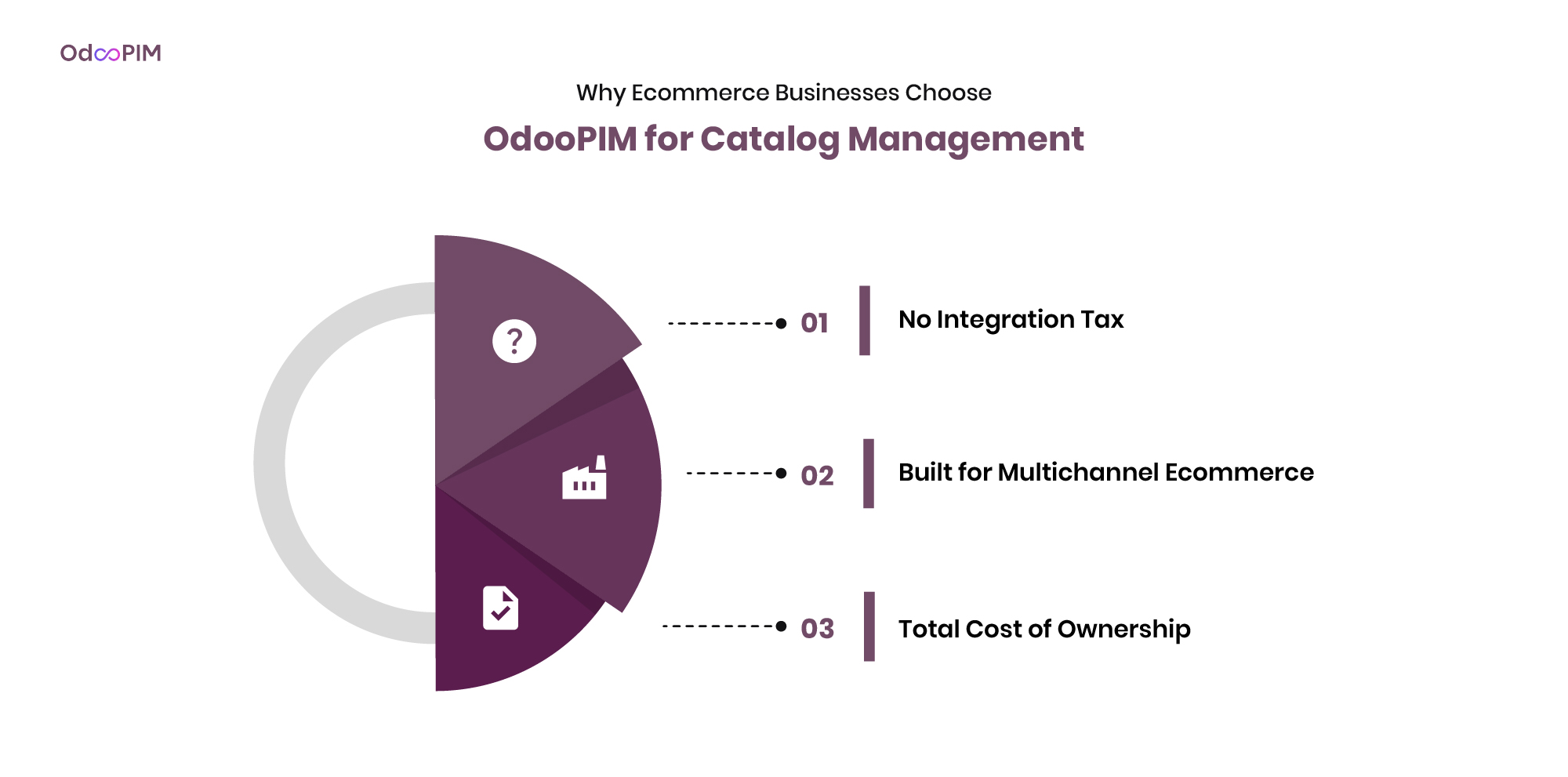
No Integration Tax:
OdooPIM eliminates the integration tax that plagues standalone catalog management solutions. While other product catalog management solutions require separate middleware, custom API mapping, and ongoing sync maintenance between PIM and ERP, OdooPIM lives inside the Odoo ecosystem. Centralized product data, inventory, and orders share the same database, no reconciliation work, no sync delays, no middleware costs. What other enterprise catalog management solutions charge extra to integrate, OdooPIM delivers natively.
Built for Multichannel Ecommerce:
Digital catalog management solutions succeed when they simplify multichannel complexity. OdooPIM handles product data syndication to Shopify, WooCommerce, Magento, and major marketplaces natively. Channel-specific field mapping, automated product data enrichment, and product taxonomy management happen automatically, not through manual exports. Catalog automation ensures Amazon gets flat descriptions while your website receives rich formatting, all from one product entry. This is ecommerce catalog management solutions built for how businesses sell.
Total Cost of Ownership:
For businesses on Odoo, adding OdooPIM costs a fraction of deploying a standalone enterprise catalog management solutions platform. No separate license fees, no integration middleware, no consultant-led API mapping. SKU management scales without per-SKU pricing. Product catalog management solutions that require separate budgets and separate implementations cannot match the TCO advantage of native integration. OdooPIM delivers enterprise catalog management solutions capabilities without the enterprise price tag.
Learn about AI Ecommerce Personalization: How It Works, Real Examples & What Powers It
How to Choose the Right Catalog Management Solution for Your Business
Choosing the correct catalog management solutions starts with an assessment of your current reality, not just where you are, but where you’re headed.
Use this decision framework to self-qualify:
- Under 500 SKUs, single channel: Native platform tools (Shopify, WooCommerce) may suffice. You don’t need product catalog management solutions yet. But if growth is on the horizon, plan ahead, transitioning later costs more than starting with scalable infrastructure.
- 500–10,000 SKUs, 2–5 sales channels: You’ve outgrown basic tools. Mid-market digital catalog management solutions like Plytix or OdooPIM deliver centralized product data, product data enrichment, and product data syndication without enterprise complexity. Catalog automation replaces manual spreadsheets.
- 10,000+ SKUs, complex taxonomy, multichannel: You need enterprise catalog management solutions with product taxonomy management, governance workflows, and product data syndication. OdooPIM, Akeneo, and Salsify lead here, each with different integration profiles.
- Odoo ERP: OdooPIM is the integrated choice. While other catalog management solutions require separate budgets, separate implementations, and middleware to connect, OdooPIM lives inside your existing ecosystem. SKU management shares the same database as inventory and orders, no sync delays, no reconciliation work.
- Need open-source + developer flexibility: Pimcore offers maximum customization for organizations with technical teams. If you require full code access and have developer capacity, open-source ecommerce catalog management solutions may fit.
- Your catalog management solutions decision should align with your tech stack, catalog size, and team resources. The right product catalog management solutions eliminate manual work, they don’t create new complexity. Start with where you are today, but choose infrastructure that scales with tomorrow’s growth. For Odoo-based businesses, the integration advantage makes OdooPIM the natural foundation.

Frequently Asked Questions
1. What is a catalog management solution?
A catalog management solution centralizes product information and distributes it across sales channels from one system. Product catalog management solutions provide centralized product data, product data enrichment, and product taxonomy management that spreadsheets cannot match. Digital catalog management solutions automate SKU management and handle product data syndication to websites, marketplaces, and wholesale portals. For growing businesses, ecommerce catalog management solutions replace manual spreadsheet chaos with scalable operations. The right tool ensures consistent, accurate product information everywhere customers shop.
2. When does an ecommerce business need a catalog management solution?
You need dedicated catalog management solutions when manual processes start breaking around 300–500 SKUs across three or more channels. Signs include team members working from different spreadsheet versions and inconsistent product descriptions between platforms. Enterprise catalog management solutions become essential when product data syndication complexity outgrows native tools. Digital catalog management solutions eliminate manual exports, reformatting, and reconciliation that consume administrative hours. If your team spends more time managing spreadsheets than improving product content, you’ve outgrown basic tools.
3. What is the difference between a catalog management solution and a PIM system?
Catalog management solutions focus on organizing and publishing product information across channels, the visible capability. A PIM system is the engine that powers advanced product catalog management solutions. Dedicated digital catalog management solutions with PIM at their core deliver centralized product data, product data enrichment, and catalog automation. Enterprise catalog management solutions are PIM-powered. OdooPIM combines both, providing the interface of catalog management solutions with PIM depth, natively integrated with Odoo ERP.
4. Can OdooPIM replace our existing catalog management tools?
OdooPIM functions as a complete catalog management solution designed to replace fragmented tools with unified operations. It delivers centralized product data, product data enrichment, SKU management, and product data syndication natively integrated with Odoo ERP. For businesses already on Odoo, OdooPIM eliminates middleware costs and sync delays that standalone ecommerce catalog management solutions require. The transition replaces manual processes with catalog automation, freeing your team from spreadsheet management. Your existing tools become unnecessary when everything lives in one platform.
5. How do catalog management solutions integrate with Shopify, WooCommerce, or Magento?
Leading catalog management solutions offer native connectors for major ecommerce platforms with real-time sync capabilities. Digital catalog management solutions like OdooPIM provide pre-built integrations that sync product data, inventory, and pricing bidirectionally. Integration depth varies, some offer field-level mapping while others rely on scheduled exports. For Odoo-based businesses, OdooPIM delivers the deepest integration because centralized product data shares the same database as ERP and ecommerce modules. Product data syndication ensures Shopify, WooCommerce, or Magento always reflect accurate SKU management without manual reconciliation.