
Online catalog management centralizes product data, automates enrichment, and distributes accurate listings across sales channels. Catalog management software handles SKU management, product data quality, and product listing management at scale. The best product catalog management tools depend on catalog size, channel complexity, and tech stack. For ecommerce businesses, ecommerce catalog management must integrate with operations. Digital catalog tools like OdooPIM offer native Shopify catalog management and ERP connectivity. The right best catalog management software fits your context, not just feature lists.
What Is Online Catalog Management?
Online catalog management is the process of centralizing, enriching, and distributing product information across every channel where you sell. Catalog management software replaces the spreadsheets, manual exports, and disconnected tools that slow growing businesses. Product catalog management tools handle everything from SKU management and product data quality to product listing management across websites, marketplaces, and social commerce. Without dedicated digital catalog tools, product data fragments, inconsistencies multiply, and customers lose trust.
Why does it matter? Because 83% of shoppers abandon sites with insufficient product information. Ecommerce catalog management done right ensures accurate, complete listings everywhere customers shop. Best catalog management software like OdooPIM offers native Shopify catalog management, automated product data quality enforcement, and smooth integration with your operational systems. Digital catalog tools that scale with your catalog prevent the manual chaos that breaks businesses at growth thresholds.

What Does a Catalog Management Tool Actually Do?
- Centralize product data: Catalog management software creates a single source of truth where the product information lives, eliminating the spreadsheet chaos that fragments data across your organization.
- Enrich product attributes: Product catalog automation management tools automate product data quality through AI-assisted attribute filling, completeness scoring, and standardized formatting. Missing specifications get populated automatically.
- Distribute to every channel: Ecommerce catalog management means one product entry feeds your website, marketplaces, and wholesale portals simultaneously. Digital catalog tools handle channel-specific formatting without manual exports.
- Maintain consistency everywhere: Product listing management ensures descriptions, images, and specifications stay synchronized across every sales destination. Customers encounter the same accurate information wherever they shop.
- Automate updates at scale: SKU management and bulk editing tools let you update thousands of products in minutes. Best catalog management software like OdooPIM offers native Shopify catalog management with real-time sync to your ERP.
- Enforce data governance: Online catalog management platforms include validation rules, approval workflows, and completeness scoring that prevent bad data from reaching your channels. Quality becomes systematic, not reactive.
Signs Your Ecommerce Business Needs a Catalog Management Tool
- Spreadsheets are breaking down: Your master product file has become too large for Google Sheets to load, and you’ve lost track of which version is current.
Inconsistent data across channels: The same product shows different descriptions on Shopify, Amazon, and your website, and customers are starting to notice. - Time-to-market is dragging: Launching new products takes weeks because manual data entry across channels consumes your team’s capacity.
- Return rates are climbing: Customers are returning items because product specifications, dimensions, materials, compatibility, were missing or inaccurate.
- Teams are duplicating work: Marketing, operations, and sales maintain separate product files, creating version conflicts and wasted effort.
- SKU management is overwhelming: You’ve crossed 500 SKUs across multiple channels, and tracking variants, bundles, and relationships has become unmanageable.
- You’re still manually updating listings: Every price change or specification update requires logging into each channel separately rather than one update flowing everywhere.
- Product data quality is inconsistent: Descriptions vary in length and quality; images follow no standard; attributes are missing for critical products.If any of these sound familiar, your online catalog management process has outgrown manual methods. Catalog management software with product catalog management tools automates what spreadsheets cannot scale. Ecommerce catalog management through digital catalog tools replaces chaos with structure. The best product catalog management tools like OdooPIM offer native Shopify catalog management and SKU management that keep your product data quality consistent across channels. Stop fighting spreadsheets.
Learn about How PDM Tools Simplify Product Data Management Across Teams

Types of Online Catalog Management Tools — What’s the Difference?
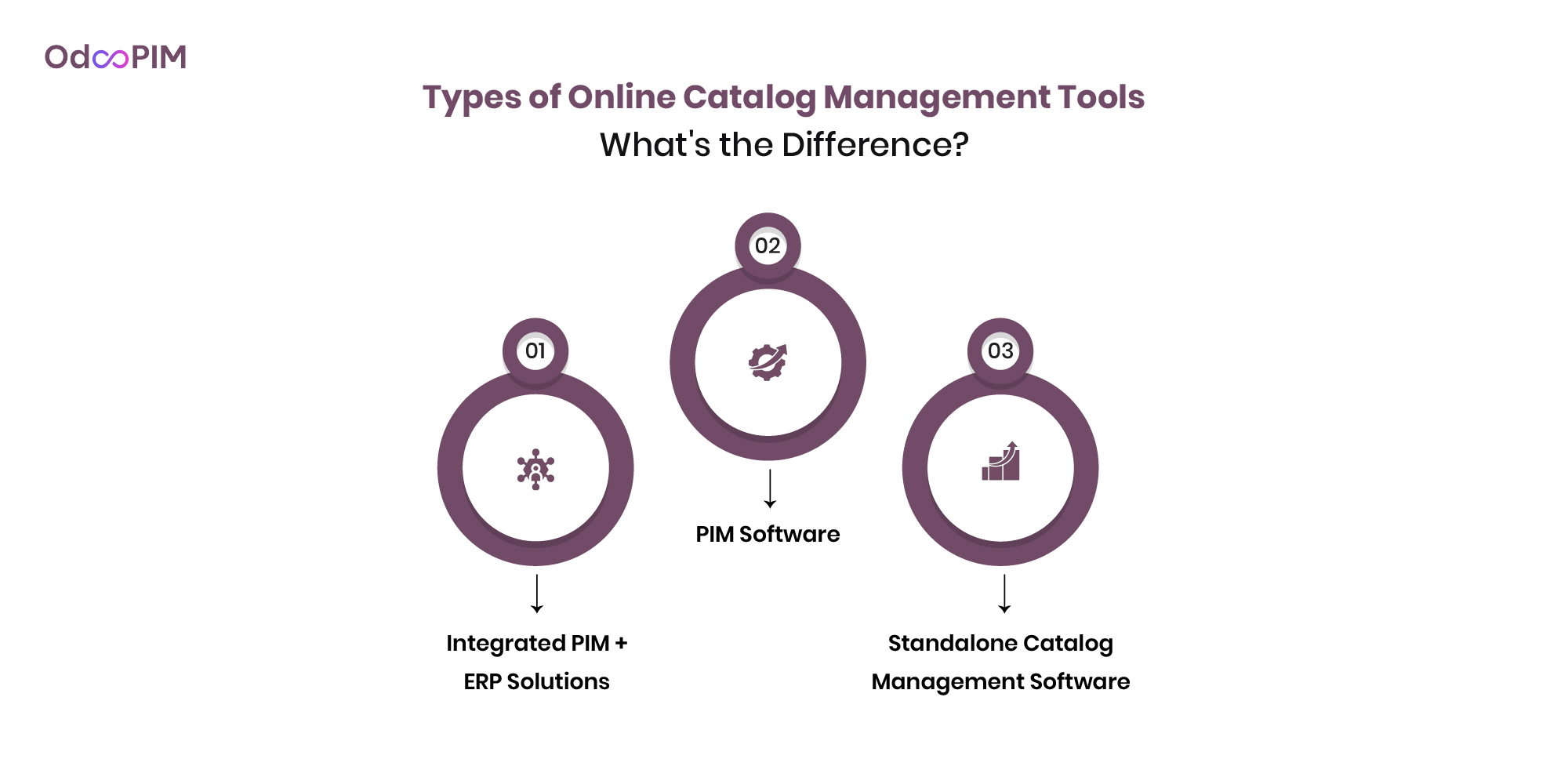
Not all digital catalog tools are built the same. Understanding the categories helps you match the solution to your actual needs, not just the feature list.
1. Standalone Catalog Management Software
These tools focus on organizing and publishing product listings across channels. Catalog management software like Sales Layer and Plytix excel at product listing management with user-friendly interfaces and channel syndication. They handle product data quality basics and SKU management for small to mid-sized catalogs.
Best for: teams with straightforward multichannel needs who don’t require deep operational integration.
2. PIM Software
Purpose-built product catalog management tools designed for product data enrichment, governance, and complex multichannel syndication. Ecommerce catalog management at enterprise scale demands PIM depth, attribute modeling, completeness scoring, workflow automation. Known players like Akeneo, Salsify, and Pimcore dominate this category.
Best for: mid-to-enterprise businesses with complex taxonomies, multiple channels, and dedicated technical resources.
3. Integrated PIM + ERP Solutions
The third category combines online catalog management with business operations, inventory, orders, procurement, accounting. Unlike standalone digital catalog tools, integrated platforms share the same database across PIM and ERP. This eliminates middleware costs, sync delays, and manual reconciliation. OdooPIM sits here, built on Odoo ERP, it delivers native Shopify catalog management, automated product data quality, and smooth SKU management across your operations.
Best for: businesses that want a single platform across operations and commerce, not disconnected best-of-breed tools.
Choosing the right best catalog management software starts with understanding which category fits your operational context. Standalone tools solve channel publishing. PIM adds governance. Integrated solutions eliminate integration tax. Your business size, tech stack, and growth trajectory determine the right fit. For Odoo-based businesses, the integrated path is clear. For others, match the category to your complexity level.
Learn about 5 Generative AI Use Cases in eCommerce
According to Gartner, PIM solutions deliver a single, trusted source of rich product content that fuels efficient multichannel commerce — a critical capability for modern online catalog management tools.
– Gartner
Key Features to Look for in Online Catalog Management Software
1. Centralised Product Data Repository
Your online catalog management foundation starts with a single source of truth. Catalog management software must centralize every SKU, attribute, and digital asset in one place, no more spreadsheets, no more version conflicts. Product catalog management tools that lack centralization simply accelerate chaos rather than solving it. Every team member should access the same current data, not their own copy.
2. Multichannel Distribution & Syndication
Ecommerce catalog management means pushing product data to Shopify, WooCommerce, Amazon, and marketplaces simultaneously, not channel by channel. Best catalog management software handles channel-specific formatting automatically. Your product listing on Amazon gets flat descriptions; your website receives rich content; all from one entry. Digital catalog tools without multichannel syndication create manual work, not automation.
3. Data Enrichment & Quality Controls
Product data quality drives conversions. 81% of shoppers say rich product content is just as important as price when deciding what to buy (Salsify 2025). SKU management tools must include attribute completeness scoring, bulk editing, and workflow automation. Product listing management without quality controls lets incomplete products reach customers, damaging trust and increasing returns. Enrichment tools should automate the manual work of populating missing specifications.
4. ERP & Platform Integrations
Digital catalog tools don’t operate in isolation. Your catalog management software must connect with your existing stack, ERP, CRM, ecommerce platform. Look specifically for Shopify catalog management, WooCommerce, Magento, and Odoo integrations. Standalone tools require middleware and API mapping; integrated solutions share data natively. Integration depth determines whether your catalog syncs in real time or requires manual reconciliation.
5. Scalability for Growing SKU Counts
The best catalog management software grows with you. Can it handle 5,000 SKUs today and 50,000 tomorrow without performance degradation? Product catalog management tools that work at a small scale break as complexity increases. Your chosen solution should scale without requiring platform migration. Evaluate not just current needs but your growth trajectory. The cost of migrating catalog systems mid-growth far exceeds choosing scalable infrastructure upfront.
Learn about PIM for furniture retailers
Best Online Catalog Management Tools for Ecommerce
Finding the right online catalog management tool means matching your business size, tech stack, and growth trajectory to the right category. Below is a neutral comparison of leading catalog management software options to help you decide.
1. OdooPIM: Best for Odoo Users and Ecommerce Businesses Needing Integrated PIM + ERP
Best for: Businesses on Odoo or seeking a unified platform where product catalog management tools share the same database as ERP, inventory, and orders.
Key features: Native ecommerce catalog management with real-time SKU management; Shopify catalog management, WooCommerce, Magento connectors; automated product data quality with completeness scoring; smooth product listing management across channels without middleware.
Notable limitation: Best suited for Odoo users, businesses without Odoo face a steeper onboarding curve.
Ideal business type: Mid-market to enterprise ecommerce teams on Odoo or evaluating Odoo as their ERP.

2. Akeneo: Best for Large Enterprises with Complex Product Data Governance Needs
Best for: Organizations managing 50,000+ SKUs with complex taxonomies, multiple languages, and dedicated technical resources.
Key features: Advanced data modeling and product listing management; completeness scoring and quality dashboards; localization and multi-language support; API-first architecture for custom integrations.
Notable limitation: High implementation cost; longer time-to-value; significant developer resource investment required.
Ideal business type: Large enterprise brands with complex data governance needs and internal IT capacity.
3. Salsify: Best for Brands Focused on Digital Shelf and Retailer Syndication
Best for: Consumer brands with heavy marketplace presence requiring pre-built connections to retail partner portals like Walmart, Target, and Home Depot.
Key features: Extensive retailer syndication network; product experience management focus; content scoring and optimization tools; enterprise-grade governance.
Notable limitation: Expensive for mid-market businesses; over-engineered for brands without retail compliance needs; complex implementation.
Ideal business type: Enterprise consumer brands prioritizing digital shelf performance and retailer compliance.
4. Plytix: Best for Small to Mid-Sized Ecommerce Teams on a Tighter Budget
Best for: D2C brands managing 400–5,000 SKUs with straightforward multichannel needs and limited technical resources.
Key features: Intuitive interface with low learning curve; affordable SMB-friendly pricing; basic product listing management to major channels; team collaboration tools.
Notable limitation: Limited scalability beyond 5,000 SKUs; lighter product data quality automation and governance features.
Ideal business type: Small to mid-sized ecommerce teams seeking accessible digital catalog tools with predictable pricing.
5. Pimcore: Best for Technically Resourced Teams Needing Open-Source Flexibility
Best for: Organizations with developer capacity who need full code access and extreme customization across PIM, DAM, and MDM.
Key features: Open-source with full code access; combined PIM, DAM, and MDM capabilities; highly customizable data modeling; scalable for large catalogs.
Notable limitation: Requires significant developer resources; not plug-and-play; implementation overhead is substantial.
Ideal business type: Enterprises with dedicated technical teams seeking open-source product catalog management tools.
6. Sales Layer: Best for Teams Needing Real-Time Data Quality Monitoring
Best for: Marketing-led teams managing mid-market catalogs who prioritize data quality visibility and ease of use.
Key features: Visual catalog interface with completeness scoring; channel-specific publishing rules; user-friendly interface for non-technical teams; pre-built connectors for major platforms.
Notable limitation: Lighter product data quality automation compared to enterprise options; limited ERP integration depth.
Ideal business type: Mid-market ecommerce teams focused on product listing management quality and speed.
How to Choose
Your best catalog management software depends on your existing tech stack, catalog size, and internal resources. For Odoo-based businesses, OdooPIM delivers native SKU management and Shopify catalog management without middleware costs. For enterprise brands with dedicated IT teams, Akeneo or Salsify offer depth. For SMBs, Plytix or Sales Layer provide accessible entry points. Evaluate digital catalog tools against your operational context, not just feature lists.
Learn about automotive catalog management
Online Catalog Management vs. Spreadsheets: Why Teams Make the Switch
Spreadsheets feel familiar. They feel free. But they quietly become the bottleneck that prevents scaling. Here’s why teams abandon spreadsheets for dedicated online catalog management:
Error compound: A formula breaks. A column sorts incorrectly. Someone overwrites data. In spreadsheets, one mistake multiplies across every channel, and you rarely catch it before customers do.
Cannot scale: What works for 200 SKUs fails at 2,000. Files become too large to load. Collaboration breaks. The time spent managing spreadsheets grows faster than your catalog.
No multichannel sync: Updating Amazon, Shopify, and your website requires manual exports and reformatting for each destination. One price change becomes three separate tasks, each prone to error.
No workflow control: Spreadsheets lack approval workflows, version history, and role-based access. Anyone can edit anything, and you never know who changed what or why.
The bottom line: Spreadsheets are designed for accounting, not ecommerce catalog management. Catalog management software automates what spreadsheets cannot. Product catalog management tools enforce product data quality, enable SKU management at scale, and handle product listing management across channels automatically.
How OdooPIM Handles Online Catalog Management
OdooPIM transforms online catalog management from manual chaos into structured workflow. The process flows through five stages: import, enrich, validate, publish, sync, within the same platform that runs your operations.
Import: Raw product data enters from suppliers, spreadsheets, or existing systems. Digital catalog tools often stop here, leaving you to clean the mess. OdooPIM structures incoming data automatically, mapping attributes to your taxonomy.
Enrich: Product catalog management tools must fill gaps, not just store what you give them. OdooPIM automates product data quality through AI-assisted attribute completion, ensuring every product meets your standards before moving forward. Missing specifications get flagged or filled automatically.
Validate: Quality controls prevent bad data from reaching channels. SKU management rules, completeness scoring, and approval workflows catch errors before publication, not after customers find them.
Publish: Ecommerce catalog management means one product entry feeds every channel. OdooPIM handles product listing management for Shopify, WooCommerce, Magento, and marketplaces simultaneously, applying channel-specific formatting automatically.
Sync: The Odoo-native advantage appears here. Unlike standalone catalog management software, OdooPIM shares the same database as your ERP, inventory, and orders. Shopify catalog management updates in real time with stock levels. Pricing changes flow everywhere instantly. No middleware, no sync delays, no manual reconciliation.
For businesses already on Odoo, OdooPIM is the best catalog management software because it eliminates the integration layer entirely. Your catalog, inventory, and operations live in one place. That’s not just product catalog management tools, that’s unified commerce infrastructure.

Frequently Asked Questions About Online Catalog Management
1. What is online catalog management?
Online catalog management is the process of centralizing, enriching, and distributing product information across sales channels from a single source. Catalog management software replaces spreadsheets with structured product catalog management tools that handle SKU management, product data quality, and product listing management at scale. For growing businesses, ecommerce catalog management ensures accurate, consistent product information appears everywhere customers shop, website, marketplaces, social commerce.
2. What is the difference between catalog management software and a PIM?
Catalog management software focuses on organizing and publishing product information across channels, the visible capability. A PIM (Product Information Management) system is the engine that powers advanced product catalog management tools. Dedicated digital catalog tools with PIM at their core deliver product data quality, governance, and workflow automation that basic catalog management software lacks. Think of catalog tools as the interface; PIM as the infrastructure. The best product catalog management tools combine both, providing user-friendly product listing management with PIM depth. OdooPIM exemplifies this convergence, offering native Shopify catalog management with enterprise-grade SKU management capabilities.
3. Do I need catalog management software if I’m already using Shopify or WooCommerce?
Native Shopify or WooCommerce catalog management software works for small catalogs under 300 SKUs across one or two channels. The breaking point comes when you hit 300–500 SKUs or add a third channel like Amazon. Suddenly, manual product listing management across platforms consumes hours. Product data quality suffers. Spreadsheets multiply. Dedicated digital catalog tools step in where native tools fail, handling SKU management, channel-specific formatting, and product data quality at scale. If your team spends more time on spreadsheets than strategy, you’ve outgrown native tools. Ecommerce catalog management dedicated solutions pay for themselves in reclaimed time alone.
4. Can OdooPIM handle online catalog management for my ecommerce store?
OdooPIM functions as complete online catalog management software built for ecommerce businesses. It handles product catalog management tools needs including SKU management, product data quality, and product listing management across Shopify, WooCommerce, Magento, and marketplaces. What sets OdooPIM apart is native integration with Odoo ERP, your catalog shares the same database as inventory, orders, and accounting. No middleware, no sync delays. Digital catalog tools that operate in isolation cannot match this integration depth. For businesses already on Odoo, OdooPIM is the best catalog management software choice because it eliminates the integration layer entirely.
5. How many SKUs do I need before investing in catalog management software?
There is no fixed number, but the threshold hits between 300 and 500 SKUs across three or more sales channels. Below this, native platform tools and spreadsheets can still function. Above it, catalog management software becomes essential. Signs include, spreadsheets breaking down, inconsistent product listing management between channels, slow time-to-market for new products, and teams duplicating work. Digital catalog tools automate what manual processes cannot scale. SKU management complexity multiplies with every new channel. Invest when manual work starts consuming strategy time. The cost of delayed investment is measured in errors, returns, and team burnout.