Omnichannel order management centralizes orders, inventory, and fulfillment across sales channels, your website, marketplaces, and physical stores. Multichannel order fulfillment without unification creates overselling, delayed shipments, and customer frustration. Order management system ecommerce with real-time sync ensures accurate inventory visibility everywhere. Unified order management routes orders to the optimal fulfillment location based on stock availability and shipping cost. Omnichannel inventory management prevents stockouts and overselling. Omnichannel ecommerce operations succeed when orders, inventory, and fulfillment share one source of truth. Spreadsheets cannot. An OMS can.
What Is Omnichannel Order Management?
Omnichannel order management is the practice of centralizing orders, inventory, and fulfillment across sales channels into a single system. Unlike basic multichannel order fulfillment where each channel operates independently, your website, Amazon, and physical stores each maintain separate order logs, omnichannel unifies everything behind the scenes. A customer buys online, returns in-store. An order placed on Amazon routes to your warehouse for fulfillment. Your retail store fulfills a website order when local inventory is available.
“Order management” covers the post-purchase workflow: capture (receiving orders from all channels), inventory check (verifying stock availability in real time), routing (assigning orders to the optimal fulfillment location), fulfillment (picking, packing, shipping), and returns (processing across any channel). Order management system ecommerce capabilities make this possible.
Omnichannel order management = one system. Every channel. Real-time inventory visibility. Intelligent order routing. Unified returns.
Unified order management eliminates overselling. When inventory updates in real time across channels, you cannot sell what you don’t have. Omnichannel inventory management ensures stock accuracy whether the sale happens on your website, a marketplace, or in a physical store. Omnichannel ecommerce operations without centralization create data silos, delayed fulfillment, and customer frustration. With it, orders flow smoothly from any channel to the optimal fulfillment location. Your customers don’t care which channel they bought from, they just want their order correct and on time. Omnichannel order management delivers that.
Learn about Omnichannel management.
Omnichannel vs. Multichannel Order Management: What’s the Difference?
The distinction determines whether your operations scale smoothly or create constant friction. Multichannel order fulfillment means you sell on multiple channels, but each channel operates independently. Omnichannel order management unifies everything behind the scenes.
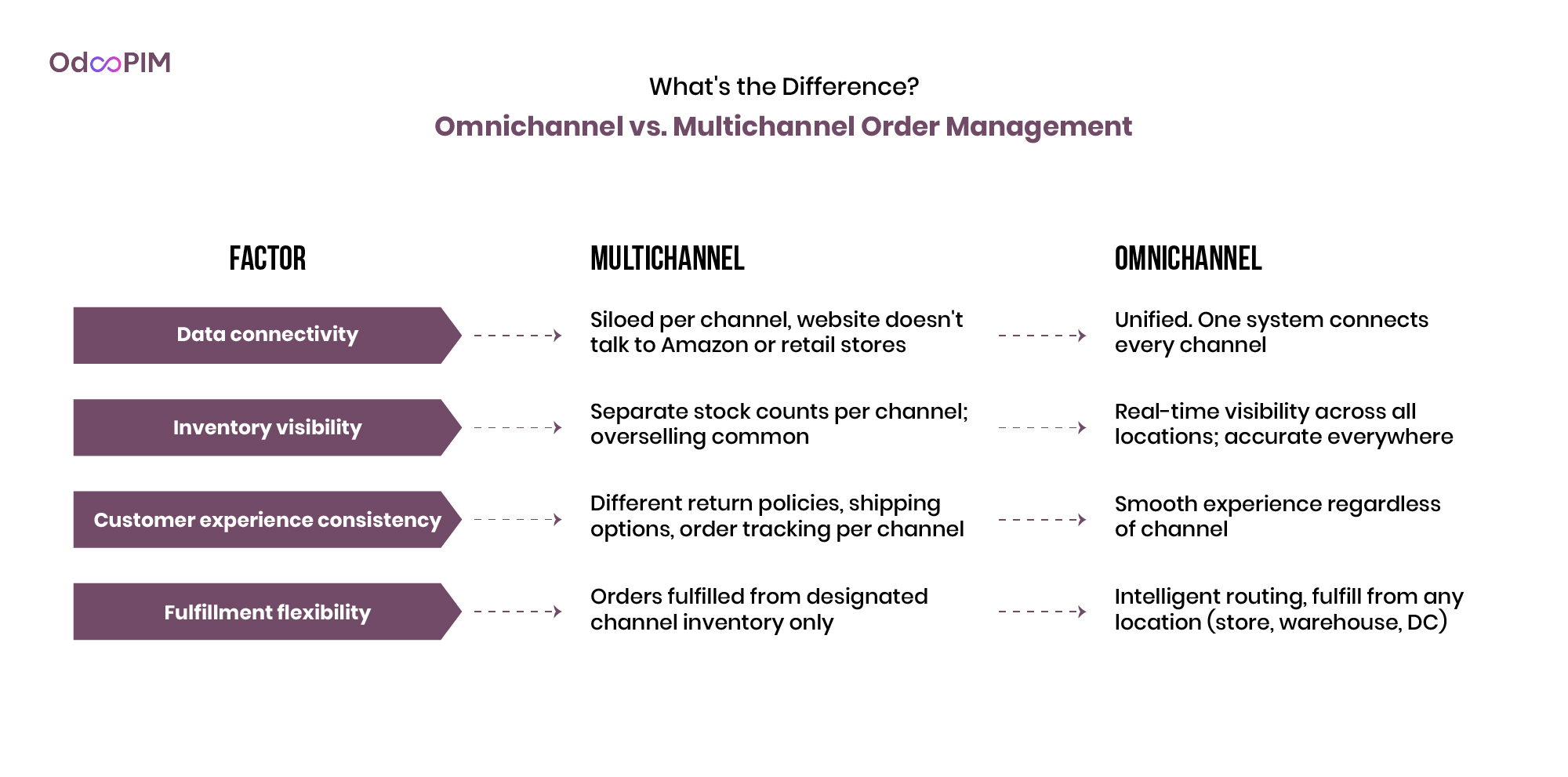
Order management system ecommerce with omnichannel capabilities enables unified operations. Omnichannel inventory management ensures stock accuracy across every selling location. Unified order management routes orders to the optimal fulfillment point, store for local pickup, warehouse for shipping, distribution center for volume.
Omnichannel ecommerce operations turn channel complexity into competitive advantage. A customer buys online, picks up in store. An order placed on Amazon fulfills from your retail location when warehouse stock runs low. Returns process through any channel. Multichannel just adds channels. Omnichannel connects them. The difference is operational intelligence, and your customers will notice.
Learn about omnichannel management software.

Why Omnichannel Order Management Is Now Non-Negotiable
Omnichannel shoppers deliver 30% higher lifetime value than single-channel customers. Retailers supporting three or more channels see 250% more customer engagement. Your competitors already have these numbers. If your order management system ecommerce can’t support omnichannel, you’re leaving revenue on the table. Single-channel OMS logic breaks down at scale, your website shows “in stock” because the warehouse has units, but your retail store sold the last one, hours ago. A customer orders online. You cancel the order. They don’t return.
Unified order management prevents these failures, real-time omnichannel inventory management ensures every channel sees accurate stock levels. Omnichannel ecommerce operations route orders to the optimal fulfillment location, warehouse, store, or distribution center, based on availability and shipping cost. Omnichannel order management is not optional for growing brands. It’s essential infrastructure. Customers expect to buy anywhere, fulfill anywhere, return anywhere. If your OMS can’t deliver that, they’ll find someone who can. The technology exists. The question is whether you’ll adopt it before your competitors do.
The Real Cost of Disconnected Order Management
Without unified order management, every channel operates in isolation. The costs show up daily in ways that frustrate customers and drain margins.
Here’s what goes wrong:
- Overselling: Your website shows “in stock” because the warehouse has units, but your retail store sold the last one hours ago. Customer orders. You cancel. They don’t return.
- Order routing errors: An order placed online, ships from the wrong warehouse, higher shipping cost, longer delivery time. Multichannel order fulfillment without intelligent routing wastes money.
- Inconsistent product data causing returns: Your Amazon listing says “medium.” Your website says “M”. The customer receives the item, expecting something else. Return processed. Margin erased.
- Delayed time-to-market: New products require manual entry into every channel’s order system. Each platform has different fields, different rules. Your catalog launches weeks late.
- Manual re-entry across platforms: A customer buys online, returns in-store. Your retail POS doesn’t talk to your ecommerce platform. Someone manually reconciles the return. Hours wasted.
Omnichannel inventory management prevents overselling. Order management system ecommerce with unified data eliminates manual re-entry. Omnichannel ecommerce operations turn these daily pains into background automation. The cost of disconnected order management isn’t just operational, it’s customer trust, team morale, and margin. Every day you delay fixing it, you pay in all three.
Learn about Best Omnichannel Software for Ecommerce Brands (2026 Guide)
The 4 Core Capabilities of Omnichannel Order Management
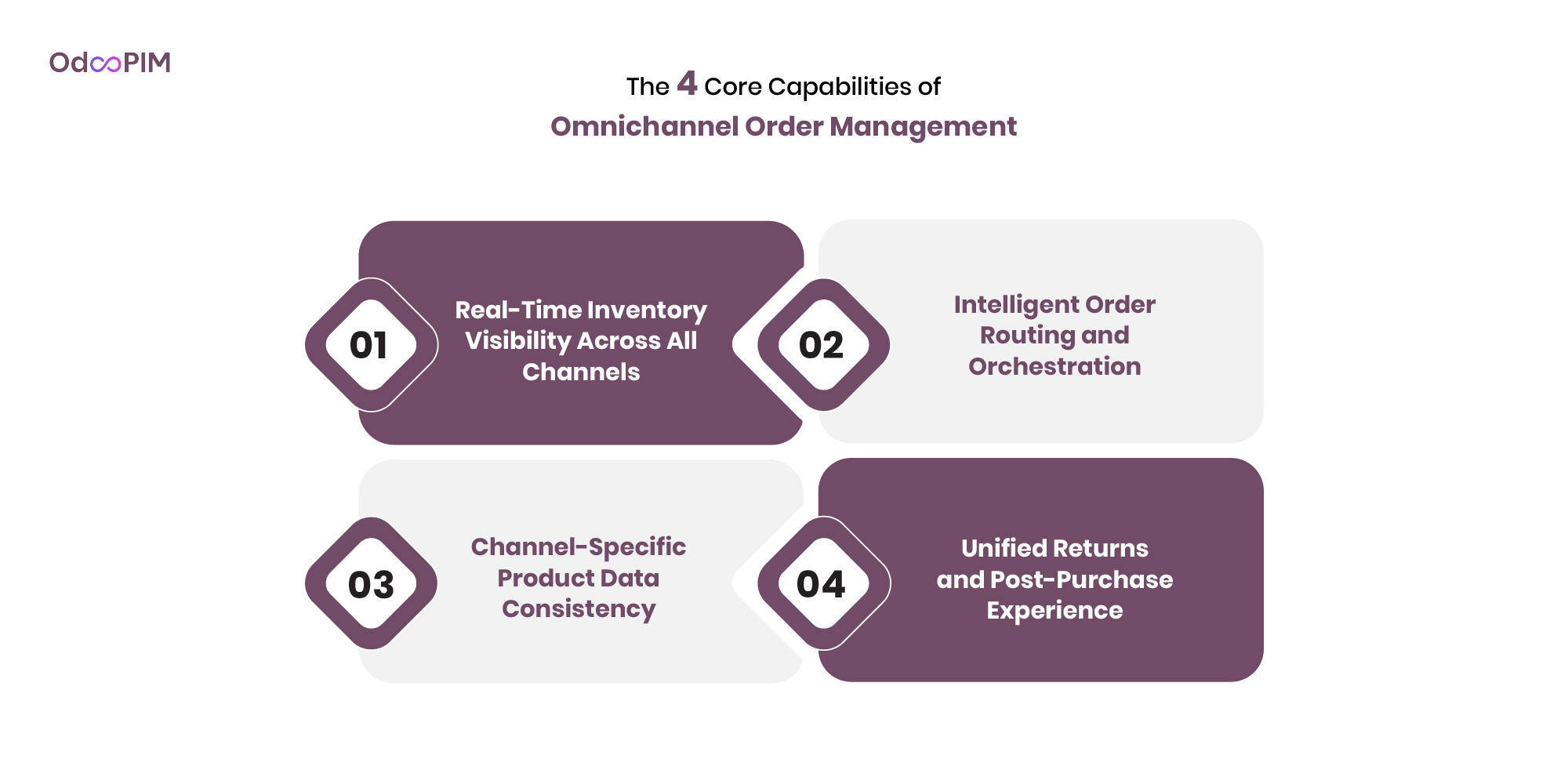
1. Real-Time Inventory Visibility Across All Channels
Omnichannel inventory management requires every channel to see the same stock levels simultaneously. Not batch updates every hour. Not daily syncs. Real-time. When a customer buys the last unit in your retail store, your website must reflect that change instantly, not after someone runs a reconciliation report.
Practical example: A shopper checks online for a popular jacket. Your website shows “in stock” because the warehouse has units. But five minutes ago, a customer purchased the last one in-store. Without real-time visibility, the online shopper orders a jacket you cannot fulfill. You cancel. They’re frustrated. Unified order management prevents this by maintaining a single inventory record that every channel reads and updates instantly.
Order management system ecommerce without real-time sync guarantees overselling. Omnichannel ecommerce operations succeed when inventory accuracy is instantaneous, not eventual.
2. Intelligent Order Routing and Orchestration
Multichannel order fulfillment without intelligence sends every order to your central warehouse, even when your retail store across town has the item in stock. Unified order management routes each order to the optimal fulfillment location based on inventory availability, shipping cost, delivery speed, and customer preference.
Practical example: A customer orders a laptop for next-day delivery. Your warehouse is out of stock, but your downtown store has three units. An intelligent OMS routes the order to the store for pickup by a local courier. The customer receives the laptop the next day. Your warehouse never touched it. Omnichannel order management turns local inventory into a fulfillment asset.
Order management system ecommerce with intelligent routing reduces shipping costs, speeds delivery, and improves inventory turns. It’s not just automation, it’s operational intelligence.

3. Channel-Specific Product Data Consistency
Product data must remain consistent across channels while adapting to each platform’s requirements. Omnichannel ecommerce operations without data consistency creates confusion, returns, and lost trust. Your Amazon listing cannot show different specifications than your website.
Practical example: A shoe retailer lists a running shoe on their website with size in US measurements. The same product on Amazon shows UK sizes. Customer orders based on UK size, receive US size. Return. Frustration. Margin lost. Unified order management integrates with your PIM to ensure consistent product data drives accurate orders, regardless of channel.
Order management system ecommerce that ignores product data consistency guarantees returns. Your OMS should connect to your PIM, not operate in isolation. The best omnichannel inventory management starts with accurate product information.
4. Unified Returns and Post-Purchase Experience
How you handle them separates operational excellence from customer frustration. Omnichannel order management processes returns through any channel, online return portal, physical store, mail-in, with unified visibility across all.
Practical example: A customer buys a sweater on your website but returns it to your retail store. The store associate scans the item, the return processes in your central OMS, inventory updates, and refund initiates. The customer walks out satisfied. No manual reconciliation between online and in-store systems.
Order management system ecommerce without unified returns forces customers to follow channel-specific return policies, “you bought online, you must mail it back.” That’s not omnichannel. That’s a barrier. Multichannel order fulfillment includes returns as a first-class citizen, not an afterthought. Unified order management treats every channel equally for both purchases and returns. Your customers will notice. They’ll appreciate it. They’ll come back.
Learn about 15 Best AI Tools for Ecommerce Business in 2026
How Product Data Powers (or Breaks) Omnichannel Order Management
1. The PIM–OMS Integration: Why It Matters
Your order management system ecommerce cannot operate in isolation. It needs accurate product data, SKUs, attributes, dimensions, weights, to route orders correctly, calculate shipping costs, and prevent fulfillment errors. Unified order management without PIM integration means your OMS makes decisions based on incomplete or outdated product information.
Omnichannel inventory management depends on clean product data. When your PIM and OMS share the same source of truth, every channel sees consistent SKUs, accurate weights for shipping calculations, and correct dimensions for packing optimization. Omnichannel ecommerce operations succeed when product data flows seamlessly from catalog to cart to fulfillment.
Practical example: A furniture retailer sells a table that ships in two boxes. Your PIM knows the weight and dimensions of each box. Your OMS uses that data to calculate accurate shipping rates and route the order to a warehouse with appropriate packing materials. Without PIM–OMS integration, the table ships as one box, wrong rate, damaged product, customer refund.
2. What Happens When Product Data Is Inconsistent Across Channels
Inconsistent product data destroys omnichannel operations. When your website lists different specifications than Amazon, customers receive items they didn’t expect. Returns spike. Customer service tickets multiply. The order management system ecommerce cannot fix what it doesn’t know.
The downstream impact: A customer orders a “medium” shirt from your website. Your OMS processes the order. Your warehouse picks a medium. The customer receives a medium. But your Amazon listing said “M” (which the customer interpreted as medium). The customer returns the shirt because “it’s not what I ordered.” Your OMS did everything correctly. The failure was upstream, inconsistent product data.
Omnichannel order management depends on consistent product information across every channel. Your OMS routes orders. Your warehouse fulfills them. But if product data varies by channel, customers receive items that don’t match their expectations, even when your operations are executed perfectly.
Unified order management requires a PIM that syndicates consistent product data to every channel. Your OMS then processes accurate orders based on that consistent foundation. Omnichannel ecommerce operations without PIM–OMS alignment guarantees returns, refunds, and frustrated customers. Fix the data first. Then your OMS can do its job.
Learn about ecommerce order management

How OdooPIM Supports Omnichannel Order Management
OdooPIM provides the product data foundation that omnichannel order management requires. Centralized product data repository ensures every SKU, attribute, and specification lives in one source of truth. Channel-specific data syndication pushes enriched product information to Shopify, WooCommerce, Magento, and Amazon simultaneously, each receiving correctly formatted content. Native Odoo ERP and OMS integration means orders, inventory, and product data share the same ecosystem. No middleware, no sync delays, no data drift between your catalog and your fulfillment operations.
Automated data enrichment workflows fill missing attributes, validate completeness, and route products through approval steps before they reach customers. Real-time synchronization across sales channels ensures inventory updates propagate instantly, your website shows accurate stock seconds after a store sale. Unified order management becomes achievable when product data and order systems speak the same language. Omnichannel inventory management transforms from reactive reconciliation to proactive accuracy.
Customer proof point: A mid-market apparel retailer managing 12,000 SKUs across Shopify, Amazon, and three physical stores implemented OdooPIM to unify product data and order management. Before OdooPIM, inconsistent specifications caused 18% return rates. Manual inventory reconciliation consumed 20 hours weekly. After implementation, returns dropped to 6%. Inventory sync became automatic. The retailer now routes online orders to stores with available stock, cutting shipping costs by 22% and delivery time by two days. Omnichannel ecommerce operations scaled without adding headcount. Multichannel order fulfillment became intelligent. The OMS now works as designed, because product data finally works too.
Learn about best PIM for ecommerce site
Omnichannel Order Management Best Practices for Ecommerce Teams
1. Build a Single Source of Truth for Product Data First
Your order management system ecommerce is only as reliable as the product data feeding it. Before configuring routing rules or fulfillment logic, establish a single source of truth for every SKU, attribute, and specification. Unified order management requires consistent product information across every channel, your website, Amazon, and physical stores must share the same foundation. Without this, your OMS processes orders based on incomplete or conflicting data.
Omnichannel inventory management depends on accurate product data. A PIM like OdooPIM centralizes your catalog before it reaches your OMS. Spreadsheets cannot serve as your source of truth at scale. Build the foundation first. Everything else depends on it.
2. Map Your Fulfillment Nodes Before Configuring Routing Rules
Multichannel order fulfillment requires knowing where your inventory lives. Map every fulfillment location, warehouses, distribution centers, retail stores, dropship partners, before configuring routing logic. Omnichannel order management without node mapping sends orders to suboptimal locations, increasing shipping costs and delivery times.
Practical approach: Document each node’s inventory availability, shipping capabilities, and geographic coverage. A store in Chicago should fulfill orders for Midwest customers. A West Coast warehouse serves Pacific region orders. Omnichannel ecommerce operations succeed when routing rules reflect your actual fulfillment network, not theoretical ideal states. Map first. Configure second.
3. Standardize Product Attributes Across Every Channel
Product data inconsistency kills omnichannel success. When your website lists size as “medium” and Amazon shows “M,” customers receive items that don’t match expectations. Returns spike. Order management system ecommerce cannot fix upstream data problems. Unified order management requires consistent attributes across every channel before orders ever reach your OMS.
Standardization rules: Define naming conventions, measurement units, and attribute formats. “Color” not “colour.” “Weight (lbs)” not “weight.” Enforce these rules in your PIM before syndication. Omnichannel inventory management depends on consistent SKUs and attributes. Standardize early, or spend eternity reconciling variations.
4. Automate Inventory Sync: Never Rely on Manual Updates
Manual inventory reconciliation breaks at scale. A warehouse ships an order. Someone forgets to update the spreadsheet. Your website still shows “in stock.” A customer orders. You cancel. They don’t return. Omnichannel order management requires real-time automation, not human memory.
Automation rules: Your OMS must sync inventory changes instantly across every channel. When a store sells the last unit, your website reflects it immediately, not after someone runs a report. Multichannel order fulfillment without automation guarantees overselling. Configure real-time sync from day one. Manual updates are not a backup plan; they are a failure plan.
5. Plan for Returns From Day One
How you handle them separates operational excellence from customer frustration. Omnichannel ecommerce operations must process returns through any channel, online return portal, physical store, mail-in, with unified visibility across all. A customer who buys online should return in-store without friction.
Return planning: Configure return logic before your first order ships. Define which locations accept returns. Set restocking rules. Automate refund processing. Order management system ecommerce without unified returns forces customers to follow channel-specific policies, “you bought online, you must mail it back.” That’s not omnichannel. That’s a barrier. Plan returns from day one. Your customers will notice. They’ll appreciate it. They’ll come back.
Omnichannel Order Management Tools: What to Look For
Enterprise expectations for order management system ecommerce have matured. Forrester’s Q1 2025 OMS Wave defines best-in-class capabilities that every growing brand should evaluate. Use this checklist to assess any omnichannel order management solution against real operational needs.
1. Real-Time Inventory Sync
What to look for: Your omnichannel order management tool must sync inventory changes instantly across every channel. When a store sells the last unit, your website reflects it immediately, not after a scheduled batch. Real-time sync prevents overselling, cancellations, and customer frustration.
Why it matters: Omnichannel inventory management without real-time accuracy guarantees order failures. Batch updates create data drift. Your website shows “in stock” for items already sold elsewhere. Customers order. You cancel. They don’t return. Verify sync speed during demos. Ask what happens when two channels sell the same item simultaneously. The answer reveals operational readiness.
2. PIM Integration (Native or API)
What to look for: Your unified order management tool must integrate with your PIM. Product data, SKUs, attributes, dimensions, weights, drives order routing, shipping calculations, and fulfillment accuracy. Without PIM integration, your OMS makes decisions based on incomplete or outdated information.
Why it matters: Multichannel order fulfillment depends on accurate product data. A furniture table that ships in two boxes requires correct weight and dimension data for rate calculation. A shirt with inconsistent size labeling across channels generates returns. For Odoo users, native OdooPIM integration eliminates middleware. For others, verify API depth and sync reliability before committing.
3. Multi-Warehouse and Drop-Ship Support
What to look for: Your omnichannel ecommerce operations tool must handle multiple fulfillment nodes, warehouses, retail stores, distribution centers, drop-ship vendors. Routing rules should assign orders to the optimal location based on inventory availability, shipping cost, and delivery speed.
Why it matters: Omnichannel order management without multi-node support sends every order to your central warehouse. Your downtown store has the item in stock? Too bad. The order ships from across the country. Higher shipping cost. Slower delivery. The customer waits. Verify that your OMS can route to any location, not just your primary warehouse.
4. Channel-Specific Data Rules
What to look for: Different channels have different product data requirements. Your order management system ecommerce should enforce channel-specific rules, Amazon needs flat descriptions, your website supports rich content, wholesale portals require case quantities.
Why it matters: Unified order management requires consistent product information, but each channel formats that information differently. Your OMS should connect to your PIM for syndication, not operate in isolation. Verify that the tool respects channel-specific formatting without manual intervention. Ask how it handles a product update across ten channels simultaneously.
5. ERP Connectivity
What to look for: Your omnichannel inventory management tool must connect natively to your ERP. Orders, inventory, pricing, and customer data should flow smoothly between systems, no middleware, no sync delays, no manual reconciliation.
Why it matters: Multichannel order fulfillment without ERP integration creates data silos. Your OMS processes orders. Your ERP tracks financials. Someone becomes the human bridge between them. For Odoo users, OdooPIM offers native ERP connectivity, orders, inventory, and product data sharing the same database. For others, verify integration depth and maintenance requirements before committing.
6. Returns Management
What to look for: Your omnichannel ecommerce operations tool must process returns through any channel, online portal, physical store, mail-in, with unified visibility across all. Return logic should handle restocking, refunds, and inventory updates automatically.
Why it matters: Omnichannel order management without unified returns forces customers to follow channel-specific policies. “You bought it online, you must mail it back.” That’s not omnichannel. That’s a barrier. Verify that returns update inventory instantly across every channel. A sweater returned in-store should show as available online immediately, not after someone reconciles reports. Returns are inevitable. Plan for them from day one.
Learn about ecommerce trends

FAQ’s
1. What is the difference between omnichannel and multichannel order management?
Multichannel order fulfillment means each channel operates independently, your website, Amazon, and stores maintain separate order logs. Omnichannel order management unifies everything behind the scenes. A customer buys online, returns in-store. An order placed on Amazon routes to your warehouse. Your retail store fulfills website orders when local inventory is available. Unified order management connects channels. Multichannel just adds them. The difference is operational intelligence, and your customers will notice.
2. Why does product data quality affect omnichannel order management?
Order management system ecommerce depends on accurate product data to route orders, calculate shipping costs, and prevent fulfillment errors. Inconsistent specifications across channels cause returns, a customer orders “medium” from your website but your Amazon listing says “M.” Your OMS processes correctly. The customer still returns the item. Omnichannel inventory management requires consistent SKUs, weights, and dimensions. Your OMS is only as reliable as the product information feeding it. Fix the data first.
3. How does a PIM system integrate with an order management system?
A PIM centralizes product data, SKUs, attributes, weights, dimensions, and syndicates it to your OMS through API connections or native integration. Your order management system ecommerce then uses that accurate data to route orders, calculate shipping, and prevent fulfillment errors. Unified order management requires this connection. For Odoo users, OdooPIM offers native PIM-OMS integration, no middleware, no sync delays. Without PIM integration, your OMS makes decisions based on incomplete or outdated product information.
4. Can OdooPIM support omnichannel order management for Shopify, WooCommerce, and Amazon?
OdooPIM provides native connectors for Shopify, WooCommerce, Magento, and Amazon. Omnichannel order management starts with centralized product data syndicated to every channel simultaneously. Omnichannel inventory management syncs in real time, when a store sells the last unit, your website reflects it instantly. Native Odoo ERP and OMS integration means orders, inventory, and product data share the same ecosystem. Multichannel order fulfillment becomes intelligent. Omnichannel ecommerce operations scale without adding middleware or sync delays.